Islamic scholars note that holding Friday prayers at 12.45pm falls within the accepted Dhuhr prayer window.
All the major policy changes and projects shaping life in the UAE in 2026
A clear breakdown of the major policy changes, new laws and projects in the UAE
Last updated:
5 MIN READ
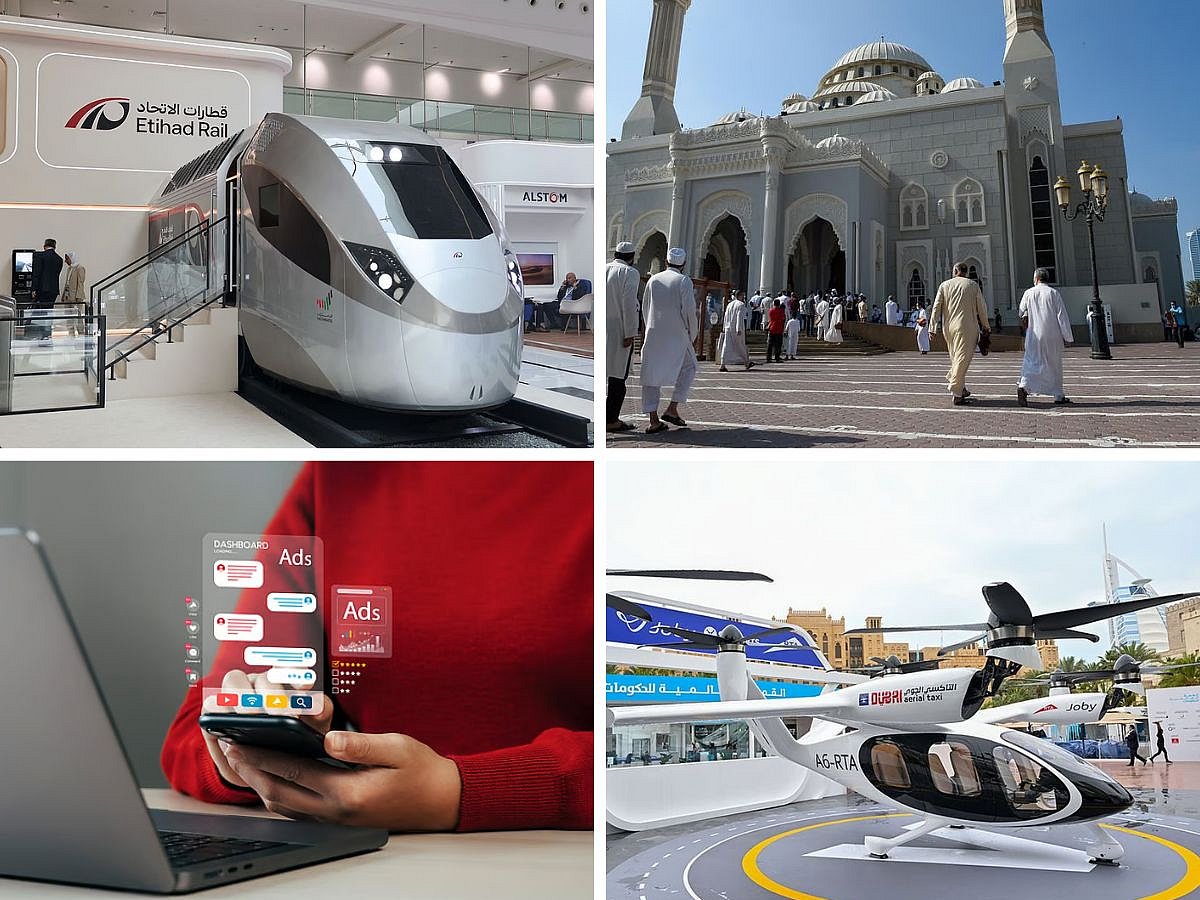
Key UAE updates in 2026 from air taxis and rail to new laws, new Friday prayer timings, school hours, taxes and single-use plastic bans.
Dubai: The UAE has entered 2026 with a wave of policy changes, infrastructure projects and legal reforms that will affect daily life for residents, families, commuters, students and businesses.
From transport and banking to education, environmental rules and new federal laws, several updates have already taken effect, while others will roll out in the months ahead. Here is a clear breakdown of the most important changes to know about this year.
1. Friday prayer time changes and shorter school days
Friday sermons and prayers across the UAE are now held at 12.45pm, following an announcement by the General Authority of Islamic Affairs, Endowments and Zakat. The change came into effect on January 2, 2026.
As a result, schools in the UAE will end earlier on Fridays. The Knowledge and Human Development Authority has directed private schools and early childhood centres to finish the school day no later than 11.30am on Fridays from January 9, 2026, giving students and staff adequate time to return home before prayers.
2. Etihad Rail passenger services to launch
Etihad Rail is preparing to launch passenger services in 2026, introducing a nationwide railway network connecting 11 cities from Al Sila to Fujairah.
Planned journey times include 57 minutes between Abu Dhabi and Dubai and 105 minutes between Abu Dhabi and Fujairah. Each train can carry up to 400 passengers, with projected annual ridership reaching 36.5 million by 2030. The service is expected to reduce road congestion and significantly improve intercity connectivity.
Etihad Rail, one of the UAE’s most ambitious and eagerly awaited transport projects, has given the public its first close look at the passenger trains set to transform travel across the country.
3. Air taxis set to take off in Dubai
Dubai’s electric air taxi project is expected to begin operations in 2026, marking a major shift in urban mobility.
The aircraft will carry four passengers and a pilot, travel at speeds exceeding 300km/h, and cover distances of more than 200 kilometres, potentially cutting inter-emirate travel times to under 30 minutes. The first vertiport is under construction at Dubai International Airport, with more planned near Palm Jumeirah and Dubai Mall.
A Joby Eletric air taxi performs a flying display at Al-Maktoum International Airport during the Dubai Airshow 2025 in Dubai on November 17, 2025.
4. Banks to phase out SMS one-time passwords
Several UAE banks have begun phasing out SMS-based one-time passwords (OTPs) for online card transactions.
From January 6, 2026, customers will need to authenticate payments exclusively through their bank’s mobile app. The move follows new UAE Central Bank directives aimed at improving digital security, as SMS and email OTPs are considered vulnerable to fraud such as SIM swapping and phishing.
5. Nationwide ban on single-use plastics
From January 1, 2026, the UAE introduced a nationwide ban on the import, production and trade of selected single-use plastic products.
The ban covers items such as beverage cups and lids, plastic cutlery, plates, straws, stirrers and food containers made of Styrofoam. It also applies to single-use bags of any material, including paper bags thinner than 50 microns.
Dubai Municipality has also implemented the final phase of its own plastic ban, expanding restrictions on products already prohibited during 2025, including polystyrene containers, plastic cotton buds, table covers and straws.
6. New VAT and sugary drinks tax rules
Amendments to the UAE’s VAT law came into effect on January 1, 2026, simplifying compliance for businesses. One key change removes the requirement for self-invoicing under the reverse charge mechanism, provided standard transaction records are maintained.
Separately, the UAE introduced updated excise tax rules for sugar-sweetened beverages. The system now uses tiered tax rates based on sugar content, replacing the previous flat 50 per cent tax. Drinks with higher sugar levels will face higher taxes, encouraging healthier consumer choices and reformulation by manufacturers.
7. Unified GCC tourist visa expected
A single GCC tourist visa is expected to launch in 2026, allowing visitors to travel across all six Gulf countries using one permit. The visa will cover the UAE, Saudi Arabia, Oman, Qatar, Kuwait and Bahrain, and is designed to boost tourism and regional travel.
Ayn Khor, a seasonal waterfall, is a key tourist attraction in Salalah, Oman. A single tourist visa for all six GCC countries is set to launch soon. This means non-GCC nationals can explore the region without repeated visa applications.
8. ‘Year of Family’ declared in the UAE
President His Highness Sheikh Mohamed bin Zayed Al Nahyan declared 2026 the Year of Family, highlighting the family as the foundation of UAE society. The initiative focuses on strengthening family values, preserving cultural identity and supporting future generations through family-centred policies and programmes.
9. Advertiser licence required for content creators
Content creators, influencers and advertisers must obtain the Advertiser (Mu’lin) Permit by January 31, 2026, following a deadline extension by the UAE Media Council.
The permit applies to anyone promoting or reviewing products or services on social media, even if unpaid. It is valid for one year, renewable, and will be free for the first three years as a support measure.
10. Major federal law reforms announced
Several new federal laws have been announced and will come into force after publication in the Official Gazette.
The UAE has lowered the legal age of maturity from 21 to 18, allowing individuals to manage their financial affairs earlier. The updated law also outlines how the assets of foreign residents who die without heirs or a will will be handled, with such assets designated as charitable endowments.
A new child digital safety law introduces strict requirements for online platforms, including age verification, privacy protections, content filtering and bans on children accessing online gambling-related games.
Another federal law overhauls governance of higher education and scientific research, setting national standards for licensing, quality assurance and alignment with labour market needs.
In the last two months of 2025, the UAE updated several key federal laws. New rules include tougher penalties for drug use, stricter punishments for sexual offences involving minors and prostitution, and changes to foster care under Federal Decree-Law No. 12 of 2025, allowing foreign residents and single women to care for children of unknown parentage or under state care.
11. Paid parking introduced in more Dubai communities
Paid parking will be introduced in Dubai International City from February 1, 2026, with charges applying from 8am to midnight and free parking on Sundays and public holidays.
Meanwhile, Discovery Gardens will introduce regulated parking from January 15, 2026. Residents without existing parking facilities will receive one complimentary permit per unit, while additional vehicles will require a paid subscription.
This article was published on November 7, 2025 and has been updated since.
Network Links
GN StoreAbout Gulf NewsTerms & ConditionsReach by GNSitemapContact usPrivacy PolicyGN FocusHave your sayWork with usAdvertise with usGulf News epaperPrinting Services
Download our app
© Al Nisr Publishing LLC 2026. All rights reserved.