1998: Construction of the Burj Al Arab was in full swing, with its sail-like form beginning to rise dramatically above the coastline. Nearby, the Jumeirah Beach Hotel—already an architectural landmark in its own right—stood in sharp contrast to the emerging icon.
What does it mean to 'Dubai-it'? Inside the city's radical new philosophy
From desert outpost to global blueprint for speed, ambition and execution
Last updated:
5 MIN READ
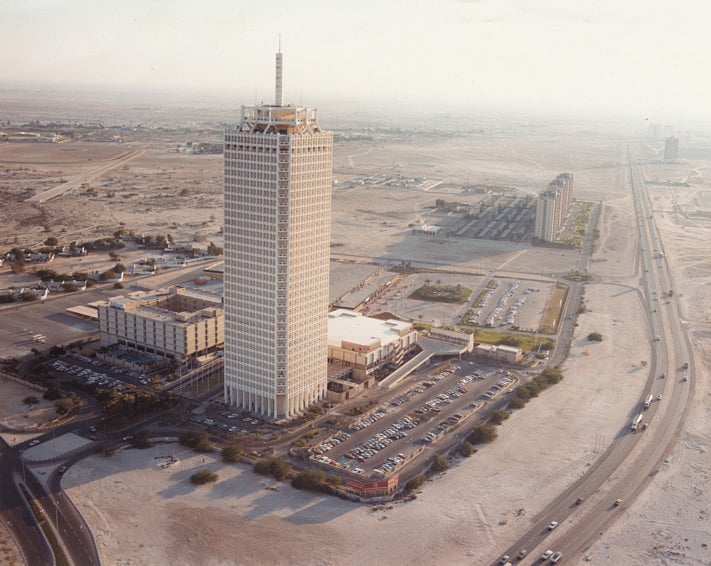
In the 1960s, Dubai was a modest trading town. Today it is one of the world's most ambitious cities. Dubai-it puts a name to the philosophy behind that transformation and aims to embed it across institutions, companies, and future generations.
Archives
Dubai: There’s a very short list of places or companies that have become verbs. Google it. Uber it. Now, apparently, 'Dubai-it'.
His Highness Sheikh Mohammed bin Rashid Al Maktoum, Vice President and Prime Minister of the UAE and Ruler of Dubai, this week launched a campaign called Dubai-it, a bold attempt to codify and export the emirate's philosophy of work to its institutions, companies, and future generations.
The announcement came with a striking piece of video: footage of Sheikh Mohammed riding in a helicopter over Dubai, filmed decades apart. In the older clip, he looks down at a vast, empty desert. In the newer one, the same landscape is unrecognisable - Burj Khalifa, Palm Jumeirah, and a glittering urban skyline where there was once sand.
Sheikh Mohammed's motto has always been simple - "we say what we do, and we do what we say". That philosophy is what made Dubai what it is today and what will define its future.
Get updated faster and for FREE: Download the Gulf News app now - simply click here.
Why the 'Dubai-it' campaign matters
On one level, Dubai-it is a citywide work ethic, given a name. But there is a larger play at work. By framing its success as a transferable philosophy, Dubai positions itself not just as an economic powerhouse, but as a cultural model, joining a growing number of ambitious cities competing to export ideas, not just goods. This is soft power in its most tangible form.
The track record that gives Dubai-it its credibility is undeniable. In the 1960s, Dubai was a trading creek town of roughly 60,000 people and almost no infrastructure. What followed was not slow, incremental growth, it was transformation at a pace the world had rarely seen.
Milestones that shaped the 'Dubai-it' philosophy
Today, Dubai ranks among the world's top destinations for tourism, business, and talent. None of that happened slowly. While there are many milestones and events that shaped the city into what it is today, here are a few major examples of Dubai-it, landmark achievements that define what it means to Dubai-it.
Dubai International Airport (DXB)
Opened in 1960, what began as a sand-compacted runway capable of handling a DC-3 is now DXB, the world's busiest international airport, handling a record 95.2 million passengers in 2025. Al Maktoum International Airport, its successor, is set to become the world's largest aviation hub, with capacity for 260 million passengers annually once complete.
Emirates Airline
A single flight to Karachi from a modest airport has grown into one of the world's most extraordinary aviation success stories. In 2026, Emirates retained its position as the world's most profitable airline, posting record financial results for 2025–26.
Burj Al Arab
Opened in 1999 and designed by British architect Tom Wright in the shape of a dhow sail on a man-made island 280 metres off the Jumeirah coast, the Burj Al Arab became one of the most instantly recognisable silhouettes on earth, a statement of intent before Dubai's defining decade had even begun.
Dubai Metro
At precisely 9 minutes and 9 seconds past 9pm on 09/09/09, Dubai made history. Doubters said a car-dependent city would never take to mass transit within 48 hours, more than 110,000 people had boarded.
By 2025, the Red and Green lines together carried 294.7 million riders annually. The Dubai Metro is now undergoing a massive multi-billion-dirham expansion, headlined by the under-construction Blue Line, opening September 2029, and the newly announced Gold Line, opening September 2032.
His Highness Shaikh Mohammad Bin Rashid AlMaktoum, Vice-President and Prime Minister ofthe UAE and Ruler of Dubai, opens the Metro.
Palm Jumeirah
The world's first and largest man-made island, shaped like a palm tree, is a testament to the city's belief that if you can dream it, you can build it. Work began in 2001; the first residents arrived in 2007.
Today, the Palm Jumeirah is one of Dubai's most exclusive and coveted addresses, lined with luxury hotels and premium properties.
The basic infrastructure was in place by 2004, and the island was open for construction in 2006.
Burj Khalifa
When the global financial crisis hit, the Burj Khalifa was halfway complete. Many expected it to be abandoned. It wasn't. Construction began in 2004; the tower was inaugurated on January 4, 2010. At 828 metres — its footprint inspired by the regional desert flower Hymenocallis — it remains the world's tallest building and the defining symbol of Dubai's refusal to stop.
Expo 2020 Dubai
Despite COVID-19 delaying Expo 2020, the UAE brought 192 countries together under the theme "Connecting Minds, Creating the Future." The six-month exposition welcomed over 24 million visits, a statement that not even a global pandemic would cause Dubai to scale back its ambitions.
Museum of the Future
After nine years of design and construction, the Museum of the Future opened on February 22, 2022.
Embellished with calligraphy drawn from Sheikh Mohammed's own words, it stands apart from the high-rises of Sheikh Zayed Road. It welcomed one million visitors in its first year and invites them to imagine what human society could look like in 2071.
2018 — Sustainable materials have been used to build the structure. There are systems to recover energy and water with the help of a parametric design, passive solar architecture, and low energy and water engineering solutions.
The Dubai-it philosophy - rapid execution, no excuses, results the world can see, is baked into every one of those milestones. It is a story of the past that continues to shape the present, and a blueprint that can carry the city, and those who adopt its mindset, into whatever comes next.
Network Links
GN StoreAbout Gulf NewsTerms & ConditionsReach by GNSitemapContact usPrivacy PolicyGN FocusHave your sayWork with usAdvertise with usGulf News epaperPrinting Services
Download our app
© Al Nisr Publishing LLC 2026. All rights reserved.