US‑Israel war on Iran, Day 25: UAE intercepts missile and drone threats; 1dead, 5 hurt in Bahrain
Missiles, drones and strikes fuel fears of global energy and security crisis
Highlights
We are closing coverage for now. Follow our live updates for the latest developments here.
Iranian drone strikes hit fuel tank at Kuwait International Airport, ignite fire
Kuwait’s General Civil Aviation Authority said Iranian drones targeted a fuel tank at Kuwait International Airport, triggering a fire at the site.
Official spokesperson Abdullah Al Rajhi told Kuwait News Agency (KUNA) that initial reports indicate the damage is limited to material losses, with no casualties reported.
Authorities said emergency procedures were activated immediately, with firefighting teams and relevant agencies responding to contain the blaze. Efforts are under way to secure the site and assess the full extent of the damage.
Trump: War in Iran has been 'won', 'Iran is going to make a deal'
US President Donald Trump has declared: "This war has been won. The only one that likes to keep it going is the fake news."
He also pointed out: "Iran is going to make a deal. The new leadership gave us a significant present that showed me that we're dealing with the right people."
Trump did not mention the people on the Iranian side that the US leadership is currently dealing with.
Oil prices: WTI slides to $88.50/barrel, Murban drops 11%, Brent jumps to $104
The global oil market is flashing signs of volatility with massive divergences across major crudes. While US and some producer benchmarks surge on supply fears, premium Middle East grades are sliding — painting a picture of a market under extreme geopolitical stress.
Modi, Trump discuss Mideast tensions: Indian leader calls for de-escalation, open Hormuz
Indian Prime Minister Narendra Modi received a telephone call from US President Donald Trump during which the Indian leader reaffirmed its support for immediate de-escalation and the restoration of peace, while stressing that “ensuring that the Strait of Hormuz remains open, secure and accessible is essential for the whole world.”
UK Military downs 14 drones in Middle East operations
British troops operating in the Middle East successfully intercepted and downed 14 unmanned aircraft in a single night, marking a record for the highest number of drones neutralised by UK troops in a 24-hour period. While the Ministry of Defence did not specify the exact location of the "high-threat area" where the interceptions occurred, the mission involved a combination of ground-based air defenses and Royal Air Force jets. To further bolster regional security, the British Army has deployed additional Stormer air defense systems equipped with advanced missiles to Cyprus. These defensive measures, which extended across airspace in Cyprus, Jordan, and Qatar, were coordinated with regional allies to ensure the safety of personnel and maintain stability in the area.
Kuwait restores 4 power lines after attacks
Kuwait's Ministry of Electricity, Water, Renewable Energy announced restoration of four overhead power lines out of seven damaged by shrapnel from Iranian attacks on Kuwait. Ministry spokesperson Eng. Fatima Hayat said four lines have been restored to service according to highest technical and safety standards after completing inspection work.
Trump says Iran has shared a ‘present’ as show of faith
Asked if he trusts the Iranians said to be in talks with US representatives, Trump said he doesn’t trust anybody but alluded to receiving a “gift” that he said suggested “we’re dealing with the right people.”
“They gave us a present, and the present arrived today,” Trump said speaking at the White House on Tuesday. “It was a very big present worth a tremendous amount of money. And I’m not going to tell you what that present is, but it was a very significant prize.”
Pressed for more detail, Trump said it was “oil- and gas-related” but went no further. “It was a very nice thing they did. But what it showed me is that we’re dealing with the right people.”
Stay updated: Get the latest faster by downloading the Gulf News app - it's completely free. Click here for Apple or here for Android. You can also find it us on the Huawei AppGallery.
Trump says Vance, Rubio and others are involved in talks about Iran
The president said while speaking at the White House on Tuesday that the US is “in negotiations right now,” and that his envoy Steve Witkoff and son-in-law Jared Kushner are involved in the talks, along with Secretary of State Marco Rubio and Vice President JD Vance.
“We have a number of people doing it,” Trump said. “And the other side, I can tell you, they’d like to make a deal.”
First Chinese ship passes Hormuz corridor
The Chinese-owned vessel sailed through a pay-to-pass corridor between Larak and Qeshm islands that Iran set up earlier this month, according to its location transponder data.
The Panama-flagged ship, Newvoyager, is the first Chinese-owned container ship to transit the corridor, according to the Chinese financial news site Caixin.
The vessel, owned by a shipping company in the Chinese province of Anhui, broadcasted its status as “China Owner” during the transit on Monday, according to Caixin.
Data show the ship set sail from Iranian waters on Sunday and transited out of the strait by Monday.
Iran has insisted that “safe passage” in the Strait of Hormuz is possible for non-enemies. Vessels with ties to India and Pakistan are among those that have already transited the strait.
US war on Iran 'unabated' as Trump mulls diplomacy: White House
Donald Trump is pressing on with military operations against Iran even as he examines "newfound" diplomatic options, the White House said Tuesday, after the US president announced talks with Tehran and Pakistan emerged as a possible mediator.
"As President Trump and his negotiators explore this newfound possibility of diplomacy, Operation Epic Fury continues unabated to achieve the military objectives laid out by the Commander in Chief and the Pentagon," Press Secretary Karoline Leavitt said in a statement to AFP.
UAE strongly condemns Iran’s unprovoked terrorist attack
The United Arab Emirates has condemned in the strongest terms Iran’s unprovoked terrorist attack that targeted the Kingdom of Bahrain, which resulted in the martyrdom of a Moroccan civilian contractor with the UAE Armed Forces while performing routine duties, as well as the injury of five members of the UAE Ministry of Defense and a number of Bahraini soldiers, in a flagrant violation of international law.
In a statement, the Ministry of Foreign Affairs (MoFA) reaffirmed that this aggression constitutes a violation of the sovereignty of the Kingdom of Bahrain and a threat to its security and stability, and further represents a dangerous escalation that threatens the security of GCC states and the wider region.
Air India, Air India Express to operate 26 flights
Air India and Air India Express will together operate a combined total of 26 scheduled and non-scheduled flights to and from the West Asia region on March 25, 2026. Both carriers will continue their scheduled services to Jeddah with eight flights in total, Air India running one return service each from Delhi and Mumbai, and Air India Express operating flights from Kozhikode and Mangalore. Air India Express will additionally operate four scheduled flights to and from Muscat from Delhi and Mumbai, as well as four flights to and from Riyadh from Bengaluru and Kozhikode. Air India will further run two scheduled flights between Riyadh and Mumbai.
Additional non-scheduled flights to UAE
Beyond their scheduled services, the two carriers will operate a total of eight non-scheduled flights to and from the UAE, subject to slot availability and prevailing conditions at departure stations. These flights are being operated with the requisite permissions from the relevant Indian and local regulatory authorities.
UAE urges public to verify content
UAE authorities have urged the public to verify information before sharing it, warning of the growing risks posed by artificial intelligence-generated content.
In a recent awareness message, Digital Dubai and National Media Authority emphasised that not everything seen online is real, calling on individuals to verify the authenticity of videos, audio recordings and images before circulating and sharing them.
The advisory highlighted that some content may be fabricated or misleading using advanced technologies such as deepfakes powered by artificial intelligence.
Woman killed in northern Israel
Israeli emergency services said a woman was killed in the north of the country on Tuesday following rocket fire from Lebanon, where Israeli forces are fighting Iran-backed Hezbollah.
"Following a launch toward northern Israel... teams are reporting a woman of about 30 with no signs of life and severe multi-system trauma, and have pronounced her dead at the scene," Israel's Magen David Adom said in a statement, adding that teams were treating two other people in mild condition with shrapnel injuries.
The Israeli military told AFP that dozens of rockets from Lebanon were fired at the area at the time the incident occurred.
US is “less and less predictable” as an ally
General Fabien Mandon made the comments Tuesday at a Paris defense and security forum. The French military chief described France’s relationship with the US as “very strong” but lamented that “they have just decided to intervene in the Near and Middle East without notifying us.”
“We acted immediately, surprised by an American ally, who remains an ally, but who is less and less predictable and doesn’t even bother to inform us when it decides to engage in military operations. This affects our security. This affects our interests,” he said.
French President Emmanuel Macron, the commander of chief of France’s armed forces, dispatched the nuclear-powered Charles de Gaulle aircraft carrier and other naval warships to the Mediterranean, and deployed aircraft and other assets, to defend France’s interests and allies in the region and the Persian Gulf after the launch of the US- Israeli war with Iran.
White House describes possibility of Iran talks
When asked about the possibility of the US participating in talks in Pakistan, press secretary Karoline Leavitt said in a statement that “these are sensitive diplomatic discussions and the US will not negotiate through the press.”
“This is a fluid situation, and speculation about meetings should not be deemed as final until they are formally announced by the White House,” Leavitt said.
China calls for Mideast peace
Amid regional efforts to revive talks between the US and Iran, China’s Foreign Minister Wang Yi held a phone call with his Iranian counterpart Abbas Araghchi on Tuesday, the Chinese Foreign Ministry said.
“Wang called on all parties to seize every opportunity and window for peace and start peace talks as soon as possible,” ministry spokesman Lin Jian said.
US stocks fall after Trump Iran talks
With airstrikes still battering Iran and missiles still targeting sites across the Middle East, some of the optimism that sent stocks rallying the day before drained out of Wall Street on Tuesday. Oil prices got back to rising, and US stocks are returning some of their gains.
The price for a barrel of Brent crude oil rose 2.9% to $102.84, a day after slumping more than 10%. The main measure of the US stock market, the S&P 500, fell 0.4% to give back more than a third of its climb from the day before.
Trump and Modi speak about the Iran conflict
Narendra Modi, the Indian prime minister, posted about the call on social media Tuesday morning.
He called it a “useful exchange of views” and stressed that India “supports de-escalation and restoration of peace at the earliest.”
Modi also emphasised that the Strait of Hormuz needs to be “open, secure and accessible.”
Trump to Tehran: 'You have one opportunity left'
US President Donald Trump on Monday warned Tehran that it has "one more opportunity" to end the fighting and reach a nuclear deal, reported Saudi Gazette.
Saying that the US has "eliminated everything there is to eliminate" in Iran, Trump said at an event in Memphis in the southern US state of Tennessee: "We're systematically dismantling the regime's ability to threaten America. They're not threatening us anymore."
"We're systematically dismantling the regime's ability to threaten America. They're not threatening us anymore."US President Donald Trump
One dead, 5 hurt in Bahrain attack by Iran
The UAE Ministry of Defence has mourned a Moroccan national working as a civilian contractor with the UAE Armed Forces who was killed during a routine mission in the Kingdom of Bahrain following an Iranian missile attack targeting the country.
The ministry said the attack also resulted in injuries to five UAE Ministry of Defence personnel.
It extended its sincere condolences and sympathy to the family of the victim, praying for God’s mercy upon him, and wished a speedy recovery for those injured.
Pakistan PM says Islamabad 'ready' to host talks to end Middle East war
Pakistan's Prime Minister Shehbaz Sharif said on Tuesday Islamabad was prepared to host negotiations to stop the US-Israeli war with Iran, after mounting speculation it could act as a mediator.
"Pakistan welcomes and fully supports ongoing efforts to pursue dialogue to end the WAR in Middle East, in the interest of peace and stability in (the) region and beyond," he wrote on X.
"Subject to concurrence by the US and Iran, Pakistan stands ready and honoured to be the host to facilitate meaningful and conclusive talks for a comprehensive settlement of the ongoing conflict."
Subject to concurrence by the US and Iran, Pakistan stands ready and honoured to be the host to facilitate meaningful and conclusive talks for a comprehensive settlement of the ongoing conflict.Pakistan's Prime Minister Shehbaz Sharif
Jazeera reroutes fresh food via Saudi route
Jazeera Airways has started moving fresh food into Kuwait through a Saudi route, flying produce into Qaisumah before trucking it across the border. The move comes amid pressure on usual logistics channels and is aimed at keeping supplies of fruits and vegetables steady, with the first 4.5-ton shipment already delivered from India.
IndiGo flags flight schedule changes
IndiGo has issued a travel advisory warning of possible changes to flight schedules amid the evolving situation in the Middle East, urging passengers to verify their flight status before heading to the airport.
Iran names ex-Guards commander to succeed Larijani as security chief
Iran named on Tuesday a former Revolutionary Guards commander to succeed Ali Larijani as head of Iran's Supreme National Security Council after the veteran insider of the Islamic system was killed in an Israeli strike.
Mohammad Bagher Zolghadr, whose appointment was confirmed by state TV, is a former deputy commander-in-chief of Iran's ideological army who has also held senior posts in the interior and justice ministries.
Larijani was killed last week in an Israeli strike.
Philippines declares 'national energy emergency'
Philippine President Ferdinand Marcos declared a state of "national energy emergency" on Tuesday, citing risks to the domestic fuel supply and energy stability created by the Middle East war.
"A state of national energy emergency is hereby declared in light of the ongoing conflict in the Middle East, and the resulting imminent danger posed upon the availability and stability of the country's energy supply," he said in the executive order.
A state of national energy emergency is hereby declared in light of the ongoing conflict in the Middle East, and the resulting imminent danger posed upon the availability and stability of the country's energy supply."Philippine President Ferdinand Marcos
Rubio to meet G7 ministers in France on Iran on Friday
US Secretary of State Marco Rubio will meet G7 counterparts in France on Friday on the war in Iran, the State Department announced.
Rubio, in his first foreign trip since the United States and Israel attacked Iran on February 28, will discuss issues including "the situation in the Middle East," State Department spokesman Tommy Pigott said Tuesday.
Stay updated: Get the latest faster by downloading the Gulf News app now - it's completely free. Click here for Apple or here for Android. You can also find it on the Huawei AppGallery.
Kuwait on cancelled flight tickets
Kuwait’s Directorate General of Civil Aviation (DGCA) on Tuesday issued a circular requiring all airlines and travel and tourism agencies in the country to provide full refunds for cancelled flight tickets and bookings affected by the current exceptional circumstances, within a period not exceeding 15 working days.
DGCA official spokesperson Abdullah Al Rajhi said in a statement to Kuwait News Agency (KUNA) that the decision follows the suspension of commercial flights to and from Kuwait International Airport since 28 February, and aims to protect the rights of passengers impacted by flight and booking cancellations. He added that travellers are entitled to a full refund for unused tickets, while partially used tickets must be refunded for the unused portion in full, even if the original fare rules stated the ticket was non-refundable.
UN rights council will meet Wednesday on Iran's Gulf strikes
The UN Human Rights Council said it will hold an urgent debate on Wednesday on Iran's strikes on countries across the Gulf region and their impact on civilians.
The session was called following an official request submitted by Bahrain on behalf of the six Gulf Cooperation Council countries and Jordan.
Human Rights Council spokesman Pascal Sim told a press conference on Tuesday that the countries will present a draft resolution to UN's top rights body.
The council will "discuss the recent military aggression launched by Iran against Bahrain, Jordan, Kuwait, Oman, Qatar, Saudi Arabia and the United Arab Emirates... targeting civilians and civilian infrastructure, which has resulted in the loss of innocent lives", according to the request.
It will be the 11th urgent debate of the Human Rights Council since its creation in 2006.
More residents return to the UAE
Residents stranded abroad were allowed to return to the UAE even if their residency permits had expired, as authorities moved swiftly to ease procedures during the crisis, a top official has said.
Lieutenant General Mohammed Ahmed Al Marri, Director General of the General Directorate of Identity and Foreigners Affairs in Dubai, said operations across all entry points continued at the highest level, with no major disruptions.
Israel military says completed large wave of strikes in Isfahan
Israel's military on Tuesday said it had conducted a large number of airstrikes in several areas of Iran, including the central city of Isfahan.
"The IDF has completed a large wave of strikes in Isfahan," the military said in a statement, adding that it had launched a "wide-scale wave of strikes.. in several areas in Iran".
UAE engaged 5 ballistic missiles, 17 UAVs
The UAE air defence systems, on March 24, 2026, engaged 5 ballistic missiles and 17 UAVs launched from Iran.
Since the onset of the blatant Iranian aggression, UAE air defences have engaged 357 ballistic missiles, 15 cruise missiles and 1,806 UAVs.
Israel says will take 'control' of security zone up to Lebanon's Litani river
Israeli Defence Minister Israel Katz said on Tuesday that the military will take control of south Lebanon all the way to the Litani river.
"All five bridges over the Litani that were used by Hezbollah for the passage of terrorists and weapons have been blown up, and the IDF (Israeli military) will control the rest of the bridges and the security zone up to the Litani," Katz said during a visit to a military command centre in Israel.
Katz added that the hundreds of thousands of south Lebanon residents who were displaced by the Middle East war this month "will not return south of the Litani River until security is guaranteed for the residents of the north" of Israel.s
Stay updated: Get the latest faster by downloading the Gulf News app now - it's completely free. Click here for Apple or here for Android. You can also find it on the Huawei AppGallery.
Deadly strikes in Iraq blamed on US and Iran
An air strike in Iraq killed 15 members of a former paramilitary coalition, the deadliest attack on the group since the Iran war began, as missile fire elsewhere in the country killed six Kurdish security personnel.
Iraq has been pulled into the war triggered by Israel and the United States striking Iran on February 28, and which has since engulfed much of the region.
The Hashed al-Shaabi coalition, part of Iraq's regular armed forces but which also includes brigades belonging to Iran-backed groups, blamed the strike that killed a commander and 14 other fighters on the United States.
In autonomous Iraqi Kurdistan, a ballistic missile attack killed six peshmergas, with the region accusing Iran of conducting the first such deadly attack since the war began.
Neither the United States nor Iran commented on the accusations.
Iran Guards threaten 'heavy' missile fire on Israel in support of Lebanese, Palestinians
Iran's Revolutionary Guards threatened on Tuesday to conduct "heavy" missile and drone attacks on Israel in what it described as support for Lebanese and Palestinian civilians.
"We warn the regime's criminal army that if its crimes against civilians in Lebanon and Palestine persist," Israeli forces "will be the target of heavy missile and drone strikes", the Guards said in a statement.
Iran is at war with Israel and the United States, while Israel is also battling Tehran-backed Hezbollah in Lebanon.
UAE private schools move to resume in-person classes
As UAE authorities open the door for private schools to apply for a return to in-person learning, one of the country's biggest education groups has moved swiftly to request the resumption of classroom teaching from next week.
Taaleem, which owns and operates 16 schools across the UAE, has become among the first private school groups to formally begin the process of submitting applications to reopen its campuses, with the intention of welcoming students back to face-to-face learning from Monday, March 30, Gulf News can reveal.
Iraqi Kurdistan accuses Iran of deadly attack against its forces
Iraq's autonomous Kurdistan region accused Iran on Tuesday of launching an attack against its peshmerga armed forces, following the deaths of six fighters.
"Six Iranian ballistic missiles targeted them" in two attacks, the region's armed forces ministry said in a statement, adding that the incident killed six people and wounded 30 others.
It is the first deadly attack on the regional security forces since the Middle East war began on February 28 with Israeli-US strikes against Iran.
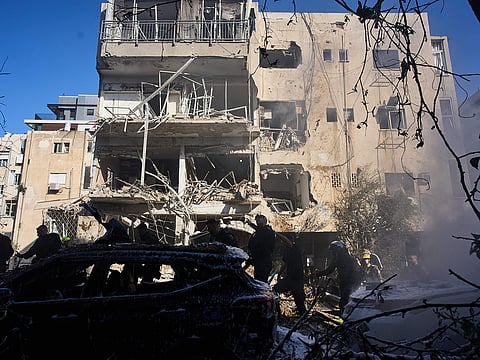
Tel Aviv mayor says building damaged in 'direct' hit after Iran missile warning
The mayor of Tel Aviv said a "direct strike" damaged a building on Tuesday after an Iranian missile attack warning, as Israeli first responders said they had treated four people for light injuries.
The strike in an upscale neighborhood in the north of the Israeli coastal city tore open the facade of an old three-storey building and scattered debris across the street, according to an AFP journalist at the scene.
Tel Aviv mayor Ron Huldai told reporters that the building had been hit by a "direct strike".
According to several Israeli media outlets, including military radio, police believe the damage was caused by a cluster munition missile equipped with three to four warheads, each carrying around 100 kilograms of explosives.
Israel's Magen David Adom emergency medical service released a video from one of the affected apartments that showed extensive damage from the explosion.
MDA said it had treated and quickly discharged four people, revising down an earlier toll of six people lightly wounded.
US weighs airborne assault options in Iran scenario
Senior US military officials are weighing contingency plans to deploy elite airborne and marine forces to support potential operations targeting Iran, including a possible move to secure key energy infrastructure, according to officials familiar with the discussions.
The planning — first reported by The New York Times — centres on the possible deployment of a combat brigade from the Army’s 82nd Airborne Division, alongside elements of its headquarters staff, as tensions in the region continue to escalate. Officials stressed that no orders have been issued by the Pentagon or US Central Command, describing the discussions as precautionary.
Stay updated: Get the latest faster by downloading the Gulf News app now - it's completely free. Click here for Apple or here for Android. You can also find it on the Huawei AppGallery.
Philippines grounding planes due to 'jet fuel shortages'
President Ferdinand Marcos Jr. warned that grounding planes due to jet fuel shortages from the US-Israel war on Iran is a "distinct possibility."
Several countries have refused to refuel Philippine airlines, forcing carriers to load extra fuel for round trips, severely impacting long-haul flights.
"We're hoping not, but it's a distinct possibility," Marcos told Bloomberg on Tuesday (March 24, 2026).
How Pakistan emerges as key mediator in US-Iran war
Pakistan is increasingly positioning itself as a key diplomatic intermediary as the US–Israel war on Iran enters its fourth week, with international reports pointing to Islamabad’s growing role in backchannel efforts to prevent a wider regional conflict.
A coordinated diplomatic push involving Pakistan, Turkey and Egypt has already shown early signs of progress, with US President Donald Trump announcing a limited five-day pause in planned strikes on Iran’s energy and power infrastructure. While fighting continues on multiple fronts, the temporary halt is being viewed as the first tangible outcome of intensified regional diplomacy.
Cathay extends flight suspensions to Dubai, Riyadh until May 31
Hong Kong carrier Cathay Pacific said on Tuesday it has extended its flight suspensions to and from Dubai and Riyadh by a month until May 31 because of the war in the Middle East.
The Asian aviation giant said in two separate statements that all Cathay Pacific flights to and from Riyadh and Dubai had been cancelled up to and including May 31, 2026, "in view of the ongoing situation in the Middle East".
Iran energy minister downplays threat of attack
Iran's energy minister said he believed the country was less vulnerable than others in the region to any attacks on its energy infrastructure, in an interview with state TV broadcast on Tuesday.
"We produce electricity in a spread out way in several places, unlike the countries of the Arabian Gulf or the Zionist regime, where production is centralised and very vulnerable," Energy Minister Abbas Aliabadi said, referring to Iran's Gulf neighbours and Israel.
"We have more than 150 power plants across the country," he added, as the Middle East war dragged into its fourth week.
Stay updated: Get the latest faster by downloading the Gulf News app now - it's completely free. Click here for Apple or here for Android. You can also find it on the Huawei AppGallery.
Iran media says energy infrastructure attacked
Iranian media reported on Tuesday that Israeli-US strikes targeted two gas facilities and a pipeline, hours after US President Donald Trump stepped back from his threat to attack power infrastructure.
"As part of the ongoing attacks carried out by the Zionist and American enemy, the gas administration building and the gas pressure regulation station on Kaveh Street in Isfahan were targeted," said the Fars news agency.
The facilities in central Iran were "partially damaged", added Fars, which did not provide a source and was Iran's only news outlet to report the incident.
It said an attack also targeted the gas pipeline of the Khorramshahr power plant, in the country's southwest.
"A projectile hit the area outside the Khorramshahr gas pipeline processing station," Fars reported, quoting the governor of the city bordering Iraq.
The governor said the infrastructure was operating normally and there was no disruption to the gas supply.
Strike in western Iraq kills 15 fighters: new toll
A strike in western Iraq on Tuesday killed a commander and 14 fighters from the former paramilitary coalition Hashed al-Shaabi, a statement from the group said, updating the toll and blaming the United States.
The fighters from the Hashed al-Shaabi, also known as the Popular Mobilisation Forces (PMF), were killed in a "treacherous American attack that targeted the operation headquarters" in western Anbar province, the statement said.
The PMF is now part of Iraq's regular army, but also includes some pro-Iranian groups.
Six injured in Tel Aviv after Iran missile alert
First responders said six people were injured on Tuesday in Israel's commercial hub Tel Aviv, where police reported several impact sites after the military warned of incoming missile fire from Iran.
Israel's Magen David Adom emergency medical service said "six people were lightly injured at four different sites" and released videos showing a partially gutted building and vehicles on fire.
Police in Tel Aviv said they were handling "several impact sites of munitions".
Select strikes on Iran to continue
Based on reports from Semafor and Reuters, the US is pausing attacks on Iran’s energy infrastructure while continuing other strikes during what President Trump called 'productive' talks with unidentified Iranian officials.
Iran strike in Bahrain results in fire
Bahrain's Civil Defence extinguished a fire in a facility of a company as a result of the Iranian aggression.
Relevant procedures were taken at the site.
Amazon confirms AWS disruption in Bahrain
Amazon said its AWS cloud region in Bahrain has been disrupted following drone activity, marking the second such incident in recent weeks amid ongoing regional tensions. The company is moving customers to alternate regions to maintain operations, though it has not given a timeline for full recovery, leaving businesses monitoring performance closely.
Stay updated: Get the latest faster by downloading the Gulf News app now - it's completely free. Click here for Apple or here for Android. You can also find it on the Huawei AppGallery.
Dubai gold prices extend 14-day slide
Dubai gold prices fell again on Tuesday morning, extending a two-week downward trend that has pulled rates sharply lower from early March highs. At 8:30 am, 24-karat gold stood at Dh523.25, down from Dh530.75 a day earlier, while 22-karat slipped to Dh484.75. The continued decline reflects ongoing pressure from rising inflation risks and interest rate expectations, keeping buyers cautious as they wait for signs of stability.
Israeli strikes near Beirut kill 2, hit targets in southern Lebanon
An Israeli strike early Tuesday on a residential apartment in Bchamoun, around 10 kilometers southeast of Beirut, killed at least two people, according to an initial toll from the Lebanese Health Ministry.
The strike wounded five others, the ministry added.
The strike came without warning and hit an area outside Beirut’s southern suburbs, where the Israeli military had previously issued evacuation notices.
Footage circulating online showed at least one apartment in a building engulfed in flames.
South Korea restricts car use by public employees
South Korea will restrict car use by public employees and extend government-set caps on fuel prices as it tries to weather the shock of the war in Iran that has exposed the vulnerabilities of an economy highly dependent on trade and imported energy.
In announcing the measures at a Cabinet meeting Tuesday, President Lee Jae Myung called for national unity to overcome the war’s growing strain, which he compared to challenges the country faced during the COVID-19 pandemic and past financial crises.
Public employees with fossil-fuel vehicles will be required to keep their cars off the road at least one day per week starting Wednesday.
Electric and hydrogen vehicles will be exempt.
Kuwait power lines hit by air defense shrapnel, causing outages
Kuwait’s Ministry of Electricity, Water, and Renewable Energy (MEW) has taken seven overhead power lines out of service following damage from falling debris after air defence interceptions.
The ministry’s spokesperson, said the incident caused partial power outages in several areas. Technical teams are working to restore services as quickly as possible, with repair crews set to begin operations once sites are secured in coordination with security authorities.
The ministry confirmed that field teams will carry out a full damage assessment to ensure safe and efficient restoration of the affected lines. Emergency crews remain on high alert to address any disruptions and maintain continuity of the national power supply.
Iran state media says 'new wave of missiles' launched at Israel
Iran launched another round of missiles towards Israel on Tuesday morning, state television announced, after earlier strikes hit a building in the north while a loud explosion rang out in Jerusalem.
"Iran fires new wave of missiles at occupied territories," the state-run Islamic Republic of Iran Broadcasting (IRIB) posted on Telegram.
Moments later, it posted that the "Iranian missiles pass(ed) through several Israeli missile defences".
The Magen David Adom emergency services released video of a damaged building in the north of Israel, and said there were no deaths from the incident.
The Israeli military later on Tuesday morning issued several notices that it had detected incoming Iranian missiles and was working to intercept them.
Brent crude back above $100, WTI rises over 3%
Brent crude jumped back above $100 a barrel on Tuesday, a day after plunging more than 10% following Donald Trump’s decision to delay fresh strikes on Iran amid “very good” talks with Tehran.
Brent rose 2.9% to $102.84 per barrel.
West Texas Intermediate (WTI) climbed 3.5% to $91.20 per barrel.
Analysts cautioned that oil prices remain volatile, with the potential to dip back toward $90 if tensions in the Middle East ease.
Stay updated: Get the latest faster by downloading the Gulf News app now - it's completely free. Click here for Apple or here for Android. You can also find it on the Huawei AppGallery.
Japan to release national oil reserves from Thursday
Japan will release another part of its strategic oil reserves from Thursday, Prime Minister Sanae Takaichi said Tuesday, after Tokyo began to tap stockpiles last week.
"In order to secure 'the necessary amount for the whole of Japan' ...we will release the state (oil) reserve from 26th March this week," she said in a post on X.
Asian shares mostly rebound
Asian stocks rose on Tuesday after Donald Trump delayed strikes on Iranian energy sites, as investors reacted with cautious optimism about a possible de-escalation in the Middle East.
Markets in Tokyo, Hong Kong, Shanghai, Sydney, Seoul, Taipei, and Manila opened higher, though gains were trimmed as the morning progressed. Singapore and Wellington slipped.
Japan’s Nikkei 225 gained 1.1% to 52,093.02, recovering some losses from the previous day. Toyota Motor Corp. rose 1.1% after announcing a $1 billion investment in its Kentucky and Indiana plants, part of a $10 billion U.S. expansion plan over five years.
Australia’s S&P/ASX 200 rose 0.5% to 8,404.00, while South Korea’s Kospi jumped 2.2% to 5,526.24.
Global markets have been volatile amid concerns over the Iran conflict, particularly in Asia, where disruptions to the Strait of Hormuz could affect energy shipments.
US-Israel strikes Iran facilities
US-Israeli strikes reportedly targeted energy infrastructure in Iran on Monday, hitting facilities in Isfahan province and the southwestern city of Khorramshahr, according to Iranian media reports. Fars News Agency said a natural gas administration building and a gas pressure reduction station in Isfahan sustained damage, along with nearby residential properties.
In Khorramshahr, a missile reportedly struck near a gas pipeline linked to a power plant, though officials said there were no casualties and electricity supplies remained stable. The reported strikes came despite earlier remarks by former US President Donald Trump indicating a five-day delay in attacks on Iranian energy facilities.
Iran state media says 'new wave of missiles' launched at Israel
Iran launched another round of missiles towards Israel early Tuesday, state television announced.
"Iran fires new wave of missiles at occupied territories," the state-run Islamic Republic of Iran Broadcasting posted on Telegram.
Iran strikes Kuwait
Kuwaiti air defense systems are currently engaged in intercepting hostile missiles and drones that breached the country's airspace, Ministry of Defense Spokesman Colonel Staff Saud Al-Atwan announced on Tuesday morning.
Brent crude back above $100 a barrel, WTI up more than 3%
Brent crude oil jumped back above $100 a barrel on Tuesday, a day after plunging more than 10 per cent in reaction to Donald Trump's decision to delay fresh strikes on Iran as he hailed "very good" talks with Tehran.
Brent rose 2.9 per cent to $102.84, while West Texas Intermediate jumped 3.5 per cent to $91.20.
EU chief urges immediate end to hostilities in the Middle East
European Union chief Ursula von der Leyen called on Tuesday for an immediate end to hostilities in the Middle East, describing a "critical" situation for energy supply chains globally.
We all feel the knock on effects on gas and oil prices on our businesses and our societies,von der Leyen said alongside Prime Minister Anthony Albanese in Canberra.
"It is of utmost importance that we come to a solution that is negotiated, and this puts an end to the hostilities that we see in the Middle East," she added.
Blast heard in Jerusalem after Iran missle alert
A loud blast rang out over Jerusalem early Tuesday after Israel's military said it detected another Iranian missile launch, the second of the day.
AFP reporters in the city heard a loud explosion minutes after the military said it had detected missile launches from Iran and was "working to intercept the threat."
UK military downs two Iranian drones, positions more jets in Mideast: Defence Ministry
A UK ground-based counter-drone unit operating in a high-threat zone successfully intercepted and downed two Iranian drones, according to the UK Defence Ministry.
This develops as Britain has bolstered its forces in the region, positioning more forces in the Middle East than at any time in the last 15 years amid threats from Iran, said British Secretary of State for Defence John Healey.
Saudi defences intercept, destroy 8 drones in Eastern Region
The Saudi Ministry of Defence announced the interception and destruction of eight drones. In a statement carried by the Saudi Press Agency (SPA), Major General Turki Al-Maliki, the official spokesperson for the Ministry of Defence, stated that the drones were intercepted and destroyed in the Eastern Region.
Abdullah bin Zayed offers condolences to Qatari PM & FM over martyrdom of helicopter crew
Sheikh Abdullah bin Zayed Al Nahyan, Deputy Prime Minister and Minister of Foreign Affairs, extended his sincere condolences to the State of Qatar during a phone call with Sheikh Mohammed bin Abdulrahman bin Jassim Al-Thani, Prime Minister and Minister of Foreign Affairs of the State of Qatar, over the martyrdom of members of the Qatari Armed Forces.
The deceased were identified as Captain (Pilot) Mubarak Salem Dawai Al Marri; Captain (Pilot) Saeed Nasser Smeikh; Sergeant Fahad Hadi Ghanem Al Khayareen; and Corporal Mohammed Maher Mohammed, who were among the crew of a helicopter that crashed into Qatar’s territorial waters following a technical malfunction.
UAE President receives French Minister of the Armed Forces and Veterans Affairs
UAE President His Highness Sheikh Mohamed bin Zayed Al Nahyan received Catherine Vautrin, Minister of the Armed Forces and Veterans Affairs of the French Republic.
The leaders discussed cooperation and coordination between the two countries in defence affairs and their shared commitment to strengthening them within the framework of the two countries’ Strategic Partnership.
UAE President, Nato Secretary General discuss regional developments
UAE President His Highness Sheikh Mohamed bin Zayed Al Nahyan held a phone call with Mark Rutte, Secretary General of the North Atlantic Treaty Organisation (Nato), to discuss the ongoing military escalation in the region and its implications for regional and international security, as well as the impact on international shipping and the global economy.
Netanyahu speaks with Trump, vows to protect Israel's interests
Israeli Prime Minister Benjamin Netanyahu said Monday that he spoke with Donald Trump, saying that the US president believed US-Israeli military gains in Iran could be converted into a negotiated agreement that protects Israel's interests.
"President Trump believes there is a chance to leverage the tremendous achievements of the IDF and the US military in order to realise the war's objectives in an agreement - an agreement that will safeguard our vital interests," Netanyahu said in a video statement.
"We will protect our vital interests under any circumstances," he said, adding: "At the same time, we continue to strike both in Iran and in Lebanon."
Netanyahu reiterated that the ongoing strikes were "crushing the missile programme and the nuclear programme" of Iran and also "inflicting heavy damage on Hezbollah".
"Just a few days ago we eliminated two more (Iranian) nuclear scientists, and this is not the end," he said.
Stay updated: Get the latest faster by downloading the Gulf News app - it's completely free. Click here for Apple or here for Android. You can also find it on the Huawei AppGallery.
US‑Israel war on Iran as it happened: What we know so far
Day 22: Trump says US considering ‘winding down’ war
Day 21: UK to let US use bases for strikes on Iran threats
Day 20: Trump vows to destroy Iran gas field; UAE intercepts threats
Day 19: Iran warns of 'consequences' after gas field hit
Day 18: Iran confirms security chief Ali Larijani killed
Day 17: Trump urges allies to secure Strait of Hormuz,
Day 16: Trump calls for allies on Strait of Hormuz security
Day 15: Trump threatens Iran’s oil infrastructure after US bombs Kharg
Day 14: Trump vows intense strikes against Iran in coming days
Day 13: US refueling aircraft crashes in Iraq
Day 12: Donald Trump says Iran near point of defeat