US-Iran ceasefire: Trump says US in no rush but 'clock is ticking' for Iran
I have all the time in the World, but Iran doesn't - The clock is ticking, says Trump
Highlights
We are closing this coverage now. For the latest updates, click here.
Trump: US could make a deal with Iran 'right now' — 'We have total control of the Strait'
US President Donald Trump said he could make a deal with Iran "right now," but he wants it to be "everlasting," not temporary.
"We have total control of the Strait... They would have opened it up three days ago. They came to us and they said, 'we will agree to open the Strait.'
"And all my people are happy. Everybody was happy — except me," he told Fox.
"I said...if we open the Strait, that means they're going to make $500 million a day. I don't want them to make $500 million a day until they settle this thing."
Trump insists Iran should not have a nuclear weapon and makes the handover of Iran's enriched uranium as a key precondition for a peace deal.
Iranian officials, including Foreign Ministry spokesman Esmaeil Baghei, have strongly stated that Iran will not transfer its enriched uranium to any foreign country, particularly the United States, calling such proposals a "non-starter".
Ceasefire in Lebanon extended by 3 weeks: Trump
President Donald Trump says a ceasefire between Israel and Lebanon has been extended by three weeks after hosting a meeting of the two countries’ representatives at the White House.
Israel and Lebanon held ambassador-level talks and President Trump greeted both representatives upon their arrival at the White House.
US troops board vessel carrying Iranian oil: Pentagon
The Pentagon said US forces boarded M/T Majestic X, a crude tanker suspected of carrying Iranian oil, while sailing in the Indian Ocean. The Trump administration warned that ships providing material support to Iran in international waters would be targeted as part of "global maritime enforcement".
France, UK eye 'real progress' in Hormuz security plan
Britain and France Thursday voiced hope that military plans to secure the Strait of Hormuz were coming together and would succeed in restoring trade flows through the vital passage.
At a two-day meeting in London, military planners discussed the practicalities of a multinational mission led by the UK and France to protect navigation in the key waterway following a sustainable ceasefire, top defence officials said.
The aim is to form a "defensive, multinational mission that will strengthen the confidence of commercial shipping, and, if necessary, clear mines and protect vessels when the hostilities end", British defence minister John Healey said.
Healey and French counterpart Catherine Vautrin said in a joint statement they were "confident that real progress can be made".
"International trade, energy, and economic stability for all our nations depend on freedom of navigation" in the strait, Healey told those attending.
He called for "practical military plans", saying "millions of people" were relying on a successful outcome from the meeting.
"We can't let them down," he said.
USS George H.W. Bush aircraft carrier arrives in Mideast
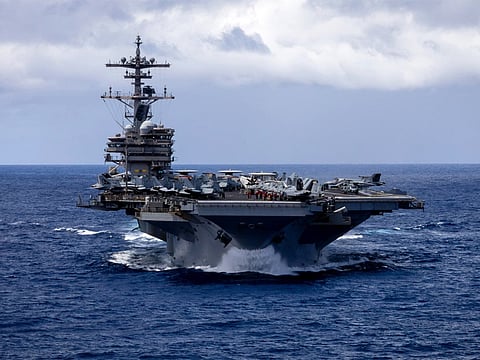
The USS George H.W. Bush aircraft carrier has arrived in the Middle East, the US military said Thursday, bringing the number of the massive American warships operating in the region to three.
The Bush was sailing "in the Indian Ocean in the US Central Command area of responsibility, April 23," the military command responsible for the Middle East said in a post on X that included an image of the carrier with its deck packed with warplanes.
A second carrier - the USS Gerald R. Ford - was operating in the Red Sea on Thursday, while a third - the USS Abraham Lincoln - is also in the region, according to social media posts by CENTCOM.
Get updated faster and for FREE: Download the Gulf News app now - simply click here.
Trump says US in no rush but 'clock is ticking' for Iran
US President Donald Trump said Thursday that the United States is under no pressure to end the war with Iran, but "the clock is ticking" for Tehran, as disruption from the conflict batters the world economy.
"I have all the time in the World, but Iran doesn't - The clock is ticking!" Trump said on social media, adding that Iran's military was destroyed and "their leaders are no longer with us, the Blockade is airtight and strong and, from there, it only gets worse."
Israel is not attacking Iran: Security source
An Israeli security source told AFP on Thursday that the country was not carrying out airstrikes in Iran, following reports in Iranian state media of blasts over the capital Tehran.
"Israel is not attacking in Iran," the source said on condition of anonymity.
Earlier on Thursday, Defence Minister Israel Katz said Israel was "prepared to resume the war against Iran", adding that his country was awaiting a green light from the United States to return Iran to "the Stone Age".
Kuwait reopens airspace after two-month closure
Kuwait has reopened its airspace starting this evening after nearly two-month closure, with the gradual resumption of flights at Kuwait International Airport.
This step marks the start of a phased resumption of flight operations after a temporary precautionary suspension imposed since February 28 amid regional developments.
Sheikh Hamoud Mubarak Al Sabah, head of the General Civil Aviation Authority, said the move was coordinated with relevant domestic and international authorities to ensure operations resume in line with the highest safety and security standards.
Trump to meet Lebanon, Israel envoys at White House talks
US President Donald Trump will meet Israeli and Lebanese envoys when they hold a second round of peace talks Thursday, a US official said.
"The ambassador-level talks between Israel and Lebanon will now take place at the White House," the official said on customary condition of anonymity. "President Trump will greet both representatives upon their arrival."
Get updated faster and for FREE: Download the Gulf News app now - simply click here.
Iran rejects claims of internal divide, asserts unity
Iran's Parliament Speaker Mohammad Bagher Ghalibaf on Thursday strongly dismissed claims of internal divisions within the country, responding to remarks attributed to US President Donald Trump.
In a post shared on X, Ghalibaf asserted that there is no divide between political factions in Iran, emphasising national unity and allegiance to the country's leadership.
In Iran, there are no radicals or moderates; we are all 'Iranian' and 'revolutionary'.Mohammad Bagher Ghalibaf
"In Iran, there are no radicals or moderates; we are all 'Iranian' and 'revolutionary,'" he stated in a post on X, adding that the nation stands united in the face of external pressures.
He further underscored what he described as "iron unity" between the Iranian people and government, along with "complete obedience" to the Supreme Leader of the Islamic Republic, Mojtaba Khamenei.
"With the iron unity of the nation and government, with complete obedience to the Supreme Leader of the Revolution," the post added.
Ghalibaf also issued a warning to adversaries, stating that Iran would make any "aggressor criminal regret his actions."
He concluded his statement with a message of national solidarity: "One God, one leader, one nation, and one path; that path being the path to victory for Iran, dearer than life."
Get updated faster and for FREE: Download the Gulf News app now - simply click here.
Pope urges US and Iran to return to peace talks
Pope Leo XIV urged the United States and Iran to return to talks to end the war Thursday and condemned capital punishment, in a wide-ranging press conference en route home from his trip to Africa.
Leo also asserted that countries have the right to control their borders but mustn't treat migrants worse than "animals," and lamented that the church's morality teaching is often reduced to sexual issues.
Leo spoke to reporters aboard his plane. He was leaving after an 11-day, four-nation voyage that took him from Algeria in the north of Africa to Angola in the south and Cameroon in-between.
Iran media report blasts over Tehran, air defence systems activated
Air defence systems were activated in parts of Tehran on Thursday evening amid reports of hostile aerial activity, Iranian state media said in the first such reports since a ceasefire began.
The IRNA state news agency said the "sound of air defence firing" was heard in western Tehran, while the Mehr news agency reported that the systems were activated in several parts of the capital to counter "hostile targets", without elaborating further.
Italy dismisses replacing Iran at the World Cup
Italian sports officials say four-time champion Italy is not interested in replacing Iran at the upcoming World Cup following a suggestion to that effect by a Trump administration official.
Iran has not withdrawn from the World Cup - the team is currently preparing to play in the US despite the war in the Middle East - and FIFA has insisted its group-stage games near Los Angeles and in Seattle will go ahead as planned in June.
The Financial Times reported that Paolo Zampolli, the US special envoy for global partnerships, had suggested the swap to President Donald Trump and FIFA president Gianni Infantino.
"First of all it's not possible. Secondly, it's not a good idea," Italian Sports Minister Andrea Abodi said Thursday.
Luciano Buonfiglio, the president of the Italian Olympic Committee, which oversees all sports in Italy, also dismissed the idea of taking Iran's place.
"I would feel offended," Buonfiglio said. "You need to deserve to go to the World Cup."
Israeli strike kills 3 south Lebanon
An Israeli strike on south Lebanon killed three people, the Lebanese health ministry said, the latest attack despite a 10-day truce in the Israel-Hezbollah war.
The attacks came hours ahead of the second meeting between Lebanon and Israel's US ambassadors in Washington, where Beirut is expected to ask for a ceasefire extension.
Lebanese cabinet discusses potential move to join the ICC
Lebanon’s Deputy Prime Minister Tarek Mitri said ministers on Thursday discussed joining the International Criminal Court, a permanent tribunal that prosecutes individuals for war crimes, crimes against humanity and genocide, for “a specific period.”
The move would mark a significant shift for Lebanon, which is not a member of the court. Mitri said the move would enable the ICC to “look into war crimes and humanitarian crimes which were committed on Lebanese territory.”
Lebanon has accused Israel of war crimes and and repeated breaches of international law during the latest war with Hezbollah.
Israel is ready to resume war with Iran
Israel’s defense minister, Israel Katz, said Thursday that Israel is prepared to resume war with Iran and is awaiting a “green light” from the United States, according to a statement following a security assessment.
“We are waiting for a green light from the United States,” Katz said, adding that the military is ready for both defensive and offensive operations and “targets are marked.”
Emirates will have a quick rebound after war: Tim Clark
Dubai's flagship Emirates is confident it will rebound quickly from disruptions caused by the Iran conflict, with President Tim Clark saying strong demand will help the airline recover lost ground and fend off competition.
Speaking at the CAPA Airline Leader Summit in Berlin, Clark said the airline is operating at 65 per cent of its capacity, with roughly 13 per cent of its network still inaccessible due to ongoing airspace disruptions, Bloomberg reported.
“I don’t think things will change how we operate the airline or this model,” Clark said. “We can get this back — the brand is particularly strong.”
‘Stable ceasefire and assurances’ needed for transit in the Strait of Hormuz
The chief safety and security officer in BIMCO, the world’s largest international shipping association, said Thursday that shipping companies need assurances from both Iran and the US to transit the vital waterway.
Mine clearance efforts are also needed as they pose a “particular concern,” Jakob Larsen said in a statement, adding that the process of mine clearance could take up to several weeks.
Hours earlier, US President Donald Trump said in a social media post that the military is intensifying its mine clearing efforts in the strait.
The Strait of Hormuz remains fully closed Thursday as the US-Iran standoff continues to intensify in the Persian Gulf.
Get updated faster and for FREE: Download the Gulf News app now - simply click here.
France is ready to host a Lebanon conference
The president of France says he’s willing to host a conference on supporting Lebanon’s army and helping rebuild the country’s battered south.
French President Emmanuel Macron said after talks with Cypriot counterpart Nikos Christodoulides on Thursday that the conference would take place when Lebanon deems it appropriate.
The conference would also aim to release additional European funding. Macron said he and Christodoulides support the idea of a European Union partnership agreement with Lebanon.
India says it’s ‘worried’ for its seafarers
India’s shipping ministry said Thursday it’s “worried about Indian seafarers” in the Strait of Hormuz after reports of vessels coming under fire in the region, though none have been injured.
Mukesh Mangal, Additional Secretary at the Indian Ministry of Ports, Shipping and Waterways, said two foreign-flagged vessels that came under fire had 22 Indian sailors on board.
“None of the Indian seafarer have been injured in the firing,” he said.
The ministry said at least 2,680 Indian sailors have been evacuated since the conflict began.
Trump claims leadership rift is confounding Iran
“Iran is having a very hard time figuring out who their leader is! They just don’t know!,” Trump said in a social media post. “The infighting is between the ‘Hardliners,’ who have been losing BADLY on the battlefield, and the ‘Moderates,’ who are not very moderate at all (but gaining respect!), is CRAZY!”
Trump has repeatedly said over the course of the ceasefire that began April 8 that his team is dealing with Iranian officials who want to make a deal, while acknowledging his decision to kill several top leaders has come with some complications.
He announced earlier this week that he was extending the truce to give the battered Iranian leadership more time to come with a “unified proposal” on ending the war.
Next UN peacekeeping force in Lebanon could be smaller than the current one
The head of the UN's peacekeeping operations says he expects the possible replacement for its force in southern Lebanon will “probably be smaller” than the current one that’s been in place for nearly a half-century.
Jean-Pierre Lacroix said the UNIFIL operation, which has inhabited a tense zone where militants from Hezbollah and Israeli forces have battled repeatedly, has recently faced pressure from funding cuts.
The force’s mandate ends at the end of the year. UN officials are facing a June 1 deadline to present a proposal for the force that could replace it.
Trump orders the US military to ‘shoot and kill’ Iranian small boats
The US president in a social media posting also said the military is intensifying its mine clearing efforts in the critical waterway.
“I have ordered the United States Navy to shoot and kill any boat, small boats though they may be ... that is putting mines in the waters of the Strait of Hormuz,” Trump posted. “There is to be no hesitation. Additionally, our mine ‘sweepers’ are clearing the Strait right now. I am hereby ordering that activity to continue, but at a tripled up level!”
UN 'working on' keeping presence in Lebanon in 2027
The United Nations said Thursday it was "working on" maintaining a presence in Lebanon once the mandate for its UNIFIL peacekeeping force expires at the end of the year.
"In terms of the post-UNIFIL, we're currently in the process of working on these options," said Jean-Pierre Lacroix, the UN Under-Secretary-General for Peace Operations, with the Lebanese government "very clear that they would want to keep a UN presence".
The United Nations Interim Force in Lebanon has served as a peacekeeping force between Israel and Lebanon since 1978 but finds itself caught in the crossfire between Israeli forces and Hezbollah.
US military seizes oil tanker associated with Iran
The US military seized another tanker Thursday associated with smuggling Iranian oil. The US Defense Department said it seized the oil tanker Majestic X in the Indian Ocean.
“We will continue global maritime enforcement to disrupt illicit networks and interdict vessels providing material support to Iran, wherever they operate,” the Defense Department said.
The seizure comes after Iran attacked three cargo ships Wednesday in the Strait of Hormuz, capturing two of them.
The Defense Department released footage of the seizure of the vessel, showing US troops on the deck of the vessel.
Ship-tracking data showed the Majestic X in the Indian Ocean between Sri Lanka and Indonesia, roughly the same location as the oil tanker Tifani, earlier seized by American forces. It had been bound for Zhoushan, China.
The Majestic X is a Guyana-flagged oil tanker. It previously had been named Phonix and had been sanctioned by the US Treasury in 2024 for smuggling Iranian crude oil in contravention of American sanctions on the Islamic Republic.
“Iran relies upon a sprawling network of tankers and ship management firms in multiple jurisdictions to transport its petroleum to overseas customers — using tactics such as false documentation, manipulation of vessel tracking systems, and constant changes to the names and flags of vessels,” the Treasury said at the time.
There was no immediate response from Iran on the news of the seizure.
Trump envoy wants Italy to replace Iran at World Cup
An envoy to US President Donald Trump has asked world football's governing body FIFA to replace Iran with Italy at the World Cup, according to the Financial Times.
US special envoy Paolo Zampolli told the FT on Wednesday it would be a "dream" to see four-time World Cup winners Italy at the finals in the United States, Mexico and Canada despite the fact they lost in a qualification playoff last month.
The Iranian embassy to Rome responded saying that the suggestion showed US "moral bankruptcy" and that Italy did not need "political privileges" to demonstrate its football greatness.
Get updated faster and for FREE: Download the Gulf News app now - simply click here.
Iran’s exiled crown prince splattered with red liquid
Iran’s exiled Crown Prince Reza Pahlavi was splattered with red liquid Thursday as he left a building after a news conference in Berlin. He waved to supporters in the aftermath and got into a car that drove away. The alleged perpetrator was immediately detained by police.
Pahlavi has been in exile for nearly 50 years.
His father, Iran’s shah, was so widely hated that millions took to the streets in 1979, forcing him from power. Nevertheless, Pahlavi is trying to position himself as a player in his country’s future.
US–Iran war clock: May 1 deadline puts Trump under pressure
As the United States edges closer to a critical May 1 deadline in its war with Iran, a decades-old law is quietly becoming one of the most consequential forces shaping the next phase of the conflict.
Nearly eight weeks after Washington joined Israeli strikes against Iran, President Donald Trump faces a legal and political inflection point: continue the war without congressional backing and risk a backlash, or seek approval and expose divisions within his own party.
At the heart of the moment is the 1973 War Powers Resolution — legislation designed to limit a president’s ability to wage prolonged military campaigns without lawmakers’ consent. While often ignored or contested, the law’s timelines are now converging with the realities of a war that has already reshaped regional dynamics, including the security of the Gulf and the stability of global energy flows.
According to reporting by The New York Times, the administration formally notified Congress of military action on March 2, triggering a 60-day countdown that ends on May 1.
Iran's exiled crown prince criticizes ceasefire
Reza Pahlavi, Iran's exiled crown prince, criticized the ceasefire between the Unites States and Iran.
He argued Thursday that the agreement assumes the Iranian government's behavior will change and "you're going to deal with people who all of a sudden have become pragmatists."
"I don't see that happening," he said during a news conference in Berlin. "I'm not saying that diplomacy should not be given a chance, but I think diplomacy has been given enough chance."
Pahlavi has tried to position himself for a return to power should the Shiite theocracy fall and has supported the U.S.-Israeli military intervention in the Middle East.
Pahlavi called on Europeans to do more to support Iranian people fighting for democracy.
He claimed 19 political prisoners were executed by Iranian authorities in the past two weeks and another 20 people have been sentenced to death.
"Will the free world do something or watch the slaughter in silence," Pahlavi wondered.
Get updated faster and for FREE: Download the Gulf News app now - simply click here.
Iran economy looks set to withstand US naval blockade
A US naval blockade of Iranian ports is likely to squeeze Iran's oil output in the coming weeks but claims it will throw the Islamic republic into economic free fall remain premature, analysts say.
After weeks of bombing and counter-strikes, focus has shifted to the standoff in the Strait of Hormuz, which ordinarily carries around a fifth of the world's oil and liquefied natural gas.
In response to Iran's blockade of the strait since the start of the Middle East war, the US imposed a counter-blockade of the Islamic republic's ports, a push to force its leaders into a compromise in peace talks.
That bid, however, looks set to fail, at least in the short term.
"If the blockade lasts for more than two or three months, it can cause more damage" to Iran, economic analyst and professor at Shahid Beheshti University in Tehran Saeed Laylaz told AFP.
"If Iran suffers any damage, the damage to the countries in the southern Arabian Gulf will definitely be greater," he added.
There's a limit on how long Iran can bide its time, however.
Arne Lohmann Rasmussen, chief analyst at Global Risk Management said Iran "was expected to run out of storage capacity within approximately one month, but it may already be forced to shut in part of its oil production within a couple of weeks".
Qatar Airways resumes daily Dubai, Sharjah flights
Travellers in the UAE will once again have more flight options as Qatar Airways resumes daily services to Dubai and Sharjah from April 23, marking a key step in restoring regional connectivity.
The airline confirmed it has restarted daily flights between Doha and both Dubai International Airport (DXB) and Sharjah International Airport (SHJ), with services to Damascus set to follow from May 1.
Iran receives first revenue from Strait of Hormuz tolls: official
A senior Iranian parliament official said on Thursday that Tehran has received the first revenue from tolls it imposed on the strategic Strait of Hormuz in its war with the United States and Israel.
"The first revenue received from the Strait of Hormuz tolls was deposited into the Central Bank account," said deputy speaker of parliament Hamidreza Hajibabaei, according to Tasnim news agency.
Other Iranian media carried the same statement, without elaborating.
Strait of Hormuz blockade drives up traffic at Panama Canal
The ongoing conflict in the Middle East has significantly boosted traffic through the Panama Canal, with one LNG vessel paying $4 million to skip the queue and avoid a wait of up to five days.
Disruptions linked to Iran and the blockade of the Strait of Hormuz have prompted Asian buyers to source energy from the US, routing shipments through the canal rather than relying on Gulf producers. This shift has driven last-minute auction slot prices from around $130,000 to as high as $385,000 in March and April, with several tankers exceeding $3 million.
Canal traffic has remained steady at between the mid-30s and over 40 vessels per day. Handling around 5 percent of global maritime trade, the canal remains a critical link between the US and Asian markets amid ongoing global trade disruptions.
'No time pressure' on Iran ceasefire, says Trump
US President Donald Trump has said he is "not in a rush" to end the conflict with Iran and wants a "good deal", Fox News reported, as cited by the BBC. Fox News presenter Martha MacCallum, who spoke to him by phone on Wednesday, said Trump told her there is "no time pressure" on his extension to the ceasefire with Iran.
White House Press Secretary Karoline Leavitt confirmed to Fox News that negotiations "are ongoing", adding that Trump had "made his red lines very clear" to the Iranians — chief among them a demand that Tehran turn over its enriched uranium to the United States.
Leavitt, as cited by the BBC, said Washington was "waiting to hear back from the Iranian regime", which she said "cannot send a unified message yet" — a key reason, she noted, behind the president's decision to extend the ceasefire.
Get updated faster and for FREE: Download the Gulf News app now - simply click here.
Pakistan interior minister meets US official
Pakistan Interior Minister Mohsin Naqvi said in a statement Thursday he hoped for “positive progress” from Iran after a meeting with US Chargé d’Affaires Natalie Baker.
The meeting in Pakistan’s capital Islamabad included discussion of diplomatic efforts related to a second round of US-Iran ceasefire talks, which was delayed after Tehran did not confirm when it would send its delegation.
Naqvi said Pakistan Prime Minister Shehbaz Sharif and Field Marshal Asim Munir were making efforts “at every level” to support a peaceful settlement and hoped all sides would give diplomacy a chance.
Naqvi praised US President Donald Trump for extending the ceasefire, calling it a welcome step toward de-escalation.
Baker appreciated Pakistan’s “constructive role” in promoting peace, the statement said.
Friday Sermon: UAE urges loyalty, warns of betrayal
The General Authority of Islamic Affairs, Endowments and Zakat (Awqaf UAE) has announced that this week’s Friday sermon across all mosques in the UAE will be delivered under the title: “Whoever betrays our nation is not one of us”.
In guidance issued to imams, the authority stressed that betrayal of one’s country is a grave moral and religious offence, rejected by sound human nature and condemned in Islamic teachings. The sermon highlights that treachery is among the most serious sins, warning against deceit, disloyalty and actions that undermine national unity.
Clearing Hormuz Strait mines could take six months: report
A Pentagon assessment said it could take six months to completely clear the Strait of Hormuz of Iranian-laid mines, which could keep oil prices high, the Washington Post reported on Wednesday.
Iran has all but blocked the vital waterway since the start of a war with the United States and Israel, sharply driving up oil and gas prices and disrupting the global economy.
The strait - through which one-fifth of the world's oil and gas passes in peacetime - has remained largely closed during a shaky ceasefire, with the US imposing its own blockade.
Even if hostilities end and the blockade lifts, it could take months to clear the waterway of mines, according to a Pentagon assessment, the Washington Post reported citing officials close to the discussion.
The assessment added that it was unlikely such an operation would begin before the end of the war.
The six-month estimate was shared with members of the House Armed Services Committee during a classified briefing, the Post reported.
Lawmakers were told that Iran may have placed 20 or more mines in and around the strait, some floated remotely using GPS technology which makes them harder to detect, according to the report.
AFP has contacted the Department of Defense for comment.
Pentagon spokesman Sean Parnell told the Washington Post that its information was "inaccurate."
Iran's Revolutionary Guards have warned of a "danger zone" covering 1,400 square kilometres - 14 times the size of Paris - where mines may be present.
Lebanon vows accountability over journalist killing
Lebanon has vowed to hold Israel accountable for its crimes against journalists ahead of a second round of talks in Washington. The vow follows the killing of Al Akhbar journalist Amal Khalil in the town of Al Tayri on Wednesday.
Lebanese President Joseph Aoun expressed his condolences over the death of Amal Khalil, who was killed in an Israeli attack on the town of Al Tayri, and extended his wishes for the swift recovery of her colleague Zeinab Faraj, who was seriously wounded in the same incident.
Aoun said in a post on X that Israel’s “deliberate and consistent targeting of journalists” was aimed at “concealing the truth of its aggressive acts against Lebanon”.
Such acts constitute “crimes against humanity punishable under international laws and conventions”, the president said, adding that Khalil’s killing should serve as “an incentive for the international community to intervene and put an end to them”.
Iran executes man over banned group ties, Israel links
Iran hanged a man on Thursday after he was convicted of membership in a banned opposition group and alleged collaboration with Israel, the judiciary said.
"Sultan-Ali Shirzadi-Fakhr was hanged early this morning for membership in the terrorist group" of the People's Mujahedin Organisation (MEK) and "collaboration with the Israeli regime's spy service," the judiciary's Mizan Online website reported.
He was also convicted of a capital offence that in Persian means waging war against God, accused of taking part in operations hostile to the Islamic Republic, Mizan said.
It was not clear when he was arrested.
Mizan said he had lived in Spain for a period, but it was not clear whether he held another passport.
Video: Iran navy seize vessels in Strait of Hormuz
The video shows masked men in a small boat approaching a large vessel and boarding it while holding weapons.
CENTCOM says more than 30 ships affected by US blockade
The U.S. military’s Central Command said Thursday its forces in the Mideast had “directed 31 vessels to turn around or return to port as part of the U.S. blockade against Iran.”
Panama condemns Iran for seizing ship flying its flag
The Central American nation's foreign ministry wrote in a statement that the boat, owned by the Italian company MSC Francesca, was "forcibly taken" into Iranian waters on Wednesday, and it accused Iran of violating international law. It wasn't immediately clear if the boat remained in Iranian custody.
The seizure "represents a serious attack on maritime security and constitutes an unnecessary escalation," it wrote.
Panama has one of the largest ship registries, with around 16% of the world's ships flying under the country's flag, according to 2024 data from Panamanian authorities.
Get updated faster and for FREE: Download the Gulf News app now - simply click here.
Pentagon says it will take months to clear mines in the Strait of Hormuz
The Pentagon told lawmakers this week it will likely take six months to clear the mines set in the strait, according to a person familiar with the situation who was granted anonymity to discuss the sensitive information.
Officials from the Department of Defense delivered the information during a classified briefing at the House Armed Services Committee on Tuesday.
The session left more questions than answers as lawmakers probed for information about the cost of the war against Iran, the strategy and objectives, the person said. The lawmakers also raised questions that have still gone unanswered about the strike on a school compound during the early days of the war.
Lebanon meets Israel in Washington to request truce extension
Israel and Lebanon hold a new round of talks in Washington on Thursday, during which Beirut plans to request a one-month extension of a ceasefire due to expire within days.
Israel stated ahead of the talks that it has no "serious disagreements" with Lebanon, calling on it to "work together" against the pro-Iran Hezbollah, which is notably absent from and opposed to the negotiations.
The two countries, officially at war for decades, held a meeting in Washington on April 14, the first of its kind since 1993, in an attempt to put an end to the more than six-week war between Hezbollah and Israel.
The United States announced a 10-day truce shortly after the first meeting, and it is due to expire on Sunday.
Oil prices up 4% on uncertain Iran-US ceasefire prospects
Oil prices jumped four percent Thursday after Iran vowed not to reopen the Strait of Hormuz so long as a US naval blockade remained in place despite a ceasefire extension.
At around 0025 GMT, the benchmark US oil contract West Texas Intermediate (WTI) climbed 4.06 percent to $96.73 per barrel. International oil benchmark Brent North Sea crude rose 3.62 percent to $105.63. Both eased back in the following minutes.
Oil prices have soared since Israel and the United States attacked Iran on February 28 and they have kept inching up on the uncertainty over whether war will resume.
As the clock ticked for a return to the war that has engulfed the region, US President Donald Trump had said Tuesday he would maintain the truce to allow more time for Pakistani-brokered peace talks.
Iran said it welcomed the efforts by Pakistan but made no other comment on Trump's announcement.
Iran says Hormuz cannot be opened due to ceasefire 'breaches'
Iran’s parliamentary speaker Mohammad Bagher Ghalibaf said reopening the Strait of Hormuz is “not possible” amid what Tehran calls “flagrant violations” of the current ceasefire by the US and Israel.
Ghalibaf posted on social media that a “complete ceasefire only has meaning if it is not violated through a naval blockade and the hostage-taking of the world economy,” asserting that the US naval blockade of Iranian ports and Israeli “warmongering” undermine truce commitments.
The remarks come amid ongoing diplomatic efforts — including a ceasefire extension and proposed talks in Pakistan — to end hostilities between Iran and the US. Iran insists that without full compliance by all parties, including lifting maritime restrictions, the strategic waterway will stay closed to international shipping.
Pentagon: Top US Navy official leaving 'immediately'
The Pentagon announced that the Navy’s top civilian official, Secretary of the Navy John Phelan, is leaving his jobeffective immediately.”
Iran peace talks could restart as soon as Friday: Trump
President Trump says Iran peace talks could restart as soon as Friday, according to US media. New reports say Trump estimates they could begin within the next "36 to 72 hours." Trump said Iran's "fructured" leadership failed to come forward with a "unified proposal."
Pezeshkian rebukes Trump, cites 3 'main obstacles' to genuine talks
US President Donald Trump has claimed that Iran’s leadership is “seriously fractured” when he announced an indefinite ceasefire extension, while signaling that US pressure on Tehran will continue.
He said the truce would be kept in place to give negotiations "more time", while the US naval blockade on Hormuz and Iranian ports stays.
In response, Iranian President Masoud Pezeshkian made an immediate pushback: he called out Trump's “hypocritical rhetoric” in the middle of a war-tinged diplomatic standoff, in a message meant to travel far beyond Tehran.
Brent crude climbs back above $100 as oil benchmarks rally
Brent crude returned to the psychologically important $100-per-barrel mark early Thursday, underscoring renewed strength across global oil benchmarks as energy markets reacted to supply uncertainty and geopolitical risk.
A market snapshot taken at 8:21 pm GMT (5.21 am Tokyo, on April 23, 2026) showed Brent crude at $101.5, up $2.97 or 3.02% on the session.
Trump has not set deadline for Iranian peace proposal: White House
US President Donald Trump has not set a deadline by which Iran must submit a peace proposal, the White House said on Wednesday.
"The president has not set a firm deadline to receive an Iranian proposal, unlike some of the reporting I've seen today. Ultimately, the timeline will be dictated by the commander in chief," Press Secretary Karoline Leavitt told journalists.
US‑Israel war on Iran: Recent developments
Day 54: Trump extends US-Iran ceasefire
Day 53: Pakistan urges the US and Iran to extend their ceasefire
Day 52: Fighting to resume as ceasefire ends Wednesday: Trump
Day 51: Iran refuses new round of talks, say reports
Day 50: Indian ships reverse course in Strait of Hormuz
Day 49: Trump says Iran agrees to 'never' close Hormuz strait again
Day 48: Trump: Iran agreed to hand over its enriched uranium
Day 47: US optimistic about reaching peace deal with Iran
Day 46: 2 days to US-Iran talks in Pakistan? Trump thinks so
Day 45: US, Iran discuss 'another round' of direct talks
Day 44: US to begin 'blockade' of Iranian ports on Monday
Day 43: 3-way talks with the US and Iran begin in Pakistan
Day 42: Trump says Iran has 'no cards' as Vance heads for talks
Day 41: Kuwait condemns drone attacks, US warns vs Hormuz toll