Pezeshkian rebukes Trump: Cites 3 'main obstacles' to genuine talks
Message to Trump: 'World sees your endless hypocritical rhetoric, contradiction'
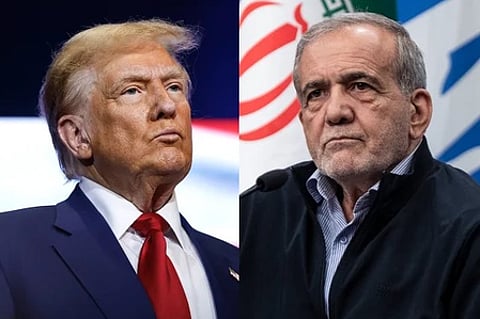
US President Donald Trump has claimed Iran’s leadership is “seriously fractured”.
He cited it as the reason for his unilateral decision to extend the ceasefire, while signaling that US pressure on Tehran will continue.
He said the truce would be kept in place to give negotiations "more time", while the US naval blockade on Hormuz and Iranian ports stays.
Iranian President Masoud Pezeshkian made an immediate pushback.
Pezeshkian called out Trump's “hypocritical rhetoric” in the middle of a war-tinged diplomatic standoff, in a message meant to travel far beyond Tehran.


In a sharply worded post, Pezeshkian accused the US of sabotaging genuine negotiations through “breach of commitments, blockade and threats.”
Furthermore, Pezeshkian argued that the world can see the wide gap between Trump's claims and actions.
The statement lands as tensions over Iran’s nuclear programme and regional conflict dominate global headlines — and as Tehran insists it is still open to dialogue despite the pressure.
Pezeshkian's words highlight his recent public criticism of the US leader, specifically his policy toward Iran’s nuclear programme and ongoing conflict.
Why Trump says Iran leadership is 'divided'
Trump’s remarks reflect Washington’s view that Iran’s leadership is not speaking with one voice.
The US believes the biggest problem is not just the terms of a deal, but whether Tehran’s negotiators even have a clear mandate on uranium enrichment and Iran’s stockpile of enriched material.
That uncertainty has been amplified by the absence of the new supreme leader, Mojtaba Khamenei, who has not appeared publicly since taking power.
US officials and regional observers have suggested that his low profile may be complicating internal decision-making, leaving subordinates uncertain about how much authority they really have.
In a briefing on Wednesday, White House press secretary Karoline Leavitt warned reporters about taking statements from Iranian officials at face value.
She stressed that there are competing narratives coming out of Iran, with leaders and state media publicly denouncing talks with Washington and rejecting US proposals, while behind closed doors, some elements of the Iranian regime have engaged privately with American negotiators.
US officials contend that what Tehran says in open forums often doesn’t match the more measured or conciliatory positions it conveys in off-the-record discussions with the US negotiating team — a discrepancy the Leavitt says should make observers cautious about equating public Iranian rhetoric with the reality of diplomatic engagements.
Iran’s key power centres
Iran’s decision-making is shaped by several overlapping centres of power, and they do not always move in lockstep: the supreme leader sits at the top, but the parliament, security establishment and Revolutionary Guard each have their own interests and ways of influencing policy.
Mojtaba Khamenei, the second son of the late Ali Khamenei, was reported to have become supreme leader after his father was killed in air strikes.
He has deep ties to the Islamic Revolutionary Guard Corps and is widely seen as a hardline figure, but his continued absence from public view has fueled speculation about his condition and about how directly he is controlling the state.
Who is Masoud Pezeshkian?
Iranian President Masoud Pezeshkian, 72, a heart surgeon, is a key figure in Tehran's leadership. In a recent statement reported by Iran’s state media, Pezeshkian challenged the United States — particularly President Donald Trump — for asserting that Iran cannot exercise its lawful nuclear rights. He
asked rhetorically why Washington should “deprive a nation of its rights,” emphasizing Tehran’s position that its nuclear activities are legitimate and lawful under international frameworks.
Pezeshkian’s early career was in medicine; he trained as a heart surgeon and served as a physician during the Iran–Iraq War (1980–1988).
After that, he transitioned into politics, serving as Iran’s Health Minister (2001–2005) under President Mohammad Khatami, followed by five terms in the Majles (parliament) from 2008 to 2024. He also held leadership roles, including First Deputy Speaker of the parliament.
Born in Mahabad, West Azerbaijan, to an Azerbaijani and Kurdish family, Pezeshkian has long been seen as a centrist reformist — advocating for moderate domestic reforms, improved civil liberties, and engagement with the West, especially on economic and diplomatic fronts.
His presidency has been dominated by escalating geopolitical tensions, internal political pressures, and the complex balance between reformist rhetoric and hardline elements within Iran’s political system.
Pezeshkian has stressed the importance of pursuing diplomatic channels to ease tensions with the United States while remaining cautious and distrustful of US intentions.
He noted that ongoing disagreements — including issues like port blockades and inconsistent cease-fire behaviour — complicate the possibility of a second round of negotiations.
Commitment to non-aggression, regional apology
In a notable, the Pezeshkian stated that Iran would no longer target neighbouring countries unless attacked first, apologising for recent cross-border strikes that occurred due to miscommunication within Iranian forces.
He framed Iran’s military posture as defensive, emphasising a desire to avoid escalation while defending national security.
Pezeshkian’s leadership thus reflects a dual narrative: advocating for diplomatic engagement and moderation while confronting the realities of war, sanctions, and geopolitical rivalry — all under the constraints of Iran’s wider political and military establishment.
Ghalibaf’s role
Parliament Speaker Mohammad Bagher Ghalibaf has also emerged as one of the most visible Iranian figures in the talks with Washington.
A former IRGC commander, police chief and Tehran mayor, he has long been part of Iran’s hardline establishment and has both security credentials and political experience.
He has defended diplomacy as a way to turn battlefield gains into political results, but he has also struck a defiant tone toward Trump.
After the ceasefire extension, he warned that Iran was ready to reveal “new cards on the battlefield” if Washington continued to threaten Tehran.
Within Iran, his role has drawn criticism from hardliners who see any engagement with the U.S. as dangerous or even traitorous. Still, Ghalibaf has tried to frame the talks as a tactical necessity rather than a surrender.
The IRGC’s influence
The Islamic Revolutionary Guard Corps remains one of the most powerful institutions in Iran and is central to how the country responds to war, sanctions and negotiations.
It controls major military assets, including drones and airspace defences, and answers directly to the supreme leader.
That makes the IRGC a decisive actor in any ceasefire or nuclear negotiation.
Recent attacks on cargo ships in the Strait of Hormuz also suggest that not all parts of the Iranian system are operating in step with the diplomats.
Those incidents point to a gap between the people talking and the people willing to escalate, or at least to keep pressure on the US and its allies.
What it means for talks
The ceasefire extension, and subsequent statement, so far shows that both sides still see room for diplomacy, but it also shows how fragile the process is.
If Iran’s negotiators are unclear about their authority, then any talks could produce mixed signals, delays or a deal that is later contested inside Tehran.
For now, Trump is betting that pressure, including the naval blockade of Iran, with aqt leastg 27 ships reportedly redirected, will expose and widen those divisions.
Iran, meanwhile, appears to be trying to project unity while managing a leadership structure that is still adjusting to the death of its previous supreme leader and the demands of war.


