Mojtaba Khamenei’s first message raises questions: Who’s calling the shots?
Iran's unseen supreme leader issues message as power questions swirl in Tehran
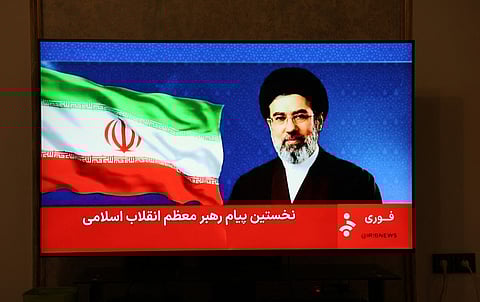
Dubai: Iran’s new supreme leader Ayatollah Mojtaba Khamenei issued his first public message since taking office, but the unusual manner in which it was delivered — and his continued absence from public view — has raised fresh questions about who is truly directing the country’s war strategy.
Instead of appearing on television or addressing the nation directly, the message attributed to Mojtaba Khamenei was circulated online through a Telegram channel set up by his office. The statement praised Iran’s armed forces, demanded reparations from countries attacking Iran and repeated familiar rhetoric about confronting the United States and Israel.
The message gave no indication of when or where it had been recorded or written, further fuelling speculation about Mojtaba’s condition and whereabouts.
It also called on neighbouring countries to shut down American military bases and doubled down on Iran’s position that the strategic Strait of Hormuz should remain closed to global trade.
Much of the language echoed the ideology and tone long associated with his father, former supreme leader Ali Khamenei, appearing designed to reassure supporters that Iran’s hardline course remains unchanged.
Yet the format of the message — and the fact that Mojtaba has still not appeared publicly since his appointment — has fuelled speculation about his condition and the internal balance of power in Tehran.
Reports have suggested the new leader was wounded in the opening days of the war, though Iranian authorities have not confirmed the extent of any injuries.
Some ships are allowed through Hormuz
The uncertainty has prompted analysts to question whether key decisions are being made elsewhere within Iran’s power structure.
Shortly after the statement was released, the Guards signalled their intention to continue enforcing the closure of the Strait of Hormuz. Navy commander Alireza Tangsiri said the force would maintain the strategy of blocking the vital waterway.
At the same time, Iran also appeared to show limited flexibility. Deputy foreign minister Majid Takht-Ravanchi said some countries had been allowed to move ships through the strait during the conflict.
Iran’s political leadership has also outlined conditions for ending the war. President Masoud Pezeshkian said any settlement must recognise Iran’s “legitimate rights”, include compensation for damage caused by the conflict and guarantee the country will not face future attacks.
Warnings
Meanwhile, senior Iranian officials continued issuing warnings to Washington and regional states.
The war of words between Tehran and Washington has also intensified. Iran’s security chief Ali Larijani warned that regional infrastructure could be targeted if the United States escalated the conflict.
“If they do that, the whole region will go dark in less than half an hour,” Larijani said in a post on X, threatening strikes on regional power grids and US forces.
US President Donald Trump responded by saying Washington could cripple Iran’s electricity infrastructure within an hour if it chose to escalate.
“We could take apart their electric capacity within one hour. And it would take them 25 years to rebuild it,” Trump said, while claiming Iran’s military capabilities had been “absolutely decimated.”
For now, however, the central question remains unresolved.
Iran’s new supreme leader has delivered a message — but he has still not appeared before the public, leaving uncertainty over who is truly calling the shots in Tehran.