Iran doubles down on hardline rule with Mojtaba Khamenei
Shadowy Bayt insider with close Revolutionary Guard ties takes the helm at height of war
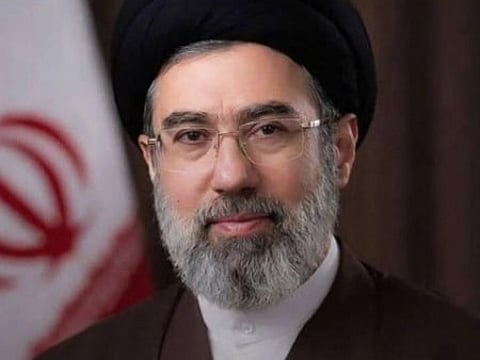
Dubai: Iran’s decision to elevate Mojtaba Khamenei as supreme leader signals that the Islamic Republic intends to maintain its hardline course even as US and Israeli air strikes pound the country and regional tensions escalate.
For years, Mojtaba Khamenei has been one of the most enigmatic figures in Iran’s ruling establishment — a powerful but largely unseen operator who worked behind the scenes in his father’s office. Now, as he steps into the country’s most powerful position, the once shadowy cleric finds himself thrust into the global spotlight and into the crosshairs of Iran’s adversaries.
Stay updated: Get the latest faster by downloading the Gulf News app - it's completely free. Click here for Apple or here for Android. You can also find it on the Huawei AppGallery.
The 56-year-old son of the late supreme leader Ayatollah Ali Khamenei has never held formal government office and has rarely spoken publicly. Yet analysts say he quietly accumulated influence inside the Islamic Republic’s most powerful institutions, particularly the Islamic Revolutionary Guard Corps (IRGC).
“He has been a secretive figure operating behind the scenes,” Mehmet Ozalp, head of the Centre for Islamic Studies and Civilisation at Australia’s Charles Sturt University, told ABC.
Mojtaba Khamenei: Profile of a hardliner
Born: September 8, 1969, in Mashhad, Iran.
Age: 56.
Family: Second son of Iran’s late supreme leader Ayatollah Ali Khamenei.
Grew up within Iran’s revolutionary elite as his father rose to prominence after the 1979 Islamic Revolution.
His father became Iran’s supreme leader in 1989.
Mojtaba studied Islamic theology at the influential Qom seminary, the heart of Shiite scholarship in Iran.
He never developed the public religious stature of many senior ayatollahs.
Despite this, he steadily built influence within Iran’s political and security establishment.
For decades he remained one of the most powerful yet least visible figures inside Iran’s system.
He rarely appeared in public and held no formal government position for much of his career.
During the late stages of the Iran–Iraq War, he joined the Islamic Revolutionary Guard Corps (IRGC).
He took part in several operations during the conflict.
His wartime service helped forge strong ties with Iran’s security elite.
Analysts say he cultivated particularly close relations with the IRGC and the Basij paramilitary force.
Both organisations play a central role in defending the Islamic Republic and suppressing dissent.
Mojtaba spent decades working inside the office of the supreme leader, often referred to as the leadership apparatus.
He acted as a gatekeeper controlling access to his father and influencing key political decisions.
His influence became widely discussed during Iran’s 2009 presidential election crisis.
Analysts say he supported the re-election of hard-line president Mahmoud Ahmadinejad.
He was also linked to the state crackdown on the Green Movement protests that followed the vote.
Through the 2010s he emerged as a powerful behind-the-scenes political operator in Tehran.
Western analysts increasingly viewed him as a potential successor to his father.
In 2019 the United States sanctioned him for ties to Iran’s leadership and security network.
In February 2026, regional conflict involving Iran, Israel and the United States erupted.
On March 8, 2026, Iran’s Assembly of Experts appointed Mojtaba Khamenei as the country’s new supreme leader, marking the first father-to-son succession in the Islamic Republic.
“He mainly used his father’s influence and acted as a gatekeeper to him, which made him a very powerful person, particularly with the revolutionary guards.”
For years Mojtaba’s influence inside the office of the supreme leader — known as the “Bayt” — earned him a reputation as the man coordinating military, intelligence and political decisions in the background.
Iran specialists Kasra Aarabi and Saeid Golkar once described him as effectively acting as a “mini supreme leader” inside his father’s office, closely involved in security and military matters.
Favourite among hardline factions
His close ties to the Revolutionary Guards, the powerful ideological military force that protects the Islamic Republic, have long made him a favoured candidate among hardline factions.
That backing appears to have proved decisive.
Iran’s Assembly of Experts — the clerical body responsible for selecting the country’s supreme leader — ultimately chose Mojtaba during a moment of extraordinary crisis, as the country faces sustained attacks from the United States and Israel.
Analysts say the decision reflects a system closing ranks around a familiar figure during wartime.
“Mojtaba is the wisest pick right now because he is intimately familiar with running and coordinating security and military apparatuses,” Tehran-based analyst Mehdi Rahmati told The New York Times.
The choice also signals continuity in Iran’s theocratic leadership.
As supreme leader, Mojtaba now holds ultimate authority over the country’s political system, including the legislative, executive and judicial branches of government. He also becomes commander-in-chief of the armed forces at a time when Iran is engaged in an escalating regional conflict.
But the appointment carries risks.
‘Target for elimination’
Iran’s 1979 Islamic Revolution toppled the shah partly in rejection of hereditary rule. Elevating the son of the previous supreme leader could fuel criticism among Iranians already deeply divided over the country’s direction.
Some analysts also warn the decision could deepen tensions with Iran’s adversaries.
Even before Mojtaba’s appointment was confirmed, US President Donald Trump had suggested that the worst-case scenario for Washington would be a successor “as bad as the previous person”.
Asked whether the United States should have a say in the choice of Iran’s next leader, Trump said it might.
“In order to choose a good leader, I would,” he said.
Israel struck an even harder tone.
Defence Minister Israel Katz warned that any future Iranian supreme leader directing attacks against Israel would become “an unequivocal target for elimination”.
Those warnings highlight the dangers facing the new leader.
For years Mojtaba was able to operate largely out of public view. Now he steps into one of the most exposed positions in global politics.
The late Ayatollah Khamenei himself spent months in hiding during previous conflicts amid fears of assassination, according to reports.
With the United States and Israel intensifying military operations against Iran, Mojtaba’s ascension may place him at the centre of their strategic calculations.
Yet analysts say Iran’s leadership appears determined to signal resilience.
By elevating a figure so closely associated with the existing power structure — and with strong ties to the Revolutionary Guards — the Iranian establishment is sending a clear message that it intends to preserve the system even under severe pressure.
“Mojtaba’s appointment shows the regime’s focus is survival,” Middle East analyst Amin Saikal told ABC.
For Tehran, naming the son of the previous supreme leader may be the clearest signal yet that the Islamic Republic plans to endure the crisis and continue the course set by his father.
But by stepping into that role, Mojtaba Khamenei has also inherited the same enemies — and the same dangers.
The mysterious cleric who long operated in the shadows now finds himself leading Iran in wartime, with the eyes of the world fixed firmly on him.
By elevating Mojtaba Khamenei at the height of war, Iran’s leadership has signalled that it intends to press ahead with the same hardline course set by his father.