Mojtaba Khamenei emerges as leading contender to succeed Iran’s Supreme Leader
Clerics deliberate succession as IRGC backs Khamenei’s son
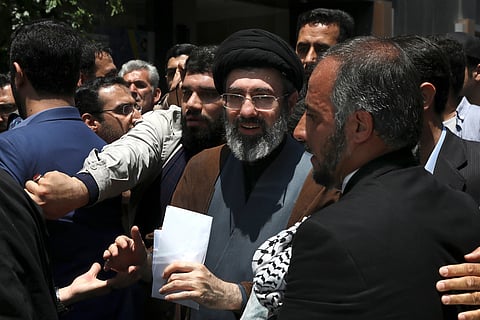
Dubai: Mojtaba Khamenei, the son of Iran’s slain Supreme Leader Ayatollah Ali Khamenei, has emerged as the leading candidate to succeed his father as the country’s next supreme leader, according to Iranian officials familiar with internal deliberations cited by The New York Times.
Senior clerics in Iran’s Assembly of Experts, the body responsible for appointing the supreme leader, held virtual meetings on Tuesday to discuss succession following Ali Khamenei’s death in US-Israeli strikes over the weekend.
According to three officials briefed on the discussions, Mojtaba Khamenei has become the clear front-runner, though no formal decision has yet been publicly announced.
'Target of assassination'
Some clerics have reportedly raised concerns that naming him quickly could make him an immediate target for Israel or the United States as the war intensifies.
Iran, meanwhile, said it was trying to swiftly appoint a new supreme leader. “We are all trying,” said Ahmad Khatami, a member of the Assembly of Experts for Leadership which is responsible for selecting a new leader.
“God willing, the leader will be appointed at the earliest opportunity. We are close, but the situation is a war situation,” he told state TV.
Earlier on Wednesday, Israeli Defence Minister Israel Katz said that any Iranian leader picked to succeed Khamenei “will be a certain target for assassination”.
Khatami said “discretion is necessary” given this threat, adding that the election of a new supreme leader was “imminent”.
Who is Mojtaba Khamenei?
Age: 56
Born: Mashhad, Iran (1969)
Family: Second son of Iran’s late Supreme Leader Ayatollah Ali Khamenei
Education: Studied Islamic theology at the Qom seminary, Iran’s main Shiite clerical centre
War service: Joined the Islamic Revolutionary Guard Corps (IRGC) during the final years of the Iran-Iraq War in the late 1980s
Power behind the scenes: For years worked inside the Office of the Supreme Leader, acting as a key gatekeeper around his father and building influence within the regime
Security ties: Known to have close links with the Revolutionary Guards, one of the most powerful institutions in Iran’s political system
Political influence: Accused by critics of playing a role in election management and the suppression of protests, particularly after the disputed 2009 election
Public profile: Rarely appears in public and has never held a formal government post, but is widely seen as a powerful figure inside Iran’s leadership
Why he matters now: Analysts say his long-standing ties with the IRGC and familiarity with Iran’s security apparatus make him a strong contender to steer the country during the current crisis
Backed by the Revolutionary Guards
Analysts say Mojtaba’s strongest backing comes from the Islamic Revolutionary Guard Corps (IRGC), Iran’s powerful military and security institution.
Officials told The New York Times that the Guards pushed for his selection, arguing that he already has extensive experience coordinating the country’s security and military apparatus during years working inside his father’s inner circle.
Why the Revolutionary Guards back Mojtaba
Security continuity: Mojtaba has long worked closely with IRGC and is familiar with how the country’s security and military apparatus operates.
Crisis leadership: With Iran facing war and internal pressure, the Guards believe a leader who already understands the security chain of command can maintain stability.
Trusted insider: For years Mojtaba has operated inside the Office of the Supreme Leader, coordinating between clerical authorities and security institutions.
Strong personal networks: His relationships with senior IRGC commanders are believed to date back decades, helping build trust within Iran’s most powerful military institution.
Hardline backing: Analysts say his potential elevation would signal that the security establishment and hardline factions are consolidating control during a national crisis.
“Mojtaba is the wisest pick right now because he is intimately familiar with running and coordinating security and military apparatuses,” Tehran-based analyst Mehdi Rahmati said.
For years Mojtaba Khamenei has operated largely behind the scenes in the office of the supreme leader, developing deep relationships with Iran’s security institutions, particularly the Revolutionary Guards.
Experts say those ties are now proving decisive as the Islamic Republic confronts one of the most dangerous crises in its history.
Vali Nasr, an Iran specialist at Johns Hopkins University, said Mojtaba’s rise could signal that the hard-line security establishment is tightening its grip on power.
“If he is elected, it suggests it is a much more hard-line Revolutionary Guard side of the regime that is now in charge,” Nasr said.
How Iran chooses its Supreme Leader
Assembly of Experts: Iran’s Supreme Leader is chosen by the 88-member Assembly of Experts, a clerical body elected in national polls.
Constitutional role: The assembly has the authority to appoint, supervise and dismiss the Supreme Leader under Iran’s constitution.
Rare process: The current succession is only the second time the assembly will select a leader since the Islamic Republic was founded in 1979.
Last selection: In 1989, the assembly chose Ayatollah Ali Khamenei after the death of Iran’s revolutionary founder, Ayatollah Ruhollah Khomeini.
Power of the position: The Supreme Leader is Iran’s highest authority, controlling the armed forces, security services, judiciary and key state institutions.
Other candidates still in contention
Two other clerics are also being discussed as potential successors.
They include Alireza Arafi, a jurist who is part of the interim leadership council formed after Khamenei’s death, and Seyed Hassan Khomeini, the grandson of Islamic Republic founder Ayatollah Ruhollah Khomeini.
Both figures are generally viewed as more moderate compared with Mojtaba.
Analysts say Mojtaba’s appointment could prove controversial, with critics warning it would resemble a dynastic transfer of power in a system founded on revolutionary principles.
A pivotal moment for Iran
The Assembly of Experts, an 88-member clerical body elected in national polls, has chosen only one supreme leader before — Ali Khamenei in 1989.
Its next decision will shape the future of the Islamic Republic as it faces war abroad, internal unrest and mounting international pressure.
If Mojtaba Khamenei ultimately secures the position, it would place a figure long known for wielding influence behind the scenes at the very centre of power during one of the most volatile moments in Iran’s modern history.


