US troops board crude tanker carrying Iranian oil: Pentagon
Boarding of Majestic X oil tanker signals US push to enforce sanctions on Iran at sea
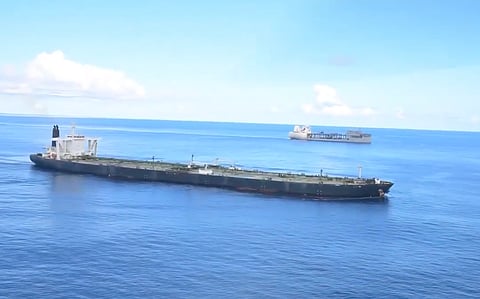
The Pentagon has said its US forces boarded M/T Majestic X crude tanker carrying Iranian oil in the Indian Ocean.
The M/T Majestic X is considered by the US as a "stateless tanker", and was boarded in the Indian Ocean within the area of responsibility of US Indo-Pacific Command.
The vessel was suspected of transporting Iranian oil in violation of sanctions, officials said.
US forces overnight conducted a maritime interdiction and right-of-visit boarding of the sanctioned vessel.
The Trump administration said they will continue maritime enforcement operations worldwide to disrupt illicit networks and interdict ships providing material support to Iran.
“International waters cannot be used as a shield by sanctioned actors,” the statement said, adding that the US Department of Defense will continue efforts to deny sanctioned vessels freedom of maneuver at sea.


New phase
The widening campaign of US ship seizures and maritime interdictions far beyond the Arabian Gulf signals a new phase in Washington’s confrontation with Iran, as US forces move to disrupt what officials describe as Tehran’s oil supply lifelines and sanctions-evasion networks.
On Tuesday, US troops boarded and seized the Iran-linked tanker M/T Tifani in the Indian Ocean as it was suspected of carrying Iranian crude, expanding enforcement operations well outside the Middle East.
The operation is part of a broader directive by the Trump administration to target vessels linked to Iran’s so-called “dark fleet,” a network of tankers accused of masking ownership, disabling tracking systems and using complex routing to evade sanctions while sustaining Iranian oil exports.
M/T Tifani, with capacity of up to 2 million barrels of oil, was intercepted in open waters between Sri Lanka and Indonesia.
Naval blockade
The interdiction follows what officials describe as a larger maritime pressure campaign that includes a naval blockade of Iranian ports backed by US naval and air power.
Since the blockade began on April 13, at least 31 vessels have been ordered to turn around or return to port.
Trump has framed the campaign as a way to force Iran back to negotiations, calling the blockade a “tremendous success” and saying the United States now “totally controls” the Strait of Hormuz, the narrow chokepoint through which a significant share of the world’s oil supply passes.
The operations mark a shift from regionally-focused enforcement in the Gulf to a broader, transoceanic effort to track and interdict vessels suspected of moving Iranian oil through distant shipping lanes.


