Video: US Marines board Iran-linked crude oil tanker 'M/T Tifani'
Tanker loaded at Kharg Island intercepted as US steps up sanctions enforcement
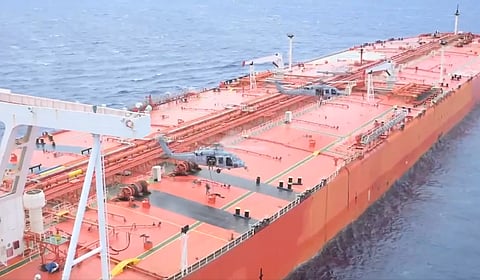
US forces have boarded the crude oil tanker M/T Tifani in the Indian Ocean, marking what appears to be a new escalation in efforts to disrupt Iran-linked shipping, according to media reports.
The move came as the 330-metre very large crude carrier (VLCC), built in 2003, was sailing in Southeast Asian waters while still appearing fully laden with crude.
Tanker tracking data showed the vessel passed Dondra Head on April 19 and entered Southeast Asia on April 20 before being boarded by US Marines, suggesting the operation took place far from the Arabian Gulf, as per Marine Traffic.
The tanker was still underway at around 6 knots and had a reported draught of 20 meters, which usually indicates it remained heavily loaded. That detail matters because it suggests the cargo had not yet been discharged when the boarding occurred.
Pentagon confirms boarding
The Pentagon confirmed that US forces carried out a right-of-visit maritime interdiction and boarded the sanctioned crude oil tanker M/T Tifani in the INDOPACOM area without incident, a move that signals Washington is broadening its enforcement campaign against vessels tied to Iran.
According to the statement, the US action was aimed at disrupting illicit maritime networks and denying sanctioned vessels “freedom of manoeuvre” in international waters.
The Pentagon said international waters are not a safe haven for ships providing material support to Iran.
What happened
The M/T Tifani is described as a "stateless sanctioned tanker" that had previously been linked to Iranian crude transfers.
Ship-tracking data showed her moving through the Indian Ocean in the days before the boarding.
US officials did not immediately release details of any detention outcome beyond saying the operation was conducted without incident.
Why it matters
This is notable because it extends US maritime pressure on Iran-linked shipping beyond the Middle East and into the Indo-Pacific, suggesting a more global enforcement posture.
That matters for oil markets because tankers tied to sanctioned crude trade often rely on long, opaque routes and shifting ownership structures.
A single interdiction can raise insurance costs, complicate chartering and increase caution among ship operators.
The boarding comes amid heightened scrutiny of Iran’s oil network and broader regional tensions, with the US signaling that vessels suspected of supporting sanctioned trade may face enforcement far from the Gulf.
On Sunday (April 19), US naval forces enforcing a blockade near Hormuz intercepted and disabled the Iranian-flagged cargo ship Touska after its crew ignored repeated warnings to change course. The guided-missile destroyer USS Spruance (DDG 111) stopped Touska as it travelled through the northern Arabian Sea en route to Bandar Abbas, a key Iranian port.


