Kharg back on Trump’s mind: What seizing Iran’s oil lifeline could trigger
Trump revives ‘take the oil’ idea, raising risks of escalation and market shock
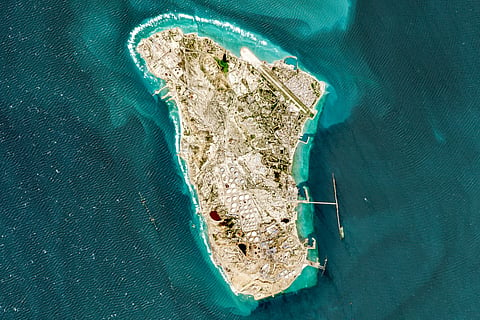
Dubai: Donald Trump has revived an idea he first floated decades ago — as early as 1988 — telling the Financial Times on March 29 that he is still considering whether to seize Kharg Island, Iran’s key oil export hub.
At the centre of that strategy is Kharg Island, a small but vital outpost in the Arabian Gulf that underpins Iran’s oil exports.
The reference to 1988 dates back to the final phase of the Iran-Iraq War, when the Gulf was engulfed in what became known as the “Tanker War” — a period marked by attacks on oil tankers and energy infrastructure that raised fears of a global supply shock.
At the time, the United States had deployed forces to protect shipping lanes, bearing the military cost of securing the region.
It was in that context that a younger Donald Trump argued that if Washington was safeguarding Gulf oil flows, it should also “take the oil” — a transactional view that the US should benefit economically from its military role.
Even then, Kharg Island stood at the centre of that logic. As Iran’s main oil export terminal and a prime target during the tanker war, it was the most obvious focal point of such thinking.
At the time, the United States had deployed forces to protect shipping lanes, bearing the military cost of securing the region. It was in that context that a younger Donald Trump — then a New York businessman — argued in paid newspaper advertisements that if Washington was safeguarding Gulf oil flows, it should also “take the oil” — a transactional view that the US should benefit economically from its military role.
Why Kharg Island matters
For decades, Kharg Island has handled the overwhelming bulk of Iran’s crude exports, serving as the primary loading terminal for tankers supplying global markets.
In effect, it is not just an energy facility — it is Iran’s financial lifeline.
Oil revenues remain central to the country’s economy, funding state functions, military operations and regional influence networks. Disrupting Kharg would therefore strike at the core of Iran’s ability to sustain both governance and conflict.
From military strikes to economic warfare
Unlike conventional strikes on bases or weapons systems, targeting Kharg would represent a shift towards economic warfare.
The logic is straightforward: if battlefield pressure does not force a breakthrough, hitting revenue streams might.
Kharg Island: Why it matters — and what could happen
Iran’s oil lifeline: Handles 90% of Iran's crude exports
Revenue core: Funds economy, state and military operations
Strategic choke point: Disabling it hits both economic and war capacity
Limited alternatives: Other routes exist but lack scale
Operational challenge: Seizing it would require sustained military action
Legal risk: Could be seen as an act of war under international law
Market impact: Oil prices likely to spike on supply disruption
Escalation trigger: Iran likely to retaliate across the region
Hormuz threat: Risk of disruption to a key global oil route
High-stakes move: Could force talks — or widen the war
Analysts say such a move would aim to rapidly reduce Iran’s export capacity, placing immediate strain on its economy and increasing pressure on its leadership.
At the same time, some see the remarks as strategic signalling — an attempt to raise stakes and push negotiations, rather than an indication of imminent action.
Can the US actually seize Kharg Island?
Despite its appeal as a target, seizing Kharg Island would be far from simple.
Any attempt to take control would likely require a sustained military operation — not just airstrikes — exposing US forces to prolonged engagement and counterattacks.
Holding the island would present an even greater challenge, with Iran capable of targeting it with missiles, drones and naval assets.
Legal and diplomatic risks
Such a move would also carry significant legal and diplomatic consequences.
Targeting or seizing a country’s primary economic infrastructure could be viewed as an act of war, raising questions under international law and potentially complicating support from allies.
Historically, these risks — along with fears of escalation — have deterred direct attacks on Iran’s oil export system.
Could Iran bypass Kharg?
While Iran has explored alternative export routes and terminals, none match the scale, efficiency or capacity of Kharg Island.
That makes it a critical vulnerability — but not an absolute single point of failure.
Limited exports could continue, but at significantly reduced levels, amplifying the economic impact.
Risk of escalation across the Gulf
The consequences would likely extend far beyond Iran.
Tehran has repeatedly warned that attacks on its economic infrastructure would trigger retaliation. This could include strikes on energy installations, shipping routes and military assets across the region.
That places renewed focus on the Strait of Hormuz — one of the world’s most critical energy corridors.
Any disruption there would have immediate global implications, affecting oil flows, prices and supply chains.
For Gulf countries, including key energy producers, the risks would be direct — raising security concerns around infrastructure and shipping lanes.
A high-stakes gamble
Ultimately, targeting Kharg Island reflects a high-risk calculation.
It could deliver a sharp economic blow and increase pressure on Iran’s leadership.
But it also risks widening the conflict, destabilising global energy markets and drawing the region into a deeper confrontation.
What is framed as leverage could quickly become a trigger — with consequences far beyond the battlefield.


