Hormuz reopening 'impossible' due to ceasefire violations: Iran's Ghalibaf
Ghalibaf says US blockade, Israeli actions make Hormuz reopening ‘not possible’
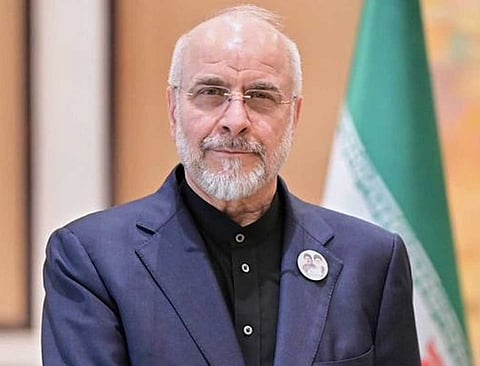
Iran’s parliamentary speaker Mohammad Bagher Ghalibaf said reopening the Strait of Hormuz — a critical global oil and gas shipping route — is “impossible” amid what Tehran calls “flagrant violations” of the current ceasefire by the United States and Israel.
Get updated faster and for FREE: Download the Gulf News app now - simply click here.
Ghalibaf, 64, posted on social media that a “complete ceasefire only has meaning if it is not violated through a naval blockade and the hostage-taking of the world economy,” asserting that the US naval blockade of Iranian ports and Israeli “warmongering” undermine truce commitments.
Iran is demanding the lifting of the US naval blockade of Iranian ports, which kicked in on April 13, but is seen by Tehran as a "flagrant violation" of the ceasefire agreement, and the reason cited for its boycott of the 2nd round of talks in Islamabad.
The post is the clearest signal yet from Ghalibaf, who has a reputation as a disciplined operator with technocratic leanings inside Iran's hardline system.
Ghalibaf joined the Islamic Revolutionary Guard Corps (IRGC) in 1980 (at age 19), is a trained pilot who also holds a PhD in Political Geography.
On Wednesday, the US military said 31 vessels had "turned back" as part Iran port blockade, mostly oil tankers.
The massive blockade operation, overseen by the Central Command, involves 10,000 troops.
Despite a conditional ceasefire, tensions spiked in Hormuz Strait. Washington demands Iran's enriched uranium, while Tehran condemns the blockade as an "act of war".
The IRGC naval forces reportedly seized two commercial ships (the Panama-flagged MSC Francesca and Liberia-flagged Epaminondas) in the Strait of Hormuz on Wednesday, April 22, 2026, citing "repeated violations".
Ghalibaf's remarks come amid ongoing diplomatic efforts — including a ceasefire extension and proposed talks in Pakistan — to end hostilities between Iran and the US.
Trump said the Islamabad talks could restart as early as Friday.
Iran insists that without full compliance by all parties, including lifting maritime restrictions, the strategic waterway will stay closed to international shipping
Who is Mohammad Bagher Ghalibaf?
Mohammad Bagher Ghalibaf, born in 1961, is one of the most influential figures in Iran’s political and security establishment, blending a career shaped by the military, law enforcement and urban governance into his current role as speaker of parliament.
Ghalibaf joined the Islamic Revolutionary Guard Corps (IRGC) in 1980 at the outset of the Iran-Iraq War.
He rose through the ranks as a field commander and later led the IRGC’s air force from 1997 to 2000.
A trained pilot who also holds a PhD in political geography, Ghalibaf served as Iran’s national police chief before becoming mayor of Tehran from 2005 to 2017.
He oversaw major infrastructure and urban management projects in the capital.
Administration
His tenure strengthened his standing as a capable administrator of translating security credentials into governance.
Elected speaker of the Majlis in 2020, Ghalibaf is widely seen as a key decision-maker who bridges conservative political factions and the military elite.
He has run for president multiple times and is often associated with the legacy of slain IRGC commander Qasem Soleimani.
Ghalibaf’s influence lies in his ability to navigate Iran’s power centres — parliament, the security apparatus and conservative politics — while maintaining a firm, pragmatic stance in national decision-making.


