US-Israel War on Iran Day 26: Tehran rejects US peace plan; UAE reports first day without missile attack
Follow along for live updates from around the world
Highlights
We are closing coverage for now. Follow our live updates for the latest developments here.
Trump says Iran 'afraid' to admit it wants a deal
US President Donald Trump insisted that Iran was taking part in peace talks, suggesting Tehran's denials were because Iranian negotiators fear being killed by their own side. "They are negotiating, by the way, and they want to make a deal so badly. But they're afraid to say it, because they figure they'll be killed by their own people," Trump told a dinner for Republican members of Congress.
White House claims 'breakthrough' as Iran flatly denies negotiations
A widening credibility gap is emerging at the heart of the 2026 Iran war: as Washington and Tehran issue starkly contradictory narratives — raising fears that diplomacy is collapsing even as both sides publicly claim otherwise.
The White House insists that negotiations with Iran remain “productive,” downplaying reports that Iran regime authorties have rejected a sweeping US peace proposal aimed at ending the war. Officials say backchannel discussions — possibly via intermediaries such as Pakistan and Turkey — are still alive and could soon evolve into formal talks.
Iran's Abbas Araghchi has bluntly denied that any negotiations are taking place, stressing that reviewing proposals through mediators “does not mean talks.” An Iranian military spokesperson reportedly accused the US of “negotiating with itself,” while senior figures warn that past "betrayals" have destroyed any remaining trust.
UAE air defences respond to Iran missile, drone threats
UAE air defences are currently responding to incoming missile and drone threats from Iran. The UAE Ministry of Defence confirmed that the sounds heard are the result of the Air Defence Systems intercepting missiles and drones.
Warthogs, Apaches unleashed vs IRGC fast-attack boats, war enters 'new phase' in Hormuz
The US military has reportedly escalated operations in the Strait of Hormuz. According to General Dan “Razin” Caine, A-10 "Warthogs" are now actively targeting Iranian fast-attack boats, including remote-controlled vessels laden with bombs that threaten oil tankers. AH-64 Apache gunships are also engaging drones and Iranian militia-linked threats. This marks a significant shift in Pentagon's strategy involving the use of military hardware for close-range battlefield control see combat action.
'A ceasefire is not enough'
"A ceasefire is not enough. We need a decisive outcome that fully addresses the entire range of Iran’s threats: its nuclear capabilities, missiles, drones, terrorist proxies, and its siege on international maritime routes. The UAE stands strong and clear in the face of the Iranian threat," stated Yousef Al Otaiba, UAE Ambassador to Washington, in an article (The UAE stands up to Iran) he wrote for The Wall Street Journal.
Malaysia supports Pakistan's offer to host Iran-US dialogue
Malaysian Prime Minister Anwar Ibrahim stated he welcomes Pakistan’s timely and constructive offer to host dialogue between the US and Iran. "I commend Prime Minister Shehbaz Sharif and the leaders of other friendly nations for stepping forward at a moment of acute regional danger, following the earlier commendable efforts of the leadership of Oman and other friendly countries. Pakistan’s relationships with the relevant parties, and its standing as a credible voice in the Muslim world, place it in a strong position to help create the conditions for meaningful negotiations. Malaysia supports this initiative and encourages in particular the United States and Iran to respond in the spirit in which it was offered. I note with cautious hope the signals, however incomplete, that suggest some space for diplomacy may still exist."
US strikes on Iran military infrastructure, capabilities continue
US forces continue striking targets to degrade the Iranian regime's military infrastructure and capabilities that have threatened American troops and regional partners for decades, as per the US Central Command.
Kuwait dismantles terror cell seeking to assassinate State leaders
The Kuwaiti Ministry of Interior announced late on Wednesday that the Kuwait State Security Service has successfully thwarted a terrorist plot and dismantled a network that planned to carry out assassinations of State symbols and leaders and undermine the country's supreme interests.
The Ministry’s Spokesperson, Brigadier Nasser Abusulaib, said in a televised statement that following intensive surveillance and security investigations, the authorities dismantled a network consisting of five citizens and one non-Kuwaiti individual whose citizenship had been revoked.
GCC Secretary-General welcomes UN resolution condemning Iranian aggression
Jasem Mohamed Albudaiwi, Secretary General of the Gulf Cooperation Council (GCC), welcomed the unanimous adoption by the Human Rights Council (UNHRC) of the resolution titled "Effects of the Recent Military Aggression Launched by Iran."
The resolution was submitted by the Kingdom of Bahrain on behalf of the GCC states and the Hashemite Kingdom of Jordan, receiving exceptional and broad support from more than 100 countries across various regional groups.
6 Arab states renew condemnation of direct, proxy Iranian attacks
The State of Qatar, the State of Kuwait, the United Arab Emirates, the Kingdom of Bahrain, the Kingdom of Saudi Arabia, and Jordan renewed their condemnation in the strongest terms of the blatant Iranian attacks, "which constitute a flagrant violation of their sovereignty, territorial integrity, international law, international humanitarian law, and the Charter of the United Nations, whether carried out directly or through their proxies and armed factions they support in the region."
The group stated: "We stress, in particular, the attacks carried out by armed factions loyal to Iran from the Republic of Iraq against a number of countries in the region, as well as their facilities and infrastructure. These acts are a breach of international laws and conventions and a blatant violation of United Nations Security Council Resolution No. 2817 (2026), which explicitly demands that Iran immediately and unconditionally cease any attacks or threats against neighboring states, including through the use of proxies."
Asia, Australia, Africa, S. America reel from fuel crisis
Asian countries are feeling the growing impact of the Middle East war thousands of miles away. South Korea has been grappling with fuel supplies, implementing a nationwide energy saving campaign while Thailand has also asked employees to ditch suits in offices and lower air conditioning.
As the knock-on effects of the fuel crunch unravels, dozens of petrol stations in Australia had reportedly ran out of supplies. The Philippines has become the first country to declare national emergency over Middle East war. Amid the tanker squeeze in the Hormuz Strait, certain fuel retailers in markets ranging from South Africa to Chile are already rationing fuel or running dry, Reuters reported.
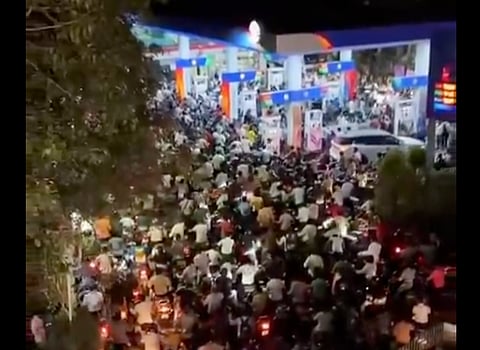
In India, meanwhile, serpentine queues had been seen at fuel pumps, with police reportedly being deployed at Gujarat petrol stations amid panic over potential fuel shortages, as Iran’s blockade of Hormuz disrupts a route that carries over 40% of India’s crude imports.
Iran FM says 'we do not intend to negotiate'
Iranian Foreign Minister Abbas Araghchi said on Wednesday that Iran did not plan to negotiate with the United States and that Tehran intended to keep fighting, after US President Donald Trump said Washington had proposed a peace plan.
"At present, our policy is the continuation of resistance", Araghchi said on state TV, adding: "We do not intend to negotiate - so far, no negotiations have taken place, and I believe our position is completely principled."
"Speaking of negotiations now is an admission of defeat," he said
Pentagon orders more missiles for Mideast war
The US Defence Department announced Wednesday agreements with defence contractors to put missile production "on a wartime footing" as the Mideast war leads to rapid use of munition stocks.
The extensive use of interceptor missiles by the United States, Israel and the Gulf states to counter Iranian retaliatory attacks has raised concerns about stockpile sizes.
In the first deal, Lockheed Martin and BAE Systems agreed to a fourfold increase in production of "seeker heads," a key component for the THAAD anti-missile system that has seen significant use in the Middle East.
The goal is to put the "industrial base on a wartime footing," the Pentagon said in a statement.
US says talks 'continue' despite Iran's reported rejection
The United States and Iran are still engaged in peace talks, the White House said Wednesday, despite Iranian state media saying Tehran had rejected Washington's plan to end the war.
"Talks continue. They are productive," Press Secretary Karoline Leavitt said.
Trump to 'unleash hell' if Iran doesn't makes deal: White House
US President Donald Trump is ready to "unleash hell" on Iran if Tehran does not accept a deal to end the war in the Middle East, the White House warned on Wednesday.
"If Iran fails to accept the reality of the current moment, if they fail to understand that they have been defeated militarily and will continue to be, President Trump will ensure they are hit harder than they have ever been hit before," Press Secretary Karoline Leavitt told a briefing.
"President Trump does not bluff and he is prepared to unleash hell. Iran should not miscalculate again."
UN Human Rights Council condemns Iran's attacks on Gulf states
The United Nations Human Rights Council today strongly condemned the Iranian attacks targeting countries in the region, calling on Iran to provide full and immediate compensation to all those affected by these attacks.
The council adopted the condemnation resolution submitted by the Gulf and Arab groups during an emergency session held today in Geneva at the request of Gulf countries and Jordan on the human rights implications of the unjustified attacks launched by Iran on several countries in the region.
The resolution affirmed that these attacks targeting the United Arab Emirates, Kuwait, Bahrain, the Sultanate of Oman, Qatar, the Kingdom of Saudi Arabia and Jordan constitute a violation of international law and a serious threat to international peace and security, as well as a breach of the sovereignty and territorial integrity of these states.
The resolution affirmed the inherent right to self-defence, individually or collectively, in response to the unlawful armed attacks launched by Iran, in accordance with Article 51 of the United Nations Charter.
Dubai: Focus on facts
Sidestep the rumours, focus on the facts, says Dubai Media Office. Dubai is operating as normal. Don’t be misled by fake news. Stay informed and verify before you share.
Russia 'deeply outraged' by reported strike on Iran nuclear plant site
Russia said Wednesday it was "deeply outraged" by a reported strike on the grounds of Iran's Bushehr nuclear power plant, which it partially constructed and helps operate.
"We are extremely outraged by this reckless, irresponsible manifestation of a disastrous course," the Russian foreign ministry said in a statement on its website.
A projectile landed within the plant's compound on Tuesday night, Iran's atomic energy organisation said, accusing the United States and Israel of being responsible.
Netanyahu says Israel is expanding 'buffer zone' in Lebanon
Israeli Prime Minister Benjamin Netanyahu said on Wednesday that his country's forces were expanding a "buffer zone" in southern Lebanon as the military pressed ahead with its campaign against Hezbollah.
"We have created a genuine security zone preventing any infiltration toward the Galilee and the northern border," Netanyahu said in a video statement.
"We are expanding this zone to push the threat from anti-tank missiles further away and to establish a broader buffer zone."
Jordan destroys five missiles, one drone over past 24 hours
The Jordanian Armed Forces announced that the Kingdom was targeted by five missiles and a drone from Iran during the past 24 hours.
The Military Media Directorate at the General Command of the Armed Forces said in a statement carried by the Jordan News Agency (Petra News) that the Royal Air Force intercepted five of the missiles and drones during the past 24 hours, while air defences were unable to intercept one missile.
Kuwaiti Defence detects 20 ballistic missiles, 9 drones in 24 hours
Kuwait's Ministry of Defence announced today that air defence systems detected 20 ballistic missiles and nine hostile drones within the country's airspace during the past 24 hours.
Colonel Saud Al-Atwan, Spokesperson of the Ministry of Defence, said in a media briefing carried by Kuwait News Agency that 13 missiles were intercepted and destroyed, while seven fell outside the threat zone without posing any danger.
He added that six hostile drones were destroyed, while two targeted a fuel tank at Kuwait International Airport, causing a fire that is being handled by specialised teams without any human injuries reported. One drone also fell outside the threat zone.
He noted that the National Guard's Task Force managed to destroy one drone and five unmanned aerial vehicles within areas of responsibility as part of coordination and integration among military entities.
Meanwhile, Kuwait's Ministry of Interior stated that explosive ordnance disposal teams handled 43 reports related to falling debris resulting from defensive interception operations during the past 24 hours, bringing the total number of reports handled since the start of the aggression to 550.
Kuwait fights airport blaze
Teams of firefighters continue to attend to a blaze triggered by a drone attack on a fuel tank at Kuwait International Airport, the national fire force said on Wednesday, citing it as a collective effort with other state bodies Firefighters, assisted by teams from the Kuwaiti military and National Guard, are dealing with four fires that erupted at different locations across the airport as a result of falling debris from air defence interceptions, Kuwait Fire Force spokesman Brigadier Mohammad Al-Ghareeb told a media briefing.
He went on to say that firefighters have responded to 82 calls related to the ongoing Iranian aggression against Kuwait, including reports of falling debris and "direct" drone attacks, added the spokesman.
UN chief says Lebanon must not become next Gaza amid fighting
UN Secretary-General Antonio Guterres warned on Wednesday that fighting between Israel and Hezbollah must not condemn Lebanon to the same fate as Gaza, the Palestinian territory devastated by years of conflict.
"The Gaza model must not be replicated in Lebanon," Guterres told reporters, urging Hezbollah to stop launching attacks at Israel and an end to Israeli military operations in Lebanon, which he said are hitting civilians the hardest.
The Gaza model must not be replicated in Lebanon"UN Secretary-General Antonio Guterres
Qatar Cabinet renews condemnation of Iranian attacks
The Qatari Cabinet renewed its condemnation and denunciation of the Iranian attacks on the State of Qatar, the Gulf countries and Jordan, calling for their immediate cessation in compliance with international law, respect for the United Nations Charter and the principles of good neighbourliness.
Qatar News Agency (QNA) reported that the Cabinet affirmed during its meeting today that the State of Qatar continues its intensive efforts, in coordination with regional and international partners, to support diplomatic solutions to end the escalation in a manner that ensures respect for state sovereignty, safeguards regional security and stability, and spares peoples further risks and repercussions.
Iran state TV says Tehran rejects US peace plan
Iranian state television, citing an unidentified senior official, said Wednesday that Iran had rejected a peace plan proposed by the United States to end the Middle East war.
"Iran has responded negatively to an American proposal aimed at ending the ongoing imposed war," the official said, according to the English language broadcaster Press TV.
"The end of the war will occur when Iran decides it should end, not when Trump envisions its conclusion."
ICC warns of 'worst industrial crisis in living memory'
The war in the Middle East could cause the "worst industrial crisis in living memory", the head of the International Chamber of Commerce warned Wednesday.
"The head of the International Energy Agency has warned that the world is facing an energy crisis more severe than the oil shocks of the 1970s," said John Denton.
"From a business perspective, we believe this could yet become the worst industrial crisis in living memory," he added, speaking on the eve of the meeting of World Trade Organisation ministers in Yaounde.
Kuwait calls for firm international stance against ongoing Iranian aggression
Kuwait strongly warned today against the continued blatant Iranian aggression, stressing that international silence is no longer acceptable in the face of this approach, which violates all international laws and conventions and threatens a comprehensive escalation in the region.
Ambassador Nasser Al-Hayen, Permanent Representative of Kuwait to the United Nations and other international organisations in Geneva, called on the international community to take a decisive stance to end this aggression, which disregards all norms and laws, in order to safeguard regional and societal peace from the risks of dangerous escalation. He made the remarks during an emergency session of the Human Rights Council held at the request of the Gulf Group and Jordan.
He said that Iranian violations have reached a grave level that makes silence untenable, as the regional situation has become catastrophic due to persistent breaches of all relevant international conventions and laws related to human rights.
He affirmed that the ongoing aggressive conduct in the region undermines all efforts and initiatives undertaken by Kuwait and regional countries over many years to promote good neighbourliness and build confidence, and represents an existential threat to regional and international peace and security.
Stay updated: Get the latest faster by downloading the Gulf News app - it's completely free. Click here for Apple or here for Android. You can also find it us on the Huawei AppGallery
Saudi defences destroy two drones in Eastern Region, Riyadh
Saudi Arabia's Ministry of Defence announced today the interception and destruction of two drones, one in the Eastern Region and the other in Riyadh.
The announcement was made in a statement carried by the Saudi Press Agency (SPA).
The Saudi Civil Defence had earlier announced that it dealt with debris resulting from the interception of a ballistic missile that fell onto the roofs of two houses, one of which was under construction and uninhabited, in a residential area in the Eastern Province.
The Civil Defence spokesperson said the incident resulted in limited material damage, with no injuries reported.
Bahrain intercepts, destroys 153 missiles, 331 drones since start of Iranian attacks
The General Command of the Bahrain Defence Force announced that air defences have intercepted and destroyed 153 ballistic missiles and 331 drones targeting Bahrain since the onset of hostile terrorist Iranian aggression.
Saudi Arabia extends visit visas amid regional disruption
Saudi Arabia’s Ministry of Interior has begun addressing the status of holders of expired visit visas, Umrah visas, transit visas and final exit permits, following disruptions that prevented their departure amid current regional conditions.
The ministry said the measures apply to visas that expired from February 26, 2026, allowing affected individuals to regularise their status under two options.
Under the first option, expired visas can be extended upon request by the host until April 18, 2026, after payment of the applicable fees through the Absher platform.
Alternatively, visa holders will be permitted to depart directly through international ports without the need to extend their visas or pay any fees or overstay fines.
The ministry said the move aims to facilitate procedures for visitors and residents affected by the situation, while ensuring compliance with regulations and maintaining smooth travel operations across the Kingdom’s borders.
US Embassy Jerusalem issues a statement
US Embassy Jerusalem has issued a statement for Americans in Israel, Gaza and the West Bank. It says: “The security situation in Israel continues to make travel out of the country difficult. The fastest option to depart Israel at this time is to take one of the available overland routes, including to Egypt or Jordan. Commercial air opportunities are readily available from airports in Jordan and Egypt. US Embassy Jerusalem is offering bus service to the Amman, Jordan International Airport via the Jordan River Sheikh Hussein crossing for U.S. citizens. If you are interested in assisted departure via bus to Amman, please fill out the online form. If you previously completed a similar form asking for assisted departure via bus to Taba and are now interested in assisted departure via bus to Amman, please complete the form again. If you have already expressed interest in a bus to Amman please do not complete it again.
“Travelers using this route are responsible for booking and paying for their onward travel from Amman airport, and are encouraged to do so before boarding the bus. Most direct flights from Amman to the United States depart early in the day, before the bus will arrive at the airport, so you may need to stay in Amman overnight. We can provide hotel accommodation as part of the bus registration process if a flight connection requires an overnight stay in Amman.”
US 15-point plan 'conveyed to Iran via Pakistan': officials
Proposals from the United States to end the war in Iran have been sent to Tehran through Pakistani intermediaries, two senior officials in Islamabad told AFP on Wednesday.
Both confirmed that the 15-point plan to stop the fighting, which has spread across the Gulf and Middle East, had been "conveyed to Iran via Pakistan".
Pakistan is being touted as a possible mediator given its longstanding ties with both neighbouring Iran and the United States, as well as close contacts in the region.
Gargash calls for decisive support as regional responses fall short
Dr Anwar Mohammed Gargash, Diplomatic Adviser to the UAE President, has called for clearer and more decisive positions from sisterly and friendly countries amid the ongoing escalation, saying recent developments have exposed a gap between genuine support and statements without action.
In a post on his X account, Gargash said: “Since the start of the Iranian aggression, friendly and allied countries had reached out, but their responses varied between sincere, tangible support and positions limited to rhetoric.”
He stressed that the UAE has demonstrated its ability to navigate challenges and remain resilient, adding that the country does not rely on numbers or resources as much as it values clarity of positions and knowing who can be relied upon in times of crisis.
UN rights council demands 'reparation' for Iran strikes on Gulf
The UN Human Rights Council on Wednesday condemned Iran's "egregious attacks" on its Gulf neighbours, calling for full and swift "reparation" to all victims of its strikes.
The 47-member council backed a resolution brought by the six Gulf Cooperation Council countries and Jordan condemning Tehran's actions aimed at closing the Strait of Hormuz, and demanding Iran immediately "cease all unprovoked attacks".
IndiGo: Check flight status before heading to airport
IndiGo calls on its passengers to check on their flight status before beginning their transit to the airport. On social media, it said: "Due to the rapidly evolving situation in the Middle East, there may be changes in the flight schedule....Flights listed below are scheduled to operate on 26 March 2026. We are actively working to ensure minimal disruption to your travel plans. Regular updates are being shared on your registered contact details so you stay informed at every step."
It added: "Our support teams are also available to assist you with any queries or concerns."
Abu Dhabi food checks
A delegation from Abu Dhabi Department of Economic Development visited LuLu Hypermarket and Carrefour in Al Ain as part of ongoing efforts to monitor market operations and stability, strengthen collaboration with retail outlets, and ensure the smooth flow of supply chains across the emirate.
UAE: Egregious, terrorist Iranian attacks targeted critical civilian infrastructure
The UAE stressed that egregious and terrorist Iranian attacks, which have persisted for 26 days, with more than 2,000 ballistic missiles, cruise missiles and drones targeting critical civilian infrastructure including airports, residential areas, and civilian sites across the UAE, in what it described as a "blatant violation of the state's sovereignty and international humanitarian law".
Iran's egregious attacks have not targeted countries with which it is at war, but rather its neighbours-countries that have repeatedly called for and, over the past months, made intensive efforts to avoid this escalation"Jamal Al Musharakh
In remarks to the Human Rights Council on Wednesday, Jamal Al Musharakh, UAE Permanent Representative to the United Nations Office and Other International Organisations in Geneva, said, "What we are witnessing today is not merely a military escalation, but a systematic, reckless behaviour that undermines the foundations of the international order and threatens regional and international security and stability, particularly as it targets infrastructure directly linked to the safety of civilians, energy security, the global economy, and international supply chains."
He added, "Let us also recall that Iran's egregious attacks have not targeted countries with which it is at war, but rather its neighbours-countries that have repeatedly called for and, over the past months, made intensive efforts to avoid this escalation, based on their firm conviction that military solutions generate crises and serious consequences for the region."
Oil prices tumble, stocks rally on Mideast peace hopes
Oil prices tumbled and stock markets rallied Wednesday on reports that the United States had sent a peace plan to Iran.
After nearly four weeks of conflict, investors jumped on signs that hostilities could be winding down, with the safe-haven dollar losing support.
However, analysts pointed out that the arrival of more US troops in the Middle East and fresh missile strikes exchanged between Iran and Israel suggested chances of escalation remained.
"Oil prices have moved lower... offering some relief to equities that had been weighed down by worries over inflation," noted Matt Britzman, senior equity analyst at Hargreaves Lansdown.
"It's still a highly fluid situation. Trying to call how the rest of the week plays out would be unwise."
Stay updated: Get the latest faster by downloading the Gulf News app - it's completely free. Click here for Apple or here for Android. You can also find it us on the Huawei AppGallery
IEA chief says 'ready' to release more oil reserves if needed
The head of the International Energy Agency (IEA) said Wednesday that he was "ready" to approve the release of more oil reserves if needed to cushion the impact of the Middle East war on global supplies.
Fatih Birol made the comments on a visit to Tokyo, where Japanese Prime Minister Sanae Takaichi asked the IEA to carry out an additional release "in case the situation drags on".
Since last month, US-Israeli attacks on Iran and Tehran's subsequent responses, including its de facto closure of the Strait of Hormuz, have severely disrupted global oil supplies, causing concern over rising prices in Japan and other import-dependent Asian economies.
The IEA previously said member countries would unlock 400 million barrels of oil from their reserves to ease the impact of the Middle East war, the biggest such release ever.
Birol said on Wednesday that the amount was only 20 per cent of the agency's stocks and there was "still a significant amount of oil" left over.
UAE issues safety alert
Soon after the UAE's National Center for Emergency and Crisis and Disaster Management sent out an alert calling on residents to head to a safe place while it carried out defence ops, another notification went out assuring them that things had been taken care of and the situation is safe and stable.
UAE issues alert
The UAE's National Center for Emergency and Crisis and Disaster Management has just issued an alert via phone, calling on people to seek a safe place and stay there. Steer away from windows, doors and open areas, it added, while it deals with potential missile threats. The alert went out in various areas of Sharjah and Dubai.
UAE air defences engaged 9 drones on March 25
The UAE air defence systems on March 25 engaged 9 UAVs launched from Iran.
Since the onset of the blatant Iranian aggression, UAE air defences have engaged 357 ballistic missiles, 15 cruise missiles and 1,815 UAVs.
These attacks have resulted in the martyrdom of 3 members of the armed forces while performing their national duty, as well as 6 fatalities of Pakistani, Nepali, Bangladeshi and Palestinian nationalities.
Iran speaker warns US not to test 'resolve to defend our land'
Iran's powerful parliament speaker on Wednesday warned Washington not to test the Islamic republic's determination to defend its territory after the United States was reported to be sending more troops to the Middle East.
"We are closely monitoring all US movements in the region, especially troop deployments. What the generals have broke, the soldiers can't fix; instead, they will fall victim to (Israeli Prime Minister Benjamin) Netanyahu's delusions," said Mohammad Bagher Ghalibaf in an X post in English.
"Do not test our resolve to defend our land."
Stay updated: Get the latest faster by downloading the Gulf News app now - it's completely free. Click here for Apple or here for Android. You can also find it on the Huawei AppGallery.
How the UAE's alert system actually works
For many people in the UAE, the past few weeks have been marked by a now-familiar sound - emergency alerts sent directly to mobile phones.
These alerts are issued when the UAE’s Ministry of Defence confirms that its air defence systems are responding to incoming missiles and unmanned aerial vehicles (UAVs) launched from Iran. At the same time, the National Emergency Crisis and Disaster Management Authority (NCEMA) and the Ministry of Interior (MOI) send notifications instructing residents and visitors to shelter in place. Once the threat has passed and interceptions are complete, a follow-up message confirms that the situation is safe.
Here is how these alerts work and why they do not reach everyone equally.
Why Philippines declared a national energy emergency
The Philippines has declared a state of national energy emergency, highlighting growing risks to global oil supply as the conflict between US, Israel, and Iran have heightened geopolitical tensions in the Middle East.
Philippine president Ferdinand Marcos Jr. has signed Executive Order (EO) 110 to prepare the country for potential disruptions in fuel production and transportation. As a net importer of petroleum products, the Philippines is highly exposed to global market shocks, particularly those affecting major shipping routes such as the Strait of Hormuz.
“The foregoing circumstances pose an imminent danger of a critically low energy supply and that urgent measures are necessary to ensure the stability and adequacy of the country’s energy supply,” read the EO.
Iran denies talks with US despite Trump claims
Iran's ambassador to Pakistan on Wednesday said there had been no talks between Washington or Tehran, after US President Donald Trump signalled tentative progress in diplomatic efforts to end the war.
"We have also heard such details through the media, but according to my information - and contrary to Trump's claims - so far no negotiations, direct or indirect, have taken place between the two countries," said ambassador Reza Amiri Moghadam, adding that it was "natural that friendly countries are always engaged in consultations with both sides to end this illegitimate aggression".
Cosco says resumes bookings to some Gulf countries
China's shipping giant Cosco said on Wednesday that it was resuming new bookings for shipments to some Gulf countries, three weeks after it halted most bookings to the region in response to the Middle East war.
The state-owned firm "resumed new bookings for general cargo containers for shipments" to the UAE, Saudi Arabia, Bahrain, Qatar, Kuwait, and Iraq "with immediate effect", according to a company statement.
"New booking arrangements and the actual carriage are subject to change due to the volatile situation in the Middle East region", it added.
US preparing to deploy 1,000 troops to Middle East
The US military is preparing to deploy at least 1,000 troops from the 82nd Airborne Division to the Middle East in the coming days, according to three people familiar with the plans who spoke on condition of anonymity due to the sensitivity of the operation. The move would add to the growing US military presence in the region as Washington weighs its next steps in the conflict with Iran.
UK annual inflation steady before oil price surge
Britain's annual inflation rate was unchanged at 3.0 percent in February, official data showed Wednesday ahead of an expected jump as the Middle East war has sent oil prices surging.
Rising clothes prices last month were "offset by falls in petrol costs, with prices collected before the start of the conflict in the Middle East and subsequent rise in crude oil prices", noted Grant Fitzner, chief economist at the Office for National Statistics.
Missile shrapnel hits two homes in Saudi Arabia
Saudi Civil Defense says shrapnel from an intercepted ballistic missile fell on the roofs of two houses in the Eastern Region, one of which was under construction, causing limited material damage but no injuries. Authorities said the incident followed the interception of a missile, with emergency teams assessing the site and ensuring the area remains safe.
Israel says struck naval missile production site in Tehran
The Israeli military on Wednesday announced it had struck a naval cruise missile production facility operating under Iran's ministry of defence in Tehran.
"In recent days, the Israeli air force acting on IDF intelligence struck two key naval cruise missile production sites in Tehran," the military said.
According to the military, the facility was used to "develop and manufacture long-range naval cruise missiles, which are capable of rapidly destroying targets at sea and on land".
The strikes "represent another step in deepening the damage done to the regime's military production infrastructure", it added.
What to know about IRGC's naval mines deployment
Nobody knows how many naval mines were deployed by Iran in the Hormuz Strait.
One estimate puts the number to "at least a dozen naval mines, possibly fewer" placed at specific points IRGC elements know in the narrow waterway that carries roughly one-fifth of the world’s seaborne oil.
What we know so far about Iran's Hormuz trap.
Lebanon says Israeli strikes kill 9 in south
Lebanese state media reported on Wednesday that Israeli strikes killed at least six people in a town and a Palestinian refugee camp in the southern Sidon area, and three more in another town.
Israel has stepped up its campaign against Tehran-backed militant group Hezbollah, whose rocket attacks on March 2 pulled Lebanon into the regional war, triggered by US-Israeli strikes on Iran.
Citing the health ministry, Lebanon's official National News Agency (NNA) said four people were killed in an "Israeli enemy raid" on the town of Adloun, and another two in a strike on an apartment in the Mieh Mieh refugee camp that left four wounded.
In another area of southern Lebanon, the NNA earlier said an Israeli raid on the town of Habboush killed at least three people and wounded 18 others.
In pictures: War damage across Iran, Israel and Lebanon
What we know so far about the Iran war negotiations
U.S. President Donald Trump's surprising claim this week that talks with Iran were yielding great progress has only raised more confusion over a war whose goals were already unclear. The most basic question: What talks?
A 15-point plan from the Trump administration offering a potential pathway to an exit was offered late Tuesday to Iran through Pakistan, according to a person briefed on the contours of the plan but who was not authorized to speak publicly about it.
Here is a look at what's known and not known about possible talks to wind down the war.
16 more drones and 1 missile intercepted in Saudi Arabia
Saudi Arabia says its air defenses intercepted and destroyed 16 more unmanned aerial vehicles and one ballistic missile in the Eastern Region early Wednesday, according to Defense Ministry spokesperson Maj. Gen. Turki Al Maliki. The latest interceptions bring the total number of drones downed since the start of Iranian aggression to 723, along with 58 missiles, including 51 ballistic and seven cruise missiles.
Diesel price more than doubles in Vietnam
The price of diesel in Vietnam has more than doubled since the start of the war in the Middle East, according to figures released by the trade ministry on Wednesday.
Diesel prices have skyrocketed about 105 percent from February 26, two days before the US and Israel launched strikes on Iran. The government raised the price to 39,660 dong ($1.50) per litre Wednesday, up from 19,270 dong last month, trade ministry figures showed.
The price of 95-octane petrol also jumped nearly 68 percent over the same period, from 20,150 dong to 33,840 dong.
US says over 9,000 Iranian military targets destroyed
US forces have destroyed more than 9,000 military targets inside Iran, significantly reducing the country’s combat capability, according to US Central Command. The strikes are part of Operation Epic Fury, which has targeted missile sites, storage facilities, naval assets and other military infrastructure across Iran in an effort to weaken its ability to project force in the region.
Projectile hits Bushehr Nuclear Power Plant premises
The International Atomic Energy Agency (IAEA) has been informed by Iran that another projectile hit the premises of the Bushehr Nuclear Power Plant on Wednesday. "According to Iran, there was no damage to the NPP itself nor injuries to staff, and the condition of the plant is normal". IAEA Director General Mariano Grossi, in an X post, reiterated his call for "maximum restraint" to avoid nuclear safety risks during conflict.
Iran Guards say missiles fired at Israel, Kuwait, Jordan, Bahrain
Iran's Revolutionary Guards said they had fired missiles at Israel as well as military bases hosting US forces in Kuwait, Jordan and Bahrain, Iranian state television reported on Wednesday.
A Guards statement carried by state broadcaster IRIB said that "targets in the heart of the occupied territories", meaning Israel, and US military bases in the region "were struck by precision-guided liquid- and solid-fuel missile systems and attack drones".
Iran to control Hormuz until deal is reached
Iran says non-hostile vessels will be allowed to pass through the Strait of Hormuz if they coordinate with the country’s competent authorities, according to a statement posted by its Iranian UN mission on X.
The mission said ships can transit the vital waterway as long as they do not participate in or support aggression against Iran and fully comply with declared safety and security regulations. The message signals Tehran’s intent to maintain strict control over the strategic shipping route until a broader deal is reached.
7 ways the war can affect monthly expenses
The impact of the Middle East conflict is moving steadily from global markets into household budgets, with early signs already visible in fuel and transport. Pressure is expected to build in stages, spreading across food, goods and services if disruptions persist.
The Strait of Hormuz sits at the centre of this shift. It carries a large share of global oil and trade flows, and any slowdown quickly feeds into prices that consumers eventually pay.
Five drones intercepted and destroyed in Saudi Arabia
Five drones targeting the Eastern Region were intercepted and destroyed, the Ministry of Defense spokesperson said, in the latest aerial engagement reported since hostilities escalated.
Kuwait activates air defenses against missiles and drones
Kuwaiti air defense systems are actively intercepting hostile missiles and drones that entered the country’s airspace, Ministry of Defense spokesman Colonel Staff Saud Al Atwan has announced. Authorities say the systems were engaged to neutralize incoming threats and protect critical infrastructure.
Oil prices drop more than 5% after Trump sends peace plan
Brent crude oil, the global market benchmark, dropped close to six percent Wednesday after US President Donald Trump sent a peace plan to Iran.
At around 0030 GMT, a barrel of Brent crude was down 5.92 percent at $98.30. Benchmark US oil contract, West Texas Intermediate, was down 5.01 percent at $87.72.
Iranian drone strikes hit fuel tank at Kuwait airport
Kuwait’s General Civil Aviation Authority said Iranian drones targeted a fuel tank at Kuwait International Airport, triggering a fire at the site.
Official spokesperson Abdullah Al Rajhi told Kuwait News Agency (KUNA) that initial reports indicate the damage is limited to material losses, with no casualties reported.
Authorities said emergency procedures were activated immediately, with firefighting teams and relevant agencies responding to contain the blaze. Efforts are under way to secure the site and assess the full extent of the damage.
Trump: Iran wants deal 'so badly', talks under way
US President Donald Trump has declared: "This war has been won. The only one that likes to keep it going is the fake news."
He also pointed out: "Iran is going to make a deal. The new leadership gave us a significant present that showed me that we're dealing with the right people."
Trump did not mention the people on the Iranian side that the US leadership is currently dealing with.
Oil prices: WTI slides to $88.50/barrel, Murban drops 11%, Brent jumps to $104
The global oil market is flashing signs of volatility with massive divergences across major crudes. While US and some producer benchmarks surge on supply fears, premium Middle East grades are sliding — painting a picture of a market under extreme geopolitical stress.
Modi, Trump discuss Mideast tensions: Indian leader calls for de-escalation, open Hormuz
Indian Prime Minister Narendra Modi received a telephone call from US President Donald Trump during which the Indian leader reaffirmed its support for immediate de-escalation and the restoration of peace, while stressing that “ensuring that the Strait of Hormuz remains open, secure and accessible is essential for the whole world.”
US‑Israel war on Iran as it happened: What we know so far
Day 25: UAE intercepts threats from Iran ; 1dead, 5 hurt in Bahrain
Day 24: Netanyahu speaks with Trump, vows to protect Israel's interests
Day 23: Trump gives Iran 48 hours to reopen Strait of Hormuz
Day 22: Trump says US considering ‘winding down’ war
Day 21: UK to let US use bases for strikes on Iran threats
Day 20: Trump vows to destroy Iran gas field; UAE intercepts threats
Day 19: Iran warns of 'consequences' after gas field hit
Day 18: Iran confirms security chief Ali Larijani killed
Day 17: Trump urges allies to secure Strait of Hormuz,
Day 16: Trump calls for allies on Strait of Hormuz security
Day 15: Trump threatens Iran’s oil infrastructure after US bombs Kharg


