The Tanker War returns: Why Hormuz risks repeating its dangerous past
As US weighs escorts, lessons from 1980s warn of mines, misfires and rapid escalation
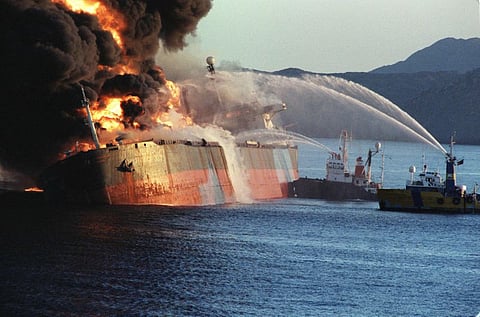
Dubai: As US President Donald Trump considers deploying naval escorts to protect oil tankers in the Strait of Hormuz, history is offering a stark warning: Attempts to secure the world’s most critical energy chokepoint have often spiralled into dangerous and unpredictable conflict.
The latest tensions come amid escalating attacks on shipping in and around the narrow waterway, through which a significant share of global oil supplies passes.
Iran has targeted vessels and signalled it could expand strikes, raising fears of a wider confrontation that could disrupt energy markets and global trade.
For analysts and historians, the situation has a familiar ring.
Nearly four decades ago, during the Iran-Iraq war, the United States faced a similar challenge. In what became known as the “Tanker War,” both sides attacked oil shipments in a bid to choke each other’s economies and draw global powers into the conflict.
5 things to know about the Hormuz crisis
Critical chokepoint: Around a fifth of global oil supply passes through the Strait of Hormuz
Narrow lanes: Shipping routes are just about 2 miles wide, making vessels highly vulnerable
History of conflict: The 1980s Tanker War saw attacks on oil shipments and US naval intervention
Mines threat: Sea mines remain one of the most dangerous and difficult-to-counter risks
Escalation risk: Even defensive moves like tanker escorts can trigger wider confrontation
As detailed in historical accounts and recent analysis by CNN, the US eventually intervened by escorting tankers through the Gulf — a move that brought American forces directly into harm’s way.
The risks were immediate and severe. In 1987, the US Navy frigate USS Stark was hit by two missiles fired by an Iraqi warplane in a case of mistaken identity, killing 37 sailors. Months later, a reflagged tanker struck an Iranian mine despite US naval protection, exposing gaps in American preparedness. The dangers escalated further in 1988 when another US warship, USS Samuel B Roberts, was nearly torn apart by a mine, prompting a major US retaliation known as Operation Praying Mantis.
Excavations
That cycle — attack, escalation, retaliation — is precisely what current planners fear could repeat.
“Mines have a chilling psychological as well as operational effect on maritime operations,” a former US naval intelligence official told CNN, highlighting one of the most persistent threats in the Gulf.
Even today, mines remain a critical concern. While there is no confirmed large-scale mining of the Strait of Hormuz in the current crisis, US officials believe Iran has the capability and may already have deployed some. Clearing them is slow, complex and resource-intensive — and, crucially, the US Navy’s dedicated minesweeping capacity in the region is limited.
Yet the strategic importance of Hormuz makes disengagement nearly impossible.
The strait, at its narrowest point, has shipping lanes just about two miles wide in each direction, making it one of the world’s most vulnerable maritime chokepoints. As noted in analysis by The Wall Street Journal, this geography gives Iran — which sits along the northern shore — a unique ability to threaten global energy flows despite its broader military constraints.
Commerce involving spices, silk
That leverage is not new.
For centuries, Hormuz has been a contested gateway linking the riches of Asia to markets in the Middle East and Europe. Ancient Persian empires, as well as later powers including the Portuguese and Ottomans, sought control of the strait. Trade in spices, silk and precious goods once passed through these waters, making it one of the wealthiest and most strategically prized locations in the world.
Even renowned travellers such as Marco Polo and Chinese explorer Zheng He passed through the region, underscoring its historic centrality to global commerce.
In modern times, the discovery of vast oil reserves in the Gulf in the 20th century transformed Hormuz into an energy lifeline. That shift also drew in global powers. The United States gradually assumed a larger role in securing the region, particularly after Iran’s 1979 Islamic Revolution reshaped the geopolitical landscape.
Since then, successive US administrations have treated any threat to Gulf shipping as a direct challenge to vital national interests.
President Jimmy Carter made that explicit in 1980, declaring that attempts to control the Arabian Gulf would be regarded as an assault on US interests. Every president since has grappled with the same dilemma: how to protect shipping without triggering a broader war.
Trump’s current deliberations echo that long-standing tension.
Error in calculation
While escorting tankers could reassure markets and deter attacks, history suggests it also raises the risk of miscalculation. In congested and contested waters, even a single mistake — a misidentified aircraft, an unseen mine, or an overreaction — can escalate rapidly.
At the same time, Iran appears to be leveraging the strait as a pressure point. Analysts say Tehran’s strategy is aimed at raising the economic cost of the conflict, forcing adversaries to weigh military objectives against the risk of global disruption.
The combination of geography, history and strategy makes Hormuz uniquely volatile.
It is not just a waterway, but a narrow maritime gate between some of the world’s largest energy reserves and the global economy. Any sustained disruption could send oil prices soaring and ripple through supply chains worldwide.
That is why, despite decades of experience, the current moment feels precarious.
The past shows that controlling Hormuz is never straightforward. Efforts to secure it have repeatedly exposed vulnerabilities, drawn in outside powers and triggered unintended consequences.
As the United States weighs its next move, one lesson stands out: in the Strait of Hormuz, even limited actions can quickly expand into something much larger.


