Is Strait of Hormuz now open? More oil, LNG tankers cross Gulf chokepoint
Shipping activity picks up pace in Hormuz as few more stranded tankers finally depart
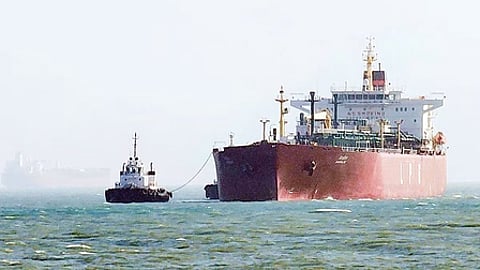
Dubai: More oil and liquefied natural gas tankers are beginning to move through the Strait of Hormuz, offering the clearest sign yet that limited commercial shipping is resuming after nearly three months of severe disruption triggered by the U.S.-Israeli war on Iran.
Get updated faster and for FREE: Download the Gulf News app now - simply click here.
Shipping data reviewed by Reuters showed that two LNG tankers crossed out of the Gulf on Monday bound for Pakistan and China, while a supertanker carrying Iraqi crude for China exited the strait over the weekend after being stranded since February.
The renewed vessel movements have raised a key question for global energy markets: is the Strait of Hormuz already reopening? The answer remains complicated.
Traffic has resumed on a limited basis under routes and controls imposed by Iran, but shipping volumes remain far below pre-war levels. Energy executives and shipping analysts warn that a full return to normal operations could still take many months, or even years.
The Strait of Hormuz normally handles around one-fifth of global oil and LNG flows, making it one of the world’s most critical energy chokepoints.
LNG cargoes move
Before the conflict began on February 28, shipping traffic through the strait averaged between 125 and 140 daily passages. Reuters reported that only a handful of supertankers have managed to exit the Gulf this month.
Among the latest vessels to leave was LNG tanker Fuwairit, which crossed the strait on Monday carrying a cargo loaded at Qatar’s Ras Laffan export terminal around March 28, according to LSEG and Kpler shipping data. The Bahamas-flagged vessel is expected to discharge its cargo in Pakistan on Tuesday.
Another LNG tanker, Al Rayyan, also exited the strait after loading at Ras Laffan. Shipping data showed the vessel outside the Hormuz passage between Iran and Oman after last being tracked inside the Gulf on May 22. It is expected to arrive in China in late June.
Separately, the Very Large Crude Carrier Eagle Verona left the strait on Saturday carrying nearly 2 million barrels of Iraqi Basrah crude destined for Ningbo in eastern China.
The Singapore-flagged vessel, chartered by Unipec, the trading arm of Chinese refining giant Sinopec, had loaded the cargo around February 26 before becoming stranded in the Gulf for almost three months.
Tighter transits
Reuters previously reported that Eagle Verona was among seven ships Malaysia had sought permission from Iran to transit through the waterway. Five of those vessels have since exited the Gulf, while two remain inside.
Last week, three VLCCs transported roughly 6 million barrels of crude through the strait to China and South Korea, another indication that energy flows are slowly restarting under tightly controlled conditions.
Iran has effectively established control over shipping movements through the waterway since the conflict erupted, according to Reuters reporting. Tehran introduced checkpoints, vessel vetting procedures and, in some cases, transit fees after attacks on commercial shipping escalated earlier this year.
The disruption has created what the International Energy Agency described as the largest energy supply crisis in modern history due to the near-closure of Hormuz.
Even with some vessels now moving again, industry leaders say global oil flows remain far from stable.
Prolonged disruption?
ADNOC Chief Executive Sultan Al Jaber warned last week that full oil flows through the strait may not recover before 2027 even if the conflict ended immediately.
“Even if this conflict ends tomorrow, it will take at least four months to get back to 80% of pre-conflict flows, and full flows will not return before the first or even second quarter of 2027,” Jaber said during an Atlantic Council event.
Saudi Aramco CEO Amin Nasser has also warned that oil markets may not fully recover before 2027 if the disruption continues into mid-June. The prolonged uncertainty has driven up energy and transport costs globally.
Jaber said fuel prices have risen 30% since the conflict began, fertiliser prices are up 50%, while airfares have increased by roughly a quarter. “Every farm, every factory, every family is paying the price,” he said.
Stranded seafarers
The crisis has also stranded around 20,000 seafarers aboard hundreds of ships still trapped inside the Gulf, Reuters reported.
Iran’s expanded control over the area has stretched beyond the narrow Hormuz passage itself. Reuters reported that Tehran now considers parts of the UAE’s Gulf of Oman coastline within its operational oversight, increasing pressure on alternative export routes.
That includes the UAE’s Fujairah oil export corridor, which has become a critical outlet allowing some Emirati crude shipments to bypass Hormuz entirely.
Jaber called the blockade a “dangerous precedent” for global trade and maritime security. “Once you accept that a single country can hold the world’s most important waterway hostage, freedom of navigation as we know it is just finished,” he said.
For now, the movement of a small number of LNG tankers and crude carriers suggests that the Strait of Hormuz is no longer completely paralysed.
But shipping volumes remain a fraction of normal levels, insurers remain cautious, and energy markets continue to price in prolonged geopolitical risk across the Gulf.