UAE Early Warning System: How it works and why you get alerts
Missile defense and weather alerts in the UAE: Why only certain areas are notified
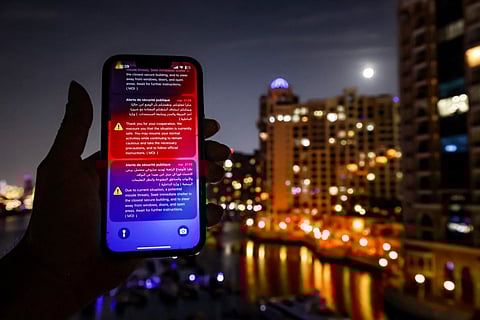
Dubai: On May 4, a familiar but unsettling sound cut through the daily routines of UAE residents, the emergency alert. It had been quiet for a while, as tensions in the Gulf region had briefly subsided. The familiar warning tone, absent in recent weeks, returned once again.
These alerts are issued when the UAE’s Ministry of Defence confirms that its air defence systems are responding to incoming missiles and unmanned aerial vehicles (UAVs) launched from Iran.
At the same time, the National Emergency Crisis and Disaster Management Authority (NCEMA) and the Ministry of Interior (MOI) send notifications instructing residents and visitors to shelter in place. Once the threat has passed and interceptions are complete, a follow-up message confirms that the situation is safe.
But how exactly do these alerts work and why do only certain people or areas receive them?
What is the Early Warning System?
These alerts are delivered through what is formally known as the Early Warning System - a framework that NCEMA has recently taken care to explain across its official social media channels.
According to NCEMA, it is a vital preventive tool designed to promptly alert the public and strengthen national preparedness in times of emergency.
How does it operate?
The national early warning system works based on geographic location. Alerts are sent only to affected areas, depending on the location, nature and scale of the hazard.
This means some areas may receive alerts related to missile activity, while others may not, simply because the incident does not directly affect those locations.
Why do some people receive alerts and others do not?
Whether or not you receive an alert can depend on your device’s location at the exact time it is issued, as well as your phone’s emergency alert settings. In addition, sound reverberations may be heard in nearby areas close to locations affected by missile attacks.
Didn’t receive an alert? Here’s why
Not receiving a warning message does not indicate a system fault. Instead, it reflects the system’s precision in targeting alerts to specific locations and groups.
According to NCEMA, this demonstrates the importance of accurately directing alerts according to geographic location and at the appropriate time.
Two different alert sounds
From 9am to 10.30pm, a high-tone alert is used, followed by a standard text message tone to signal the end of the alert. Between 10.30pm and 9am, a standard message tone is used for both the alert and its conclusion.
When else is the system used?
Whilst the system has recently been employed to alert the public to defence operations across the country, a response to Iranian aggression during the ongoing Middle East conflict, its scope extends beyond missle threat alerts.
The Early Warning System is also routinely used during extreme weather conditions. These alerts may include warnings to stay away from valleys, beaches, and areas prone to flash flooding, as well as guidance to drive with caution and observe traffic advisories.
The public warning system project was established in 2017 to alert residents and visitors about any imminent emergency.
Stay updated: Get the latest faster by downloading the Gulf News app now - it's completely free. Click here for Apple or here for Android. You can also find it on the Huawei AppGallery.
Who can send these alerts?
Only government entities involved in national emergency management are authorised to issue alerts. These include:
NCEMA
Ministry of Interior (MOI)
Abu Dhabi Police
Dubai Police
Sharjah Police
Ajman Police
Umm Al Quwain Police
Ras Al Khaimah Police
Fujairah Police
Ministry of Health and Prevention (MOHAP)
How are alerts delivered?
The technology underpinning the delivery of warning alerts is known as Cellular Broadcast (CB). When an alert is issued for a specific geographical location, it is delivered to every mobile device present within that selected area at the time, regardless of whether the SIM card belongs to a resident or a visitor.
Both residents and visitors in the UAE receive public warning alerts. The alerts feature is enabled by default on smartphones, so there is no need to adjust your settings or manually enable notifications. If your device is within the designated geographic zone when an alert is issued, you will receive it.


