Supporters watch a televised speech by Hezbollah chief Naim Qassem (on video wall) during a rally to show their solidarity with Iran, in the southern suburb of Beirut. File photo taken on January 26, 2026.
Israel-Lebanon ceasefire agreed as US House curbs Trump on Iran war; UN peacekeeper killed in south Lebanon shelling
US-brokered truce links Israel-Lebanon calm to stalled Iran negotiations
Last updated:
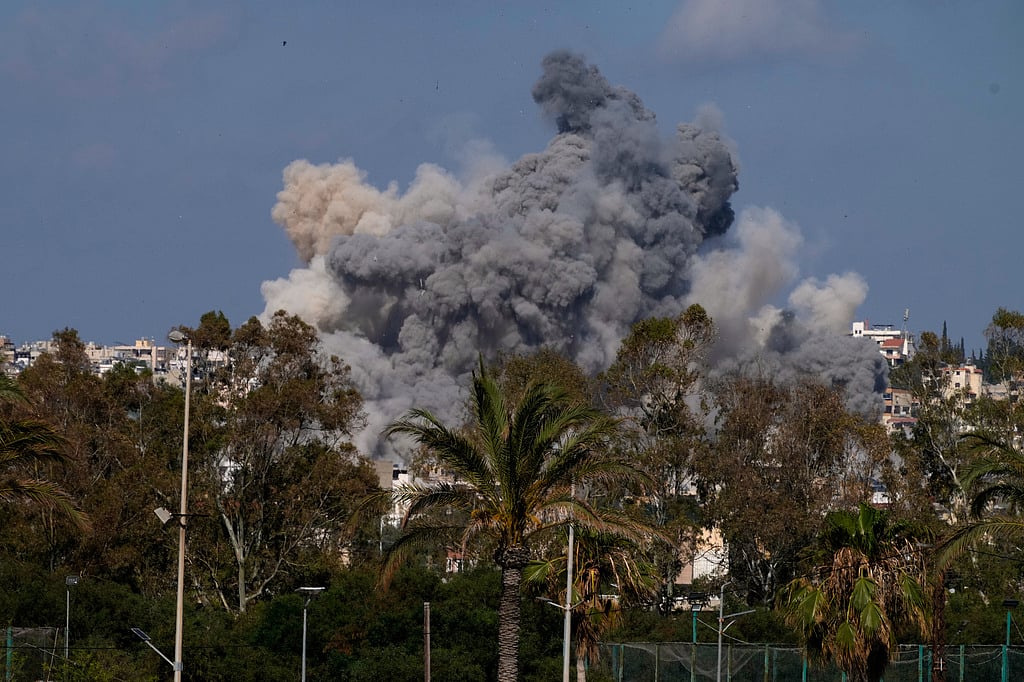
Smoke rises from an Israeli airstrike that hit Burj al-Shamali village near the southern port city of Tyre, Lebanon, Tuesday, June 2, 2026. (AP Photo/Mohammed Zaatari)
Tensions across the Middle East remain high as Lebanon and Israel agree to implement a ceasefire following talks in Washington, even as Israeli strikes in southern Lebanon killed at least eight people, including two paramedics. Meanwhile, the US-Iran ceasefire faces fresh tests after an Iranian drone strike on Kuwait International Airport left one dead and dozens wounded, with Washington and Tehran reportedly moving closer to a multi-phase interim agreement and President Trump voicing optimism that a deal could come "this weekend." Follow our live coverage for the latest updates.
US‑Israel war on Iran: Recent developments
Iran FM warns any attack on Beirut will trigger 'full-scale resumption of war'
Iranian Foreign Minister Abbas Araghchi warned on Wednesday that any attack on Lebanese capital Beirut would trigger a "full-scale resumption" of the Middle East war, as Israel pressed its campaign against Lebanese militant group Hezbollah.
"Any attack on Beirut will have grave consequences and will lead to a full-scale resumption of the war," the Tasnim news agency quoted Araghchi as telling Lebanon's Al Mayadeen TV. "Our armed forces are ready to strike Israel if it attacks Beirut."
Iran FM says 'no tangible progress' in talks with US to end war
Iranian Foreign Minister Abbas Araghchi said Wednesday that lines of communication with the United States were still open, but "no tangible progress" has been made in negotiations to end the Middle East war.
"Communications with the Americans have not been cut off, and messages have been exchanged regarding the need to stop aggression against Beirut, but no tangible progress has been made in the negotiation process," the Tasnim news agency quoted him as telling Lebanon's Al Mayadeen TV.
"Returning to the negotiating table is conditional on ensuring the rights of the Iranian people, ending the war in Lebanon, and stopping tensions in the region."
Iran's Guards deny deadly attack on Kuwait airport
Iran's Revolutionary Guards denied responsibility on Wednesday for an attack on Kuwait's international airport that officials said left an Indian national dead and 63 people wounded.
"Our investigation and review into the Kuwait passenger terminal attack shows that the IRGC Air Force did not fire any shots at this target," said Guards spokesman Hossein Mohebi, according to the IRGC's official Telegram channel.
He said that "the destruction of the Kuwait airport passenger terminal was caused by an error in the American Patriot systems, which landed on the terminal after failing to intercept Iranian missiles".
The Guards earlier said they had targeted a different location, "the Ali Al Salem Air Base in Kuwait, which hosts helicopters" for the US.
US: Iran's attack on Kuwait was 'deliberate, calculated'
8 killed, including 2 medics, in Israeli strikes in southern Lebanon
At least eight people were killed in separate Israeli strikes in southern Lebanon, Lebanon's Ministry of Public Health said late on Wednesday, as per CNN. The BBC reported nine people were killed in the recent attacks.
Both news organisations reported that the dead included two paramedics whose ambulance was hit while responding to emergencies.
The ministry's Emergency Operations Center said an air strike on the town of Housh in the Tyre district killed six people. The victims included four Syrians and two Palestinians.
In a separate incident, an ambulance operated by the Al-Risala Scout Association was struck in the town of Shahour (also spelled as "Chehour"), the ministry said. Two paramedics were killed. A third was seriously wounded and underwent emergency surgery.
Lebanon's Health Ministry condemned the attack on the ambulance. It said the strike breached international humanitarian law, which protects medical personnel and emergency responders during armed conflict.
Ceasefire under fire: Trump sees progress with Iran as Israel-Lebanon violence threatens wider conflict
A fragile US-Iran ceasefire is facing one of its toughest tests yet, even as President Donald Trump insists diplomacy remains on track.
Speaking to reporters, Trump said the ceasefire between Washington and Tehran remains intact despite a fresh wave of missile and drone attacks across the Gulf. He described ongoing negotiations with Iran as having gone “very well,” signaling optimism that months of tension could still yield a broader agreement.
The remarks came after Iran claimed responsibility for what it called “self-defence strikes” targeting US military facilities in Kuwait and Bahrain, as well as a vessel near the strategically vital Strait of Hormuz. The attacks followed US military operations against Iranian targets near the waterway, underscoring how quickly the region could slide back into open conflict despite the ceasefire framework.
Washington and Tehran 'moving closer to a multi-phase interim agreement': report
Washington and Tehran are moving closer to a multi-phase interim agreement that begins with de-escalation and could eventually address Iran’s nuclear programme.
The talks focused on an unpublished draft memorandum outlining a framework implemented in four phases, each dependent on mutual compliance
The first phase focuses on stabilising a ceasefire, preventing further escalation, and avoiding the opening of new regional fronts, with Iran insisting on Lebanon be included in the arrangement.
The second phase is meant to address maritime security in the Strait of Hormuz, including restoring full commercial shipping flows and easing restrictions on vessels and energy routes.
US military denies its vessel was hit in Sea of Oman, says 'Iran is lying' about Strait of Hormuz rules violation
US Central Command on Wednesday rejected Iranian assertions that its forces targeted a US Navy destroyer in the Gulf of Oman, calling the claims false and affirming that American naval assets in the region remain fully operational.
"Iran is lying," CentCom stated in a post on X. "US military assets at sea continue to fly, sail, and operate safely and unimpeded." The command accompanied the statement with a graphic labeled "Fact Check."
The denial follows Iranian claims amid heightened tensions in the Gulf region. It comes one day after reports of an Iranian drone strike on Kuwait International Airport that killed at least one person and injured dozens, which allied countries condemned as aggression. US officials have linked such actions to broader Iranian retaliation in an ongoing conflict that escalated earlier in 2026.
The US and Iran have been engaged in direct and proxy hostilities since early 2026, including US-led strikes under Operation Epic Fury aimed at degrading Iran's military capabilities, enforcement of a naval blockade in the Gulf, and Iranian responses involving missiles, drones, and attacks on shipping and regional targets.
Netanyahu a 'great partner', says Trump amid reports of rift between two leaders
President Donald Trump sought to underscore his close relationship with Israeli Prime Minister Benjamin Netanyahu on Wednesday, describing him as a "great partner" just days after revealing frustrations over Israel's military operations in Lebanon.
Speaking to reporters in the Oval Office, Trump downplayed reports of a rift between the two leaders and emphasized that their strategic partnership remains intact despite occasional disagreements over regional security issues.
“Bibi Netanyahu has been for me a great partner. For other people not so good, for me he’s been very good,” Trump said, using Netanyahu's longtime nickname.
The remarks came after Trump disclosed details of a recent phone call with the Israeli leader in which he expressed concern over continued military activity along Israel's northern border with Lebanon.
Earlier this week, Trump said he had become increasingly uneasy as Israel pressed ahead with military operations while Washington was simultaneously pursuing diplomatic efforts aimed at reducing tensions with Iran.
“I wouldn’t say angry. I was a little bit perturbed at his constantly fighting with Lebanon. You know, at some point I said, ‘Bibi, we got to stop this,’” Trump said during an interview on a New York Post podcast recorded Tuesday and released Wednesday.
Get updated faster and for FREE: Download the Gulf News app now - simply click here.
Video: CCTV footage reveals moment Iranian Shahed kamikaze drone hits Kuwait Airport Terminal
CCTV footage from multiple angles captured a low-flying drone slamming into a passenger terminal at Kuwait International Airport on Wednesday, causing visible damage. This raises questions about the accuracy of Iranian denials that it targeted civilian infrastructure amid escalating regional conflict.
One widely circulated video shows the unmanned aerial vehicle, consistent in appearance with an Iranian Shahed-136 "kamikaze" drone, approaching Terminal 1 from the east before impacting the structure.
Additional angles from security cameras depict the drone in its terminal dive phase and the ensuing explosion and smoke, according to posts circulating on social media and analysed by open-source intelligence accounts.
Iran’s Islamic Revolutionary Guard Corps (IRGC) denied responsibility for striking the airport, instead attributing the damage to a malfunctioning US-made Patriot air defense missile that allegedly failed to intercept Iranian projectiles and fell onto the terminal.
Trump says Iran talks could yield result 'this weekend'
US President Donald Trump said Wednesday that talks with Iran are going "very well" and could yield results over the coming weekend.
"I hear the negotiation itself is going very well actually," Trump told reporters, adding of a potential deal: "It could happen... over the weekend."
Trump's assessment differed sharply from that of Iran's foreign minister, Abbas Araghchi, who said that lines of communication with the United States were still open, but "no tangible progress" had been made in negotiations to end the Middle East war.
Trump also said he wants to separate the US-Iran talks from those on the conflict between Israel and Hezbollah in Lebanon.
House passes war powers rebuke targeting Trump over Iran strikes
The US House of Representatives approved a resolution late on Wednesday to restrict President Donald Trump’s authority to take military action in Iran, marking a rare bipartisan break and a fresh flashpoint in the escalating constitutional debate over executive war powers.
The measure passed 215–208, with four Republicans—Reps. Thomas Massie, Brian Fitzpatrick, Tom Barrett and Warren Davidson—joining all Democrats in support, underscoring growing unease within parts of the GOP over Trump’s handling of foreign policy and military escalation.
The resolution, introduced by New York Democrat Rep. Gregory Meeks, the ranking member of the House Foreign Affairs Committee, reflects a broader Democratic effort to reassert congressional authority over military action. Similar war powers challenges have been repeatedly brought in both chambers in recent months, gradually attracting limited Republican backing.
“I am thrilled that we’ve had the opportunity to have some members from the Republican side stand up. I’m really thrilled and proud of my Democratic colleagues, because every Democrat, every single one voted for this,” Meeks told reporters after the vote.
The vote highlights an increasingly uneasy dynamic within the Republican-controlled Congress, where some lawmakers have shown willingness to break with Trump on procedural and constitutional grounds, even as party leadership continues to broadly support his agenda.
Lebanon, Israel agree to implement ceasefire following Washington talks
Lebanon and Israel have agreed to implement a ceasefire following extensive negotiations held in Washington, according to a joint statement issued by the United States late last night. The joint communique outlines that the ceasefire is strictly conditional upon the complete cessation of hostilities by Hezbollah and the withdrawal of all its elements from the region south of the Litani River.
US House votes to curb Trump on Iran war as talks stall
The US House of Representatives has backed a resolution seeking to halt American military action in Iran -- a symbolic move that deals a political blow to President Donald Trump as efforts to find a deal with Tehran stagnate.
Weeks of complicated talks marked by sharp rhetoric and flare-ups of violence have not managed to reach a deal to end the war and reopen the Strait of Hormuz, which is essential to oil supplies.
Washington and Tehran have sent divergent message in recent days, with Iran saying Wednesday "no tangible progress" was made, while Trump again voiced optimism by telling reporters at the White House "it could happen... over the weekend."
Israeli military says air raid alarm sounded in northern Israel
The Israeli military reported on Thursday that air raid sirens were sounded in northern Israel, saying one incident was resolved and another found to be a false alarm.
"Following the sirens that sounded a short while ago regarding a hostile aircraft infiltration in the area of Kfar Yuval, a suspicious aerial target was identified. The incident has concluded. No injuries were reported," the Israeli military wrote on social media, adding that another alert in the Arab al-Aramshe area was a "false identification".
Iran says war will only end when it ends in Lebanon
Iran's Foreign Minister Abbas Araghchi has declared that the US-Israel conflict with Tehran will conclude only "when it also ends in Lebanon."
Speaking in an interview with Arab media that was circulated by Iran's foreign ministry, Araghchi said Tehran's stance is consistent across both fronts: "We hold the same position regarding a ceasefire, and the same position regarding ending the war."
Tehran has insisted on multiple occasions that any ceasefire deal must cover Lebanon as well — a condition that has risked derailing Washington's negotiations with Iran.
Araghchi added that a genuine end to the war would also require Israeli forces to pull out of Lebanon, where Israel has been striking Iran-backed Hezbollah since early March, as reported by CNN.
Emir of Qatar, US President discuss regional de-escalation
His Highness Sheikh Tamim bin Hamad Al Thani, Emir of the State of Qatar, received a phone call on Wednesday from US President Donald Trump.
During the call, the two sides discussed the latest updates in the Middle East in light of ongoing political and security developments, as well as regional and international efforts aimed at de-escalation and promoting stability, according to Qatar News Agency.
Kuwait PM visits attacked airport terminal
Kuwait's Prime Minister visited the severely damaged Terminal 1 building at Kuwait International Airport, according to the Kuwait News Agency (KUNA), which shared the visit on X. The terminal sustained extensive damage in a wave of Iranian missile and drone attacks, one of which struck the passenger terminal and left at least one person dead and dozens wounded.
India's envoy visits airport attack victims in Kuwait
India's Ambassador to Kuwait, Paramita Tripathi, visited the Central Mortuary in Kuwait, where the body of the Indian national killed in the attack on Kuwait International Airport was brought, according to a statement shared by the Embassy of India in Kuwait on X.
The ambassador met Brig. Abdulrahim Al-Awadhi, General Manager of the General Department of Criminal Evidence, to express appreciation for the prompt and sensitive support provided.
The embassy said it is in contact with the deceased's family and is coordinating with Kuwaiti authorities to expedite the transportation of the remains. Tripathi also visited Indian nationals injured in the attack who are being treated at hospitals across Kuwait, interacting with them and assuring them of full assistance and close follow-up by the embassy with the hospitals and their families.
Get updated faster and for FREE: Download the Gulf News app now - simply click here.
Oil prices decline in early Asian trading
Oil prices fell during early Asian trading on Thursday, reversing some of the sharp gains recorded in the previous session.
Brent crude futures declined by 67 cents, or 0.69%, to trade at $97.14 a barrel. Meanwhile, US West Texas Intermediate (WTI) crude futures dropped 62 cents, or 0.65%, to reach $95.40 a barrel.
The early morning decline is reportedly driven by profit-taking from commodity traders following the sharp price surge late Wednesday.
Ben-Gvir slams Lebanon ceasefire as 'grave mistake'
Israel's far-right National Security Minister Itamar Ben Gvir criticised on Thursday a ceasefire deal with Lebanon brokered by Washington, calling it a "serious mistake".
"The ceasefire with Lebanon is a serious mistake and the pipe dreams of advisers are dragging the prime minister (Benjamin Netanyahu) to wrong decisions," the minister wrote on X.
Israel and Lebanon agreed Wednesday to implement a ceasefire but said it would require a "complete cessation" of fire by Iran-backed Hezbollah, according to a joint statement after US-led talks in Washington.
Israeli strikes hit Lebanon after truce deal
Lebanese official media reported Israeli strikes on the country's south on Thursday morning, hours after an announcement that Israel and Lebanon had agreed to implement a conditional ceasefire following talks in Washington.
The state-run National News Agency (NNA) reported Israeli drone strikes along roads at several south Lebanon locations, saying at least one caused casualties.
Israel says operations in south Lebanon to continue
Israel defence minister says military to continue operations in south Lebanon
Israel defence minister says military to strike Beirut if Hezbollah attacks
Israel's defence minister said Thursday that a ceasefire agreement with Lebanon grants the military the "freedom" to strike Beirut if Hezbollah attacks Israeli communities, adding that operations in southern Lebanon would continue.
"The IDF will, at this stage, continue its fire and ground operations, remain in the security zone in Lebanon up to the Yellow Line -- including in the Beaufort area -- and without the return of the population, while continuing to dismantle terrorist infrastructure on the ground," Israel Katz said in a statement, as he hailed the ceasefire deal reached on Wednesday.
Supreme leader says Iran delivered 'decisive blow' to US, Israel
UN force says peacekeeper killed in south Lebanon
The United Nations Interim Force in Lebanon said Thursday that a peacekeeper was killed and two others wounded when shelling hit their base in the country's south the previous night.
"A UNIFIL peacekeeper died early this morning from critical injuries sustained when mortar shells struck his position," a statement from the force said, adding that an investigation had been launched.
US, Israel aim to sow 'division' after war defeat
Iran's supreme leader on Thursday accused the US and Israel of trying to sow "division" among Iranians after suffering a "decisive blow" during the Middle East war.
In a written message, Mojtaba Khamenei said "the malicious enemy" was seeking to "plant the seeds of doubt, despair, fear, mistrust and division" among the public.
"In confronting these ill intentions, everyone must, through steadfastness, insight, preserving unity and cohesion... neutralise their sinister plot," his message said.
War clouds Iran's World Cup preparations
Iran is heading to the World Cup while the country is at war with the primary host nation, a situation that is unique in the tournament’s history.
In exclusive interviews with The Associated Press during a team camp in Turkey, two members of Iran’s squad described how the conflict is affecting its World Cup preparations.
“Well, to be honest, it’s not easy,” said Saeid Ezatolahi, a 29-year-old midfielder who also played for Iran in the 2018 and 2022 World Cups.
“That’s going to be my third World Cup. So for me and some of the other players, it might be easier to manage these kind of things,” he said in English on the sidelines of a training session on Wednesday. “But at the end ... it is going to be difficult for us because at the same time, we are following the news in our country and the political things, of course, can affect the mind of the players and the people."
Kuwait PM visits airport attack victims
Kuwait's Prime Minister Sheikh Ahmad Abdullah Al-Ahmad Al-Sabah visited those wounded in the Iranian attack on Kuwait International Airport, calling on them at Jaber Al-Ahmad Hospital to check on their condition and review the care being provided, according to a statement by the Kuwait News Agency (KUNA) shared on X.
Accompanied by Health Minister Dr. Ahmad Abdulwahab Al-Awadhi, His Highness stressed the government's commitment to closely monitoring the injured and ensuring all necessary support until their full recovery, directing authorities to mobilize all available medical and technical resources to provide the highest standards of treatment. He also offered his condolences over the death of one person in the attack, wishing patience to the bereaved family and a swift recovery to all those hurt.
Iran's Guards say Israel must withdraw to pre-war positions in Lebanon
The head of the Quds Force, the foreign arm of Iran's Islamic Revolutionary Guards, said Thursday that Israel must pull back from its current front lines in Lebanon, where it is fighting Tehran's ally Hezbollah.
"Supporting the resistance in Lebanon is the duty of all of us, and removing Israel from the region is an attainable goal for Muslims," Esmail Qaani said in a post on a domestic social media platform. "The minimum demand of the resistance is the withdrawal of the usurping regime (Israel) to the position it held before the start of the 40-day war."
Lebanon president says deal announced in Washington 'last chance' for comprehensive Israel truce
Lebanese President Joseph Aoun said Thursday that an agreement on implementing a ceasefire announced in Washington after talks with Israel was the "last chance" to reach a comprehensive truce.
"The results of the fourth round of negotiations, and the statement issued from it, which included very important points in Lebanon's favour, represent the last chance to enter into a final, comprehensive ceasefire. Each party bears responsibility" if it fails to respond positively, Aoun said, according to a statement from his office.
Aoun said Lebanon would inform the United States of its position "as soon as responses are received from the concerned internal parties, particularly Hezbollah", adding that the US would determine the ceasefire's start date and "President Donald Trump will be the direct guarantor of its implementation".
Get updated faster and for FREE: Download the Gulf News app now - simply click here.
Trump slams 'unpatriotic' US House vote to end Iran war
President Donald Trump on Thursday slammed a vote in the US House seeking to order the withdrawal of American troops from the Iran war, suggesting the "unpatriotic" move disrupted negotiations with Tehran.
The largely symbolic vote came "right in the middle of my final negotiations to end the War with the Islamic Republic of Iran," Trump said in a post on his Truth Social platform.
"Who would do such an unpatriotic thing. They know where the negotiations stand."
Hezbollah chief demands 'comprehensive' ceasefire, Israeli withdrawal from Lebanon
Hezbollah chief Naim Qassem on Thursday demanded a comprehensive ceasefire and the withdrawal of Israeli troops from Lebanon, urging authorities to abandon direct talks with Israel after a truce agreement was announced.
"The ceasefire must be comprehensive... without the Israeli enemy having the freedom to kill," Qassem said in a televised message, urging the government to halt "the farce and humiliation called direct talks" with Israel.
He also vowed that "as long as our villages are unsafe - being bombed, destroyed and our people killed - the settlements (north Israel) are unsafe".
France throws weight behind Israel-Lebanon ceasefire
President Emmanuel Macron on Thursday said that France backed the ceasefire in Lebanon after the announcement of an agreement in Washington.
The French head of state told reporters on a visit to Montenegro: "We support the ceasefire between Lebanon and Israel and everything that helps restore peace, combat terrorist activities, and fully establish Lebanon's sovereignty and territorial integrity.
"France is, of course, as we have always been, available to move forward along this path. A coordination mechanism has been put in place where the United States and France are working together.
"If the ceasefire is serious, this is the mechanism that must be reactivated, so that we can follow up and verify its implementation."
UN nuclear watchdog concerned by lack of access to Iran sites
The UN nuclear agency said in a confidential report seen by AFP on Thursday that a lack of access to verify nuclear material in Iran posed a "proliferaton concern", calling on the Islamic republic to "engage the agency constructively".
"While the agency acknowledged that the military attacks on Iran's nuclear facilities and sites have created an unprecedented situation, it is critical for the agency to conduct verification activities in Iran without delay," the International Atomic Energy Agency (IAEA) said in the report.
EU signs off on new €100-million in support for Lebanese army
The European Union signed off Thursday on a new €100-million ($116 million) support package for the Lebanese Army, as it seeks to bolster the military amid a fragile ceasefire in the country.
"The latest ceasefire between Israel and Lebanon offers a chance to prevent a return to full-scale hostilities," EU foreign policy chief Kaja Kallas posted online.
"But the death of a UNIFIL peacekeeper and continued skirmishes underscore the tenuous nature of what was agreed."
Kallas said "the best way to reduce the threat posed by Hezbollah is to strengthen the Lebanese state, empower its institutions, and restore its monopoly on the use of force".
The new assistance for the Lebanese armed forces is the fourth provided by the EU in recent years, taking the overall value to 182 million euros.
Iran leader says dealt enemies 'decisive blow' in Middle East war
Iran's supreme leader said Thursday that the United States and Israel had been dealt a "decisive blow" in the Middle East war, after the government reported "no tangible progress" in negotiations on ending the conflict.
Ayatollah Mojtaba Khamenei's message, read out by a prayer leader at a ceremony marking the anniversary of the death of the Islamic republic's founder, came after the US House of Representatives passed a resolution seeking to halt American military action in Iran.
In his message, Khamenei said his country's enemies, after "facing a decisive blow", were now "experiencing a deeply meaningful and profound humiliation".
Every June 4 since 1989, the elder Khamenei had delivered a speech at the commemoration of Ayatollah Ruhollah Khomeini's death.
This year, however, an empty chair bearing his portrait stood at the mausoleum, according to footage broadcast from the site.
Iranian oil leaves Gulf despite US blockade: monitor
Four Iranian-flagged oil tankers passed through the Strait of Hormuz on Monday, a first since April 15 and the US blockade of Iranian ports, according to maritime tracking firm Kpler.
In data published on Thursday, the firm detected the passage of the Hilda I, the Amber, the Silvia 1, and the Happiness I, which were carrying a total of seven million barrels of oil.
They all loaded their cargo in mid-April on Kharg Island, the country's main oil terminal, through which 90 percent of the Islamic Republic's crude oil normally transits.
The ships crossed the strait on Monday with their AIS transponders turned off.
Kpler relies primarily on satellite imagery to track ships transporting raw materials.
The four oil tankers typically transport Iranian crude to an offshore area off the coasts of Malaysia and Singapore, where they transfer the cargo at sea to other tankers (ship-to-ship) tasked with delivering it to the final customer, often in China.
Tehran adopted this practice to circumvent international sanctions.
The four tankers had initially continued their operations despite the conflict with Israel and the United States but had paused operations since April 13, when Washington imposed a blockade on Iranian ports in response to Tehran's blockade of the Strait of Hormuz.
Three other oil tankers linked to Iran had already defied the blockade on April 15, according to Kpler.
None had attempted to do so since then.
'In the queue': Busy with Iran, US has little energy for Kyiv
US Secretary of State Marco Rubio faced four different congressional panels this week on Washington's role in various global conflicts, but the war in Ukraine barely came up.
With the Trump administration consumed by the crisis in Iran, Ukraine has largely dropped off the radar, despite increasingly deadly attacks from Russia.
Speaking in Kyiv a day after 23 people were killed across Ukraine in the latest massive Russian aerial assault, Ukrainian President Volodymyr Zelensky on Wednesday lamented dwindling US attention.
"Today we are not in focus," Zelensky said alongside visiting NATO chief Mark Rutte. "Iran is the number one issue for the United States of America, and then comes the issue of Ukraine. Unfortunately, we are in the queue of these wars."
127 vessels redirected
US Central Command posted on X that, as of June 4, the US forces have redirected 127 commercial vessels, disabled 6 non-compliant ships, and allowed 36 vessels supporting humanitarian aid to pass under the US blockade of Iranian ports.
Iran says it will charge service fees, not tolls, in Strait of Hormuz
Tehran intends to levy service fees on vessels passing through the Strait of Hormuz in return for guaranteeing their security, rather than imposing transit tolls, Iranian officials say. Deputy Foreign Minister Kazem Gharibabadi told the semi-official outlet Mehr on Thursday that the country "is not seeking to collect passage fees, transit duties, or transit rights payments."
Instead, he said, Iran will seek compensation for services it provides together with Oman, such as navigation help, search and rescue, safety and security work, and environmental cleanup after any pollution incident. Gharibabadi noted that the waterway "lies entirely within the territorial waters of Iran and Oman," and that the two governments hold sovereignty over it "under international law and the law of the sea." As reported by CNN.
Get updated faster and for FREE: Download the Gulf News app now - simply click here.
Rubio condemns Iran's 'outrageous' attacks on Kuwait
US Secretary of State Marco Rubio on Thursday condemned Iran's "outrageous" attack this week on a Kuwait airport that killed one person and wounded dozens.
Meeting Kuwaiti Foreign Minister Jarrah Jaber Al-Ahmad Al-Sabah in Washington, Rubio "condemned Iran's outrageous and unacceptable attacks targeting Kuwait International Airport and other parts of the country and expressed condolences for those killed and injured in that attack," according to a State Department readout.
Putin says Iran war has 'shifted' US attention from Ukraine
The United States has switched its attention away from trying to end the Ukraine conflict since it launched its war against Iran, Russian President Vladimir Putin said Thursday.
"Naturally, we can all see and understand that the US administration is being forced to shift its attention and deal with this issue above all others," Putin told foreign journalists, including AFP, in Saint Petersburg.
Get updated faster and for FREE: Download the Gulf News app now - simply click here.
Lebanon health ministry says Israeli strikes in south and east kill eight
An Israeli strike in eastern Lebanon killed five people on Thursday, while another attack near the southern city of Tyre killed three more, the Lebanese health ministry said.
The strikes also left eight wounded, including three children and two women. They came a day after the Lebanese and Israeli governments agreed a ceasefire plan for Israel's war with Hezbollah, which the group has rejected.
Hezbollah rejects 'humiliating' new US-brokered Lebanon-Israel ceasefire deal
Iran-backed Hezbollah has rejected a renewed ceasefire arrangement negotiated by Lebanon and Israel with US mediation, casting doubt on efforts to stabilise the volatile border and prevent a broader Middle East conflict.
The heavily-armed group operating in Lebanon and classified as a terrorist group by the UAE, the GCC, the US, the UK, and several other countries, said it was "not bound" by the agreement and vowed to continue what it described as "resistance operations" against Israel, underscoring the challenge facing Lebanese authorities as they seek to enforce a truce after months of cross-border fighting.
The ceasefire was intended to halt hostilities along the Israel-Lebanon frontier, facilitate the return of displaced civilians and create conditions for broader diplomatic talks. Lebanese officials backed the arrangement in hopes of avoiding another devastating war, while Israel presented the deal as a step toward restoring security in its northern communities.
Hezbollah's rejection highlights a longstanding complication in Lebanon's political and security landscape: while the Lebanese government can negotiate on behalf of the state, Hezbollah maintains an independent military structure and significant influence.
The renewed fighting has stalled Lebanon's rare push to disarm the militia, reshaping power, security and US-backed diplomacy.
Hezbollah, Israel trade fresh strikes amid uncertainty surrounding US-Iran talks
Hezbollah and Israel exchanged fresh attacks despite renewed diplomatic efforts to reduce tensions across the Middle East, underscoring the fragile state of a proposed ceasefire and the uncertainty surrounding negotiations between Washington and Tehran.
Israeli forces carried out new strikes in southern Lebanon while Hezbollah launched rockets and drones toward northern Israel, raising fears that the Lebanon front could derail broader efforts to end months of conflict linked to the wider Iran war.
The renewed fighting is unfolding against the backdrop of delicate US-Iran diplomacy.
US issues security alert for Americans in Middle East amid tensions
The US State Department sent a security alert overnight on Friday to Americans across the Middle East, highlighting a complex environment with potential for hostilities due to ongoing strains like Israel's operations in Gaza and Lebanon, Iranian proxy activities, and Houthi shipping attacks.
Embassies from Jerusalem to Riyadh urged enrolling in the Smart Traveler program, avoiding crowds, monitoring news, and keeping a low profile near US sites — echoing shelter precautions common in rocket-prone areas like Israel. Travel advisories remain unchanged, with many countries at Level 3 'Reconsider Travel' and others at Level 4 'Do Not Travel,' signaling caution without calling for evacuations. While social media buzzed with speculation about US planes and unverified ultimatums, officials emphasized vigilance over alarm.
Jamshid Ghomi, tech company CEO living in a $35-million US mansion arrested for secretly arming Iran
A dual US-Iranian national and CEO of a Tehran-based technology company was arrested on federal charges accusing him of conspiring to violate US sanctions by supplying sophisticated American networking, security and encryption equipment to Iran’s military and nuclear programs, according to the US Justice Department.
Jamshid Ghomi, 63, of Newport Coast, was taken into custody at his $35-million-dollar waterfront home in Orange County following a federal investigation, authorities said. He faces a charge of conspiracy to violate the International Emergency Economic Powers Act and could receive up to 20 years in prison if convicted.
Get updated faster and for FREE: Download the Gulf News app now - simply click here.
We are closing this coverage now. For latest updates, click here.
Sign up for the Daily Briefing
Get the latest news and updates straight to your inbox
Network Links
GN StoreAbout Gulf NewsTerms & ConditionsReach by GNSitemapContact usPrivacy PolicyGN FocusHave your sayWork with usAdvertise with usGulf News epaperPrinting Services
Download our app
© Al Nisr Publishing LLC 2026. All rights reserved.