New round of Israel-Lebanon talks begin in Washington; US imposes sanctions on Iran's largest crypto exchange
Trump says Iran ceasefire and Strait of Hormuz deal could be reached within a week

Highlights
We are closing this coverage now. For latest updates, click here.
US military says it has 'defeated' Iran missile, drone attacks on neighbours
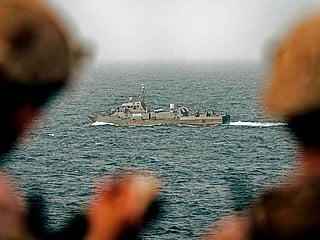
The US military that it had "successfully defeated" a series of Iranian missile and drone attacks on its regional neighbours, and conducted self-defence strikes on Iran's Qeshm Island.
"Iran launched several ballistic missiles toward regional neighbours; however, all failed to hit their intended targets," US Central Command said in a statement.
"Two Iranian missiles fired at Kuwait fell short or broke apart enroute, and three missiles launched at Bahrain were immediately intercepted by US and Bahrain air defence forces."
Bahrain emergency sirens activated, residents urged to head to safe location
Bahrain's Ministry of Interior has confirmed that the siren has been sounded. "Citizens and residents are requested to remain calm, head to the nearest safe location, and follow updates through official channels."
Bahrain has also shut its airspace and grounded civilian flights as threat over the Gulf intensifies.
Significant air defence activity is "ongoing", as the Iran Islamic Revolutionary Guard Corps (IRGC) says they’re targeting US bases.
Kuwait military says air defences responding to missile, drone attacks
Kuwait's military said on Wednesday its air defences were intercepting "hostile" missile and drone attacks, as the sounds of sirens rang out.
"Any sounds of explosions heard are the result of air defense systems intercepting these hostile attacks," the military said on X, without specifying their origin.
Kuwait's state-run news agency KUNA reported that the sirens were heard for the second time that night.
Ministry of Interior urged the public not to approach or touch any shrapnel, suspicious objects, or debris, warning of potential danger or explosion risks, and called for immediate reporting via emergency hotline.
US blockade: Missile cripples crude oil tanker, preventing it from reaching Iran's Kharg Island
The US military has disabled an empty oil tanker after it ignored repeated warnings and attempted to sail toward an Iranian port in the Arabian Gulf, US Central Command said. A US aircraft fired a Hellfire missile into the engine room of the Botswana-flagged M/T Lexie, preventing it from reaching Kharg Island, CentCom said in a statement.
US forces have now disabled six commercial vessels and redirected 122 others since the blockade took effect. The M/T Lexie was transiting international waters when it was intercepted.
Kharg Island, a small coral island in the northern Persian Gulf, serves as the terminal for roughly 90 percent of Iran's crude oil exports. Its deepwater berths allow supertankers to dock and load directly, making it the centerpiece of Iran's petroleum export infrastructure, and a focal point of the ongoing US enforcement effort.
Lebanon says Israeli strikes on south kill 5, wound 48, including hospital staff
Israeli strikes on southern Lebanon on Tuesday killed five people, including a child, and wounded 48, the Lebanese health ministry said.
Those wounded in the strikes across the south included "a doctor and five employees of Tebnine Governmental Hospital, which sustained damage in yet another episode of the series of attacks carried out by the Israeli enemy against hospitals and health centres", the ministry said in a statement.
US imposes sanctions on Iran's largest crypto exchange: CNN
The Trump administration imposed sanctions Tuesday on Iran’s largest cryptocurrency exchange as part of its pressure campaign against Tehran, says CNN.
The sanctions were announced amid ongoing diplomatic efforts that have failed so far to reach an agreement on ending the US war with Iran. They target Nobitex, its CEO and three of its co-founders, as well as three other Iranian crypto exchanges.
The US Treasury Department accused Nobitex of “facilitating payments tied to Iran’s terrorist activities, sanctions evasion efforts, and Islamic Revolutionary Guard Corps (IRGC)-linked transactions, including activity associated with IRGC-affiliated ransomware actors.”
Israel, Hezbollah trade blows as diplomats meet in Washington
Israel and Hezbollah exchanged fire on Tuesday while Lebanese and Israeli diplomats met in Washington for direct talks, with top US diplomat Marco Rubio saying the Iran-backed militant group was the only impediment to a peace deal.
The fighting came after US President Donald Trump declared on Monday that he had brokered a deal which the Lebanese embassy in Washington later said would at first only cover Israeli attacks on Beirut and Hezbollah attacks on Israeli territory, before expanding in scope
Neither side has publicly accepted Trump's deal, with senior Hezbollah official Mahmud Qomati telling AFP in a written statement the group "will not accept a partial ceasefire".
Hezbollah main obstacle to Israel-Lebanon peace, Rubio says
Israel and Lebanon could reach a peace agreement within days were it not for the obstacle posed by Hezbollah, US Secretary of State Marco Rubio said Tuesday, as the two countries began a fourth round of talks in Washington.
"Israel and Lebanon can do a peace deal tomorrow," Rubio told the Senate Foreign Relations Committee.
He added: "Israel has no territorial claims in Lebanon. Hezbollah is the impediment. There is no Hezbollah without Iran."
Rubio stressed that Washington, acting as a mediator, wanted the Israel-Lebanon talks to proceed independently of negotiations with Iran, something Tehran has resisted.
The ambassadors of Israel and Lebanon began a new round of direct talks in Washington as Israeli forces and Hezbollah continue to exchange fire, despite Trump announcing an agreement Monday to halt attacks.
The fourth meeting between representatives of the two countries, which do not have diplomatic relations, is taking place at the State Department and is scheduled to last two days.
Hezbollah-owned media says Trump ceasefire proposal is under discussion: CNN
Hezbollah-owned Al Manar television reported Tuesday that the militant group has received two US ceasefire proposals to end its fighting with Israel and acknowledged it is discussing one put forward by US President Donald Trump, while insisting it must entail a “full inclusive ceasefire”, reported CNN.
The report marked Hezbollah’s first acknowledgment of a truce that Trump announced yesterday.
In its report, Al Manar said Hezbollah rejected the first proposal, which it said came from US Secretary of State Marco Rubio. The Lebanese TV station said the Iranian-backed militant group is discussing a second proposal offered by Trump.
Trump says Iran talks happening 'continuously'
US President Donald Trump said Tuesday that the United States and Iran were speaking "continuously," denying reports that Tehran had broken off contact over Israel's attacks on Lebanon.
Trump added that "one never knows" where the negotiations would lead, as weeks of direct and indirect talks have failed to end the US-Israeli war on Iran that began on February 28.
"Fake News Reports that the Islamic Republic of Iran, and the U.S.A., stopped speaking a few days ago are false and erroneous," Trump said on his Truth Social network.
"The conversations between us have been going on continuously, including four days ago, three days ago, two days ago, one day ago, and today."
Trump added: "Where they lead, one never knows, but as I told Iran, 'It's time, one way or another, for you to make a Deal. You've been doing this for 47 years, and it cannot be allowed to go on any longer!'"
Rubio says Iran is trying to "stymie" diplomatic efforts between Israel and Lebanon: CNN
US Secretary of State Marco Rubio said Iran is trying to “stymie” diplomatic efforts between Israel and Lebanon and involve itself in the matter in order to claim credit if a peace deal is reached.
“We are trying to view the Lebanon-Israeli talks as separate and distinct from Iran, and Iran wants to do is mix it all together,” Rubio told lawmakers on the Sente Foreign Relations Committee, reported CNN.
Hezbollah will not accept 'partial ceasefire' with Israel: senior group official to AFP
Hezbollah will not accept a "partial ceasefire" with Israel, a senior official from the Iran-backed group said Tuesday, refusing to halt attacks against northern Israel in exchange for Israel sparing Beirut's southern suburbs.
"We will not accept a partial ceasefire," Mahmud Qomati told AFP in a written statement, adding that "the Zionist enemy should know that any aggression against the suburbs could lead to a deeper and stronger response" from the group.
On Monday, US President Donald Trump announced a deal which Lebanese officials later said involved Israel refraining from attacking Beirut's southern suburbs in return for Hezbollah not attacking Israeli territory.
Rubio says Iran's Khamenei alive and 'increasingly engaging'
US Secretary of State Marco Rubio said Tuesday that Iran's supreme leader Mojtaba Khamenei, who was wounded in US-Israeli attacks and has not been seen in public since assuming office, is alive and increasingly active.
"I think there are indications out there that he is increasingly engaging at some level," Rubio told the Senate Foreign Relations Committee.
Mojtaba Khamenei, 56, succeeded his father Ali Khamenei, who was killed in the first wave of US-Israeli strikes that launched the war on February 28.
Rubio says 'highly technical' negotiations on Iran’s nuclear programme could take months: CNN
Negotiations on Iran’s nuclear programme would be “highly technical” and could take months, US Secretary of State Marco Rubio said Tuesday, reported CNN.
The top US diplomat said such a phase would be predicated on Iran reopening the Strait of Hormuz.
“Phase 2 is they have to commit to very specific negotiations on … the disposition of the highly enriched uranium that still is buried deep in a mountain somewhere,” Rubio told the Senate Foreign Relations Committee. “They have to agree on negotiating severe and long-term limitations, and/or cancellation of enrichment activity in their country.”
Iran must make a clear commitment to reopening Hormuz
US Secretary of State Marco Rubio said on Tuesday that reopening the Strait of Hormuz is the primary condition for any progress in talks with Iran, while insisting that Tehran must also agree to negotiations over its stockpile of highly enriched uranium before any sanctions relief can be considered.
Speaking to lawmakers in Washington, Rubio said Iran must make a clear commitment to reopening the strategically important waterway, which has become a focal point of tensions following the recent conflict between the United States, Israel and Iran.
Israel kills 8 in Lebanon, a day after Trump said Israel and Hezbollah will de-escalate
Israeli drone strikes on southern Lebanon on Tuesday killed eight people, including two children and their father, a day after US President Donald Trump said Israel and the militant group Hezbollah agreed to dial back fighting. Hezbollah, which is backed by Iran, continued launching dozens of projectiles and drones toward Israeli soldiers in southern Lebanon and civilians in Israel.
The ongoing hostilities - despite Trump's announcement and a nominal ceasefire that began in April - are deepening displacement for Lebanon's conflict-weary population. They also are a significant sticking point in negotiations to extend a ceasefire in the US-Israeli war in Iran, as the Islamic Republic wants any such deal to end fighting in Lebanon, too.
Two semiofficial Iranian news agencies reported Tuesday that the country cut off communication with mediators facilitating the ceasefire talks.
Iran plans three-day funeral for late supreme leader
Iran said on Tuesday it will hold a three-day state funeral for late supreme leader Ali Khamenei, killed by US-Israeli strikes on the first day of the Middle East war, at a date to be announced.
Ali Khamenei, who led the Islamic republic for nearly 37 years, was killed in his home in central Tehran on February 28.
A state funeral initially planned for March 4 was postponed due to the war.
"A three-day public funeral is planned," Tehran Deputy Mayor Mohammad Amin Tavakolizadeh was quoted as saying by state television on Tuesday.
Tavakolizadeh did not specify when the funeral would take place but said it could be in early Muharram, the first month of the Islamic calendar, which falls in mid-June.
He said funeral events would take place in Tehran, as well as in the holy cities of Qom and Mashhad, where Khamenei would be buried.
"In Tehran, the ceremony will last at least 24 hours," Tavakolizadeh stated, adding that up to 20 million people are expected to attend.
Netanyahu says Israel will help make Iran 'terror regime' disappear
Prime Minister Benjamin Netanyahu on Tuesday said Israel would help to make Iran's "terror regime" disappear, as talks to reach a peace agreement between the US and the Islamic republic appeared to stutter.
"This terror regime which is destined to disappear from the world, and we will help bring about this outcome, this regime will no longer threaten us with nuclear bombs and thousands of lethal ballistic missiles," Netanyahu said at an event marking the appointment of Major General Roman Gofman as the head of Israel's Mossad spy agency.
Middle East war hammering aid supply chains: UN
Even if the Middle East war stopped immediately, disrupted global humanitarian supply lines would not recover before 2027, the United Nations said Tuesday.
Nearly 100 days on from the February 28 US-Israeli attacks on Iran which triggered the conflict, the fall-out extends far beyond the Middle East region, said Jean-Cedric Meeus, chief of global transport and logistics for the UN children's agency UNICEF.
"The disruption to the global humanitarian supply chain is impacting children across all the globe, with continued congestion in global supply chain routes and higher costs," he told a press conference in Geneva.
Weeks of indirect US-Iran talks, threats and air strikes have failed to end the war or reopen the Strait of Hormuz, the key shipping channel for Gulf oil and gas.
"What begins like a disruption from lanes into the Middle East, the Hormuz Strait, spirals directly into humanitarian crisis," said Meeus, speaking from Mogadishu in Somalia,
"For UNICEF, persistent delays and high operational costs, when they come into the context of global funding crisis, are already causing impossible choices.
Oil steady, stocks mixed with all eyes on Mideast war prospects
Oil prices wavered and stocks were mixed on Tuesday as investors weighed the chances for a peace agreement between the US and Iran, after AI enthusiasm again sent tech stocks soaring.
Wall Street wavered at the US opening after the Dow, S&P 500 and Nasdaq all posted fresh record highs on Monday, even as oil prices soared on reports of stalled talks to end the Mideast war.
The concerns eased after US President Donald Trump insisted that the talks were moving rapidly and that Israel and Hezbollah had agreed to stop fighting - though Israeli strikes resumed Tuesday.
"There is no concrete progress in Middle East negotiations... but investors appear broadly optimistic that a longer-term resolution will be reached," said Susannah Streeter, chief investment strategist at Wealth Club.
David Morrison at Trade Nation noted that despite the oil market turmoil, "prices remained near the bottom of their recent range", and well below the $100 a barrel seen a few weeks ago.
Iran war puts RBI in razor-edge policy bind over inflation
India's central bank faces one of the toughest interest rate calls in recent memory this week, as the Middle East energy shock, a slumping currency and a weak monsoon risk both crimping growth and stoking inflation, reported Reuters.
The rupee has tumbled to record lows since the Iran war broke out at the end of February, as a resultant spike in crude prices delivered a severe blow to Asia's third-largest economy, which imports nearly 90 per cent of its oil needs.
24 boats have passed through Strait of Hormuz in last day: CNN
A total of 24 boats have passed through the Strait of Hormuz in the last day, according to Iran’s Islamic Revolutionary Guard Corps (IRGC), reported CNN.
The two dozen vessels were able to transit the strait — effectively closed by Iran ever since the US and Israel launched strikes on February 28 — after “obtaining authorisation, coordination, and security support” from the IRGC Navy, Iran’s state-linked Tasnim news agency reported today.
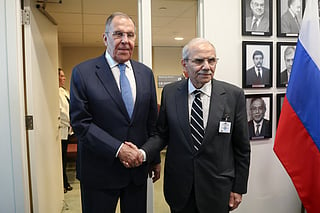
New round of Israel-Lebanon talks begin in Washington
The ambassadors of Israel and Lebanon began a new round of direct talks in Washington on Tuesday after US President Donald Trump said he had received commitments to de-escalation from both sides.
The fourth meeting between representatives of the two countries, which do not have diplomatic relations, is taking place at the State Department and is scheduled to last two days.
Ship off Iraq hit by projectiles: company
Two projectiles hit a container vessel in the Gulf as it was leaving port in Iraq, a Swiss-based company said Tuesday, after Iran's Revolutionary Guards said they had targeted the ship.
Both the company MSC, based in Geneva, and the British maritime security agency UKMTO reported no injuries to crew members in Monday's incident.
In Iran, a spokesman for the Revolutionary Guards said Monday they had targeted the Panama-flagged MSC Sariska V "belonging to the American-Zionist enemy" with a cruise missile.
The spokesman said the container ship was targeted in retaliation for a US attack on the Iranian vessel Lion Star in the Sea of Oman.
The UKMTO said the vessel was 40 nautical miles off the Iraqi port of Umm Qasr when the initial explosion occurred on Monday.
MSC said that the first projectile hit the vessel as it was leaving port with the pilot still on board, and the second impacted the crew area soon afterwards.
In a statement, MSC said it "is a neutral commercial carrier with no affiliation to the United States or Israel".
It said all crew members were safe and unharmed.
Iran World Cup squad to head for Mexico via Spain
Iran's football team will leave for Spain this weekend en route to their World Cup base in Mexico despite still awaiting visas, the head of the country's football federation said.
The 2026 World Cup is being hosted jointly by the United States, Mexico and Canada.
Neither the United States, where Iran will play their three group stage matches, nor Mexico, where the team will be based throughout the tournament, have yet issued visas for the players.
"We will leave for Spain on Saturday, and from there the team will go directly to Tijuana in Mexico," football federation chief Mehdi Taj said on Monday on a sports programme broadcast on state television.
"We will obtain a Mexican visa tomorrow (Tuesday) or the day after, and then a US visa will be issued quickly," Taj said.
Lebanon says Israeli strikes Monday near hospital killed 4, wounded 127
Lebanon's health ministry said Tuesday that Israeli strikes a day earlier near a hospital in the southern city of Tyre killed four people and wounded 127 others, including 39 staff from the facility.
The ministry statement said the wounded staff at the Jabal Amel hospital were "four doctors, 27 nurses, and eight (administrative) employees - four of whom are in critical condition and receiving treatment in intensive care".
The attack "also caused severe and extensive damage across the hospital's various floors, departments, and parking lot"," it added.
Oil falls, stocks rise as traders bet on Mideast progress
Oil prices retreated and stock markets largely gained Tuesday as investors assessed the chances of a Middle East peace agreement, with tech shares enjoying another strong showing thanks to AI enthusiasm.
Crude futures had soared about 7 per cent Monday after an Iranian state news agency announced Tehran had suspended its negotiations with Washington.
But concerns eased after US President Donald Trump said Iran talks were moving rapidly and that Israel and Hezbollah had agreed to stop fighting.
"There is no concrete progress in Middle East negotiations... but investors appear broadly optimistic that a longer-term resolution will be reached," said Susannah Streeter, chief investment strategist at Wealth Club.
An end to the war would likely boost the global economy, which has been battered by surging energy costs that risk a renewed spike for global interest rates.
Lebanon university postpones exams after Israeli strike kills students
Lebanon's public university said on Tuesday it was postponing some examinations after two students and their father were killed while returning to south Lebanon after sitting exams a day earlier.
The state-run National News Agency (NNA) said a dentist from the border village of Qlayaa "was killed with his son and daughter when an enemy drone targeted his car on the Nabatieh-Khardali road" on Monday.
The Lebanese University in a statement on X mourned the loss of the two students "in an Israeli attack targeting civilians on the Khardali road".
The institution, "which has lost a large number of its students, lecturers and employees during the Israeli aggression, affirms that the safety of the university community remains the highest priority".
Austria expresses concern over expansion of Israeli offensive in Lebanon
Austrian Foreign Minister Beate Meinl-Reisinger expressed concern over the expansion of the Israeli offensive in Lebanon and strongly condemned the announced attacks on Beirut.
In a statement, Meinl-Reisinger said: "We strongly condemn the announcement of attacks on Beirut," stressing that such attacks "constitute a serious violation of the ceasefire and a further escalation."
At the same time, she emphasised the need to put an end to attacks against Israel and to disarm Hezbollah, stating that "it is absolutely clear that Hezbollah is the greatest obstacle to peace and stability in Lebanon." She also welcomed the Lebanese government's position, adding: "It is encouraging that the Lebanese government has recently and unequivocally distanced itself from this terrorist organization."
She considered direct talks between Lebanon and Israel to be the best available option and thanked the United States for its mediation efforts.
The Austrian Foreign Minister also renewed her country's support for the Lebanese Armed Forces through diplomatic efforts in cooperation with European Union partners, including the reallocation and increase of humanitarian assistance.
Israel kills 8 in southern Lebanon
Israeli drone strikes on southern Lebanon killed eight people, including a father and his son and daughter, a day after Trump said Israel and Hezbollah agreed to dial back fighting.
Lebanon's State-run National News Agency reported that an Israeli drone strike hit a car on the road linking the southern town of Marjayoun with the city of Nabatiyeh, killing James Karam, a dentist from the nearby Christian town of Qlayaa, along with his daughter and son. The Lebanese army said two soldiers were lightly wounded when a separate drone targeted them on a road outside the city.
A drone strike on the village of Jibchit killed two Syrians who worked at a plant nursery, the agency reported, while another on the nearby village of Toul killed two people. A third strike hit a car near the village of Harouf, killing one person.
NNA also reported that an Israeli airstrike on Monday killed six in the southern village of Marwaniyeh.
Hezbollah said Tuesday its fighters fired anti-tank missiles on Israeli troops who were pushing into the southern village of Hadatha, about 7 kilometers (4 miles) from the Israeli border. Sirens sounded in several areas in northern Israel, the military said in a statement, adding that "a suspicious aerial target" was identified in the area in which Israeli soldiers are operating in southern Lebanon, and that no injuries were reported.
Get updated faster and for FREE: Download the Gulf News app now - simply click here.
Iran has paid heavy price: Netanyahu
Israeli Prime Minister Benjamin Netanyahu said Iran has already paid a “very heavy price,” adding that the country’s ruling system is weakening under pressure.
In a post on X, Netanyahu said the “foundations of this reign of terror in Iran have been cracked” and claimed it would not recover to its previous state.
He further asserted that Iran’s leadership is “destined to fall,” signalling continued hardline rhetoric as tensions remain high between Israel and Iran.
Bahrain bans citizens from travelling to Iran and Iraq
The Ministry of Interior of the Kingdom of Bahrain has banned citizens from travelling to Iran and Iraq, citing ongoing regional security tensions.
The ministry affirmed that the necessary legal action would be taken against violators. The advisory comes as authorities tighten precautionary measures amid continued instability in parts of the Middle East.
Iran yet to submit ceasefire response to mediators: Report
Iran has not yet submitted its final response to a proposed interim ceasefire agreement with the United States, according to a report by Iran's semi-official Mehr News Agency.
Citing an unnamed informed source, the report said Tehran is still reviewing the final draft and no official reply has been sent to mediators.
The source said Iran's approach remains cautious due to what it views as a long history of the United States failing to honour commitments, adding that deep-rooted mistrust continues to shape discussions.
According to Mehr, Iran is seeking "real and tangible benefits" from any potential agreement before moving forward, suggesting negotiations remain ongoing despite efforts to secure a ceasefire framework.
Senior Iranian officer says renewed war with US 'inevitable'
A senior Iranian military officer said that a resumption of hostilities with the United States was inevitable, as negotiations between Tehran and Washington appeared to stall.
"The United States demands our total surrender, and the Iranian nation will never surrender," said Mohammad Jafar Assadi, deputy head of Iran's central military command, Khatam Al Anbiya. "Without surrender, war is inevitable."
How one Iranian missile could trigger a US counterstrike
When a US surveillance drone is shot down by an Iranian missile, the immediate image is one of military success: a multimillion-dollar aircraft such as the falling from the sky.
On Sunday (May 31, 2026), Iran's Islamic Revolutionary Guard Corps (IRGC) announced that its air defence forces shot down a $4-million MQ-1 Predator drone and fired at an "intruding" F-35 fighter jet over the Arabian Gulf. Tehran claimed the aircraft violated its airspace.
The US military strongly denied the shotdown of the $100-million F-35, stating all assets remained "accounted for". This triggered "measured and deliberate strikes" on Saturday and Sunday in response to what it described as "aggressive Iranian actions". Read more
Get updated faster and for FREE: Download the Gulf News app now - simply click here.
Gargash blames Iran’s expansive policy for instability
Dr Anwar Mohammed Gargash, Diplomatic Adviser to the UAE President, said the entire Arab region is paying the price for what he described as Iran's inflated regional ambitions, calling for a reassessment of regional relations based on sovereignty, good neighbourliness and non-interference.
In a post on X platform, Gargash said ongoing instability stretching from the Arabian Gulf to Yemen, Lebanon and Iraq reflects the consequences of Tehran's expansive policies that undermine regional security and prosperity.
The remarks come amid heightened tensions across the Middle East and ongoing diplomatic efforts to reduce regional conflicts and promote long-term stability.
“A policy was both necessary and inevitable, as our future relations with Iran should be built on clear foundations, including respect for sovereignty, good neighbourliness and non-interference in the affairs of others”.
Cargo ship damaged after claimed Iranian missile strike
State media footage showed a large hole in the side of an MSC-branded cargo ship after Iran's Revolutionary Guards claimed they hit the vessel, identified as the MSC Sariska, with a cruise missile.
Earlier, UK Maritime Trade Operations (UKMTO) reported that a merchant vessel was struck about 40 nautical miles southeast of Iraq's Umm Qasr port, triggering two explosions and a fire that was later extinguished.
No injuries were reported, and the vessel continued its voyage. Authorities are investigating the incident and have urged ships in the area to exercise caution.
‘Nothing justifies’ prolonged Israeli occupation in Lebanon: France FM
France's foreign minister said that nothing could justify Israeli troops remaining deep inside Lebanon, following the deepest incursion into Lebanese territory in two decades.
Israel and Iran-backed Lebanese militant group Hezbollah clashed overnight despite US President Donald Trump's announcement that both sides had agreed to halt fighting ahead of US-hosted talks between Israel and Lebanon.
"Nothing can justify the continuation of military operations and Israel's prolonged occupation deep inside Lebanese territory," Foreign Minister Jean-Noel Barrot told France TV.
Israeli attacks target multiple areas in southern Lebanon
Israeli forces continue strikes across southern Lebanon, with artillery fire reported near Nabatieh and attacks hitting Shukin and Kafr Tibnit, according to reports. Separately, Israeli drones carried out three strikes on the town of Tallet Tol in the Nabatieh district, reports said. In another incident, an Israeli airstrike hit the area near Tibnin.
US to cut tariffs on agricultural equipment as costs bite
US President Donald Trump signed an order Monday to cut tariffs on agricultural equipment, the White House said, as farmers and manufacturers face pressure from surging costs over the Middle East war.
Trump's proclamation reduces the duty rate on machinery like harvesters, alongside certain other equipment, from 25 percent to 15 percent.
Foreign companies can also qualify for a 10-percent duty rate if their manufacturing equipment contains at least 85 percent US steel or aluminum, the White House added in a fact sheet.
The changes take effect on June 8 and last until December 31, 2027.
Farmers have raised concern over rising costs ahead of key midterm elections, and face a further squeeze from the Middle East war as diesel and fertilizer prices have surged.
Get updated faster and for FREE: Download the Gulf News app now - simply click here.
Qatari PM, Iranian FM discuss mediation efforts
Qatar's Prime Minister and Minister of Foreign Affairs, Sheikh Mohammed bin Abdulrahman bin Jassim Al-Thani, held a phone call with Iranian Foreign Minister Seyed Abbas Araghchi to discuss regional developments, according to Qatar's Foreign Ministry.
The ministry said in a statement that the two officials reviewed Pakistani mediation efforts between the United States and Iran, as well as the latest developments in Lebanon.
Al-Thani reaffirmed Qatar's support for reaching a comprehensive agreement to resolve the crisis, urging all parties to engage constructively with mediation initiatives to achieve lasting peace and regional stability, reports Xinhua news agency.
He also stressed that freedom of navigation is a fundamental principle that must not be compromised, warning that closing the Strait of Hormuz or using it as a tool of pressure would only deepen the crisis and jeopardise the vital interests of regional countries.
The Qatari prime minister reiterated the importance of pursuing diplomatic solutions and dialogue to address regional challenges and prevent further escalation, according to the statement.
Get updated faster and for FREE: Download the Gulf News app now - simply click here.
Asian stocks swing on mixed signals over Middle East
Equities fluctuated as investors assessed the likelihood of a Middle East peace agreement as US-Iran talks stuttered, while Donald Trump and Israel's Benjamin Netanyahu gave mixed signals over ending Israel's attacks in Lebanon.
While Wall Street ended with more tech-led records, traders took a breather in Asia following a recent strong run-up, with attention also turning to the release of US jobs data at the end of the week.
With uncertainty continuing to hang over the crisis, Asian equity traders moved cautiously after a healthy, tech-fuelled run-up that has pushed some markets to record highs.
Seoul, which has been at the forefront of the rally this year, dropped almost two percent, while Tokyo was off more than one percent, having also hit fresh new peaks.
Shanghai, Sydney and Wellington were down, though there were gains in Hong Kong, Singapore, Taipei, Manila and Jakarta.
That came on the back of records for all three main indexes on Wall Street that came as chip titan Nvidia rocketed more than six percent after unveiling a powerful laptop chip for Windows machines.
Traders are also awaiting the release of key US jobs figures on Friday, which should provide a fresh snapshot of the US economy as rising energy prices sends inflation rising.
They will also be the first under new Federal Reserve boss Kevin Warsh after he last month replaced Jerome Powell, who was constantly rebuked by Trump for not cutting interest rates enough.
UN Security Council presses Israel over Lebanon escalation
At an emergency UN Security Council meeting on Monday, most members — with the exception of the United States — called for Israel to pull its forces out of southern Lebanon and avoid further escalation, according to The New York Times.
The session, convened at France’s request, came amid rising tensions and mass displacement in Lebanon, where tens of thousands fled their homes as shelters became overcrowded following warnings of imminent Israeli strikes on Beirut’s southern suburbs.
The day also saw Israel advancing further into southern Lebanon, fuelling fears of a widening military operation and deepening panic across the country.
Iran warns US, Israel of severe consequences over Lebanon attacks
Ebrahim Azizi, chair of Iran’s parliamentary national security committee, has warned of serious repercussions for Israel and US forces in the region if Israeli strikes in Lebanon continue.
In a post on X, he said: “If the attacks against Lebanon do not stop completely, the consequences will be severe for the Zionist regime and US forces in the region.”
He added: “They are fully aware that this is not an empty threat, and we are prepared for a military response.”
Israel military says intercepted projectiles from Lebanon
The Israeli military said air defences intercepted two projectiles from Lebanon, hours after US President Donald Trump announced that fighting would end.
"Following the sirens that sounded at 01:35 (2235 GMT) in several areas in northern Israel, the IAF intercepted two projectiles that crossed from Lebanon into Israeli territory," the military said on Telegram.
A "suspicious aerial target" that later fell in Israeli territory near the Lebanese border was also identified it said, adding that no injuries were reported.
It came after Trump announced he had persuaded Israel and Hezbollah to de-escalate.
IRGC claims missile strike on 'US-owned' vessel in Arabian Gulf
The Islamic Revolutionary Guard Corps (IRGC) has claimed it fired a cruise missile at a Panama-flagged container ship, identifying it as the “US-owned” MSC Sariska V, Iranian media reported.
The operation was described by the IRGC as retaliation for an earlier strike near the coast of Oman targeting an Iranian vessel.
The claim comes amid reports of a separate incident in the Arabian Gulf, where a cargo ship was hit by an unidentified projectile, causing a large explosion off Iraq’s coast and prompting an investigation.
121 ships redirected as US rachets up Iran blockade
The US naval blockade continues to choke Iran, with 121 ships redirected and five "disabled" so far as of June 1, according to the Central Command (CentCom), which oversees US military operations in the Gulf and Middle East.
The move ensures "compliance" to the US naval blockade of Iranian ports, initiated on April 13, 2026, under orders from President Donald Trump following the collapse of nuclear negotiations.
The blockade "remains in full effect", CentCom stated, adding their forces as strictly enforcing it against all vessels attempting to enter or exit Iranian ports along the Arabian Gulf and Gulf of Oman.
The blockade aims to economically pressure Iran by restricting its oil exports and imports through its ports.
Ghalibaf warns of action if Israel expands Lebanon offensive
Iran's parliamentary speaker Mohammad Bagher Ghalibaf threatened to halt negotiations and confront Israel if its military operations in Lebanon continue, amid heightened regional tensions.
Ghalibaf said he had phone call with Nabih Berri, speaker of Lebanon's parliament, in which emphasised solidarity with Hezbollah and Lebanese allies. "If the Zionist regime's crimes in Lebanon persist, we will not only stop the talks but will stand against them," he posted on X.
He concluded with chants of "Long live the resistance! Long live the defense of the motherland! Long live the brotherhood of the Iranian and Lebanese nations!"
The statement comes against the backdrop of Israel's ongoing campaign against Hezbollah in southern Lebanon, part of broader 2026 hostilities that have included direct Iran-Israel exchanges.
Iran has long provided support to the Hezbollah, the powerful Iran-backed militia that has long operated as a "state within a state".
The group, listed as a terrorist organisation by the UAE, the GCC, the US, the UK and several other countries, is a key proxy in Iran's narrative of "axis of resistance" against Israel.
Ghalibaf, a prominent hard-liner and former IRGC commander, plays a key role in Iran's strategic messaging and past ceasefire talks. His remarks underscore Tehran's willingness to escalate support for allies despite diplomatic pressures.
Get updated faster and for FREE: Download the Gulf News app now - simply click here.
Iran’s missile video sends message to Trump amid fragile peace talks
Iranian state media has released dramatic footage purporting to show missile launches carrying messages directed at the United States, in what analysts view as a calculated show of force amid increasingly fragile negotiations between Washington and Tehran.
The video, aired Monday by the state broadcaster Islamic Republic of Iran Broadcasting (IRIB), emerged just days after US and Iranian forces exchanged fire in the Gulf and as President Donald Trump reportedly returned revisions to a proposed agreement aimed at extending a regional ceasefire.
CNN reported that it could not independently verify where or when the footage was recorded, a reminder of the information warfare increasingly accompanying the military confrontation. Still, the symbolism of the video appears difficult to miss: Iran signaling that even while negotiations continue, its missile forces remain active and central to its deterrence strategy.
Earlier this year, Iranian outlets released missile videos mocking Trump following threats of military action against Tehran.
Oil prices hover near $95
Crude oil futures held near multi-month highs on Tuesday (June 2, 2026), with US benchmark WTI trading around $92 per barrel and international Brent near $95 as of 8.07am Tokyo, as lingering fallout from the US-Israel-Iran conflict continues to disrupt critical Middle East energy flows.
The elevated prices reflect persistent supply fears more than three months into regional hostilities that effectively closed the Strait of Hormuz — the narrow chokepoint carrying roughly one-fifth of global seaborne oil — and triggered production shut-ins across multiple Gulf nations.
Conflicting US-Iran statements deepen uncertainty over talks
The status of ongoing US-Iran peace negotiations remained unclear on Tuesday as both sides issued conflicting statements on whether talks were advancing or on the verge of "collapse", deepening uncertainty over the future of the Strait of Hormuz and Iran’s nuclear enrichment program.
Fresh doubts emerged after Iranian state-linked media reported that Tehran had suspended indirect message exchanges with Washington following renewed Israeli military operations in Lebanon.
Ben-Gvir says ‘no’ to Trump over Iran peace push
Israeli National Security Minister Itamar Ben-Gvir has publicly urged Prime Minister Benjamin Netanyahu to reject pressure from US President Donald Trump and avoid concessions to Iran, exposing growing divisions within Israel's ruling coalition over ongoing peace negotiations.
“Time to say no to Trump,” Ben-Gvir stated, arguing that Israel should not accept any agreement that leaves Iran with nuclear capabilities or preserves the influence of Tehran-backed groups across the Middle East.
The remarks come as Washington seeks to broker a broader settlement with Iran following months of conflict that disrupted regional energy supplies and threatened shipping through the Strait of Hormuz.
US negotiators have reportedly pushed for a framework involving limits on Iran’s uranium stockpile, security guarantees in the Gulf and the reopening of key maritime routes.
Get updated faster and for FREE: Download the Gulf News app now - simply click here.
US taps emergency oil stockpile amid supply crisis: CNN
The Trump administration continues to rapidly release oil from America’s emergency stockpile in a bid to ease the supply crisis caused by the war with Iran, reports CNN.
According to Energy Department data released on Monday, the Strategic Petroleum Reserve lost another 8 million barrels of crude last week alone.
That’s down from 9.1 million barrels the week before and a record-setting 9.9 million the week ending May 15.
Netanyahu warns Trump: Israel may strike Beirut
Israeli Prime Minister Benjamin Netanyahu said on Monday he told US President Donald Trump that his country would strike Beirut if Hezbollah doesn't stop attacking Israel.
"I spoke this evening with President Trump and told him that if Hezbollah does not cease attacking our towns and our citizens, Israel will strike terrorist targets in Beirut," Netanyahu said, according to a statement released by his office.
"Our position on this remains unchanged. At the same time, the IDF will continue to operate as planned in southern Lebanon," he added.
Lebanon’s US embassy says Hezbollah accepts US ceasefire plan
Lebanon's US embassy said on Monday that Hezbollah had accepted a US proposal for a "mutual cessation of attacks", after Israel threatened more strikes on south Beirut on the eve of a fourth round of Israel-Lebanon negotiations.
The announcement came after US President Donald Trump said Monday he had persuaded Israel and Hezbollah to de-escalate, with Prime Minister Benjamin Netanyahu agreeing not to send troops to southern Beirut and the Lebanese militant group promising to stop attacks.
"The Lebanese authorities received confirmation of Hezbollah's acceptance of the US proposal providing for a mutual cessation of attacks," said an embassy statement published by Lebanese President Joseph Aoun's office.
It said the confirmation came after a telephone call between Aoun and US Secretary of State Marco Rubio.
On Sunday, a senior US official had told AFP that Rubio spoke with Aoun and Netanyahu about the ongoing diplomatic negotiations.
Get updated faster and for FREE: Download the Gulf News app now - simply click here.
US‑Israel war on Iran: Recent developments
Day 94: Kuwait intercepts missiles, drones; Iran halts US talks
Day 93: Trump asked for tougher terms in proposed Iran war deal
Day 92: Hormuz disruption raises summer fuel shortage fears
Day 91: Trump wraps Iran talks without announcement
Day 90: US, Iran reach deal pending Trump's final approval
Day 89: Trump says 'not satisfied' yet on Iran deal
Day 88: Iran condemns US attacks as violation of ceasefire
Day 87: 'Proceeding nicely': US-Iran talks intensify, oil drops
Day 86: US-Iran talks: Trump says 'I don’t make bad deals'
Day 85: Trump: Iran deal ‘largely negotiated’, Hormuz to open