Iran Guards claim US drone downed over its airspace; Trump to meet cabinet at Camp David; internet returns to Iran after 88 days
Strikes on Iran coincide with Doha push for US‑Iran deal and Hormuz reopening
Highlights
We are closing this coverage now. For latest updates, click here.
US CentCom denies escorting ships transiting Hormuz Strait
The military has denied resuming escorts of commercial vessels through the Strait of Hormuz. In a statementm the Central Command, which overseas US military operations in the Middle East said "Project Freedom has not resumed, and US forces are not currently escorting commercial vessels through the Strait of Hormuz."
Trump calls off rare Camp David meeting due to weather
US President Donald Trump said he had shifted a rare Cabinet meeting planned for Wednesday at his Camp David retreat to the White House because of bad weather. The meeting at the secluded lodge in the Maryland hills was expected to focus on talks to end the Iran war.
Iran threatens to retaliate after US strikes on launch sites and boats
Tensions between the US and Iran surged again after Tehran warned of retaliation over fresh military strikes targeting Iranian missile launch sites and mine-laying boats near the strategically vital Strait of Hormuz.
Iran condemned the US attacks as a "gross violation" of the ceasefire.
The overnight attacks marked the first direct US strikes inside Iran since a fragile ceasefire framework began taking shape earlier this month.
According to US Central Command, American forces launched what officials described as “self-defence strikes” against missile batteries and vessels allegedly threatening US aircraft and commercial shipping routes in southern Iran. Iran condemned the operation as a violation of ongoing ceasefire negotiations and warned Washington that any further attacks would trigger a response.
Trump's lashes out at media on social media
US President Donald Trump posted on his Truth Social: "If Iran surrenders, admits their Navy is gone and resting at the bottom of the sea, and their Air Force is no longer with us, and if their entire Military walks out of Tehran, weapons dropped and hands held high, each shouting “I surrender, I surrender” while wildly waving the representative White Flag, and if their entire remaining Leadership signs all necessary “Documents of Surrender,” and admit their defeat to the great power and force of the magnificent U.S.A., The Failing New York Times, The China Street Journal (WSJ!), Corrupt and now Irrelevant CNN, and all other members of the Fake News Media, will headline that Iran had a Masterful and Brilliant Victory over The United States of America, it wasn’t even close. The Dumacrats and Media have totally lost their way. They have gone absolutely CRAZY!!! President DJT"
Israeli military issues evacuation warning for 19 south Lebanon villages
The Israeli military issued two new evacuation warnings on Tuesday for residents of 19 villages across southern Lebanon, as it expanded its ground operations deeper inside Lebanese territory.
"For your safety, you must evacuate your homes immediately and move north of the Zahrani River," the military's Arabic-language spokesman, Colonel Avichay Adraee, wrote on X, listing 14 villages.
Minutes later, he issued another warning calling on residents of five more villages to evacuate.
KLM cancels flights to Dubai up to August
KLM has decided to cancel flights to Dubai up to and including August 2. Flights to Riyadh and Dammam have been canceled up to and including July 12, it announced through its website.
Israel says targeted new Hamas armed wing chief in Gaza strike
Israel said it targeted the new chief of Hamas' armed wing in a strike in Gaza on Tuesday, just days after his predecessor was killed in a similar attack in the Palestinian territory.
"Under the direction of Prime Minister Benjamin Netanyahu and Defence Minister Israel Katz, the IDF has just carried out a strike in Gaza targeting Mohammed Odeh - the new commander of the military wing of the Hamas terrorist organisation and one of the architects of the October 7 massacre," a joint statement issued by Netanyahu and Katz said.
Odeh was appointed as chief of the Ezzedine Al-Qassam Brigades after his predecessor Ezzedine Al-Haddad was killed in a strike in Gaza earlier in May.
Iranians greet partial internet restoration with skepticism after 88-day blackout: CNN
Iranians reacted with a mix of skepticism, caution and sarcasm on Tuesday after internet monitors reported a partial restoration of online access following months of near-total isolation under a nationwide shutdown imposed by Iranian authorities.
“Yes, I’m connected, but I still have to use a VPN. Don’t get too excited though — the internet isn’t fully open, it’s just no longer completely shut down,” a 46-year-old man in Tehran told CNN on the condition of anonymity because of security concerns.
Strikes hit south Lebanon city as Israel expands ground operations
Several strikes hit the southern Lebanese city of Nabatieh on Tuesday after an Israeli evacuation warning, an AFP correspondent said, as an Israeli military official confirmed ground operations had expanded deeper into the country.
The latest strikes came after Israeli Prime Minister Benjamin Netanyahu on Monday ordered his military to intensify attacks on Hezbollah to "crush" the Iran-backed group, the same day at least 11 people were killed in a strike in eastern Lebanon.
An AFP correspondent in Nabatieh reported airstrikes following the warning on Tuesday and saw plumes of smoke rising from various locations within the city.
An Israeli military official told AFP that troops had begun operating beyond the Israel-announced "Yellow Line" in south Lebanon, which runs around 10 kilometres (six miles) deep inside Lebanese territory.
Leaders of Iran and Qatar discuss de-escalation in phone call: CNN
The leaders of Iran and Qatar spoke over the phone today about de-escalation efforts regarding the ongoing conflict in the Middle East, according to a readout of the conversation shared by Qatar’s Amiri Diwan, the administrative offices of the emir, reported CNN.
It added, Qatar’s emir, Sheikh Tamim bin Hamad Al Thani, spoke to Iran’s President Masoud Pezeshkian, where they “reviewed the latest developments in the region and the efforts being made to reduce escalation, preserve regional security, and strengthen peace and stability,” the Amiri Diwan said.
Oil back at $100 as US strikes douse Iran war hopes
Oil prices rebounded back to $100 on Tuesday while stock markets were mixed and the dollar firmed after US military strikes on Iran deflated hopes of an imminent deal to reopen the Strait of Hormuz.
The United States and Iran have been working on an agreement to end the Middle East war and reopen the crucial waterway to tanker and cargo traffic since a fragile ceasefire on April 8.
But the fresh strikes had Tehran warning it was ready to retaliate after it accused Washington of breaching their truce with what US Central Command described as "self-defence strikes".
Stock markets had rallied Monday and crude futures dropped below $100 a barrel after reports that a deal might come within days.
That was before US forces said they had attacked missile sites in southern Iran and boats trying to lay mines.
Brent North Sea crude, the international benchmark, jumped almost 4.5 per cent Tuesday to edge back above $100 a barrel.
Iranian delegation returns from negotiations in Qatar: CNN
Senior officials from Iran returned to their country on Tuesday after seeing mediators in the Qatari capital of Doha, as ceasefire talks between Tehran and Washington grind on, reported CNN.
It added: "The trio — Iranian parliament speaker Mohammad Bagher Ghalibaf, Foreign Minister Abbas Araghchi and the governor of the Central Bank of Iran Abdolnaser Hemmati — 'returned to the country a few hours ago', according to the state-affiliated Islamic Republic of Iran Broadcasting agency.
"Qatari and Iranian diplomats chiefly discussed Iran’s “frozen funds,” the semi-official Fars news agency reported on Tuesday. Crippling US sanctions and regional violence have exacerbated an economic crisis in Iran, with Tehran urging the immediate unfreezing of billions of dollars of assets stored in banks overseas."
Trump to meet cabinet at Camp David on Iran
US President Donald Trump is set to hold a rare cabinet meeting at the Camp David presidential retreat on Wednesday as Iran talks near a critical point, a White House official told AFP.
The choice of the secluded retreat in the Maryland mountains - which Trump hardly ever visits, in a break with previous presidents - reflects the sensitive nature of discussions.
The New York Post reported that Iran was set to dominate the meeting, which was expected to be attended by all cabinet members. The economy was also on the agenda, it said.
Trump said Saturday that a deal with Tehran to end the Middle East war was close but negotiations are still tense, with the US leader warning that strikes on Iran could resume.
Camp David has been the scene of major US-led diplomatic developments in the past, including the 1978 accords between Israel and Egypt under President Jimmy Carter and a failed 2000 Israeli-Palestinian summit under Bill Clinton.
Iran vice president says first steps taken to restore internet after shutdown
Iran's vice president said on Tuesday that the government has taken the first steps to restore the internet after a near-total blackout since war with the United States and Israel broke out in late February.
"The first step toward free and regulated access to cyberspace has been taken," Vice President Mohammad Reza Aref said in a post on X, adding that the demands of Iranians "will be fulfilled".
Iran sees 'partial restoration' to internet after three-month shutdown: monitor
Iranian authorities partially restored internet connectivity Tuesday after an almost three-month shutdown imposed against the backdrop of the war against Israel and the US, said a monitor, a senior official and sources inside the country.
The shutdown left Iranians largely cut off from international networks, with only a domestic intranet working for daily tasks like shopping, ride-hailing and education.
"Live metrics show a partial restoration to internet connectivity in Iran on day 88," of the shutdown, monitor Netblocks said on X, saying it was "unclear" if this meant a permanent end to the "longest nationwide internet shutdown in modern history".
Vice President Mohammad Reza Aref said in a post on X that the "first step toward free and regulated access to cyberspace has been taken," adding that the demands of Iranians "will be fulfilled."
Sweden halves price of public transit cards over energy crisis
Sweden will cut the price of monthly public transit passes in half to soften the blow from soaring energy costs due to the Middle East war, the government said Tuesday.
The discounts will begin in July and last for six months. A monthly pass in Stockholm currently costs 1,060 kronor ($114).
"We cannot eliminate all the consequences of the war. That's obviously impossible," Prime Minister Ulf Kristersson told reporters.
"But we can mitigate the consequences so that the upturn in the Swedish economy is not interrupted," he said.
The left-wing opposition criticised the announcement as election pandering ahead of a September 13 general election.
The government has reduced petrol taxes twice since the start of the war in the Middle East in late-February, when US and Israeli forces began striking Iran.
"The time has come to complement [the reductions to)] those who drive their own car to work with [reductions to] those who commute by public transport," Kristersson said.
The government will present a revised budget to parliament of 6.5 billion kronor ($700 million) to cover the cost.
Iran accuses US of violating ceasefire over past 48 hours
Iran's foreign ministry on Tuesday accused the United States of violating a fragile ceasefire during the past 48 hours in the southern coastal province of Hormozgan, without specifying the incident.
"The US terrorist army, continuing its illegal and unjustified actions since the ceasefire ... has, in the past 48 hours, committed a gross violation of the ceasefire in the Hormozgan region," the ministry said in a statement.
The US terrorist army, continuing its illegal and unjustified actions since the ceasefire ... has, in the past 48 hours, committed a gross violation of the ceasefire in the Hormozgan region"Iran's foreign ministry
The US Central Command said forces had on Monday attacked missile sites and boats it said were trying to lay mines in the Gulf, while Iran's Revolutionary Guards said it had fired at US aircraft attempting to enter the country's airspace.
Lebanon says Israeli strike on Monday killed at least 11 people
Lebanon's health ministry said Tuesday that an Israeli strike a day earlier killed at least 11 people, two of them children, as the Israeli military said it had launched strikes on Hezbollah infrastructure.
In a statement, the ministry said that "yesterday's Israeli enemy airstrike on the town of Mashghara in West Bekaa resulted in a preliminary toll of 11 martyrs, including two girls and a woman, and 15 wounded, including a child", adding that rescuers were still clearing the rubble in the eastern town.
Explosion damages tanker off Oman
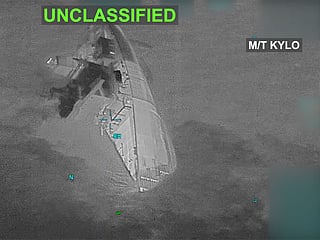
An explosion damaged a tanker close to its waterline as it sailed off Oman, a marine monitor said Tuesday, as tensions remained high around the blockaded Strait of Hormuz.
"The crew and vessel are safe, although the master reports some bunker fuel has discharged into the sea," UK Maritime Trade Operations said.
The incident, in the Gulf of Oman about 60 nautical miles east of Muscat, was an "external explosion", UKMTO added, without detailing the cause of the blast.
Iran has been laying mines in waters nearby as part of its campaign to block Hormuz, which normally carries one-fifth of global oil production.
Hours earlier, US forces launched overnight strikes on missile sites in Iran and on boats that they said were trying to lay mines in Gulf waters.
Iran judiciary suspends presidential body after it ordered internet restored
Iran's judiciary on Tuesday suspended a presidential body that had ordered the restoration of internet access after months of near-total blackout since the start of war with the US and Israel.
The judicial decision targeted the "Special Headquarters for Organising and Governing the Country's Cyberspace", a body formed on May 12 by President Masoud Pezeshkian.
The body had on Monday reached a decision to "restore the internet" in Iran, according to government spokeswoman Fatemeh Mohajerani, after local media reported that Pezeshkian had decreed the measure.
Oil rebounds, stocks drop as US strikes douse Iran war hopes
Oil prices rebounded slightly on Tuesday while stock markets mostly retreated and the dollar firmed after US military strikes on Iran deflated hopes of an imminent deal to reopen the Strait of Hormuz.
The United States and Iran have been working on an agreement to end the Middle East war and reopen the crucial waterway to tanker and cargo traffic since a fragile ceasefire on April 8.
Stock markets had rallied Monday and crude futures dropped below $100 a barrel after reports that a deal could be announced in the coming days.
Those hopes were tempered when US forces said they attacked missile sites in southern Iran and boats trying to lay mines.
Brent North Sea crude, the international benchmark, jumped more than three per cent Tuesday, but was still below $100.
Get updated faster and for FREE: Download the Gulf News app now - simply click here.
Netanyahu finding it hard to sway Trump's decisions: Sources
Israeli Prime Minister Benjamin Netanyahu is said to be having "a hard time influencing Trump's decisions" as Washington pushes forward with its diplomatic agenda in the region, according to Reuters. With an election looming in the fall, Netanyahu faces growing pressure to frame any emerging agreement as a political win, Reuters correspondent Rami Ayyub noted on the Reuters World News podcast, adding that the Israeli leader "faces an election in the fall and will want to be able to paint whatever deal comes out as a success."
Netanyahu aide expected to face indictment
Israeli prosecutors said Tuesday they were considering indicting Prime Minister Benjamin Netanyahu's former chief of staff, Tzachi Braverman, in connection with an investigation into the leak of classified intelligence information.
In a statement, the State Attorney's Office said Attorney General Gali Baharav-Miara and State Attorney Amit Aisman were weighing charges of "fraud and breach of trust, as well as obstruction of justice," subject to a pre-indictment hearing.
Oil climbs after US strikes on Iran
Global oil prices edged higher on Tuesday, clawing back some of the previous session's losses as renewed US military action against Iran dampened hopes of an imminent ceasefire deal. Brent crude rose 3.3% to $99.4 a barrel in early trading, after having shed around 7% on Monday when markets briefly grew optimistic that Washington and Tehran were nearing a preliminary agreement to halt hostilities and lay the groundwork for a broader settlement. Trading activity was also lighter than usual due to public holidays in both the US and UK, according to reports.
Israel military issues evacuation warning for Lebanese city
The Israeli military warned residents of the southern Lebanese city of Nabatiyeh to immediately evacuate on Tuesday ahead of expected attacks against Hezbollah, despite a ceasefire.
"For your safety, you must evacuate your homes immediately and move north of the Zahrani River. Anyone who is near Hezbollah members, facilities or military equipment is putting their life at risk!" the military's Arabic-language spokesman, Avichay Adraee, posted on X.
Iran executes man over cooperation with Israeli spy agency
Iranian authorities on Tuesday executed a man after convicting him of cooperation with and espionage for Israel's Mossad spy agency, the judiciary said.
"Gholamreza Khani Shakarab was executed on charges of intelligence cooperation and espionage in favour of the Zionist regime," the judiciary's Mizan Online website reported, adding that his sentence had been upheld by the Supreme Court.
The Tuesday hanging is the latest in a string of executions by the Islamic republic for security-related cases following the outbreak of war with Israel and the United States on February 28.
Gaza health officials say five killed in Israeli airstrike
Gaza health officials said an Israeli airstrike killed at least five people and wounded several others on Tuesday, in the latest violence to hit the territory despite a ceasefire between Israel and Hamas.
"Five martyrs and several wounded were transferred (to hospital) after an Israeli airstrike targeted a group of citizens in eastern Al-Maghazi," the civil defence agency, which operates as a rescue service under Hamas said.
At least 904 Palestinians have been killed since the October 10 ceasefire, according to Gaza's health ministry, which operates under Hamas authority and whose figures are considered reliable by the UN.
Region will no longer shield the US
Iran's supreme leader Ayatollah Mojtaba Khamenei said on Tuesday that regional countries would no longer be shields for US bases, in a written statement carried by state television.
"What is certain in this regard is that the hands of time will not turn backwards, and the nations and lands of the region will no longer serve as shields for American bases," said Khamenei, who has not appeared in public since he took office in March, in a message marking the Eid Al Adha holiday.
He said the United States "in addition to no longer having any safe haven in the region for aggression and the establishment of military bases, is moving further and further away from its former position with each passing day".
Iran Guards say 'downed' US drone entering airspace
Iran's Islamic Revolutionary Guards said on Tuesday that they had downed a US drone and shot at other aircraft entering the country's airspace.
US military aircraft "entered Iranian airspace in the Arabian Gulf region, and air defence units of the Islamic Revolutionary Guard Corps... identified and shot down an MQ-9 drone," the Guards said in a statement on their Sepah News website.
The Guards forces "also fired upon an RQ-4 drone and an intruding F-35 fighter jet," the statement said, without specifying when the incidents took place.
UAE's strong foundations will see it through the war, says Gargash
UAE Presidential Diplomatic Adviser Anwar Gargash took to X to reaffirm the country's resilience amid regional tensions, posting: "Wars may impose circumstantial challenges, but the UAE was built on solid foundations that make it more capable of cohesion and overcoming them. Conscious leadership, strong institutions, a developed and competitive economy, and authentic values based on solidarity, tolerance, and justice. The UAE's success was not born of chance, but the fruit of a steadfast vision and sincere, continuous work over the years. The UAE is capable of overcoming challenges with confidence and steadfastness."
Israeli strike on village in eastern Lebanon kills 12
An Israeli airstrike on a village in eastern Lebanon killed 12 people, the country's state-run National News Agency said Tuesday.
The strike late Monday in Lebanon's Bekaa Valley area came after Israeli Prime Minister Benjamin Netanyahu said that he had authorized more intensive strikes targeting the Hezbollah militant group across Lebanon. The Israeli military did not comment on this particular strike, but said Monday that it was targeting Hezbollah infrastructure in eastern Lebanon.
Rescue workers say that a dozen bodies were pulled out of the rubble following an intense wave of overnight strikes targeting swaths of southern and eastern Lebanon.
The intensified attacks come three days before Lebanese and Israeli military delegations are set to meet in Washington for direct talks.
Rubio revives 'Quad' with new Asia projects after questions on US
The United States, India, Australia and Japan announced new maritime and critical minerals cooperation on Tuesday, reviving a forum viewed suspiciously by China following questions over the US commitment and disagreement on Iran.
US Secretary of State Marco Rubio took part in the meeting in New Delhi, 10 days after President Donald Trump paid a friendly state visit to China and spoke glowingly of the two powers working together as a "G2" -- a concept that the US allies, which view Beijing's rise warily, fear could shut them out.
Albanese meets UAE minister to discuss regional security
Australian Prime Minister Anthony Albanese met with UAE Minister of State for International Cooperation Reem Al Hashimy on Tuesday, reaffirming the two nations' bilateral ties amid ongoing tensions in the Middle East. Posting on X, Albanese said: "Today I met with Her Excellency Reem Al Hashimy, UAE Minister of State for International Cooperation. Australia and the UAE have a strong relationship, and Australia is committed to stability in the region. We discussed our ongoing work on the security of the UAE, and I thanked her for the support provided to Australians during the conflict in the Middle East."
First oil tanker reaches Japan after Hormuz transit
More than 12 weeks into the conflict with Iran, a Japanese oil tanker has successfully completed a transit of the Strait of Hormuz and reached its home port, marking a significant moment for a country heavily dependent on Persian Gulf energy. The Panama-flagged vessel Idemitsu Maru docked near Chita City on Honshu, Japan's largest and most populous island, on Monday, after making the passage in April, CNN reported. To offset the impact of surging oil prices, Japan has drawn down a historic volume of its strategic petroleum reserves in recent months. Despite this milestone, 39 Japan-linked vessels remain stranded in the Gulf, including one carrying Japanese crew, with Tokyo said to be pursuing active diplomatic channels to secure safe passage for its ships.
Iran calls US Strike a "war crime"
Iranian Foreign Ministry Spokesperson Esmail Baghaei on Tuesday blamed the US for committing a "despicable war crime" after a missile strike hit a sports hall in Lamerd, Fars Province, leaving 24 civilians dead — among them teenage volleyball players and a two-year-old child — and wounding more than 130 others. Baghaei took to X to share details he said were relayed to him by Iranian MP Mousa Mousavi, describing a "devastating American missile strike" on a residential area and sports facility in the city, according to ET.
Rubio tempers hopes for quick Iran deal
US Secretary of State Marco Rubio has indicated that reaching a nuclear agreement with Iran could "take a few days," dampening expectations of an imminent resolution to the ongoing standoff. His remarks came just a day after US forces carried out what Washington described as defensive strikes in southern Iran, adding fresh tension to already fragile diplomatic efforts. Rubio's comments signal that while talks remain on the table, a swift end to the conflict is far from guaranteed, according to Reuters.
Rubio revives 'Quad' alliance in India
US Secretary of State Marco Rubio called Tuesday for a revival of joint cooperation with Australia, India and Japan -- the so-called Quad grouping viewed suspiciously by China -- following disagreement on Iran and questions over US commitment.
The meeting in New Delhi comes 10 days after US President Donald Trump paid a friendly state visit to China and spoke glowingly of the two powers working together as a "G2" -- a concept that the US allies who are concerned about Beijing's rise fear could shut them out.
Hormuz strait will reopen 'one way or the other'
Top US diplomat Marco Rubio insisted on Tuesday that the blockaded Strait of Hormuz would reopen "one way or the other", after fresh US strikes on Iran cast doubt on an accord to end the Mideast war.
"The straits have to be open. They're going to be open one way or the other, so they need to be open," Rubio told reporters in the Indian city of Jaipur, where he was making an official visit.
"What's happening there is unlawful, it's illegal, it's unsustainable for the world, it's unacceptable," he said.
Iran deal still possible within days despite US strikes
US Secretary of State Marco Rubio said on Tuesday that a deal with Iran was still possible despite new American strikes that cast doubt on their fragile ceasefire.
"There were some talks going on in Qatar today, so we'll see if we can make progress. I think it's a lot of talking back and forth going on about specific language in the initial document, so it'll take a few days," Rubio told reporters in Jaipur during a visit to India.
"The president's expressed his desire to make it. He's either going to make a good deal or no deal," he said.
Get updated faster and for FREE: Download the Gulf News app now - simply click here.
US military strikes missile sites in southern in Iran
US forces attacked missile sites in southern Iran and boats trying to lay mines on Monday, US Central Command said, as top Iranian negotiators arrived in Doha for talks to end the war.
"US forces conducted self-defence strikes in southern Iran today to protect our troops from threats posed by Iranian forces," Tim Hawkins, a US Central Command spokesman, said in a statement.
'Proceeding nicely': US-Iran talks intensify in Qatar, as Trump pushes Abraham Accords
The United States and Iran are inching toward a possible breakthrough agreement aimed at ending months of conflict, with negotiators working on what US Secretary of State Marco Rubio described as a “memorandum of understanding” (MOA).
But major disagreements over the wording surrounding Iran’s nuclear programme and the removal of sanctions continue to delay a final deal, CNN reported, citing US "officials".
Iranian officials are currently in Qatar for what a diplomatic source described as “intense talks,” with discussions reportedly continuing behind closed doors as both sides attempt to narrow remaining gaps.
US President Donald Trump struck an optimistic tone, telling reporters negotiations are “proceeding nicely,” while also pressing Middle Eastern nations to join the Abraham Accords once a broader regional agreement is secured.
The Abraham Accords, brokered during Trump’s first term, normalised relations between Israel and several Arab states including the United Arab Emirates and Bahrain. Trump has repeatedly argued that expanding the accords is key to reshaping regional alliances and isolating Iran diplomatically.
Get updated faster and for FREE: Download the Gulf News app now - simply click here.
Oil prices plunge more than 6% on hopes for US-Iran deal, Hormuz reopening
Crude oil prices tumbled sharply in Asian trading early Tuesday, with US benchmarks falling more than 6% as optimism grew over progress in negotiations to end the US-Iran conflict and restore flows through the critical Strait of Hormuz.
West Texas Intermediate (WTI), the US benchmark crude for near-term delivery, was at $90.55 per barrel, down $6.061 or about 6.27%.
Brent crude, the global benchmark, stood at $96.14, off $6.84 or roughly 6.61%, as per Trading Economics.
Murban crude dropped even more sharply to $92.82, down over 9.19%, while Louisiana Light crashed 11.96% to $102.20, down by $13.89 as of 7.47am Tokyo, on Tuesday (May 26, 2026).
Netanyahu orders escalation of Lebanon offensive to 'crush' Hezbollah
Israeli Prime Minister Benjamin Netanyahu said Monday he had ordered the military to intensify its offensive in Lebanon in an effort to "crush" Hezbollah, accusing the group of targeting Israeli forces with drone attacks.
"I have ordered an even greater acceleration of our operations," Netanyahu said in a video statement posted on his Telegram channel.
"It is true that they are attacking us with drones, including fibre-optic drones, but we have teams working on countermeasures and we will solve this issue... We will intensify our blows, increase our firepower, and we will crush them."
Iran’s president orders the reopening of international internet access
Iranian President Masoud Pezeshkian has ordered the reopening of international internet access, state media reported on Monday, following a near-90-day blackout imposed in the aftermath of the war involving the United States and Israel. The report, citing the head of public relations at Iran’s Communications Ministry, said the directive has been issued but did not clarify how or when connectivity to the global web would be restored.
According to internet monitoring group NetBlocks, the blackout has now lasted 87 consecutive days, amounting to more than 2,000 hours of restricted access. The organisation said the shutdown has significantly reduced transparency and deepened uncertainty for detainees, dissidents and other affected groups inside the country.
Get updated faster and for FREE: Download the Gulf News app now - simply click here.
Qatar, Oman leaders highlight importance of regional stability
Sheikh Tamim bin Hamad Al Thani, Emir of the State of Qatar, received a phone call on Monday from Sultan Haitham bin Tarik of Oman, according to QNA.
During the call, the two leaders exchanged Eid Al Adha greetings and discussed bilateral relations as well as key regional and international developments.
The discussion also touched on ongoing efforts to de-escalate tensions, with the Omani Sultan praising the Emir’s role in promoting dialogue and supporting peaceful solutions amid the current crisis.
Both leaders stressed the importance of reaching a swift resolution to help safeguard regional security and stability.
US‑Israel war on Iran: Recent developments
Day 87: 'Proceeding nicely': US-Iran talks intensify, oil drops
Day 86: US-Iran talks: Trump says 'I don’t make bad deals'
Day 85: Trump: Iran deal ‘largely negotiated’, Hormuz to open
Day 84: UAE backs WHO move against Iran's attacks on civilians
Day 83: Trump rejects tolls in Hormuz: 'We want it free'
Day 82: Trump says US-Iran talks are ‘right on the borderline’
Day 81: Iran’s position 'unclear', deal 'uncertain': VP Vance
Day 80: Trump says 'holding off on attack on Iran tomorrow'
Day 79: Trump says 'clock is ticking' for Iran
Day 78: Iran plans new Strait of Hormuz toll system
Day 77: Israel and Lebanon extend ceasefire by 45 days: US
Day 76: World leaders call for security in Strait of Hormuz
Day 75: Trump arrives in Beijing for summit with Xi
Day 74: Iran signals potential 90% Uranium enrichment
Day 73: Trump calls Iranian response 'totally unacceptable'
Day 72: 'As of today, Tehran’s restraint is over': Iran official