Britain's King Charles III speaks beside a bell inscribed “Trump 1946” a gift to US President Donald Trump during a State Dinner in the East Room of the White House in Washington, DC, on April 28, 2026.
US-Iran ceasefire: The war has cost estimated $25 billion, says US, while Trump plans long blockade of Iran's ports
US unlikely to accept offer to end Hormuz chokehold without nuclear program discussions
Last updated:
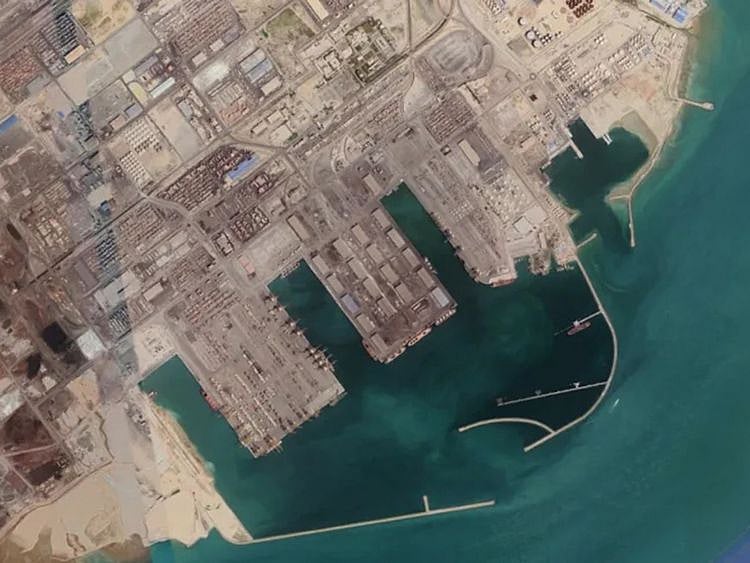
Shahid Rajaee port in Iran. The cyber-attack by the Israeli regime, snarled traffic around the port for days.
GoogleEarth
The UAE announced that it will leave OPEC on Tuesday, a move that has been lauded by US President Donald Trump. Meanwhile, oil sees a record high with Brent shooting above $119/barrel. Iran offered to end its chokehold on the Strait of Hormuz if the US lifts its blockade on the country and ends the war in a proposal that would postpone discussions on the Islamic Republic's nuclear programme. US President Donald Trump seems unlikely to accept the offer. Meanwhile, a Pentagon official said the Iran war has cost estimated $25 billion so far. Follow our live blog for the latest updates.
UAE announces decision to exit OPEC & OPEC+
The United Arab Emirates today announced its decision to exit the Organisation of the Petroleum Exporting Countries (OPEC and OPEC+), effective 1 May 2026. This decision reflects the UAE’s long-term strategic and economic vision and evolving energy profile, including accelerated investment in domestic energy production, and reinforces its commitment to a responsible, reliable, and forward-looking role in global energy markets.
This decision follows a comprehensive review of the UAE’s production policy and its current and future capacity and is based on our national interest and our commitment to contributing effectively to meeting the market’s pressing needs.
Trump claims Iran in "State of collapse"
President Donald Trump posted on social media Tuesday claiming Iran has declared itself in a "State of Collapse" and is requesting the United States help reopen the Strait of Hormuz. Trump indicated Iran is simultaneously working through an internal leadership transition, though he expressed optimism about the country's ability to resolve it. The post signals a potentially significant shift in US-Iran dynamics, with Washington apparently in active communication with Tehran during what the regime itself is describing as a crisis moment.
First tankers slip through Hormuz Strait
The crude supertanker Idemitsu Maru, operated by Japan’s Idemitsu Kosan, has exited the Hormuz chokepoint, making it the first crude oil shipments to move through the Strait of Hormuz after weeks of disruption, signaling a possible easing of tensions following a two-month conflict between the US-Israel and Iran. The vessel departed a "holding position" in the Gulf and was tracked moving through waterway earlier this week. This came after LNG tanker Mubaraz had successfully exited the chokepoint, marking the first such transit since hostilities began, as per ship-tracking data.
Oil prices climb amid ongoing Hormuz risks
Oil prices continued their upward trajectory as of early Wednesday, April 29, 2026, as WTI crude climbed near $100 and Brent at $111+, driven by persistent anxieties surrounding the ongoing risks faced by tankers crossing the Strait of Hormuz. According to the latest market data, benchmarks showed significant gains across the board, even as traders digest the UAE's decision to quit OPEC and OPEC+ effective May 1, 2026.
Gulf Arab countries jointly condemn Iran's actions in the Strait of Hormuz
The leaders of several wealthy Gulf nations rejected Iran's "illegal actions" to close the strait and threaten navigation, warning against any disruption to shipping or charging fees for safe passage.
The statement followed a Gulf Cooperation Council meeting on Tuesday in Saudi Arabia, chaired by Saudi Crown Prince Mohammed bin Salman and attended by leaders from Qatar and Bahrain, Kuwait's crown prince, and the United Arab Emirates' foreign minister.
They called for restoring "security and freedom of navigation" to prewar levels and urged deeper military integration, including joint infrastructure projects and a ballistic missile early warning system.
US budget airlines seek billions in aid amid soaring fuel costs
Their trade group is asking the Trump administration for $2.5 billion to offset rising jet fuel costs and keep ticket prices affordable. The Association of Value Airlines said smaller carriers are being hit hardest by the jump in fuel prices, despite carrying more than 90 million passengers last year.
"Temporary government support" would help "preserve vital industry competition," the association said.
The trade group represents Frontier, Allegiant, Avelo and Sun Country. Another member, Spirit, is separately in talks with the U.S. government on a potential financing deal aimed at keeping the struggling carrier flying as it navigates fuel price shocks during its second bankruptcy since 2024.
An Israeli military contractor is killed by drone strike in southern Lebanon
A brief statement by the Israeli army said the civilian employee of an engineering company was working with the military on projects in southern Lebanon.
An Israeli military official confirmed the contractor was a civilian and died in a drone attack. The official spoke on condition of anonymity under military briefing rules.
Despite a ceasefire in Lebanon, Israeli forces and Hezbollah militants have been intermittently attacking each other in the south, where Israeli soldiers are occupying a slice of territory along the border.
US fuel prices hit highest level since Russia-Ukraine war
US fuel prices surged to an average of $4.18 per gallon for petrol (gasoline) — the highest level recorded since the 2022 onset of the Russia-Ukraine war — as fears of a long-term energy crisis mount. The price spike follows reports from the Wall Street Journal and the Associated Press confirming a deadlock between Washington and Tehran over the ongoing two-month conflict and the reopening of the vital Strait of Hormuz.
Bahrain minister says it's time to find solutions to restore peace after Iran strikes
Foreign Minister Abdullatif bin Rashid Al-Zayani urged the international community at this critical time "to shift from crisis management to finding solutions" to the Iranian crisis.
This should include constructive dialogue that ensures Iran's compliance with principles of good neighborliness and international law, respect for the sovereignty of states and freedom of navigation in the Strait of Hormuz and other vital waterways, he said.
Al-Zaysni, who chaired a ministerial meeting of the U.N. Security Council, told diplomats Iran must also halt its nuclear, missile and drone programs, refrain from arming or financing proxies and armed militias, and stop attacking Bahrain and other Gulf countries and Jordan.
Trump, with King Charles, says US has 'militarily defeated' Iran
US President Donald Trump told Britain's King Charles III and other guests at a state dinner Tuesday that Iran has been "militarily defeated," in his first public comments on the sensitive topic during the ongoing royal visit.
"We have militarily defeated that particular opponent," Trump said at the White House dinner, adding: "Charles agrees with me even more than I do - we're never going to let that opponent have a nuclear weapon."
King Charles urges Western unity
In an address to the US Congress, King Charles III urged the United States to stand firm with its Western allies, noting that the meeting in Washington came "in times of great uncertainty".
The monarch added that these were "times of conflict from Europe to the Middle East which pose immense challenges for the international community and whose impact is felt in communities the length and breadth of our own countries".
Trump has publicly and repeatedly criticised the UK for not supporting the war in Iran.
US lawmakers to grill Pentagon chief on Iran war
US Defense Secretary Pete Hegseth will face tough questions from lawmakers about the Iran war on Wednesday during his first testimony to Congress since the start of the conflict.
Hegseth's appearance before the House Armed Services Committee will be for a hearing on President Donald Trump's $1.5 trillion defense budget request.
Lawmakers from both parties have previously expressed dissatisfaction with the information provided in classified briefings on the war, setting up a potentially fiery public hearing in which top US military officer General Dan Caine is also set to testify.
Trump claims King Charles aligns with US stance
US President Donald Trump sparked a diplomatic conversation by asserting that Britain's King Charles III is firmly aligned with Washington's stance against Tehran's nuclear ambitions. The President integrated the volatile subject of the Middle East conflict into his formal remarks during a high-profile White House state dinner held in honour of the visiting monarch.
During his address, the President shifted from ceremonial pleasantries to the geopolitical arena, referencing the US-Israeli military campaign against Iran. This conflict has surfaced as a significant point of contention between the United States and the United Kingdom.
"We're doing a little Middle East work right now," Trump noted, before adding, "and we're doing very well."
US embassy congratulates Iraq's PM-designate, says hopes for peaceful future
The US embassy in Baghdad congratulated Iraq's new prime minister-designate Ali al-Zaidi on Wednesday, after Washington's interference scuppered the chances of former candidate Nouri al-Maliki.
"US Mission Iraq extends its best wishes to Prime Minister-Designate Ali al-Zaidi as he works to form a government capable of fulfilling the hopes of all Iraqis for a brighter and more peaceful future," the embassy posted on X.
King Charles to stress UK-US cultural, trade ties in New York
King Charles III will use a trip to New York on Wednesday to showcase cultural and economic ties between Britain and the United States at a time when the "special relationship" is under strain.
It is the third day of a four-day state visit, clouded by tensions over the Iran war, that began in Washington with President Donald Trump warmly greeting the monarch and his wife Queen Camilla.
The New York leg will first see the royals take part in a wreath-laying ceremony at the 9/11 memorial to mark 25 years since the terror attacks that killed nearly 3,000 people.
Power price fall slows Spanish inflation in April
Spanish inflation cooled in April thanks to falling electricity prices even as the Middle East war roiled global energy markets, official data showed on Wednesday.
April's figure of 3.2 percent came after annual inflation in one of the world's most dynamic developed economies hit a 21-month high of 3.4 percent in March as fuel prices spiked.
Prices in the tourist sector also contributed to the slowdown by rising less than in April 2025, the National Statistics Institute (INE) said in a statement.
Iran closed the Strait of Hormuz, a commercially critical waterway for Gulf oil and gas exports, after US-Israeli strikes triggered the war on February 28, unleashing turmoil for global energy markets.
Spain's leftist government put in place measures worth five billion euros ($5.9 billion) to cushion the blow on households and businesses, including tax cuts and a direct subsidy for the hardest-hit sectors.
Costs for fuel and lubricants for personal vehicles nevertheless increased in April, the INE added.
The European Union's fourth-largest economy is less exposed to the turbulence than other peers thanks to its bet on renewable energy, which makes up around 55 percent of its energy mix.
The country imports most of its crude oil from the Americas and Africa, while the United States and Algeria are key sources for gas.
Saudi refinery restarts
TotalEnergies also said that it had restarted its Satorp refinery in Saudi Arabia in mid-April, after the facility, jointly owned with the kingdom's Aramco, had been shut down following damage sustained in airstrikes during the Middle East war.
"Following the events of April 8, which affected three units at the Satorp site and led to its shutdown as a safety precaution, the undamaged units were able to be restarted, and the refinery has been operating at a capacity of 230,000 b/d (barrels per day) since April 14," the company said.
Record TotalEnergies profits
French fossil fuel giant TotalEnergies said net profit rose 51 percent in the first quarter to $5.8 billion, boosted by higher oil prices linked to the war in the Middle East.
Growth in its oil and gas production in Brazil and Libya allowed the group to offset losses in the Gulf region, which is normally equivalent to 15 percent of its total oil and gas business, the company said in a statement, while also highlighting its "ability to capitalize on rising prices".
Trump shares 'No More Mr. Nice Guy!' post on Truth Social
A sharply worded social media post by Donald Trump has reignited Washington’s tense standoff with Iran, after the US president shared an image of himself against a backdrop of explosions carrying the caption: “No more Mr. Nice Guy!”
In the accompanying post on Truth Social, Trump accused Tehran of failing to move toward what he described as a “nonnuclear deal,” warning that Iran “better get smart soon.”
The post comes amid renewed uncertainty over US-Iran negotiations. In recent days, Trump has alternated between suggesting diplomacy remains possible and warning of severe consequences if talks collapse.
Iran has executed 21, arrested 4,000 since start of Mideast war: UN
Iran has executed at least 21 people and arrested more than 4,000 since the beginning of the Middle East war, the United Nations said on Wednesday.
Since the US-Israeli strikes sparked the war in late February, "at least nine people have been executed in connection with the January 2026 protests, ten for alleged membership in opposition groups, and two on espionage charges," the UN's rights office said.
"Since 28 February, more than 4,000 individuals are estimated to have been arrested on national security related charges in Iran," the agency added in a statement.
Trump plans long blockade of Iran: WSJ report
US President Donald Trump has told US national security officials to prepare for a long blockade of Iran's ports in order to compel Tehran to give up its nuclear program, according to the Wall Street Journal.
Trump, according to the report, does not believe that Iran is negotiating in good faith and hopes it can be forced to suspend uranium enrichment for 20 years and accept tight restrictions thereafter.
"They better get smart soon!" Trump declared, in a post on his social media platform.
Citing unnamed officials, the Journal said Trump had decided during a Monday meeting in the White House situation room that both resuming bombing or walking away from the conflict were too risky.
Instead, he reportedly told officials, the US Navy would continue to squeeze Iran's key oil exports until Tehran agrees to all of Washington's demands.
Get updated faster and for FREE: Download the Gulf News app now - simply click here.
EU chief warns billions could be wasted if energy aid is not well targeted as the Iran war bites
European Union countries must funnel their energy aid chiefly to vulnerable households and industries or risk wasting billions of euros as the Iran war hits oil and gas prices, European Commission President Ursula von der Leyen warned on Wednesday.
The U.S.-Israel war, combined with retaliation from Iran such as choking the Strait of Hormuz, is costing the EU almost 500 million euros ($600 million) a day, raising prices at the pumps and fears of a jet fuel shortage within weeks.
Iran's rial currency hits record low of 1.8 million to $1
Iran's national rial currency hit a record hit Wednesday of 1.8 million to $1 as a shaky ceasefire with the US and Israel still holds.
The rial had remained stable for weeks during the war, which began Feb. 28, in part because there was little trading or imports coming into the country.
The rial began to slide two days ago, hitting the record low Wednesday.
Experts warn the fall of the rial is likely to further fuel inflation in a country where many imported goods, from food and medicine to electronics and raw materials, are affected by the dollar rate.
The war is now in a ceasefire, but a U.S. blockade has continued to increase pressure on Iran's already-battered economy, cutting into a key source of government revenue and hard currency by stopping or intercepting oil shipments.
Lebanon army says Israeli strike in south kills two including soldier
Lebanon's army said Wednesday that one of its soldiers was among two people killed in an Israeli strike in the country's south, the latest deadly raid despite a ceasefire in the Israel-Hezbollah war.
"A soldier and his brother were killed in an Israeli strike that targeted them in the town of Khirbet Selm in Bint Jbeil (district) while they were travelling on a motorbike" heading home from the soldier's post, the army statement said.
EU to allow more aid for sectors hard hit by the energy crisis
Brussels on Wednesday announced the temporary relaxing of state aid rules to allow EU countries to pour money into sectors badly hit by soaring energy costs.
Oil and gas prices surged in the wake of the US-Israeli war against Iran that began in February.
Now the EU executive said it would allow member states to let public cash flow into particularly hard-hit sectors like farming.
"The impact on our citizens and companies demands immediate answers. They need to be proportionate, they need to be effective," EU competition chief Teresa Ribera said during a press conference in Brussels.
She added the EU was responding to member states' call for "stronger support for energy-intensive industries" and "simple and flexible rules" for sectors that rely on imported fuels while "preserving a coordinated European approach".
German inflation jumps in April as energy costs surge
German inflation jumped again in April as the Middle East war triggered a surge in energy costs, official data showed Thursday.
Consumer prices in Europe's biggest economy rose 2.9 per cent compared with the same month a year earlier, according to preliminary data from the federal statistics agency Destatis. The figure was up from 2.7 per cent in March.
Get updated faster and for FREE: Download the Gulf News app now - simply click here.
Hegseth will be grilled by Congress for the first time since the Iran war began
Defence Secretary Pete Hegseth will face questioning from lawmakers Wednesday for the first time since the Trump administration launched the war against Iran, which Democrats have contested as a costly conflict of choice waged without congressional approval.
The hearing before the House Armed Services Committee is being held to discuss the administration's 2027 military budget proposal, which would boost defense spending to a historic $1.5 trillion. Hegseth and the chairman of the Joint Chiefs of Staff, Gen. Dan Caine, are expected to stress the need for more drones, missile defense systems and warships.
Democrats are likely to pivot to the ballooning costs of the Iran war, huge drawdown of critical US munitions and bombing of a school that killed children. Some lawmakers also may question how prepared the military was to shoot down swarms of Iranian drones, some of which penetrated U.S. defenses and killed or injured American troops.
Oil above $114 raises fresh fuel and airfare worries
Oil’s latest rally is putting fuel, freight and airline costs back in focus for consumers and businesses, with Brent crude rising above $114 a barrel on Wednesday after the US-Iran standoff over the Strait of Hormuz showed little sign of easing.
Over 1.2 million people in Lebanon to face acute hunger due to war: report
A UN-backed report said Wednesday that more than 1.2 million people in Lebanon were expected to face acute hunger due to the latest war between Israel and Hezbollah.
The figure was announced in a joint statement by the UN's Food and Agriculture Organisation, the World Food Programme and Lebanon's agriculture ministry.
Some "1.24 million people - nearly one in four of the population analysed - are expected to face food insecurity" at crisis levels or worse between April and August 2026, they said.
They were referring to analysis from the Integrated Food Security Phase Classification (IPC), a UN-backed group that monitors hunger and malnutrition.
Oil prices jump 5% on fears of prolonged Hormuz blockade
Oil prices spiked sharply Wednesday after a report that US President Donald Trump had told national security officials to prepare for a long blockade of Iran's ports and the Strait of Hormuz.
At around 1335 GMT, a barrel of Brent crude for June delivery was up 5.16 percent at $117, its highest level since the fragile ceasefire between the United States and Iran came into effect.
Benchmark US oil contract, West Texas Intermediate, for delivery in the same month, gained 4.85 percent to reach $104.78, following the report in The Wall Street Journal.
Italy has adequate jet fuel supplies through May: minister
Italy has enough reserves of jet fuel to last through the end of May, the country's transportation minister told parliament on Wednesday.
"The reserves available in Italy guarantee operations at least until the end of May, and our position is stronger than that of most European countries," said Matteo Salvini.
"I want to be very clear. We are not facing an emergency that jeopardises flight safety or the continuity of the system," added Salvini, who also serves as deputy prime minister in the hard right government of Giorgia Meloni.
Salvini said a meeting was scheduled next week to present a national plan for Italy's airports in light of the energy crisis provoked by the US-Israeli war on Iran.
Canada holds key rate steady, warns on Middle East 'volatility'
Canada's central bank held its key lending rate at 2.25 per cent on Wednesday, but cautioned the conflict in the Middle East "is causing heightened volatility" and impacting market expectations for borrowing costs.
"The Iran war has led to sharply higher energy prices and transportation disruptions, diminishing growth prospects in oil-importing countries and boosting inflation worldwide," the Bank of Canada said in a statement.
Get updated faster and for FREE: Download the Gulf News app now - simply click here.
Lebanon president says Israel must 'fully implement ceasefire' before talks
Lebanese President Joseph Aoun said Wednesday that Israel must "fully implement" the ceasefire between the two countries before beginning direct negotiations, adding that Beirut was waiting for Washington to set a date for the talks.
Israel "must first fully implement the ceasefire in order to move on to negotiations... Israeli attacks cannot continue as they are," Aoun said in a statement shared by the presidency. "We are now waiting for the United States to set a date to begin direct negotiations" with Israel.
Despite the ceasefire, Israel and Iran-backed Lebanese militant group Hezbollah have both engaged in fighting, trading blame over violations of the fragile truce.
Trump eyeing Iran blockade lasting 'months if needed': White House official
The United States could extend its naval blockade of Iran for months more, oil executives were told in a meeting with US President Donald Trump, an official said on Wednesday.
Participants at a White House meeting, which took place Tuesday and was first reported by Axios, discussed "the steps President Trump has taken to alleviate global oil markets and steps we could take to continue the current blockade for months if needed and minimise impact on American consumers," said the official, speaking on condition of anonymity.
Iran war has cost estimated $25 billion so far, Pentagon official
The war against Iran has cost the United States $25 billion since it was launched in late February, a senior Pentagon official said on Wednesday.
"We're spending about $25 billion on Operation Epic Fury. Most of that is in munitions," acting Pentagon comptroller Jules Hurst told lawmakers, using the official name for US operation.
US Defense Secretary Pete Hegseth later told the same congressional hearing that the estimated figure was less than $25 billion at this point.
The Pentagon chief pushed back against questions about the war's cost, saying: "The question I would ask this committee is, what is it worth to ensure that Iran never gets a nuclear weapon?"
TotalEnergies first-quarter profits surge amid Middle East war
French oil and gas giant TotalEnergies said Wednesday net profit had risen 51 per cent in the first quarter to $5.8 billion, boosted by higher oil prices linked to the war in the Middle East, drawing criticism from climate groups.
Growth in its oil and gas production in Brazil, Libya and Australia allowed the group to offset losses in the Gulf region, which is normally equivalent to 15 per cent of its total oil and gas business, the company said in a statement.
It also highlighted its "ability to capitalise on rising prices".
The company's oil and gas production rose four per cent in the quarter, with the amount of liquefied natural gas transported by sea gaining 12 per cent.
TotalEnergies also said its trading arm had produced "a very strong performance."
In early April, the Financial Times reported that TotalEnergies had earned more than one billion dollars by buying almost all of the exportable oil cargoes in the Middle East, at a time when US-Israeli attacks on Iran had closed the key Strait of Hormuz and sent oil prices soaring.
Iran: US blockade aims at 'internal division'
Iran's speaker of parliament Mohammad Bagher Ghalibaf, who has emerged as a figurehead since the start of the Middle East war, said on Wednesday the United States' naval blockade of the country aimed to create division and "make us collapse from within".
He said US President Donald Trump "divides the country into two groups: hardliners and moderates, and then immediately talks about a naval blockade to force Iran into submission through economic pressure and internal discord," state TV reported.
The enemy has entered a new phase and wants to activate economic pressure and internal division through naval blockade and media hype to weaken or even make us collapse from withinMohammad Bagher Ghalibaf, Speaker of Iran's Parliament
Ghalibaf, a powerful figure, has grown in prominence since the start of the war and was the lead negotiator in the so far only round of direct US-Iranian talks.
"The enemy has entered a new phase and wants to activate economic pressure and internal division through naval blockade and media hype to weaken or even make us collapse from within," he said on Wednesday.
Pentagon chief spars with Democratic lawmakers on Iran war
US Defence Secretary Pete Hegseth repeatedly clashed with Democratic lawmakers over the Iran war on Wednesday, in his first testimony to Congress since US President Donald Trump launched the conflict more than two months ago.
Appearing before the House Armed Services Committee, Hegseth quickly struck a combative tone, saying in his opening remarks that the main challenge at this point is the "defeatist words of congressional Democrats and some Republicans."
Representative Adam Smith - the committee's top Democrat - took aim at the regional fallout from the war and its toll on both US troops as well as civilians, saying he wanted answers on where the conflict is going and "the plan to achieve our objectives."
He later asked Hegseth how the "lethal, kinetic action" of the war could be turned into an improvement when it comes to Iran's nuclear program, which Washington is seeking to eliminate.
Hegseth responded by taking aim at the "very bad" Iran nuclear agreement that Trump scrapped during his first term in office.
Israel military chief visits south Lebanon, vows strikes beyond 'Yellow Line'
Israel's military chief Lieutenant General Eyal Zamir vowed to strike Hezbollah targets north of the Litani River and beyond the so-called "Yellow Line" during a visit to south Lebanon on Wednesday.
"Any threat, anywhere, against our communities or our forces - including beyond the Yellow Line and north of the Litani - will be eliminated," Zamir said, according to a military statement issued after his visit to troops stationed within Israel's security zone in southern Lebanon.
Brent oil prices shoot above $119/barrel, highest since 2022
Brent oil prices surged Wednesday to more than $119 a barrel, its highest level since early 2022, raising the economic toll from the war in the Middle East.
Near 1715 GMT, Brent oil futures were up 7.6 per cent at $119.69, its highest level since the early days of the Ukraine war in 2022. Oil prices have surged since the US-Israel attacks prompted Iran to effectively close the Strait of Hormuz, a key waterway for petroleum deliveries.
Putin, Trump held a phone call, discussed Mideast: Kremlin aide
Russian President Vladimir Putin spoke by phone with US counterpart Donald Trump, Putin's diplomatic advisor Yuri Ushakov told reporters Wednesday, adding that the two leaders focused primarily on the Middle East war.
"The presidents paid particular attention to the situation regarding Iran and in the Persian Gulf," Ushakov said.
"Vladimir Putin considers Donald Trump's decision to extend the ceasefire with Iran to be the right one, as this should give negotiations a chance and, overall, help to stabilise the situation."
Iran officials leave Canada before FIFA Congress over airport 'insult': Iranian media
Iran's delegation to the FIFA Congress, due to be held this week in Vancouver, left Canada on Wednesday before the global football gathering because of an "insult" at immigration at Toronto's international airport, Iranian media reported.
The Iranian delegation "returned to Turkey on the first flight due to the inappropriate behaviour of the immigration officials at the airport and the insult to one of the most honourable organs of the Iranian Armed Forces", several outlets reported, without providing further details.
In 2024, Canada designated Iran's Revolutionary Guards a terror group, barring its members from entering the country.
Get updated faster and for FREE: Download the Gulf News app now - simply click here.
Trump: US having talks with Iran — 'they’ve come a long way'
US President Donald Trump says ongoing talks with Iran have “come a long way,” but warned that no agreement will be reached unless Tehran formally renounces the development of nuclear weapons. Trump’s remarks underscore a high-stakes diplomatic and strategic standoff that has persisted even amid intermittent ceasefires and military pressure.
Iran blockade: 41 crude oil tankers 'redirected' — US military
At least 41 crude oil tankers laden with 69 million barrels of crude oil from Iran — estimated at $6 billion in market value — had been redirected by the US military after the ships attempted to breach the naval blockade near the Hormuz Strait, according to the US Central Command.
Iran's Ghalibaf mocks Trump's blockade
Iran's Parliament Speaker Mohammad Bagher Ghalibaf has mocked the US naval blockade. In his taunt, Ghalibaf mocked the Trump administration's oil strategy, noting that after three days, no Iranian oil wells had "exploded" from the predicted pressure buildup caused by blocked exports.
We are closing this coverage now. For the latest updates, click here.
Sign up for the Daily Briefing
Get the latest news and updates straight to your inbox
Network Links
GN StoreAbout Gulf NewsTerms & ConditionsReach by GNSitemapContact usPrivacy PolicyGN FocusHave your sayWork with usAdvertise with usGulf News epaperPrinting Services
Download our app
© Al Nisr Publishing LLC 2026. All rights reserved.