Iranian President Masoud Pezeshkia
Middle East War: Iran, Oman propose temporary Hormuz shipping corridor
Iran and Oman propose a Hormuz shipping corridor as a tanker is struck near the waterway
Last updated:
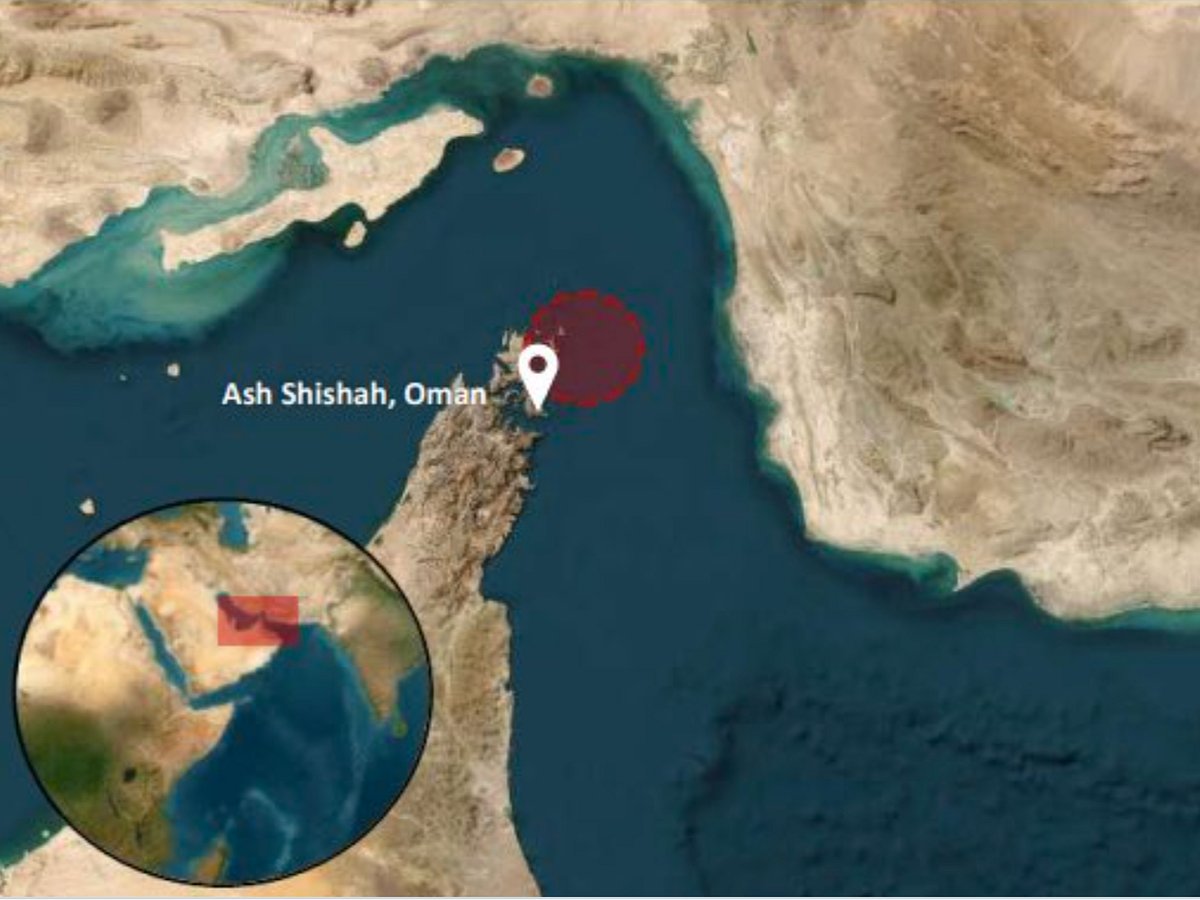
The UK Maritime Trade Operations (MTO) has reported that an oil tanker was struck by an unknown projectile off the coast of Oman at 20:57 UTC on Aug. 24, (12:57 am Gulf Standard Time).
UKMTO
The Middle East war enters another day with Iran and Oman proposing a temporary shipping corridor through the Strait of Hormuz and agreeing to work on clearing mines from the waterway. Technical negotiations are set to continue, and no temporary or permanent corridor has yet been established. Maritime security also remains a concern after an oil tanker was struck by an unidentified projectile near Oman, damaging its engine room and disabling the vessel. The crew was reported safe. Meanwhile, the US has begun returning diplomatic staff to some Middle East missions that were evacuated or downsized during the conflict. Follow along for the latest updates:
US‑Israel war on Iran: Recent developments
Ship-to-ship transfers keep Gulf oil moving outside Hormuz as direct traffic hits multi-month low
Large volumes of oil from Gulf producers continue to reach global markets through ship-to-ship transfers in the Gulf of Oman even as direct vessel traffic through the Strait of Hormuz remains sharply suppressed, maritime tracking data showed early on Wednesday (Aug. 26). TankerTrackers reported at least 15 simultaneous ship-to-ship transfer operations underway in the Gulf of Oman involving roughly 25 million barrels of crude oil plus refined products. The cargoes originated from nearly every country in the region except Iran, according to the firm. A later update noted an additional set of transfers that included one Iranian LPG cargo.
Six months on, grief still raw for Iran school parents
For months, Masoumeh Zakeri has endlessly replayed the last night she spent with her nine-year-old daughter before she was killed in a strike on her school during the opening hours of the US-Israel war with Iran.
Six months on, a team of AFP journalists obtained rare access to the school which has remained largely in ruins, its collapsed walls and twisted steel now surrounded by portraits of the children killed as Iranian flags flutter above the rubble.
Iran says the attack on the school involved two separate US Tomahawk missiles but neither the United States nor Israel has officially claimed responsibility for the strike.
Rights groups including Amnesty International blamed the United States while The New York Times has reported that the school was hit by a US Tomahawk cruise missile.
Get updated faster and for FREE: Download the Gulf News app now - simply click here.
UAE travellers should check their flights
UAE travellers flying today should check their individual flight status before leaving for the airport, with Emirates, Air Arabia and flydubai among the carriers reporting cancellations on selected routes, while Etihad Airways has largely maintained services to Bahrain and Kuwait.
Get all the latest updates here.
Iran says Hormuz strait still closed despite transit corridor talks
Iran and Oman are discussing a temporary transit corridor and mine-clearing for the Strait of Hormuz, but Tehran warned on Wednesday that the vital waterway will not be reopened unless the United States ends the war.
Washington has announced fresh sanctions aimed at pressuring Iran into submission, with Treasury Secretary Scott Bessent threatening the Islamic republic with "economic asphyxiation".
During talks in Tehran, foreign ministers from Iran and Oman discussed a "phased framework" that included setting up a "joint temporary navigational corridor through the Strait of Hormuz and an agreement to implement a joint project to clear the Strait of mines," according to a statement.
US is not expected to initiate new strikes against Iran: Rubio
Secretary of State Marco Rubio has told several of his foreign counterparts in recent days that "for the time being" the US is not expected to initiate new strikes against Iran, according to a US official and a second source with knowledge of the matter, reports Axios.
Instead, he's said the focus is on other means of pressure, including the sanctions initiative announced this week.
Stocks edge higher as oil drops on fresh Mideast hopes
Asian stocks edged higher Wednesday as oil prices extended a decline on receding concerns about another military flare-up between the United States and Iran, while traders were also nervously awaiting Nvidia's earnings and key US inflation data.
Both main crude contracts have tumbled more than eight per cent this week as Tehran and Oman edge towards a deal to partially reopen the Strait of Hormuz, while signs of fresh diplomacy to end the Middle East crisis added to the upbeat mood.
While US Treasury Secretary Scott Bessent said the White House was declaring an "economic D-Day" against Iran and its trade partners, the measures were regarded as softer than many had feared.
Jason Wong at BNZ wrote: "The move could reflect market sentiment that the latest US strategy, 'Operation Economic Outcast', aimed at severing Iran's remaining financial lifelines, could bring Iran back to the negotiating table and help resolve the conflict."
UK energy bills to rise as Mideast war pushes up gas prices
British energy bills are set to rise in October, the sector regulator Ofgem announced Wednesday, as the Middle East war drives up wholesale gas prices.
Higher energy costs have raised concerns about a fresh spike in inflation, piling pressure on the new Prime Minister Andy Burnham, who has made lowering the cost of living a priority.
Ofgem, which sets every quarter the price cap that suppliers can charge customers, said the cap would increase four percent from October, adding around £5 ($7) per month to the average bill.
A typical annual bill for gas and electricity will rise to about £1,723, Ofgem said.
It cited "the ongoing conflict in the Middle East" as a reason for the latest increase, with the effective months-long closure of the crucial Strait of Hormuz crimping gas supplies.
Iran expanding defense capabilities, army commander says
Iran is expanding its defence capabilities, an Iranian army commander said Wednesday, after much of the country’s equipment was degraded by US-Israeli strikes in the early days of the war, reports CNN.
“We gained valuable experience during the third imposed war that proved useful in terms of tactics, the production of systems, and their deployment and positioning, and we have made changes accordingly,” Commander of the Army’s Air Defense Force Brigadier General Alireza Elhami was cited as saying by Iran’s state broadcaster IRIB.
In May, Iran had already restarted some of its drone production during a six-week ceasefire, added CNN.
Netanyahu says no diplomatic deal possible with Iran 'savages'
Israeli Prime Minister Benjamin Netanyahu said a diplomatic deal was not possible with the "savages" who rule Iran as he hailed US President Donald Trump's new campaign of economic pressure.
Recounting a recent meeting with Trump, Netanyahu said they had discussed the possibility of diplomacy with the Islamic republic and added: "I doubt, however, that an agreement can be reached with that group there, with those savages.
"I tell you -- an agreement cannot be reached," Netanyahu told an event late Tuesday at an Israeli settlement in the occupied West Bank.
Sri Lanka tracks 11 US-sanctioned Iranian tankers off coast
Sri Lanka's maritime authorities were monitoring a fleet of 11 US-sanctioned Iranian oil tankers just off the island's southern coast, officials said Wednesday.
The vessels are in limbo — they cannot return to Iran because of a United States blockade on ships using Iranian ports.
The ships were spotted close to the Galle harbour where an Iranian frigate, IRIS Dena, was sunk by a US submarine in March, killing 104 sailors. Sri Lanka's navy rescued 32 Iranian sailors from that frigate.
"We have deployed reconnaissance aircraft and patrol boats to monitor these Iranian vessels outside our 12-nautical-mile territorial waters," a military official told AFP on condition of anonymity.
The vessels had not sought permission to enter Sri Lankan territory and were entitled to freedom of navigation in international waters.
Get updated faster and for FREE: Download the Gulf News app now - simply click here.
Top US official to meet NATO allies over force review
A senior US defence official will brief NATO countries Thursday on Washington's review of its forces in Europe, officials said, in the face of fears over an American pullback from the continent.
US Defense Under Secretary Elbridge Colby will meet ambassadors from NATO countries at the headquarters of the 32-country alliance in Brussels.
"The United States is consulting with allies as part of its force posture review," a NATO official said Wednesday.
Washington launched a six-month review in July as it presses European countries to take principal responsibility for the conventional defence of their continent.
The move was announced by Pentagon chief Pete Hegseth amid US anger at the response of European nations to the war with Iran, including restrictions on US forces using their bases at the start of the conflict.
Iran president says 'US will achieve nothing' with economic pressure
Iranian President Masoud Pezeshkian on Wednesday said that the "United States will achieve nothing" with its new round of economic sanctions, local media reported.
"Given the measures the government has undertaken, America will not achieve anything with economic pressure at this stage, just as it was unable to achieve anything in the war," Pezeshkian said, according to ISNA news agency.
US aircraft carrier will stop in Thailand as its Mideast deployment draws to end
The US aircraft carrier USS Abraham Lincoln will make a stop in Thailand after its grueling deployment in the Middle East, Thai officials said, without specifying a date or port for security reasons.
The Lincoln has been deployed during the Iran war. Its very lengthy deployment, including a record-setting uninterrupted time at sea of more than 250 days, raised concerns about deteriorating mental health among the crew.
A statement from the Royal Thai Navy on Tuesday said a short stopover by U.S. Navy ships was for recuperation and that no military exercises would be carried out during the visit.
No military vessels will transit through Hormuz, Iran says
Iran and Oman have reached an understanding on a new framework for managing ship traffic in the Strait of Hormuz that would exclude military vessels, Iranian Deputy Foreign Minister Kazem Gharibabadi told state TV late on Tuesday night.
"If the understanding becomes binding, no military vessel will be permitted to pass through the Strait of Hormuz," he said. "No military vessel at all."
Gharibabadi didn't provide further details about military traffic. He described the proposed commercial route through the Strait of Hormuz, the vital shipping waterway.
Iran Guards say agreed with Oman to share revenues from Hormuz
Iran's Revolutionary Guards said on Wednesday they had agreed with Oman to share any revenues earned from transit fees in the Strait of Hormuz.
"During negotiations with Oman, some agreements were made regarding the share of each country in the waters of the Strait and the share of Iran and Oman in its revenues," said Guards spokesman Hossein Mohebi, adding that the US was "obstructing work" to finalise a deal.
Trump says believes that Iranian leader Khamenei still alive
Iran’s new Supreme Leader Mojtaba Khamenei
US President Donald Trump on Wednesday said he believes Iran's supreme leader, who has not been seen in public since taking over after his father's killing in February, remains alive.
"I don't think he's dead. He was very seriously wounded. The left side of his body, the arm, the leg, the whole thing. He was very seriously wounded. But I don't think he's dead," Trump said in an interview with conservative radio host Glenn Beck.
Iran blocks Indian tanker's attempt to cross Hormuz
An Indian oil tanker named HAANA turned back after attempting to pass through the southern route of the Strait of Hormuz,Iran’s semi-official Fars news agency reported.
The tanker had intended to transit the route but backed off following a warning, according to the report.
No vessel traffic has been observed along the southern route of the Strait of Hormuz over the past 24 hours,
Wartime conditions keep nuclear inspections on hold: Iran
Iran remains in a wartime situation and inspections at nuclear facilities hit by military strikes cannot resume until a new inspection protocol is established, nuclear chief Mohammad Eslami said on Wednesday, according to state news agency IRNA.
“The country is still in a wartime situation, and conditions are not yet such that we can assume the war has ended and the sites are secure,” Eslami said.
Iran puts Persian-language media outlets on ‘target’ list
Iran's armed forces said Wednesday that several Persian-language media outlets operating abroad were included in its "military target bank", accusing them of working for US and Israeli intelligence agencies.
In remarks published on state television, armed forces spokesman Abolfazl Shekarchi named BBC Persian, Iran International and Radio Farda among the outlets.
"These hostile media outlets are the soldiers of Zionism and America and are included in our military target bank," Shekarchi said, accusing them of being "directly connected to Mossad, CIA and enemy intelligence organisations."
"The Iranian Armed Forces do not view these news outlets as media," he added.
He did not clarify where they would be targeted.
Iranian authorities have frequently accused Persian-language media outlets based abroad of cooperating with Israel.
Iran has designated Iran International as a terrorist organisation since 2022 and has warned that cooperation with the channel is punishable under Iranian law.
Get updated faster and for FREE: Download the Gulf News app now - simply click here.
Qatar Emir to visit Tehran for de-escalation talks
Qatar's Emir Sheikh Tamim bin Hamad Al Thani will travel to Tehran on Thursday for talks with Iranian officials on de-escalating regional tensions and creating conditions for renewed dialogue.
The discussions will also focus on freedom of navigation in the Strait of Hormuz and Qatar's call for conditions there to return to the status quo before February 28.
US sanctions UK-based Palestine Action as ‘global terrorist’, widens crackdown on far-left groups
The United States has sanctioned UK-based direct-action group Palestine Action as a Specially Designated Global Terrorist, widening the Trump administration’s campaign against organisations it describes as violent far-left networks. The US Treasury announced the designation on Wednesday (Aug. 26, 2026), alongside sanctions against Italy-based digital collective Autistici/Inventati and the transnational pro-Palestinian group Masar Badil, as well as two of its leaders.
Get it: Fast, verified news for FREE ... download the Gulf News app — simply click here
Tanker hit by 'unknown projectile' in Strait of Hormuz: UKMTO
An "unknown projectile" has struck a tanker in the Strait of Hormuz, causing a fire that has since been put out, a British maritime agency said early on Thursday. "Local authorities have reported a tanker has been hit by an unknown projectile causing fire to the vessel which has since been extinguished," the United Kingdom Maritime Trade Operations (UKMTO) said.
Trump says Iran war may end ‘fairly soon’
US President Donald Trump has said the war with Iran could end “fairly soon”, while asserting that Iranian Supreme Leader Ayatollah Mojtaba Khamenei was seriously wounded but remained alive. “I don't think he's dead. He was very seriously wounded,” Trump said in an interview with conservative broadcaster Glenn Beck. “The left side of his body, the arm, the leg, the whole thing, he was very seriously wounded. But I don't think he's dead,” he said.
He said Iranian officials continued to speak about consulting the supreme leader. “And if he is, they're putting on a pretty good show because they talk about, you know, going back to talk to him all the time, you know, to get a final blessing on things,” Trump said.
US forces 'destroy 22 boats': Trump
US President Donald Trump has claimed that US forces had destroyed 22 boats overnight as part of operations connected to the blockade.
“And, you know, we have this great open; we took out 22 boats last night. We have people coming in the blockade. Our Navy has been unbelievable. Our military has been unbelievable, the combination,” he told US media.
Trump predicted that the campaign would soon produce what he described as a major victory. "We had the victory in Venezuela, and we're going to have a big victory here very soon,” he said.
Asked why Iranians had not risen against the government, Trump said protesters faced armed security forces and snipers.
Iran's Ghalibaf welcomes China’s rejection of new US sanctions
Iranian Parliament Speaker Mohammad Bagher Ghalibaf has publicly welcomed China’s firm opposition to the Trump administration’s latest sanctions campaign against Tehran, describing Beijing’s stance as a “principled statement” against what he called illegal measures. “We welcome China’s principled statement rejecting illegal sanctions against Iran. The Iran-China comprehensive strategic partnership is rooted in mutual respect, win-win cooperation, and a shared vision for a multipolar world. This relationship needs no one’s permission.”
We are closing this blog here. For live updates, click here.
Sign up for the Daily Briefing
Get the latest news and updates straight to your inbox
Network Links
GN StoreAbout Gulf NewsTerms & ConditionsReach by GNSitemapContact usPrivacy PolicyGN FocusHave your sayWork with usAdvertise with usGulf News epaperPrinting Services
Download our app
© Al Nisr Publishing LLC 2026. All rights reserved.