Strait of Hormuz crisis: Trump demands Iran pay for ‘conflicts’; Tehran reshuffles military
Oil markets roiled as Trump claims full control of Hormuz, Iran digs in
Highlights
We are closing this live coverage. For the latest updates, click here.
Oman moves to contain oil spill after tanker ran aground
Oman said it was working to contain an oil spill off its southern coast after a tanker ran aground in June inside a protected marine area, triggering calls for action by environmentalists. The ship had been stranded for weeks near al-Qibliyyah island after it was rocked by explosions. The Oman Environment Authority on Monday said the ongoing spill had affected roughly 390 square kilometres, according to its most recent analysis.
The slick was concentrated around Oman's Hallaniyat archipelago off the country's southern coast, where a marine reserve was established last year to protect sensitive ecosystems home to diverse marine life, including rare sea turtles. The country's environment authority said rapid action was needed to protect the area's biodiversity, including "coral reefs, turtle nesting areas, marine habitats and coastal areas of ecological importance”.
Diesel prices surge as refinery attacks squeeze global fuel supplies
Diesel prices in the US and Europe surged Monday as a series of refinery disruptions tightened supplies of the fuel used by trucks, farmers, manufacturers and other major industries.
US ultra-low-sulfur diesel futures jumped 7.4% to $4.19 a gallon, the biggest one-day increase since July, while European diesel refining margins rose nearly 10%, Reuters reported. Diesel prices have been rising faster than crude oil benchmarks as traders focus increasingly on shortages of refined products rather than crude itself.
The latest pressure followed a Ukrainian attack on a refinery in Russia's Tatarstan region and renewed attacks by Yemen's Iran-aligned Houthis on Saudi Arabia's Jazan refinery, which has been offline since July 27. The Saudi facility is now expected to resume operations around Aug. 30.
US Navy has '100% control' of the Strait of Hormuz with an 'infallible' blockade: Trump
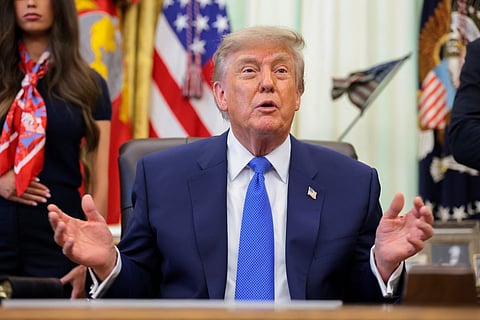
The US Navy is the only force with control over the Strait of Hormuz, US President Donald Trump claimed late on Monday. Speaking during a White House event, he said: “The only one that has control of the Strait of Hormuz right now is the United States Navy. We have a blockade that’s been infallible—it’s a steel wall… We control the Strait, 100%.”
Trump added that the strait is “open now” for non-Iranian traffic and that US forces have "mine-swept" the entire waterway.
Trump demands Iran pay reparations for decades of deaths, including Soleimani-era attacks
Trump called for Iran to compensate families of those killed by Iranian roadside bombs, conflicts led by General Soleimani, USS Cole victims, and hundreds of thousands of protesters over 50 years, including 52,000 in the last five months.
This responds to Iran's request for $300 billion, plus other demands like releasing frozen assets and lifting sanctions, amid threats to keep the Strait of Hormuz closed.
Trump says US has ‘mine-swept the entire’ Strait of Hormuz
Trump said the US Navy has swept the Strait of Hormuz for mines and claimed Washington now has full control of the vital waterway.
“It’s open now. Look, the only one that has control of the Strait of Hormuz right now is the United States Navy,” Trump told reporters in the Oval Office on Monday.
“They will, on occasion, drop a mine, and we find the mine,” he said. “We’ve mine-swept the entire strait, as you probably maybe heard, maybe you didn’t hear.”
Trump said the United States controls the Strait of Hormuz “100%”.
Mojtaba Khamenei 'completely healthy': President Pezeshkian
Iranian President Masoud Pezeshkian has stated that Supreme Leader Mojtaba Khamenei is "completely healthy", dismissing speculations regarding his physical condition, according to a report by the ISNA news agency.
"Someone who can sit and discuss for seven to eight hours cannot have any health problems," the President said, noting that he had held a "very good" meeting with Khamenei.
This high-level interaction took place amid persistent reports concerning Mojtaba Khamenei's health. Earlier on Sunday, an undated video was released by Iran's semi-official Mehr News Agency depicting Mojtaba Khamenei appearing in good health. The video was published following claims in Israeli media that the Supreme Leader was in critical condition and had been admitted to a hospital.
Get updated faster and for FREE: Download the Gulf News app now - simply click here.
Trump insists relationship with Netanyahu 'very good' despite Gaza rift
President Donald Trump insisted Monday that his relationship with Prime Minister Benjamin Netanyahu is "very good" despite the Israeli leader's rejection of a US-led Gaza plan.
"The relationship is very good," Trump said in response to a shouted question from a journalist at the end of an Oval Office event.
Iran supreme leader names Guards general Abdollahi military chief
Iranian supreme leader Mojtaba Khamenei named Revolutionary Guards general Ali Abdollahi head of the country's armed forces on Monday, while also confirming a new commander of the Guards, putting his imprimatur on the country's military.
Abdollahi had previously led the Khatam al-Anbiya, Iran's inter-branch central military command tasked with coordinating operations.
An statement on Khamenei's website announced that "Major General Ali Abdollahi has been appointed chief of staff of the armed forces. Brigadier General Ahmad Vahidi has also been appointed Commander-in-Chief of the Islamic Revolutionary Guard Corps with the rank of major general."
The pair represent Khamenei's first senior military appointments since being named supreme leader early in the Middle East war after the death of his father in US-Israeli strikes.
Abdollahi has issued bellicose threats over the course of the war, warning regional neighbours earlier this month that "any country serving as a defensive shield for criminal and aggressive America will be engulfed by the flames of war."
Oil prices finish up 5% as Hormuz dispute drags on
Oil prices jumped about five percent Monday as the United States and Iran remained far apart on terms to reopen the vital Strait of Hormuz.
International benchmark Brent oil gained 5.0 percent to $87.72 a barrel, while US benchmark West Texas Intermediate surged 5.1 percent to $82.13 a barrel.
Trump extends shipping waiver, with limits, to aid energy flow
Trump again extended a waiver that allows foreign ships to carry oil and other commodities between US ports, as the war on Iran continues disrupting energy flows and keeping costs elevated.
The 90-day extension of relief from the Jones Act comes shortly before an earlier waiver was due to expire in mid-August.
But the scope covered is narrower this time, focusing more on the transport of energy, a White House official confirmed Monday.
"Today, the Trump Administration issued a 90-day extension to the Jones Act waiver to ensure our military and key industries maintain uninterrupted access to critical resources," said White House spokeswoman Taylor Rogers.
"Data shows the waiver has driven a significant increase in domestic deliveries of essential products such as gasoline, diesel, and jet fuel," she added.
The relief this time also calls for reviews on the availability of US vessels before determining if the waiver applies to individual voyages.
Trump says Iran should pay for Middle East deaths, damage
Trump said Iran should be held responsible for “damages and death” across Lebanon, Syria, Yemen and Gaza, and said the US would seek compensation from Tehran.
His comments came after Iran demanded compensation for damage caused during the current war. Trump said he had instructed US representatives to include compensation in “any, and all, future negotiations”.
The remarks came as the Strait of Hormuz remains largely blocked, with Iran demanding that the US end its blockade of Iranian ports and lift sanctions before the waterway fully reopens.
Get updated faster and for FREE: Download the Gulf News app now - simply click here.
Pakistan PM: Mecca Defence Agreement is defensive, not aggressive
Pakistan Prime Minister Shehbaz Sharif has said the Mecca Defence Agreement with Saudi Arabia and Turkey is strictly defensive and carries no aggressive intent.
Addressing a federal cabinet meeting, Sharif said the agreement was “solely and exclusively for defensive purposes”, according to a statement posted by the Pakistani government on X.
He said the pact is aimed at promoting peace, development and prosperity in the region and described it as a source of strength for the Muslim world.
Sharif added that efforts to establish the agreement had been underway for several years.
Get updated faster and for FREE: Download the Gulf News app now - simply click here.
Trump says will demand conflict compensation from Iran
Trump said he would seek conflict compensation from Iran as part of any peace negotiations, citing attacks and atrocities stretching back decades allegedly backed or perpetrated by Tehran.
Iran is "asking for compensation for the damage done to them during the last five month Military Conflict... I am likewise demanding compensation from Iran, for all of the people that they have killed and gravely wounded with their roadside bombs and many conflicts," Trump posted.
In what has become a regular pattern, Trump last week threatened to hit Iran "very hard", potentially with attacks against civilian infrastructure, only to pull back, hinting a peace deal was near.
His latest comments on Truth Social came a day after Trump said he was "low-keying" his approach to the conflict, suggesting that he was prepared to let economic pressure mount in place of further military strikes.
Digital media outlet Axios said that the US president did not express any frustration with Iran's delaying an agreement to open the Strait of Hormuz in their interview with him published Sunday.
Iran’s supreme leader appoints six senior military commanders
Iran’s Supreme Leader and commander-in-chief of the armed forces, Mojtaba Hosseini Khamenei, has appointed six senior military commanders across the General Staff, Islamic Revolutionary Guard Corps (IRGC) and Basij.
The appointments, announced in decrees posted on Telegram, include:
Major General Ali Abdollahi as Chief of Staff of the Armed Forces, with Brigadier General Kioumars Heydari as his deputy.
Major General Ahmad Vahidi as Commander-in-Chief of the IRGC, with Mostafa Izadi as his deputy.
Rear Admiral Ali Ozmaei as commander of the IRGC Navy.
Hossein Taeb as head of the Basij.
Iran says talks with Oman going ‘smoothly’
Iranian Foreign Ministry spokesperson Esmail Baghaei said talks with Oman are progressing “smoothly”, although some parties are seeking to obstruct an agreement.
Baghaei did not identify those he said were trying to derail the talks.
Speaking on Iran’s state broadcaster IRIB, he said an understanding with Oman was likely and would represent an important step in the negotiations.
Iran says Hormuz unsafe as ‘hostile US actions’ continue
Iran’s Foreign Ministry said the Strait of Hormuz cannot be considered safe as long as “hostile US actions” continue.
The ministry said the security situation in the key waterway remains linked to ongoing tensions between Iran and the United States.
Iran rules out Trump talks until his term ends in 2029
Iran has completely ruled out any future negotiations with the Trump administration, declaring it will wait out Trump's term until January 20, 2029, per Iranian outlets and Ghalibaf advisor's post.
"Trump will not reach an agreement with us. We will accompany him until his term ends," said Majid Shakeri, advisor to Parliament Speaker Ghalibaf.
He posted: "The path to victory is neither fighting nor a deal — it is managing the process of neither war nor peace, up to the point of victory. Publicly confirming negotiations with the US is sheer folly. The winning approach is denial, ambiguity, and strategic patience."
Iran's conditions remain unchanged: $300 billion in compensation, release of frozen assets, and withdrawal of US forces. Until then, the Strait stays closed.
Strait of Hormuz traffic falls further
Traffic through the Strait of Hormuz remained “subdued” over the past week and weakened further over the weekend, maritime intelligence firm Kpler said on Monday.
Confirmed crossings fell from 15 on Friday to 11 on Saturday and just six on Sunday, Kpler said. About half of the vessels used the Iranian-approved northern route, while the route taken by 10 vessels could not be confirmed.
The decline comes as Iran and Oman signal that an agreement on navigation through the key waterway could be close.
Traffic through the Bab al-Mandeb Strait at the southern end of the Red Sea was considerably more active, with 116 crossings recorded over the same three-day period, according to Kpler.
Daily crossings remained relatively stable, with 43 vessels passing through on Friday, 37 on Saturday and 36 on Sunday.
Oman moves to contain oil spill after tanker ran aground
Oman said it was working to contain an oil spill off its southern coast after a tanker ran aground in June inside a protected marine area, triggering calls for action by environmentalists.
The Oman Environment Authority said the ongoing spill had affected roughly 390 square kilometres, according to its most recent analysis.
The slick was concentrated around Oman's Hallaniyat archipelago off the country's southern coast, where a marine reserve was established last year to protect sensitive ecosystems home to diverse marine life, including rare sea turtles.
The country's environment authority said rapid action was needed to protect the area's biodiversity, including "coral reefs, turtle nesting areas, marine habitats and coastal areas of ecological importance".
A report in the state-backed Oman News Agency quoted an official with the transport ministry as saying authorities were conducting aerial surveillance and had deployed divers.
The official said authorities were in the early stages of developing a plan to transfer the vessel's oil cargo "to reduce the risks arising from the incident, ensure navigational safety and protect the marine environment".
Iranians 'professional chess players', says ministry in response to Trump analogy
Tehran on Monday said Iranians had shown "they are professional chess players" in response to remarks by US President Donald Trump comparing his dealings with Iran to the board game.
Trump on Sunday signalled he was prepared to let economic pressure mount against Iran, apparently backing away from more military strikes after Tehran issued a list of demands for opening the Strait of Hormuz.
"Lights out or lights on, Iranians showed they are professional chess players," Iran's foreign ministry spokesman Esmaeil Baqaei said during a weekly press conference.
Trump had earlier been quoted by news outlet Axios as saying he was "low-keying it" with Iran.
"We are only semi-negotiating with them. We are just watching Iran with its huge inflation and the fact they have no money," he said.
"It will work out. It always works out. It's like a chess game," Trump added.
Oil prices see an uptick
Oil prices remain elevated after Iran said an imminent agreement with Oman to manage the Strait of Hormuz would not be enough to reopen the vital waterway, as it demanded the United States meet a set of conditions, reports CNN.
Brent crude, the global oil benchmark, rose 0.6% to $84.03 a barrel. WTI, the US benchmark, ticked up 0.4% to $78.49 a barrel.
Iran says Saudi-Pakistan-Turkey deal shows 'change in perception' towards US
Iran's foreign ministry said Monday that a defence pact signed last week between Saudi Arabia, Turkey and Pakistan was "a sign of a change in the perception" of countries in the region towards the United States.
"The countries of the region have realised that security is not a commodity that can be bought from false brokers," said ministry spokesman Esmaeil Baqaei at a weekly press conference, referring to the United States, an ally of the three signatories to the pact.
Netanyahu rejects US-led Gaza plan
Israeli Prime Minister Benjamin Netanyahu on Sunday rejected a US-led Gaza plan endorsed by Hamas, putting distance between himself and US President Donald Trump as he tries to shore up his base ahead of close elections.
After more than a week of gradually escalating criticism of the plan, and despite receiving assurances that Israel would not need to start withdrawing in Gaza immediately, Netanyahu explicitly opposed the deal following pushback from his right-wing allies.
"Israel rejects the 15-point document," Netanyahu said, referring to the plan Hamas agreed to in late July.
The Israeli military "will not carry out any withdrawal until Hamas is genuinely disarmed, and will continue to thwart threats against our forces and our citizens", he told a cabinet meeting.
Netanyahu described Trump, who had hailed the Gaza deal as a milestone for peace, as "our greatest friend in the White House" - but quickly made clear he was willing to challenge him, saying Israel was raising its objections with the United States.
"They have ideas; some of them are acceptable to us and some are not, and we know how to stand our ground on these matters," he said.
Get it: Fast, verified news for FREE ... download the Gulf News app — simply click here
Houthi missile, drone attacks hit Yemen’s strategic Red Sea Port of Mokha
Yemeni government forces and medical sources reported that Iran-backed Houthi rebels launched a large-scale missile and drone assault on the Red Sea port city of al-Mokha (also spelled Makha or Mocha) late on Sunday, August 9, 2026, killing at least seven people — including three civilians and four to eight military personnel — and wounding around 30–32 others.
The Yemeni military stated that four armed forces members and three civilians were killed and 30 others injured in the strikes targeting civilian infrastructure, the commercial port, and armed forces positions.
Air defences intercepted and shot down 11 Houthi drones. Later medical and AFP-cited figures raised the toll to at least 11 dead (three civilians and eight military personnel) and 32 wounded (including six civilians), with all civilian casualties linked to hits on the port.
Iran Guards say won't reopen Hormuz without US meeting Tehran's demands
Iran's Revolutionary Guards insisted late on Sunday that they would not reopen the Strait of Hormuz until the US complied with a list of demands, including paying compensation for war damage.
Iran's effective blockade of the crucial energy conduit has rattled allies, roiled markets and driven up prices, but US President Donald Trump said Sunday that he was "low-keying it" in his approach to Tehran, suggesting he believed he could wait them out economically.
Oil rises as Hormuz deal hopes clash with Iran’s demands
Oil prices were higher in early Asian trading Monday as uncertainty over a possible agreement to reopen the Strait of Hormuz continued to outweigh hopes for a quick return to normal shipping.
At 8:33 am Tokyo on Monday (Aug. 10, 2026), market data on OilPrice.com showed West Texas Intermediate crude at $78.71 a barrel, up 53 cents, or 0.68%; Brent crude at $84.28, up 73 cents, or 0.87%; and Murban crude at $80.25, up 72 cents, or 0.91%.


