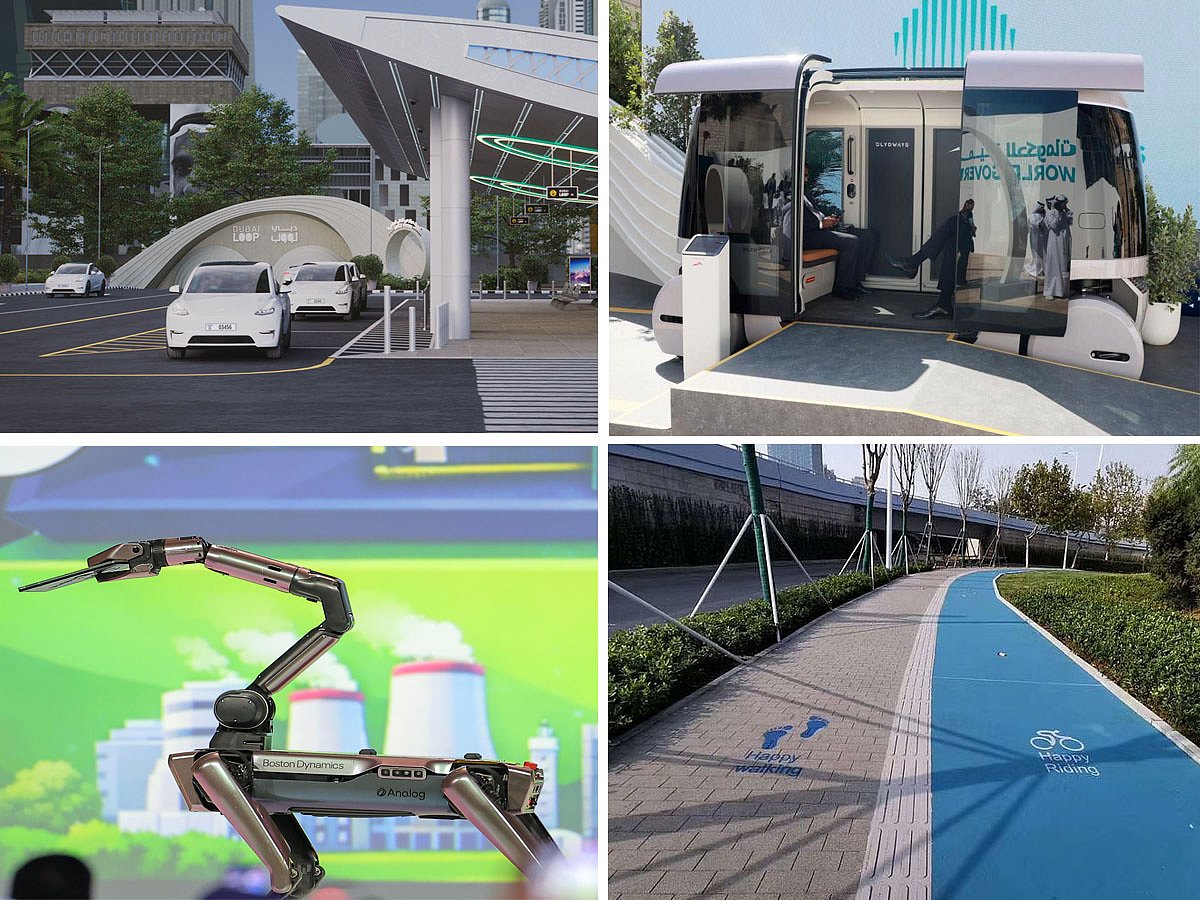
The Dubai Loop tunnels will have a diameter of 3.6 metres and will be dedicated to vehicle transport.
Top 6 WGS announcements set to change daily life in the UAE
From driverless taxis to faster commutes, WGS 2026 delivered consumer-focused shifts
Last updated:
5 MIN READ
Virendra Saklani/Gulf News and Dubai Media Office
Dubai: The World Governments Summit 2026 concluded in Dubai on Wednesday after three days of policy debates, technology showcases and high-level meetings that placed everyday impact firmly in focus. The largest edition of the summit brought together more than 6,250 participants, including heads of state, ministers and global business leaders, with discussions spanning mobility, artificial intelligence, healthcare, education and future cities.
In the three-day event, several announcements stood out for their direct relevance to residents, commuters and workers. Here are four that could shape daily life in the months ahead.
1. Driverless taxis move closer to public use
Dubai took a major step toward autonomous transport with the launch of fully driverless RT6 taxis developed by Baidu Apollo Go. Sheikh Hamdan bin Mohammed bin Rashid Al Maktoum marked the occasion by arriving at the summit venue in one of the vehicles. The autonomous taxi service is set for public rollout in the first quarter of 2026.
The sixth-generation autonomous taxis are equipped with more than 40 sensors, including LiDAR, radar and high-definition cameras, allowing them to operate on live roads alongside regular traffic. Officials said the vehicles rely on artificial intelligence and real-time decision-making systems designed to meet transport safety standards
The project moved from planning to operational trials in about 10 months, following cooperation between Dubai’s Roads and Transport Authority and Baidu Apollo Go. The operator has already logged more than 150 million kilometres of autonomous driving globally.
An autonomous vehicle operations centre was also inaugurated at Dubai Science Park, the company’s first such facility outside China. Spanning 2,000 square metres, the centre will oversee fleet management, monitoring and maintenance, with plans to scale the fleet to more than 1,000 vehicles over time.
2. Glydways
Dubai’s Roads and Transport Authority also signed a cooperation agreement with Glydways to introduce an automated transit network aimed at easing short urban journeys. The system uses small, autonomous electric vehicles running on narrow guideways, either elevated or at ground level, separate from road traffic.
Each vehicle carries up to six passengers and travels directly between destinations without stops. Proposed pilot routes include a 2.8-kilometre link between National Paints Metro Station and Bluewaters Island, alongside future connections to Madinat Jumeirah, Alserkal Avenue and Dubai Festival City.
The system could carry more than 20,000 passengers per hour in both directions, with significantly lower capital and operating costs compared to traditional transport modes.
3. Dubai Loop
Major updates on one of Emirates' most anticipated projects were announced during the summit. The first phase of the Dubai Loop, a high-speed underground people-mover designed to cut travel times between key commercial and leisure hubs, will link the Dubai International Financial Centre with Dubai Mall and Burj Khalifa through four stations, including ICD Brookfield Place and Zabeel parking.
Developed in partnership with Elon Musk’s Boring Company, the initial 6.4-kilometre route carries an estimated investment of about Dh565 million. Passengers will book trips at stations and travel underground in electric vehicles, bypassing surface congestion entirely.
RTA estimates the pilot route could cut journey times from around 20 minutes to about three minutes and serve roughly 13,000 passengers a day. Future phases are expected to expand the network to more than 22 kilometres and 19 stations.
IDer, which is the primary component of Sponge City, includes porous materials such as bricks, pavers, and kerbstones
4. Sponge city model targets flooding and water reuse
Dubai announced plans to adopt the “sponge city” model, an urban design approach that allows cities to absorb, store and reuse rainwater instead of letting it overwhelm drainage systems. The concept, pioneered in Chinese cities such as Shenzhen, treats the urban landscape like a sponge, using green roofs, permeable pavements and underground storage to slow runoff and reduce flooding.
Dubai Municipality signed a memorandum of understanding with the Urban Planning and Design Institute of Shenzhen during the World Governments Summit, setting the stage for cooperation on future-ready urban planning. The partnership focuses on sustainable city design, low-carbon urbanism, smart infrastructure and advanced water management systems supported by data and artificial intelligence.
More than 15 major development projects will revitalise coastlines and introduce three new beach destinations annually.
5. More blue and green spaces reshape everyday city life
Dubai also unveiled its 2030 Blue and Green Spaces Roadmap, a Dh4 billion-plus programme aimed at embedding nature into daily urban life. Launched by Dubai Municipality, the roadmap sets out a wide-ranging plan to expand parks, beaches, waterfronts and green corridors across the emirate.
The strategy includes planting around 1.5 million trees over five years, adding 120 new parks covering nearly three million square metres, and creating 200 integrated sports and recreational spaces. Public beach capacity is set to rise by 150%, while beach facilities and amenities will expand by 400%. The length of beachfront walking, jogging and cycling tracks will increase by nearly three times.
The roadmap positions beaches, parks and public spaces as core infrastructure, designed around people, families and communities. By 2030, the plan aims to make access to green areas, coastlines and outdoor facilities a routine part of everyday life, strengthening public health, climate resilience and Dubai’s appeal as a city to live and work.
Also Read
UAE unveils world's largest AI chip with 4 trillion transistors at WGS 2026ADSW 2026: There is no AI without energy, and the UAE is planning for that futureUAE ranked among top 10 globally for AI investment and resilience Dubai's DEWA to deploy world's first AI virtual engineer for power networkSheikh Saif bin Zayed receives the chip from a robot at WGS on Thursday
6. A massive AI chip with global reach
The summit also highlighted the UAE’s growing role in artificial intelligence infrastructure with the unveiling of what was described as the world’s largest AI chip. The wafer-scale processor, co-developed by G42 and Cerebras Systems, packs more than four trillion transistors onto a single chip.
G42 Group CEO Peng Xiao demonstrated the chip during a session, saying, “There are over 4 trillion transistors in this chip. That’s 4,000 billion transistors on a single chip.” He added, “If you think of energy as food to feed AI, then the chip is the heart.”
The chip will be deployed across G42’s 5-gigawatt UAE-US AI campus in Abu Dhabi, which aims to deliver hundreds of megawatts of computing capacity each quarter. Lt General Sheikh Saif bin Zayed Al Nahyan said the technology would help enable access to AI for about 40% of the world’s population, stressing that trust and data protection remain central to the UAE’s approach.
Zainab Husain, Sajila Saseendran, Balaram Menon and Nathaniel Lacsina contributed to this report.
Sign up for the Daily Briefing
Get the latest news and updates straight to your inbox
Network Links
GN StoreAbout Gulf NewsTerms & ConditionsReach by GNSitemapContact usPrivacy PolicyGN FocusHave your sayWork with usAdvertise with usGulf News epaperPrinting Services
Download our app
© Al Nisr Publishing LLC 2026. All rights reserved.