Dubai to launch Glydways network of self-driving pods, like train in cycle lane at cost of Metro
The first rollout will take place later this year as part of a trial phase
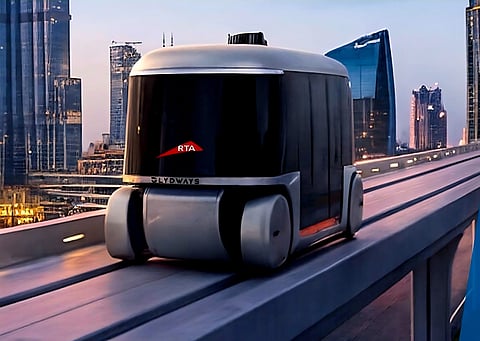
Dubai: Dubai’s Roads and Transport Authority (RTA) is preparing to launch a new autonomous automated transit network, Glydways, in a move aimed at easing congestion and improving mobility across key areas of the city.
Speaking to Gulf News on the sidelines of the World Governments Summit 2026, Mark Seeger, CEO of Glydways, said operations are expected to begin later this year, with a trial launch of the first phase planned within the next four months.
“The RTA has already planned four routes but within the next four months we’ll be launching the first trial route,” Seeger noted.
Glydways is a San Francisco-based transportation technology company developing an on-demand, autonomous personal rapid transit (PRT) network. The system is designed to provide driverless, point-to-point travel while reducing traffic on busy urban roads.
Four initial locations planned
The first rollout is expected to cover four major areas in Dubai, with potential future links to the upcoming Dubai Metro Blue Line.
Bluewaters: A route is planned from National Paints Metro Station to Bluewaters Island (2.8km) (trial route)
Umm Suqeim: The service may connect Mall of the Emirates Metro Station with Madinat Jumeirah (1.9km)
Al Quoz: A corridor is expected to run from OnPassive to Alserkal Avenue and Times Square Centre (2.6km)
Dubai Festival City: The system will operate within the Dubai Festival City area, with the possibility of a future connection to the Metro Blue Line (7km)
Glydways vehicles are autonomous and electric, travelling at speeds of up to 50 km/h. Each vehicle can carry four to six passengers and has a range of up to 250 km on a single charge. The system is designed to reduce capital costs by up to 90 per cent, while delivering around 70 per cent savings in operational expenses.
Autonomous rides on demand, priced like a bus or Metro ticket
“You hail this like a taxi and then the fare is pegged to the local transit fare system. So you get your whole vehicle on demand, with no strangers, no people sharing the vehicle, for the same cost as a bus or a train ticket,” he said.
Seeger added that this is significant because no other transit system operates at those prices without financial support.
“It operates without a subsidy. So we provide mass transit service at about one tenth of the cost of the train system.”
You hail it like a taxi, but the fare is linked to the local transit system. You get the entire vehicle on demand, with no strangers sharing it, for the same cost as a bus or train ticket.

Moving 10,000 passengers per hour in lanes the width of a bike path
“So we deliver the same throughput, about 10,000 people per lane per hour, and our lanes are only two metres wide, the size of a bike lane, roughly. And we can move the same number of people as a heavy rail system, but for 90 per cent lower cost to both build and operate, and that allows us to go to all sorts of markets around the world.”
He added that it is the first time in nearly a century that a system can provide public transit-level pricing without requiring operational subsidies.
“So as long as we can match that throughput, with economics that people can afford and most importantly, an experience people want to have repeatedly, which we think this offers, that’s how you get people to say, ‘I’d rather take this,’ with predictable, fast, nonstop journey times, rather than be stuck in traffic.”
There are contracts and projects already underway in multiple countries, including the United States and Asia. “There are contracts and projects in the United States, on the East Coast and the West Coast - California, New York, and Georgia. Japan, Philippines. It’s already in place in San Francisco.”
How Glydways could help reduce Dubai traffic congestion
Traffic remains a hot-button issue for many Dubai residents. While the RTA continues rolling out major road upgrades and the Dubai Metro Blue Line, planned for 2029, Glydways is expected to become another key addition to help reduce congestion across the city.
“The way we achieve that is to take vehicles, which are electric and autonomous with our AI software that 'deconflicts' every vehicle trajectory in real time, on dedicated lanes.”
Seeger explained that traffic is ultimately a capacity problem.
“Traffic is a symptom of not enough capacity. Too many people are trying to use the road than the road can handle, and you get into gridlock.”
The CEO stressed that the system offers passengers a fully private ride experience. “This vehicle you get all by yourself. It’s on demand 24/7, nonstop between origin and destination, and zero stops in between and congestion free.”
As a result, it combines the capacity of a train system with the comfort of a private ride. “That provides the throughput of the train system, but also the experience of the chauffeur - you get music, WiFi, AC, but at the cost of public transit.”
The vehicles can be booked through an app or kiosk, and passengers will be able to pay using their existing Nol card or phone for the cost of the fare.


