How technology powers Dubai’s transport evolution
As population surges, AI, automation and data are doing the heavy lifting
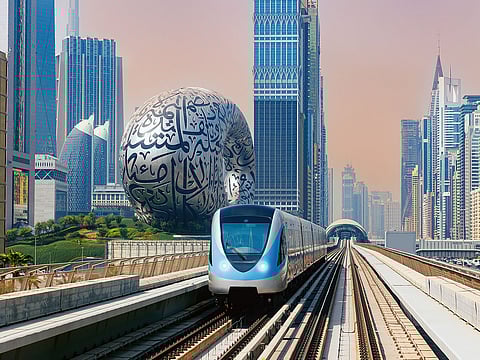
As Dubai has grown over the years, the challenge of moving people efficiently across the city has become about far more than building roads, bridges and rail lines. Keeping a fast-expanding urban population on the move now depends on sophisticated technology that turns steel, tracks and asphalt into intelligent, responsive transport networks designed to manage demand in real time.
The Dubai Metro exemplifies this technological ambition. Already recognised as one of the world’s longest fully automated, driverless rail systems, it operates through Thales Rail Signalling Solutions’ SelTrac IS communications-based train control (CBTC) technology. This system enables trains to operate at headways as short as two minutes during peak hours, achieving throughputs of 25,720 passengers per hour per direction on the Red Line. The technology relies on continuous communication between trains and wayside equipment, allowing dynamic speed adjustments and precise positioning without human intervention at GoA4 automation level, the highest grade of autonomous operation.
This automation extends beyond mere train movement. Platform screen doors, synchronised with train arrivals through millisecond-precise sensor arrays, enhance safety while maintaining climate control in stations. Over 3,000 CCTV cameras equipped with video analytics monitor passenger flow and security incidents in real time. The metro’s regenerative braking system captures kinetic energy during deceleration, feeding it back into the 750-volt DC power grid, reducing overall energy consumption by up to 15 percent compared to conventional systems.
The Blue Line, scheduled for completion in September 2029, represents a technological leap forward. The AED 20.5 billion project employs advanced tunnel boring machines for its 15.5 kilometers of underground sections through creek-side terrain. These sophisticated mechanical systems, featuring rotating cutter heads with precisely engineered disc cutters, can advance through varied geology while minimising surface disruption. Modern TBMs incorporate real-time monitoring systems that track ground movement, water pressure, and structural integrity, adjusting operations dynamically to geological conditions.
Digital twin technology
Construction employs digital twin technology, allowing engineers to simulate signal adjustments and assess their impact before physical implementation. This virtual modeling reduces trial-and-error iterations and accelerates optimisation. The Blue Line will feature 28 new driverless trains with enhanced IoT-enabled predictive maintenance systems that monitor component health continuously, scheduling repairs before failures occur rather than responding to breakdowns.
Beyond rail infrastructure, Dubai’s Roads and Transport Authority has deployed the UTC-UX Fusion smart vehicle network, representing some of the region’s most sophisticated AI-powered traffic management. This integrated system, operating from the Dubai Intelligent Traffic Systems Centre, connects to one hundred percent of the emirate’s traffic signals through fibre optic networks spanning 820 kilometers. The system processes data from 311 traffic surveillance cameras, 227 incident monitoring devices, 115 travel time sensors, and 17 weather stations, analysing traffic patterns through artificial intelligence and big data analytics.
The iTraffic platform at the system’s core uses machine learning algorithms to predict traffic flow patterns and optimise signal timings dynamically. During the first half of 2025, the system reduced delays by 25 percent and cut operational costs by 20 to 30 percent. Its Cooperative Intelligent Transport Systems technology enables data exchange between vehicles and connected infrastructure, providing real-time priority adjustments for emergency vehicles and public transport.
Real-time responsiveness
Variable Message Signs deployed across 112 locations throughout Dubai demonstrate real-time responsiveness. In the first half of 2025, these displays communicated 17,819 messages addressing traffic incidents, congestion, breakdowns, and weather conditions. The AI-powered system analyses incoming sensor data through predictive algorithms, generating sequential alert zones at calculated distances before incident sites. Messages are deployed either through operator approval or automatically during emergencies such as severe weather, with the system creating congestion zones and guidance zones at algorithmically determined distances to redirect traffic efficiently.
The RTA’s AI Strategy 2030 encompasses 81 projects targeting 30 percent travel time reductions, 40 percent productivity increases, and 20 percent operational cost savings by 2030. This builds on over 40 AI applications deployed since 2017 across six operational pillars including smart mobility, intelligent traffic management, and cognitive licensing systems.
Unified digital mobility platform
Public transport integration relies on the S’hail app, Dubai’s unified digital mobility platform. This serves as a technology convergence point, consolidating data from metro, buses, trams, taxis, and shared mobility services into a single interface. The platform aggregates real-time information from multiple data sources, offering trip planning algorithms that optimise routes based on current conditions, costs, and user preferences. Contactless payment systems using NFC technology eliminate transaction friction, while integration with Huawei smartwatches provides haptic notifications for upcoming departures and transfers.
The metro’s ARIIS Safe Tracks Rail Inspection System demonstrates how technology enhances safety and efficiency. This advanced system employs intelligent analytics to deliver data-driven maintenance recommendations, reducing inspection time by 70 percent while elevating safety standards. The system represents proactive asset management, identifying potential issues before they escalate into service disruptions.
Dubai’s approach recognizes that population growth to 5.8 million by 2040 under the Dubai 2040 Urban Master Plan requires not just physical infrastructure expansion but technological sophistication that multiplies capacity without proportional physical growth. The target of 55 percent of residents living within 800 meters of main public transport stations depends on making those stations more attractive than private vehicles through technology-enabled convenience.
The 395.3 million public transport journeys recorded in the first half of 2025, representing a nine percent increase over the previous year, demonstrate technology’s role in mode shift. BurJuman Station’s 8.6 million passengers and the bus network’s 95.7 million riders chose public transport partly because technology made it reliable, predictable, and comfortable. Free Wi-Fi across stations and trains, real-time arrival displays, and mobile applications that provide accurate service information transform public transport from a compromise into a preference.
Intelligent traffic systems
The broader intelligent traffic systems project will expand coverage from 60 percent to 100 percent of Dubai’s main road network by 2026. Phase II adds infrastructure spanning 230 additional kilometers of roadways, incorporating enhanced sensors, additional cameras, and expanded communication networks. This comprehensive coverage enables citywide traffic optimisation impossible with partial deployment.
The share of journeys using public and shared transport climbing from six percent in 2006 to 21.6 percent in 2024 reflects technology’s transformative impact. Each percentage point represents tens of thousands of daily journeys shifting from private vehicles to public transport, reducing congestion, emissions, and infrastructure stress. This transition occurred not through mandate but through technology making alternatives genuinely superior.
The Blue Line’s integration at Creek Station and Centrepoint Station will employ advanced interchange technology, including synchronised timetables, real-time connection protection systems that hold connecting services when inbound trains are delayed, and wayfinding systems using digital displays and mobile integration to guide passengers through transfers efficiently.
Dubai’s AutoCheck 360 system represents another technological innovation, automating vehicle inspection processes that traditionally required extensive manual review. The system employs computer vision and machine learning to assess vehicle condition, identifying issues with precision while dramatically accelerating inspection timelines.
The trackless tram concept under development demonstrates Dubai’s willingness to explore emerging technologies. This driverless vehicle operates on conventional roads without embedded tracks, using optical guidance systems to follow virtual routes marked by sensors and cameras. The 15-kilometre autonomous transport corridor planned for deployment will test this technology’s viability for medium-capacity transit applications where full metro infrastructure would be excessive but conventional buses insufficient.
Last-mile connectivity
Technology also addresses last-mile connectivity challenges. The 37.6 million shared mobility rides in early 2025 relied on GPS positioning, mobile applications, and payment processing systems that make micro-transit economically viable. These services connect metro stations to final destinations, solving the accessibility problem that limits public transport adoption.
The mathematical challenge remains formidable. Adding nearly three million residents over 15 years while improving mobility for current inhabitants requires sustained technological innovation alongside infrastructure investment. Yet technology offers multiplier effects impossible through purely physical expansion. Signal optimisation algorithms can increase road capacity by 20 percent without adding lanes. Predictive maintenance reduces downtime by identifying failures before they occur. Real-time information systems reduce perceived wait times by eliminating uncertainty, making ten-minute waits feel shorter than five minutes without information.
Dubai’s transport evolution demonstrates that twenty-first-century urban mobility problems demand solutions beyond twentieth-century engineering. The emirate is not simply building bigger roads and longer rail lines; it is constructing intelligent systems that sense, analyse, and respond to conditions in real time. Fibre optic networks, AI algorithms, sensor arrays, and automated control systems transform physical infrastructure into adaptive networks that optimize themselves continuously.
The question is whether technology can evolve as rapidly as population. The answer depends partly on Dubai’s continued investment in digital infrastructure alongside physical construction, and partly on global technological advancement in autonomous systems, AI optimisation, and predictive analytics. The Blue Line, advanced traffic management systems, and integrated mobility platforms represent substantial progress. Yet with the population projected to increase by nearly 50 percent over 15 years, the technology must not only keep pace but accelerate.
Dubai’s bet is that silicon can solve what steel alone cannot: the fundamental problem of moving millions efficiently through limited physical space. Early results suggest this wager may succeed. The emirate’s transport challenge ultimately becomes a technology integration challenge, and that is a race Dubai appears determined to win.
Chris Redmond is a global tech executive who is now an entrepreneur in the media tech space

