Etihad Rail, one of the UAE’s most ambitious and eagerly awaited transport projects, has given the public its first close look at the passenger trains set to transform travel across the country.
UAE traffic set to change in 2026 with 8 major transport plans
A series of major projects could completely reshape how drivers move across the city
Last updated:
5 MIN READ
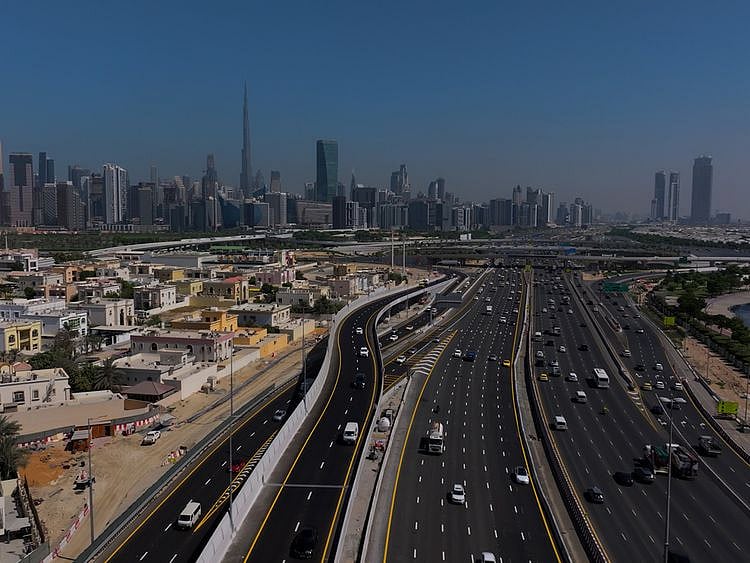
Dubai is investing heavily in road expansions and public transport upgrades to ensure faster, more efficient travel.
RTA
Dubai: The UAE is poised for a transportation transformation that is set to revolutionize how both residents and tourists travel within the city and beyond. With the introduction of Etihad Rail, air taxis, the expansion of the Dubai Metro, and advanced smart traffic systems, commuting is expected to become quicker, more intelligent, and more efficient than ever before.
1. Dubai Loop: Elon Musk’s underground transport network
Dubai will begin construction of the first phase of the Dubai Loop, an underground transport project developed in partnership with Elon Musk’s Boring Company, with an initial investment of about Dh565 million ($153.85 million).
The Dubai Loop will operate as a people mover system, focusing on first- and last-mile journeys while bypassing surface congestion. Electric vehicles will carry passengers through dedicated underground tunnels, with trips starting only from designated stations. Private cars will not enter the system.
Dubai Loop, the high-speed underground road system, will feature four stations linking the Dubai International Financial Centre with Dubai Mall and Burj Khalifa.
2. Flying taxis set to take off by 2026
By 2026, Dubai could become the first city in the world to launch a commercial air taxi service - not just a trial, but a fully operational transport mode integrated into the city’s infrastructure.
The project is being developed by Joby Aviation, a California-based company that signed an exclusive six-year operating agreement with Dubai’s Roads and Transport Authority (RTA) in 2024.
Construction has already started on the first vertiport at Dubai International Airport, located behind the Emirates Airline building. Additional vertiports are also being planned.
3. Etihad Rail to launch passenger services by 2026
Although a national project, the UAE’s rail network is on the fast track to reality, promising to transform travel between cities and across emirates.
The Etihad Rail passenger network is on track to begin operations by 2026, offering a fast, comfortable, and efficient alternative to driving. Each train will carry up to 400 passengers and operate multiple daily trips across the country.
Expected travel times include:
Abu Dhabi to Dubai: 57 minutes
Abu Dhabi to Fujairah: 105 minutes
Abu Dhabi to Ruwais: 70 minutes
A high-speed connection is also in the works, designed to link Abu Dhabi and Dubai at speeds up to 350 km/h, cutting the journey to just 30 minutes.
By providing a reliable rail option, Etihad Rail aims to reduce the number of vehicles on the roads, lower emissions, and improve inter-emirate connectivity.
4. Dubai’s Blue Line to expand metro, cut congestion, and boost connectivity
The Dubai Metro Blue Line will have two main routes:
21 km from Al Khor to Academic City with 10 stations
9 km from Centrepoint to International City with 4 stations
It will integrate with the Red and Green lines, connect to Dubai International Airport, and cut traffic congestion by 20 per cent. With trains every two minutes, it can carry 46,000 passengers per hour and accommodate 200,000 daily riders by 2030, rising to 320,000 by 2040.
5. Ongoing road upgrades across Dubai
If you’ve noticed construction on key roads around Dubai, it’s all part of the city’s ongoing infrastructure expansion. The RTA currently has many active projects designed to reduce travel times and ease congestion across busy routes.
Some of the major upgrades include:
Trade Centre Roundabout Development: Travel time from Sheikh Zayed Road to Sheikh Khalifa bin Zayed Street cut from 6 minutes to 1 minute, with overall delays reduced from 12 minutes to 90 seconds.
Al Mustaqbal Street: Travel time reduced from 13 minutes to 6 minutes.
Al Qudra Street: Travel time dropped from 9.4 minutes to 2.8 minutes, with capacity tripling to 19,200 vehicles per hour.
Oud Metha and Al Asayel Streets: Travel time cut from 20 minutes to 5 minutes, and capacity on Oud Metha Street increased to 15,600 vehicles per hour.
Umm Suqeim Street: Travel time cut by 61%, from 9.7 minutes to 3.8 minutes, with road capacity rising to 16,000 vehicles per hour.
6. Smart traffic system: Cars that talk to traffic lights
Dubai is also moving toward smarter, AI-powered roads. The RTA’s upcoming V2X smart traffic system will link vehicles directly to traffic signals, enabling real-time communication across the city’s network.
Set to roll out between 2027 and 2028, it will leverage AI and digital twin technology to analyse live traffic data, helping reduce congestion, enhance safety, and optimise signal timings for smoother journeys.
7. Dubai’s new trackless tram to reduce traffic
Dubai is expanding its transport network with new projects aimed at making travel faster, safer and more sustainable.
One of the key plans is a trackless tram system. These electric, driverless trams do not run on rails. Instead, they follow virtual tracks using cameras that read road markings. They are cheaper and quicker to build than traditional tram lines and are expected to run in eight main areas across the city.
Using artificial intelligence, the trams can spot obstacles and adjust their route in real time, offering a flexible and environmentally friendly alternative to standard rail systems.
8. Dubai’s 20-minute city vision
Dubai is pushing ahead with its goal of becoming a '20-Minute City', where residents can reach 80 per cent of daily destinations within 20 minutes using public transport or other sustainable modes.
This vision is backed by two decades of RTA investment in metro, bus, and road infrastructure - turning Dubai into one of the most connected cities in the world.
A recent McKinsey & Company study revealed the impressive impact of these efforts:
Dh150 billion generated in direct transport revenues
Dh319 billion saved in fuel and time costs
Dh156 billion contributed to Dubai’s GDP
16 per cent rise in property values, equivalent to Dh158 billion
The Dubai Metro Blue Line is expected to be completed by 2029
Network Links
GN StoreAbout Gulf NewsTerms & ConditionsReach by GNSitemapContact usPrivacy PolicyGN FocusHave your sayWork with usAdvertise with usGulf News epaperPrinting Services
Download our app
© Al Nisr Publishing LLC 2026. All rights reserved.