Death toll from Israeli raids on Lebanon rises to 303 killed and 1,150 injured
US-Iran ceasefire: Trump says Iran has 'no cards' beyond Strait of Hormuz as Vance heads to Pakistan for peace talks
Kuwait accuses Iran-linked drones; Saudi Arabia reports pipeline damage amid tensions
Last updated:
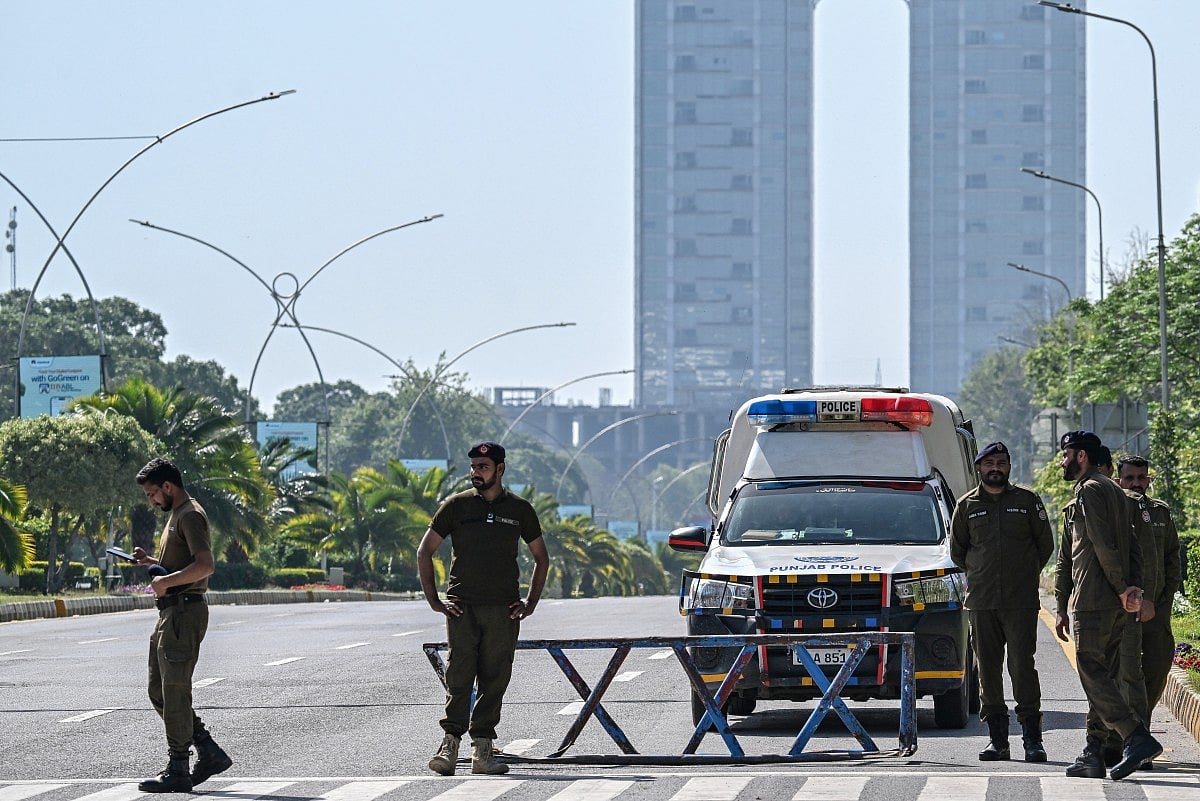
Security personnel keep watch along the cordon street near the expected venue of the US-Iran talks in the Red Zone area of Islamabad on April 10, 2026.
AFP
A US delegation is set to travel to Pakistan this weekend for talks on a potential long-term deal with Iran, as diplomatic efforts intensify alongside rising regional tensions. Donald Trump has warned Tehran against imposing tolls on oil tankers in the Strait of Hormuz, where limited shipping continues despite the route reopening. Israel has called for talks with Lebanon as fighting with Hezbollah threatens the truce, with PM Benjamin Netanyahu ordering direct negotiations, while Iran accuses Israel of violating the ceasefire. Meanhile, Kuwait has accused Iranian-linked drones of striking vital facilities despite the ceasefire, while Saudi Arabia reports damage to a key pipeline, increasing pressure ahead of US-Iran talks in Islamabad. Follow our live coverage for the latest developments in the region.
US‑Israel war on Iran: Recent developments
Kuwait condemns drone attacks by Iran, proxies
Kuwait has assailed drone attacks launched from Iran. The Kuwait National Guard said one of its sites was targeted with hostile drones, with no human casualties. Brigadier General Dr. Jadaan Fadel stated in a press statement that the competent authorities in the Guard immediately began taking the necessary security and field measures to deal with the incident.
A statement issued by Kuwait's Ministry of Foreign Affairs on Friday reads:
"The Ministry of Foreign Affairs expresses the State of Kuwait's strong condemnation and denunciation of the heinous attacks launched by the Islamic Republic of Iran and its proxies, including factions, militias, and armed groups loyal to it, via drones that targeted several vital facilities in the State of Kuwait, on the evening of Thursday, 9 April 2026, in flagrant violation of the sovereignty of the State of Kuwait and its airspace, and a blatant breach of international law, international humanitarian law, and the United Nations Charter.
"The Ministry of Foreign Affairs affirms that the continuation of these brazen attacks launched by the Islamic Republic of Iran and its proxies against the State of Kuwait and the countries of the region undermines the regional and international efforts that have recently borne fruit with the announcement of a ceasefire between the United States of America and the Islamic Republic of Iran, and constitutes a blatant challenge to the international community."
"While the Ministry of Foreign Affairs emphasizes the necessity of obligating the Islamic Republic of Iran and its proxies to immediately and unconditionally cease all hostile acts directed against the State of Kuwait and all other countries of the region in accordance with the provisions of Security Council Resolution 2817 of 2026, it renews its affirmation of the State of Kuwait's firm adherence to its full and legitimate right to self-defense under Article 51 of the United Nations Charter, and to take all necessary measures to preserve its sovereignty, security, and stability."
Trump warns Iran over ‘tolls’ on ships in Strait of Hormuz
The Trump administration has cautioned Tehran against imposing fees on commercial vessels transiting the strategic Strait of Hormuz, amid reports Iran has sought to charge tolls as part of ceasefire arrangements.
The White House warned that if reports of charges are accurate, Tehran “better stop now,” underscoring US opposition to levying transit fees that could violate international maritime norms and disrupt global trade.
White House press secretary Karoline Leavitt told reporters late on Thursday that Trump’s firm “red lines”, including reopening the Strait of Hormuz, were key to securing Iran’s agreement.
Only one set of Iran's 10-point terms acceptable: Trump
US President Donald Trump insisted that only one set of proposed terms is acceptable to the United States as it negotiates with Iran to solidify a fragile ceasefire in the Middle East conflict. In a statement released by the White House, Trump declared there is “only one group of meaningful ‘POINTS’” the U.S. will discuss behind closed doors. Those points, he said, formed the basis for the two-week truce announced late Tuesday. On Thursday, AFP reported that the details of the 10-point plan proposed by Iran that were published was not the one agreed to by the US.
NATO steps up: Allies eye Hormuz patrols
NATO Secretary-General Mark Rutte has signalled that European allies are preparing to secure the Strait of Hormuz.
Speaking after White House talks with President Donald Trump, Rutte urged rapid commitments from the 22-nation coalition — including NATO members, South Korea, and Japan —to reopen the vital oil chokepoint, closed by Iranian forces since early 2026. A European diplomat revealed Trump expects a concrete plan "within days", with the UK under Prime Minister Keir Starmer taking a leading role in coordinating naval efforts, Business Review reported.
While Rutte noted that NATO members would not directly fight in the Iran conflict, he said allies are willing to assist in terms of longer-term solutions to ensure freedom of navigation in the strait.
Iran's de facto blockade — via mines, drones, and missile threats — has spiked global oil prices and disrupted 20% of world trade, prompting UN Security Council Resolution 2817 demanding compliance. Trump, frustrated by allies' reluctance to join the US-Israel campaign, has threatened NATO withdrawal, calling it a "one-way street" after European nations deemed the Iran war "not our fight".
Oil prices extend gains amid Strait of Hormuz concerns
Oil prices continued to rise in early Asian trading as investors weighed concerns over restricted shipping through the Strait of Hormuz, with a fragile Iran–US ceasefire under strain amid ongoing Israeli strikes in Lebanon.
At 01:00 GMT on Friday, Brent crude futures were up 0.87% at $96.75 per barrel, while US crude also climbed more than 1%.
Australia PM in Singapore for fuel security talks
Australian Prime Minister Anthony Albanese will seek to boost ties with a key supplier of refined fuel in Singapore as a shaky ceasefire between the United States and Iran showed no sign of curbing petrol prices.
Australia relies on imports for an estimated 90 percent of its refined petroleum products.
Three percent of service stations across the country were reported this week to have run out of diesel.
Albanese will meet with Singaporean leader Lawrence Wong on Friday after a tour of Jurong Island, where the city state's key oil refining facilities are located.
The city state provides Australia with more than a quarter of its refined fuel.
In turn, Australia is Singapore's second-largest supplier of liquefied natural gas.
"It is in both of our countries' interests to engage with each other to make sure that we are both reliable suppliers," Albanese said on Thursday as he arrived in Singapore.
"It's so important that at difficult times in the world we can rely upon each other," he said.
"This is an important relationship at a time where fuel security is on the agenda, right around the globe due to the conflict in the Middle East," the Australian leader added.
Death toll from Israeli raids on Lebanon rises to 303
The death toll from Israeli air strikes targeting Lebanon yesterday has risen to 303 killed and 1,150 wounded.
In a statement issued on Thursday evening, the Lebanese Ministry of Health explained that rescue teams are still retrieving bodies from under the rubble at several sites.
It noted that work is ongoing to identify a number of the deceased in hospitals through DNA testing.
The Ministry indicated that the total toll of victims from 2nd March until 9th April has reached 1,888 killed and 6,092 wounded.
Ship-tracking data shows tankers’ movement in Strait of Hormuz
Underlining Iran’s continued control of the Strait of Hormuz, a Botswana-flagged liquified natural gas tanker called the Nidi attempted to travel out of the Gulf via a route ordered by the Revolutionary Guard but suddenly turned around and headed back early Friday, ship-tracking data showed.
On Thursday, four tankers and three bulk carriers crossed through the Strait of Hormuz, bringing the total number of ships passing through since the ceasefire to at least 12, according to the data firm Kpler. However, other ships not transmitting their locations may have passed through as well. The strait typically saw well over 100 ships passing through it daily in peacetime.
South Korea to send senior diplomat to Iran for talks
Seoul said senior diplomat Chung Byung-ha will soon depart for Iran as a special envoy to discuss the safety of its citizens and Iran’s chokehold on the Strait of Hormuz.
South Korea’s Foreign Ministry said Friday that Chung plans to push for freedom of navigation for all vessels in the strait, including South Korean ships.
The ministry earlier said Iranian Foreign Minister Abbas Araghchi welcomed Seoul’s plan to send a special envoy during a phone call with South Korean Foreign Minister Cho Hyun on Thursday.
Air raid sirens across Israel after rocket launches from Lebanon
Air raid alerts rang out across Israel early Friday, including in the commercial hub of Tel Aviv and in the southern coastal city of Ashdod following rocket fire from Lebanon.
Continued fighting between Israel and Iran-backed Hezbollah is testing a fragile truce reached between the United States and Iran.
Israel and Hezbollah exchanged fire repeatedly on Thursday.
The Israeli army's Home Front Command issued alerts for several areas following Friday's rocket fire, including the Tel Aviv area and southern communities far from the Lebanon border.
There were no immediate reports of casualties, but Israeli media reported that air-defence systems had intercepted at least one incoming rocket.
Pakistan to issue visas on arrival ahead of talks
Pakistan said Friday it would issue visas on arrival for those traveling to Islamabad for the Iran-US talks, signaling the interest in the world’s media in the event.
Japan releases more oil reserves
Japan said it will release an additional 20 days’ worth of oil reserves in May, in a second round address supply uncertainty over the war in the Middle East.
Japanese Prime Minister Sanae Takaichi said the planned release of the government reserves will start in early May, after an earlier release last month.
Japan started releasing about 50 days’ worth of oil reserves in March, including from those held by the state, the private sector and oil-producing Gulf nations.
As of April 6, Japan had 230 days’ worth oil reserves, including 143 days’ worth in government stockpiles, according to the Natural Resources and Energy Agency.
Takaichi said her government is working to secure oil imports via routes that do not include the Strait of Hormuz, while Japan seeks to diversify suppliers.
Air defence fire and explosions heard in Iran
Multiple times overnight into Friday morning, people around Iran's capital, Tehran, and other parts of the country said they heard what sounded like air defense fire and explosions.
However, Iran's government did not acknowledge any attack during that period.
After past exchanges of fire with Israel, similar incidents happened as troops remained on edge.
Iran leader issues new written message
Iran's new supreme leader, Mojtaba Khamenei, said in his latest written message that the Islamic republic did not want war with the United States and Israel but would protect its rights as a nation, state television reported.
"We will not renounce our legitimate rights under any circumstances, and in this respect, we consider the entire resistance front as a whole," he added, in an apparent reference to Lebanon, where Israel is fighting with Tehran's ally Hezbollah.
Khamenei has still not been seen in public since being appointed to succeed his father, who was killed in the initial wave of strikes on February 28.
Vance sets off to Pakistan to lead talks with Iran
US Vice President JD Vance, who has long been skeptical of foreign military interventions and outspoken about the prospect of sending troops into open-ended conflicts, sets off Friday to lead mediated talks with Iran in the Pakistani capital of Islamabad.
Vance is joined by Trump's special envoy Steve Witkoff and Trump's son-in-law Jared Kushner, who took part in three rounds of indirect talks with Iranian negotiators aimed at settling US concerns about Tehran's nuclear and ballistic weapons programs and its support for armed proxy groups in the Middle East before Trump and Israel launched the Feb. 28 war against Iran.
The White House has provided scant detail about the format of the talks - whether they will be direct or indirect - and has not provided specific expectations for the meeting.
Former Iran FM dies from injuries after attack: Report
Former Iranian foreign minister Kamal Kharrazi
Iranian media report former Foreign Minister Kamal Kharrazi has died from injuries sustained in an attack earlier this month.
According to BBC reporting, Kharrazi was a prominent reformist figure in Iran’s political establishment, serving as foreign minister from 1997 to 2005. He later headed Iran’s Strategic Council on Foreign Relations and acted as an adviser to the late Supreme Leader Ayatollah Ali Khamenei.
Reform-leaning outlet Jamaran reported on 1 April that Kharrazi had been severely injured and hospitalised after an attack on his Tehran residence, which it said also killed his wife. The reports indicated his home had been directly targeted.
Fuel supplies in focus amid ceasefire talks
World leaders are moving to secure oil and fuel supplies as the two-week Middle East ceasefire enters its final stretch, the BBC reports.
Japan has confirmed it will release 20 days’ worth of oil reserves, with attention focused on shipping routes through the Strait of Hormuz, according to media reports.
Australian Prime Minister Anthony Albanese is visiting Singapore in a bid to strengthen fuel security amid growing concerns over potential shortages.
US Vice-President JD Vance is expected to travel to Islamabad to lead peace talks with Iran starting Saturday, as diplomatic efforts intensify.
Meanwhile, Israeli Prime Minister Benjamin Netanyahu has outlined plans for talks on a potential peace deal with Lebanon, following reports of deadly Israeli strikes that killed hundreds in recent days.
Saudia to resume flights to Dubai, Abu Dhabi, Amman
Saudia will resume selected daily flights between Jeddah and Dubai, Abu Dhabi, and Amman from Saturday, 11 April 2026, including both outbound and return services on each route. Passengers are advised to check flight status before travelling, with further updates to be issued through official channels.
Daily exceptional flight schedule
Saudia will operate the following daily services:
Jeddah – Dubai (DXB): SV588
Jeddah – Amman (AMM): SV631
Jeddah – Abu Dhabi (AUH): SV570
Return flights include:
Dubai – Jeddah: SV589
Amman – Jeddah: SV632
Abu Dhabi – Jeddah: SV571
Zelensky urges Russian oil sanctions to be reimposed after ceasefire
Ukrainian President Volodymyr Zelensky has said he wants energy sanctions to be reinstated on Russia following a US-Iran ceasefire agreement that has opened the Strait of Hormuz waterway, vital to global energy supplies.
"Now a ceasefire is beginning in the Middle East and the Gulf. And I am waiting for sanctions on Russian oil to be fully reimposed, as they were before," Zelensky said in comments released under embargo to journalists, including from AFP, on Friday.
Security tightened in Islamabad ahead of US–Iran talks
Pakistan’s capital fell unusually quiet Friday as authorities locked down Islamabad ahead of high-stakes talks between the United States and Iran aimed at securing a lasting ceasefire after weeks of war.
Roads lay nearly empty, checkpoints were set up at major arteries, and a two-day public holiday kept residents indoors.
Behind the calm, diplomatic activity intensified. Security was tightened, with additional troops and police deployed across Islamabad.
Singapore rules out restrictions on fuel exports
Singapore’s Prime Minister Lawrence Wong said the island state will not restrict fuel exports from its refineries due to Iran war disruptions. Singapore was Australia’s largest supplier of refined petroleum products.
“We do not plan to restrict exports. We didn’t have to do so even in the darkest days of COVID and we will not do so during this energy crisis,” Wong said at a news conference with his Australian counterpart Anthony Albanese. “It’s hypothetical. It won’t happen,” Wong added.
Albanese said Wong had given the same assurance in their bilateral meeting. “The prime minister’s just as confident in private as he is in public,” Albanese said.
Spain called on Iran to negotiate in 'good faith': Minister
Spain's foreign minister said that he had spoken with his Iranian counterpart and urged him to negotiate in good faith during talks with the United States in Islamabad.
"I encourage Iran - this is what I conveyed to the Iranian foreign minister - to take part in those negotiations and to participate in good faith," Jose Manuel Albares told the press, adding that he had spoken with his Iranian counterpart, Abbas Araghchi, "the day before yesterday" and had also asked him to halt "all missile and drone launches".
India and Japan discuss shipping safety in Strait of Hormuz
Japanese Foreign Minister Toshimitsu Motegi and Indian External Affairs Minister S Jaishankar have “confirmed their commitment to closely collaborate toward calming the situation and ensuring stable energy supplies,” said the Japanese foreign ministry.
“Discussed developments in West Asia, including international shipping through the Strait of Hormuz. Appreciate his condolences for the Indian lives lost in the conflict,” Jaishankar said in a post on X.
Iran official says over 3,000 people killed in the war
A top medical official in Iran has put the death toll in the war with Israel and the United States at over 3,000 people.
The state-run IRAN daily newspaper quoted Abbas Masjedi, head of the Legal Medicine Organization, as saying “more than 3,000 people were killed in enemy attacks.” Masjedi did not elaborate on the breakdown in civilian versus military casualties. Iran’s government has not provided any definitive death toll from the weekslong war.
UAE to reassess global ties after Iran aggression: Gargash
Dr Anwar Gargash, diplomatic adviser to the UAE President, said it was still too early to draw definitive lessons from the “brutal Iranian aggression,” while stressing that the country would continue to strengthen its national model and defensive capabilities.
In a statement, Gargash said the UAE would press ahead in reinforcing the state framework that has underpinned its success, alongside efforts to safeguard the nation and protect its stability.
He added that, with the confidence of a country that has overcome a “treacherous attack”, the UAE would reassess its regional and international relationships with clarity and precision, identifying trusted partners, while pursuing economic and financial recalibration to reinforce the resilience of its model.
Gargash said a rational reassessment of national priorities would guide the country’s path forward.
Macron meets Pope Leo to talk Mideast war
French President Emmanuel Macron arrived at the Vatican for his first meeting with Pope Leo XIV, a private audience expected to be dominated by the Iran war.
The French leader, who arrived with his wife Brigitte after flying to Rome on Thursday, will meet the US pontiff and the Vatican's secretary of state, Pietro Parolin.
Macron and the leader of the world's 1.4 billion Catholics were due above all to discuss "the resolution of the crisis in the Middle East", a spokesman for Macron's office told reporters.
They are particularly focused on Lebanon, where deadly Israeli strikes threatened this week's temporary truce between the US and Iran.
In recent days, both Macron and the Chicago-born pontiff have spoken out against US President Donald Trump over the war, which began with Israel-US attacks on Iran.
Israel and Hezbollah exchange cross-border fire
Israeli forces carried out multiple airstrikes and artillery shelling in southern Lebanon, as hostilities with Hezbollah continued along the border.
Hezbollah said it had fired rockets into northern Israel, targeting what it described as Israeli troop positions inside Lebanese territory. It also claimed responsibility for strikes on the towns of Kiryat Shmona and Misgav Am in the Upper Galilee region, launched at 10:00 local time (06:00 BST) on Friday.
The group said the attacks were a response to what it called Israel’s “violation” of a US-Iran ceasefire agreement. “This response will continue until the Israeli-American aggression against our country and our people ceases,” it said in a statement.
WHO: Israel pledges not to attack 2 key Lebanese hospitals
The World Health Organization said Israel forces had previously issued an evacuation order for Beirut’s Jnah area, which includes the Rafik Hariri — the main public hospital in the city — and Al Zahraa Hospital.
WHO’s top representative in Lebanon said Friday that Israel provided “assurance” after late night talks with UN officials that Israeli forces would not attack the hospitals as they continue military action against Hezbollah.
Dr. Abdinasir Abubakar, speaking to reporters in Geneva, said UN officials “got some assurance back saying that these two hospitals will not be attacked.”
Separately, Abubakar said Israeli forces warned that “ambulances will be attacked.” An Israeli army spokesman wrote on X that Hezbollah is “deliberately using ambulances for terror purposes.” Abubakar said WHO was not able to independently confirm those claims.
Beirut residents sift through the wreckage of their homes
A Lebanese civil defense worker, right, stands with a resident at the site of a building destroyed in an Israeli airstrike a day earlier in central Beirut, Lebanon.
In the Ain Al Mraisseh neighborhood along Beirut’s coastal corniche, where an Israeli strike on Thursday wiped out the bottom floors of a multi-story building, causing a partial collapse, stunned residents tried to salvage whatever furniture and personal mementos they could find in the rubble.
Although now homeless, some men at the scene expressed gratitude that they lost only their apartments, not their loved ones. The strikes killed more than 300 people and wounded over 1,800, authorities said.
“There is no substitute for family,” said Wissam Tabila, 35. “Everything else can be replaced. The house and other things can be replaced, but parents, children, or a wife, this is the most important.”
UN food agency aids 1 million displaced in Lebanon
The World Food Program said that 874,000 people in Lebanon were already facing “acute food insecurity” before the latest escalation. Despite the risks, the WFP is continuing to send humanitarian convoys to southern Lebanon to villages on the border with Israel, which have been subject to heavy bombing, the agency said in a statement.
It says it has provided emergency food and assistance to over 440,000 people since March 2.
Hezbollah says it targeted Israel's Ashdod naval base with missiles
Hezbollah said Friday it had targeted Israel's Ashdod naval base with missiles, two days after deadly Israeli airstrikes on Beirut left more than 300 people dead.
"In response to the enemy's violation of the ceasefire and its repeated attacks on Beirut, and after the Resistance adhered to the ceasefire while the enemy did not, the fighters of the Islamic Resistance targeted... the naval base in the port of Ashdod with missiles," the group said in a statement.
Vance leaves for Iran peace talks, hopes for 'positive' outcome
US Vice President JD Vance boards Air Force Two at Joint Base Andrews, Maryland, on April 10, 2026, as he departs for Pakistan for talks on Iran.
US Vice President JD Vance said Friday he hoped for a "positive" outcome as he departed Washington for US-Iran peace talks being held in Pakistan.
"We're going to try to have a positive negotiation," he told reporters before take-off from Joint Base Andrews. "If the Iranians are willing to negotiate in good faith, we're certainly willing to extend the open hand. If they're going to try to play us, then they're going to find the negotiating team is not that receptive."
Gas price spike pushes up inflation by the most in 4 years in March
The largest monthly jump in gas prices in six decades caused a sharp spike in inflation in March, creating major challenges for the inflation-fighters at the Federal Reserve and heightening the political challenges of rising costs for the White House.
Consumer prices rose 3.3% in March from a year earlier, the Labor Department said Friday, up sharply from just 2.4% in February. On a monthly basis, prices rose 0.9% in March from February, the largest such increase in nearly four years.
Excluding the volatile food and energy categories, core prices rose 2.6% in March from a year earlier, up from 2.5% in February. But last month, core prices rose a modest 0.2%, suggesting the gas price shock hasn’t yet spread to many other categories.
Starmer says he's 'fed up' in rare criticism of Trump
U.K. Prime Minister Keir Starmer told broadcaster ITV in an interview recorded Thursday that he's "fed up with the fact that families across the country see their bills go up and down on energy, businesses' bills go up and down on energy because of the actions of Putin or Trump across the world."
Starmer's point was that Britain needs energy independence. But mentioning the Russian and U.S. presidents in the same breath is a departure for the prime minister, who usually avoids direct criticism of U.S. President Donald Trump.
The Iran war has soured relations between the two leaders, with Trump lashing out over Starmer's reluctance to join the conflict.
Israel army says over 4,300 Hezbollah sites 'dismantled' in Lebanon since start of war
The Israeli military said Friday that it had "dismantled" more than 4,300 Hezbollah sites in Lebanon since fighting with the militant group began last month.
"More than 1,400 Hezbollah terrorists eliminated and over 4,300 terrorist infrastructure sites dismantled," the military said.
Lebanon's health ministry reports that at least 1,888 people have been killed in the country - including 163 children - since fighting erupted between Israel and Hezbollah on March 2.
Lebanon state media says Israeli strikes in south kill 8 security personnel
Lebanese official media said Israeli strikes on Friday in the southern city of Nabatiyeh killed eight members of the country's State Security agency.
The state-run National News Agency said "enemy warplanes launched a series of heavy strikes" on the city, including one in the vicinity of the Nabatiyeh government building that hit the nearby State Security office, killing at least eight of its personnel.
An AFP photographer saw extensive damage at the site, where a fire was still raging.
Iran speaker demands Lebanon truce, release of assets 'before negotiations'
Iran's parliament speaker on Friday set a ceasefire in Lebanon and the "release of Iran's blocked assets" as pre-conditions for the start of negotiations with the United States.
"Two of the measures mutually agreed upon between the parties have yet to be implemented: a ceasefire in Lebanon and the release of Iran's blocked assets prior to the commencement of negotiations," Mohammad Bagher Ghalibaf wrote in a post on X in English.
"These two matters must be fulfilled before negotiations begin."
Trump's tenuous Iran exit plan isn't healing Republican rifts exposed by the war
President Donald Trump's search for an off-ramp from the war with Iran is getting bumpy inside his Republican Party.
In the decade since Trump's "America First" movement rose to power by rejecting military intervention, his coalition has rarely been tested the way it is now. Trump's exit efforts - first through threats of annihilation, then with a ceasefire that is proving precarious - are doing little to paper over tensions that have festered since the war began six weeks ago.
Despite the growing criticism, Republican leaders in Congress were largely silent. Many were privately uncomfortable with Trump's threats on social media and were concerned about how the war would play out, especially in an election year.
But with Congress on recess for the opening two weeks of April, House Speaker Mike Johnson, R-La., and Senate Majority Leader John Thune, R-S.D., have offered little public reaction to Trump's moves.
Trump warns of fresh strikes if Iran talks fail: NY Post
President Donald Trump said Friday that US warships are being reloaded with weaponry to strike Iran if talks in Pakistan fail to produce a deal, in an interview with the New York Post.
"We have a reset going. We're loading up the ships with the best ammunition, the best weapons ever made - even better than what we did previously and we blew them apart," the Post quoted Trump as saying.
"And if we don't have a deal, we will be using them, and we will be using them very effectively."
In a brief and cryptic message on his Truth Social network earlier, Trump had spoken of the "WORLD'S MOST POWERFUL RESET!!!"
Trump says Iran has 'no cards' beyond Hormuz control
President Donald Trump said Friday that Iran has "no cards" in upcoming talks with the United States - apart from Tehran's effective stranglehold on the crucial Strait of Hormuz shipping channel.
"The Iranians don't seem to realize they have no cards, other than a short term extortion of the World by using International Waterways. The only reason they are alive today is to negotiate!" Trump said on his Truth Social network.
Lebanon says death toll from Israeli strikes on Wednesday rises to 357
Lebanon's health ministry said Friday that the death toll from Israeli strikes across the country two days earlier was 357, up from a previous count of 303, while it said 1,223 more people were wounded.
"The toll is still not final, due to the ongoing removal of rubble and the presence of a large amount of human remains" requiring DNA testing, the ministry statement said, after Israel's massive strikes on Wednesday.
The ministry also raised the overall toll in Lebanon since war erupted between Israel and Hezbollah on March 2 to 1,953 dead and 6,303 wounded.
Kuwait says drone attack wounded National Guard members
Kuwait's defence ministry said on Friday that several members of its National Guard have been wounded, after the country's air defences responded to a drone attack the previous day.
The Gulf countries have been targeted by hundreds of Iranian missiles and drones since the beginning of the war, which was triggered by Israeli-US strikes on Iran on February 28.
Kuwait's defence ministry said in a statement that "Iranian aggression" had targeted several vital installations belonging to the National Guard, injuring some members.
It said they were receiving treatment and were in stable condition.
It added that the armed forces had "detected and intercepted, over the past 24 hours, seven hostile drones in Kuwaiti airspace".
The National Guard specified on X that some of its members had been wounded "in the line of duty at one of their sites" while others were wounded "while taking part in extinguishing a fire started by the drone attack".
It had said on Thursday that the attack targeted one of its sites and caused "significant damage".
Iran's Revolutionary Guards said, however, that they have not launched anything at any country since a two-week ceasefire between the United States and Iran took effect this week.
Get updated faster and for FREE: Download the Gulf News app now - simply click here.
Israel army says killed over 180 Hezbollah militants in Wednesday strikes
The Israeli military said Friday that airstrikes it carried out in Lebanon two days earlier killed more than 180 Hezbollah militants.
"Following an initial intelligence assessment... it can be determined that the IDF eliminated more than 180 militants from the Hezbollah terrorist organisation. The count is still ongoing," the military said.
Lebanon's health ministry meanwhile said Friday that the death toll from Israeli strikes across the country two days earlier was 357, up from a previous count of 303, while it said 1,223 more people were wounded.
Pakistan PM says US, Iran leadership both attending Islamabad talks
Pakistani Prime Minister Shehbaz Sharif said Friday that leaders of both Iran and the United States would attend ceasefire talks set to take place in Islamabad.
"In response to my sincere invitation, the leaderships of both countries are coming to Islamabad. There, negotiations will be held for the establishment of peace," Sharif said in an address to the nation.
US Vice President JD Vance was on his way to Pakistan, but Tehran has said certain conditions must be met before negotiations can occur, casting some doubt on the process.
We are closing coverage for now. Follow our live updates for the latest developments here.
Sign up for the Daily Briefing
Get the latest news and updates straight to your inbox
Network Links
GN StoreAbout Gulf NewsTerms & ConditionsReach by GNSitemapContact usPrivacy PolicyGN FocusHave your sayWork with usAdvertise with usGulf News epaperPrinting Services
Download our app
© Al Nisr Publishing LLC 2026. All rights reserved.