Russian President Vladimir Putin, right, shakes hands with Iranian Foreign Minister Abbas Araghchi during their meeting at the Boris Yeltsin Presidential Library, in St. Petersburg, Russia, on Monday, April 27, 2026.
Iran FM says the US wants to negotiate because it failed to achieve its war goals
Foreign Minister Abbas Araghchi reaffirms Russia ties amid war comments on US
Last updated:
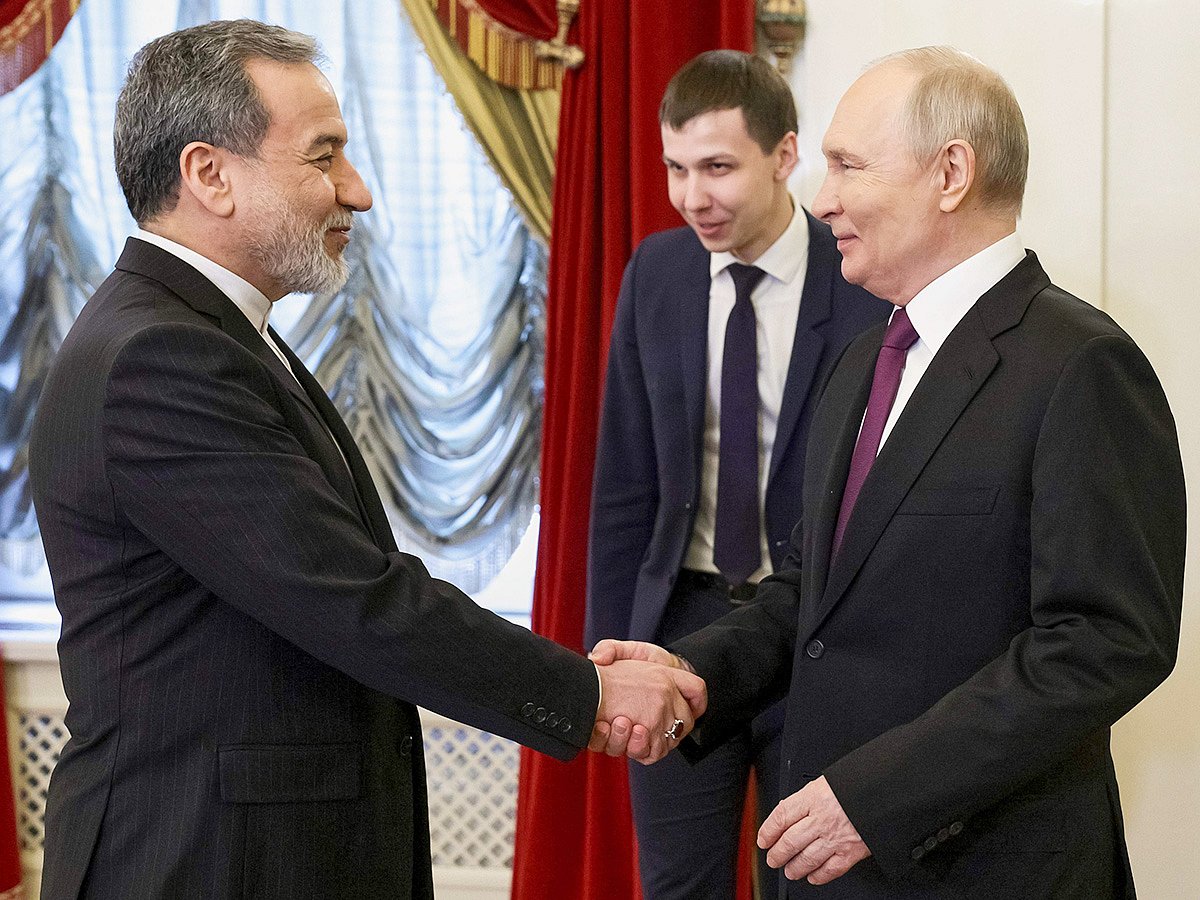
Russian President Vladimir Putin, right, shakes hands with Iranian Foreign Minister Abbas Araghchi during their meeting at the Boris Yeltsin Presidential Library, in St. Petersburg, Russia, on Monday, April 27, 2026.
AP
Global markets remain on edge as hopes for a US-Iran peace deal flicker. While US President Trump suggests an end to the war may be nearing, Tehran’s latest proposal seeks to decouple the maritime crisis from nuclear negotiations. With the Strait of Hormuz largely shuttered and oil prices climbing, we bring you real-time updates on the blockade, Iran FM Araghchi’s high-stakes visit to Moscow, and the latest from Washington:
Pakistan lifts Islamabad Red Zone lockdown
Pakistan's foreign minister, Ishaq Dar, said late Sunday that the government has lifted all restrictions around the high-security zone in the capital of Islamabad.
Iranian and U.S. delegations held rare face-to-face talks there earlier this month. The area had remained under lockdown for more than a week as Pakistan hoped to host a second round of talks aimed at securing a ceasefire.
Dar's remarks signaled that there was no immediate prospect of further direct talks between the United States and Iran. Still, Pakistan's government says it continues to mediate by conveying messages between the two sides to promote lasting stability in the region.
In a post on X, Dar thanked residents of Islamabad and the nearby city of Rawalpindi "for their patience and cooperation."
US crude oil tanker makes landmark delivery to Japan
A tanker carrying about 910,000 barrels of US-produced crude oil from Texas arrived in Tokyo Bay, completing a roughly 35-day voyage through the Panama Canal, in one of the largest direct US crude deliveries to Japan in years.
The cargo aboard the tanker M/V Otis marks a notable shift in global energy flows as buyers seek alternatives to Middle Eastern supplies amid disruptions in the Strait of Hormuz, a crucial chokepoint for world oil shipments.
Araghchi holds high-level talks with Oman's Haitham
Iran's Foreign Minister Abbas Araghchi held high-level talks with Oman's Sultan Haitham bin Tariq in Muscat, focusing on cooperation among Hormuz littoral states to ensure safe maritime transit amid the ongoing war with the US and Israel.
Donald Trump signals US-Iran conflict may end soon
US President Donald Trump has indicated that the ongoing tensions between the United States and Iran could be nearing an end, asserting that mounting military and economic pressure has placed Tehran in a weakened position and may push it towards a resolution.
Trump added that internal divisions within Iran's leadership could further accelerate the path to an outcome.
Putin to meet Iranian foreign minister: state media
Russian President Vladimir Putin plans to meet with Iranian Foreign Minister Abbas Araghchi on Monday, Russian state media reported.
Russia and Tehran, who are both subject to fierce Western sanctions, have developed an increasingly close relationship in recent years.
Moscow's TASS news agency confirmed the Russian leader's plans, citing Kremlin spokesman Dmitry Peskov.
Russia's foreign ministry had said earlier that Araghchi would travel to Moscow for talks.
"We confirm a visit by Araghchi to Russia with the aim of holding talks," the ministry told RIA Novosti news agency, without providing more details.
Iran's ISNA news agency quoted Tehran's ambassador to Russia, Kazem Jalali, saying that Araghchi would meet Putin to "consult with Russian officials regarding the latest status of the negotiations, ceasefire, and surrounding developments".
US naval blockade forces 38 ships to turn back from Iran
The US Central Command (CENTCOM) said American forces have intercepted and redirected 38 vessels since the start of what it described as a maritime blockade on Iran.
According to CENTCOM, the ships were either forced to turn around or return to Iranian ports as US forces continued operations aimed at restricting maritime access.
In a post on X, CENTCOM said US forces are enforcing the blockade by preventing vessels from entering or leaving Iranian ports, as tensions between Washington, Tehran and Israel continue to escalate across the region.
Iran FM arrives in Saint Petersburg for Putin talks
Iran's Foreign Minister Abbas Araghchi arrived in Saint Petersburg on Monday, state media reported.
"He arrived early on Monday morning with the aim of meeting and holding talks with Russian President Vladimir Putin," Iranian state news agency IRNA posted on Telegram.
Moscow's TASS news agency confirmed earlier that Putin plans to meet Araghchi, citing Kremlin spokesman Dmitry Peskov.
Oil rises, stocks swing as peace talk hopes wobble
Oil prices rose more than one percent Monday, though lingering hopes that a US-Iran deal can eventually be reached has tempered the gains.
Fawad Razaqzada of Forex.com, warned they could surge again at any time.
"If tensions were to escalate further, particularly into open conflict, there's a clear risk of a sharper spike," he wrote.
"For now though, as long as shipping through the Strait remains constrained, that premium is unlikely to fade. Until there's a credible breakthrough, the path of least resistance still looks higher, with a move beyond $110 appearing increasingly plausible."
Stocks fluctuated through the morning, with Tokyo, Seoul and Taipei sharply up on the back of healthy AI-fuelled tech gains following US giant Intel's healthy revenue forecasts.
There were also gains in Shanghai and Jakarta, while Sydney, Singapore and Manila fell and Hong Kong was flat.
That came after the S&P 500 and Nasdaq ended Friday at fresh record highs.
Iran presents new proposal to end war, reopen Hormuz
Iran has reportedly delivered a fresh diplomatic proposal to the United States through Pakistan aimed at ending the war and reopening the strategic Strait of Hormuz, Axios reported.
The latest proposal calls for talks on Iran's nuclear program to be postponed to a later stage, according to media reports.
The proposal, communicated via Pakistani intermediaries to the US, outlined in reporting by Axios and cited by US and regional sources, seeks to break a negotiation deadlock that has stalled peace efforts and unsettled global energy markets.
ECB set to hold rates steady with eye on Iran crisis
The European Central Bank is expected to hold interest rates steady again this week as it waits to see if the inflation spike triggered by the Middle East war will prove temporary or begin to weigh on growth.
Markets ramped up their bets on a rate hike after the US-Israeli war on Iran sparked a global energy shock, which is already pushing up eurozone consumer prices.
Inflation in the 21-nation single currency area jumped to 2.6 percent in March, above the ECB's two-percent target, and the bank has warned it could surge far higher in a worst-case scenario.
Iran FM details Pakistan, Oman diplomatic missions
Upon his arrival in St Petersburg, the Iranian Foreign Minister provided insights into his recent diplomatic missions to Pakistan and Oman. According to the Iranian state media broadcaster, IRNA news agency, Abbas Araghchi described his journey to Islamabad as "very productive" and noted it involved "good consultations."
During these meetings, officials reportedly "reviewed past events and the specific conditions under which negotiations between Iran and the US could continue."
Shifting the focus to maritime security, the Foreign Minister detailed his subsequent visit to Muscat, where discussions centred on the strategic Strait of Hormuz. The IRNA news agency quoted Araghchi as saying, "Iran and Oman are the two coastal states of the Strait of Hormuz, making mutual consultations necessary--especially as safe passage through the Strait has become a significant global issue."
The Foreign Minister further explained that the geography of the waterway necessitates a unified approach between the neighbouring nations. "It is natural that, as the two coastal nations of this Strait, we must engage in dialogue to ensure our common interests are met and to remain coordinated in any action taken, as the interests of both Iran and Oman are directly involved," he stated.
Highlighting the diplomatic alignment between the two countries, the IRNA news agency reported a "high degree of consensus" regarding these maritime concerns. Araghchi added that both sides have agreed "that consultations should continue at the expert level" to maintain regional stability and safeguard shared interests.
Building on this regional momentum, the Iranian Foreign Ministeris in St Petersburg to conduct high-level discussions with senior Russian officials, including President Vladimir Putin
Iran FM blames US for failure of Pakistan talks
Iranian Foreign Minister Abbas Araghchi on Monday blamed the United States for the failure of peace talks in Pakistan, after arriving in Russia for a meeting with President Vladimir Putin.
"The US approaches caused the previous round of negotiations, despite progress, to fail to reach its goals because of the excessive demands," Araghchi was quoted as saying by Iranian state media.
He also said that "safe passage through the Strait of Hormuz is an important global issue", as the US and Iran continue their rival blockades in the waterway.
Safe passage through Hormuz an ‘important global issue,’ says Iran’s top diplomat
The ceasefire in the US-Israeli war with Iran has so far held, but its economic shock waves have continued to reverberate globally.
Iran has blockaded the strait, cutting off flows of oil, gas and fertiliser and sending prices soaring, raising fears of food insecurity in developing countries.
In response, the US has imposed a blockade of Iranian ports in the waterway and beyond.
Trump faces domestic pressure as fuel prices rise following Iran's closure of Hormuz, with midterm elections due in November. Polls show the war is unpopular among Americans.
The subject of the strait was on the agenda during Araghchi's trip to Oman, which lies on the other side of the waterway from Iran.
"The safe passage through the Strait of Hormuz is an important global issue. Naturally, as the two coastal countries of this strait, we must speak with each other so that our common interests are secured," Araghchi said from Saint Petersburg.
Iranian aggression in GCC premeditated: Gargash
Dr Anwar Gargash, Diplomatic Adviser to the UAE President, said the recent Iranian aggression on GCC countries was “premeditated and not a momentary reaction”, adding that its intensity exceeded expectations.
Speaking during a session titled "Re-evaluating Alliances in Times of Tension" at "Gulf Creators", which kicked off on Monday at Atlantis The Palm Dubai, Gargash said GCC countries had worked to avoid war and had maintained an implicit understanding not to allow their territories to be used against Iran.
Read more here.
Hezbollah leader rejects Lebanon-Israel direct talks
Hezbollah leader Naim Qassem on Monday rejected Lebanon's planned direct talks with Israel, calling them a "grave sin" that will destabilise Lebanon.
"We categorically reject direct negotiations with Israel, and those in power should know that their actions will not benefit Lebanon or themselves," Qassem said in a statement, calling on authorities to "back down from their grave sin that is putting Lebanon in a spiral of instability".
"These direct negotiations and their outcomes are as if they do not exist for us, and they do not concern us in the slightest," he added, saying "we will continue our defensive resistance for Lebanon and its people".
"No matter how much the enemy threatens, we will not back down, we will not bow down, and we will not be defeated."
Get updated faster and for FREE: Download the Gulf News app now - simply click here.
Iran ships 4 million barrels of oil despite US blockade
Iran is still moving oil — even under a US naval blockade — undercutting Washington’s effort to choke off its energy lifeline and easing fears of an immediate global supply shock.
Tanker trackers and media reports say Tehran has loaded at least 4.6 million barrels of crude — amounting to nearly $400 million worth of crude — at its export terminals in recent days, with another four million barrels appearing to have crossed the blockade line.
Satellite imagery cited by monitoring firms shows some vessels “going dark” — switching off transponders to slip past surveillance and deliver cargo beyond restricted zones.
With Iran along the northern coast of the narrow Strait of Hormuz, its geographic edge makes such evasion easier.
Read more here.
Trump to hold talks on Iran with security team
US President Donald Trump will hold talks on the Iran war on Monday with his top security advisors, US media reported, as negotiations between the rival parties seemed to reach an impasse.
Tehran's top diplomat blamed Washington on Monday for the failure of talks in Pakistan this month - the first and only round of negotiations in a bid to strike a deal to end the conflict that has engulfed the Middle East and strangled the global economy.
Barak Ravid, global affairs correspondent for US media outlet Axios, reported that Trump was expected to hold a meeting with his top national security and foreign policy team on Monday to discuss the next steps.
ABC News quoted two unidentified US officials as saying that Trump would meet with his key security advisors on Iran, adding that a new deal proposed by Tehran to resolve the conflict fell short of Washington's red lines.
That deal centred on reopening the Strait of Hormuz and ending a US naval blockade of the vital waterway, with nuclear negotiations postponed for a later stage, Axios reported.
China opposes US sanction on oil refinery
China said Monday it opposed a decision by the US to sanction one of its refineries for purchasing Iranian crude oil shipments.
The US announced Friday it would sanction Hengli Petrochemicals in China’s northeastern port city of Dalian. The measure blocks the company and others that transport Iranian oil from accessing the US financial system. Hengli Petrochemicals is among dozens of Chinese buyers of Iran’s oil. China is Iran’s largest overall oil customer.
“China always opposes illegal unilateral sanctions that lack a basis in international law and urges the US to stop its wrong practices of abusing sanctions and exercising long-arm jurisdiction,” Ministry of Foreign Affairs spokesperson Lin Jian said.
We will firmly safeguard the legitimate rights and interests of Chinese companies.Lin Jian
Get updated faster and for FREE: Download the Gulf News app now - simply click here.
Oil rises, stocks steady as US-Iran peace talk hopes wobble
Oil prices rose and stock markets were steady on Monday as peace talks between the US and Iran stalled, ahead of a week full of central bank decisions and corporate earnings.
The international oil benchmark Brent crude stayed above $100 a barrel on Monday as the crucial Strait of Hormuz waterway remained largely closed.
Both main oil contracts were up around one per cent, though lingering hopes that a deal can eventually be reached tempered gains.
Stock markets in London, Paris and Frankfurt all advanced despite elevated oil prices and a lack of progress in negotiations.
Taking country to war is 'treason': Lebanese President
Lebanese President Joseph Aoun said Monday that direct negotiations with Israel were aimed at ending the conflict with Hezbollah, while accusing those who drew Lebanon into war of "treason" in an implicit rebuke to the Iran-backed armed group.
"My goal is to reach an end to the state of war with Israel, similar to the armistice agreement" of 1949, Aoun said in a statement, adding that "I assure you that I will not accept reaching a humiliating agreement".
"Those who dragged us into war in Lebanon are now holding us accountable because we made the decision to go to negotiations... What we are doing is not treason. Rather, treason is committed by those who take their country to war to achieve foreign interests," he said.
Iran seeks tighter control over Strait of Hormuz
Iran's armed forces would be the authority responsible for the Strait of Hormuz under the country's proposed law for managing the waterway, a top official said on Monday.
Ebrahim Azizi, head of the national security commission in Iran's parliament, told state television that the armed forces were already in control of the strait and were seeking to prohibit the passage of "hostile vessels".
Azizi also said the proposed law states that financial gains from the strait should be paid in the local rial currency.
Bahrain revokes citizenship of 69 over Iran links
Bahrain has revoked the citizenship of 69 individuals convicted of communicating with foreign entities and glorifying Iranian attacks during the recent conflict, authorities said, as part of a broader security crackdown.
The decision follows the arrest of dozens of people accused of posting content on social media that incited instability and threatened public order in the Kingdom.
Putin meets Iran FM Araghchi
Russian President Vladimir Putin met with Iranian Foreign Minister Abbas Araghchi on Monday in Saint Petersburg, Russian state news agency Tass said.
Putin praised the Iranian people as bravely fighting for their sovereignty and said Russia would do everything possible in the interest of Iran and other countries in the region to bring peace to the Middle East, Tass reported.
Israeli military videos show weapons discovered and homes levelled
It released videos Monday showing troops operating in Lebanon, including coordinated explosions in unnamed villages, toppling homes it said was infrastructure used by the Lebanese militant group Hezbollah.
Footage also showed a brigade discovering a cache of rifles and missile launchers stashed in a children’s room, which it said were hidden beneath toys, beds and elsewhere in kids’ rooms.
The military says it destroys buildings that were used as outposts by the Iran-backed militant group, but the wide scale of destruction has Lebanese officials and residents increasingly worried that displaced people will have nowhere to return.
Oil prices rise as US stocks ease from record highs
The US stock market’s record-breaking rally is slowing Monday after uncertainty rose over the weekend about what will happen next in the Iran war, while oil prices are rising.
The S&P 500 edged down by less than 0.1%, coming off its latest all-time high driven by strong profit reports from US companies and hopes that the United States and Iran can avoid a worst-case scenario for the economy because of their war. The Dow Jones Industrial Average was up 86 points, or 0.2%, as of 9:35am Eastern time, and the Nasdaq was 0.3% lower after setting its own record.
The moves were stronger in the oil market, where prices climbed more than 1.5% as tankers still find the Strait of Hormuz effectively closed. That’s keeping crude stuck in the Middle East and away from customers worldwide, including crude produced by Iran that’s being blockaded by the US Navy.
Iran reroutes food imports via Caspian Sea amid US pressure
With the US trying to squeeze Iran by blockading goods from entering or exiting its ports, food suppliers are re-routing imports via the Caspian Sea to ensure food keeps to getting into the country.
The head of the Association of Iran’s Food Industries said Monday that alternative import routes are being “incorporated into the supply chain for essential goods.”
“At present, there is no problem with the country’s food security, but maintaining this situation requires careful planning,” Mohammad Reza Mortazavi said, according to the state-owned Islamic Republic of Iran Broadcasting.
Iran is a net importer of food staples like grain and cooking oil.
The Caspian is the world’s largest inland body of water and its southern coastline stretches more than 700 kilometres in northern Iran.
Pakistan clears transit of third-country goods to Iran
Pakistan has cleared the way for Iran to import goods from third countries through its territory by opening new transit routes.
According to a government notification issued Saturday, six routes have been designated linking ports including Karachi, Port Qasim and Gwadar with key border crossings in southwestern Balochistan province.
The notification was issued during a visit to Islamabad by Iranian Foreign Minister Abbas Araghchi, who met Pakistani officials for talks amid tensions between the United States and Iran.
The order took immediate effect.
Analysts said Monday the new policy allows cargo bound for Iran to move across Pakistan swiftly without facing delays due to bureaucratic hurdles. They said it could also help Pakistan strengthen its role as a regional transit route and improve connectivity with Iran and beyond the region in future.
German Chancellor criticises US over Iran war strategy
Germany's Chancellor Friedrich Merz
German Chancellor Friedrich Merz on Monday criticised the US for going into the Iran war without any strategy, saying this also makes it harder to end the conflict.
“The problem with conflicts like these is always the same: it’s not just about getting in; you also have to get out. We saw that all too painfully in Afghanistan, for 20 years. We saw it in Iraq,” the chancellor said while speaking Monday to students in Marsberg in the Sauerland region of Germany.
The lack of US strategy and the fact that the Iranians are stronger than previously thought made it hard to end the conflict now, he said.
“Especially since the Iranians are negotiating very skillfully — or rather, very skillfully not negotiating,” he added. “And then letting the Americans travel to Islamabad, only to send them back without any results. An entire nation is being humiliated by the Iranian leadership, especially by these so-called Revolutionary Guards.”
Germany, he said, maintains its offer to send minesweepers in order to help reopen the Strait of Hormuz, but only after the fighting is over.
Lebanon’s Health Ministry raises death toll there to 2,521
The ministry added Monday that 7,804 people were wounded since the latest Israel-Hezbollah war started March 2.
Despite a ceasefire that’s been in place since April 17, there have been repeated violations by both sides.
Rubio rejects Iran proposal on Strait of Hormuz
US Secretary of State Marco Rubio
US Secretary of State Marco Rubio says a purported offer from Iran to reopen the Strait of Hormuz under strict conditions is not acceptable to the United States or others.
Speaking in a Monday interview with Fox News, Rubio said Iran has a different view of the strategic waterway than most of the rest of the world.
“What they mean by opening the straits is, yes, the straits are open, as long as you coordinate with Iran, get our permission, or we’ll blow you up and you pay us,” Rubio said.
“That’s not opening the straits. Those are international waterways. They cannot normalize, nor can we tolerate them trying to normalize, a system in which the Iranians decide who gets to use an international waterway and how much you have to pay them to use it.”
‘UK doesn’t support US blockade of Iranian ports’
Stephen Doughty, minister of state for Europe and North America, said that while the UK doesn’t support the US blockade, it supports working with the US and others to reopen the Strait of Hormuz — where he said the Iran is holding “the rest of the world to ransom.”
Maritime traffic must flow safely and unimpeded through the strait, he said, “and that includes no tolls, no security risk and, of course, adherence to the international laws on freedom of navigation.”
Diplomacy is crucial, Doughty told a small group of UN reporters ahead of a Security Council meeting Monday on the safety of navigation in the critical waterway, through which around 20% of the world’s crude oil normally passes.
He said de-escalation and a ceasefire are also crucial, stressing that Iran can’t be allowed to block the strait, attack its Gulf neighbours and civilian infrastructure, and develop nuclear weapons.
Get updated faster and for FREE: Download the Gulf News app now - simply click here.
UN and dozens of countries call for reopening of Strait of Hormuz
In a joint statement led by Bahrain, dozens of countries reiterated their weekslong “call for the urgent and unimpeded opening” of the critical waterway as negotiations between the US and Iran remain stalled.
Antonio Guterres, the UN secretary-general, told the Security Council on Monday that given the impasse in the negotiations, the world body should support an emergency framework in the meantime put forth by the International Maritime Organization.
The UN chief warned about the consequences of waiting to address the “worst supply chain disruption since COVID-19 and the war in Ukraine.”
“These pressures are cascading into empty fuel tanks, empty shelves — and empty plates,” he told the 15-member council. “The humanitarian toll is mounting.”
French minister criticises all sides over Hormuz tensions
At a UN Security Council meeting on maritime security, French Foreign Minister Jean-Noël Barrot said the energy and humanitarian crisis caused by the closure of the Strait of Hormuz began after “operations launched by the United States and Israel without a clearly set of goal, which were conducted in a manner that flouts international law.”
But Barrot added that Iran now holds responsibility for what it is doing with the critical waterway.
“Straits are the arteries of the world. They are not the property of any individual. They are not for sale, therefore, they cannot be impeded by any obstacles, tolls, nor bribery, neither by Iran, nor by any other party, and under no pretext,” he said.
Emirates to resume flights to Kuwait, Muscat from May 1
Dubai's Emirates airline will resume flights to Kuwait from May 1 following the reopening of Kuwaiti airspace and the return of normal air traffic, according to schedules published on the airline’s website.
The carrier will initially operate two daily direct flights between Dubai International Airport and Kuwait International Airport, with the first flight (EK855) departing at 7:50am and the second (EK857) at 2:55pm.
From May 16, Emirates will increase frequency to four daily flights using A350 and B777 aircraft, boosting seat capacity on the route, before adding a fifth daily service from May 21.
The airline will also resume flights to Muscat from May 1 to May 15, operating five weekly services on flight EK866, in addition to two weekly flights on EK862, before returning to daily operations on the route from May 16 via flight EK866.
Iran’s FM says US has fallen short in war aims
Iran's Foreign Minister Abbas Araghchi told a Russian state TV reporter on Monday that despite the US being a superpower, its leaders "have achieved none of their goals" in the war against his country.
"That's why they ask for negotiation," Iran's top diplomat said. "We are now considering it."
Araghchi was in St. Petersburg on Monday, meeting with Russian President Vladimir Putin and other top officials.
Asked by another reporter about Russia's support, the minister said only that "Iran and Russia are strategic partners," and that the two counties "have always supported" each other. "Our cooperation would continue," Araghchi said
US and Iranian officials clash during a UN nuclear weapons conference
Officials from the US and Iran clashed over the Islamic Republic’s nuclear ambitions at the opening of the Nuclear Nonproliferation Treaty review, a dispute almost certain to continue during the four-week meeting.
At issue was the election of Iran as one of 34 vice-presidents of the conference. Iran was a candidate of the Nonaligned Movement, comprising 121 mainly developing countries.
The US was backed by Australia, and the UK, France and Germany also expressed “concern.” Russia objected to singlling out Iran.
The US representative, whose name was not immediately available, said the Trump administration was “deeply shocked” that a country that has demonstrated “contempt” for the treaty is now a vice-president.
Iran’s Ambassador to the UN in Vienna, Reza Najafi, categorically rejected the US statement, calling the allegations “baseless and politically motivated.”
Israel cancels major holiday gatherings over Hezbollah threat
Typically, around 100,000 mostly ultra-Orthodox Jews would gather next week on Mount Meron in northern Israel to celebrate the Lag BaOmer holiday.
However, the office of Prime Minister Benjamin Netanyahu said Monday that the large festival will replaced with a smaller symbolic ceremony, citing concerns about the gathering being attacked by Hezbollah. Similar restrictions were imposed during the COVID-19 pandemic and previous wars.
Mount Meron is only about 6 kilometres from the border with Lebanon. People normally light bonfires, dance and have large meals there in honor Rabbi Shimon Bar Yochai, a 2nd-century sage and mystic who is believed to be buried on the mountain.
Across Israel, even in secular areas, people often celebrate Lag BaOmer with barbecues and bonfires in parks and forests.
2026 'likely to be year of fighting' on all fronts: Israel army chief
Israel's chief of staff Lieutenant General Eyal Zamir warned Monday that the country's military was likely to be fighting on multiple fronts throughout 2026, as it fights wars against Iran and Lebanese militant group Hezbollah.
"Since 7 October (2023), the IDF has been engaged in fighting in an ongoing multi-front campaign... 2026 is likely to be another year of fighting on all of those fronts," he said, citing the date of Hamas's attack on Israel that sparked the Gaza war.
He also reiterated the urgent need for the military to recruit more troops to handle the operational demands facing it.
"Given the growing tasks facing the IDF in the coming years, the urgent need facing the state of Israel is to increase the number of military personnel and fighters," he said.
US reviews Iran proposal, Trump to respond later
US President Donald Trump met with his top security advisors Monday to discuss an Iranian proposal that would reportedly re-open the Strait of Hormuz as broader negotiations over the war continue, the White House said.
When asked about the reported plan - which would see both Iran and the United States lift their blockades ahead of further talks on the thorny issue of Tehran's nuclear program - spokeswoman Karoline Leavitt told a White House briefing that "the proposal was being discussed."
"Only because it's been reported, I will confirm the president has met with his national security team this morning," she said, refusing to say if Trump would accept the proposal.
Hezbollah is down to about 10% of its arsenal: Netanyahu
Meeting with army commanders, Israeli Prime Minister Benjamin Netanyahu said Hezbollah’s ability to fire into Israel has been sharply degraded, estimating the group retains about 10% of its arsenal. He did not clarify whether that figure refers to the Lebanese militant group’s stockpile from before the current war, or since the Gaza war began back in 2023.
Iran-backed Hezbollah is believed to still have tens of thousands of rockets, missiles and drones despite decades of efforts by Israel, UN peacekeepers and Lebanon’s government to disarm it. Despite Israeli pressure, it’s unclear whether Lebanese authorities have the capacity or political will to disarm Hezbollah.
Netanyahu said Israeli forces’ occupation of parts of southern Lebanon — which he described as a “security zone” — has made northern Israel safer. He said deals brokered with the US and Lebanon gave Israel a “freedom of action” to counter threats inside that country. Beirut has not acknowledged any such right, and Hezbollah says it will keep firing as long as Israel does.
UN demands emergency plan for stranded Hormuz crews
Warning the humanitarian toll is mounting because of the blockade of the Strait of the Hormuz, UN Secretary-General Antonio Guterres on Monday called for ending the use of merchant shipping as a tool of political pressure.
At meeting of the Security Council on maritime security, he also made a plea on behalf of the sailors trapped in Hormuz region, asking for the implementation of an emergency plan to evacuate
More than 20,000 seafarers remain stranded at sea in the over 2,000 commercial vessels "caught in a web of risks and restrictions to navigation", he said.
"Their safety, their well-being, and their rights must be protected -- at all times, and in all waters", he said.
He urged member nations to support the International Maritime Organisation's (IMO) emergency evacuation framework for a coordinated plan "to ensure the safe movement, assistance, and protection of affected crews".
Iranian official criticises EU remarks on sanctions
Esmaeil Baqaei, spokesperson for Iran’s Foreign Ministry, rebuked European Commission President Ursula von der Leyen for her remarks about what he described as inhumane sanctions imposed on Iran.
Von der Leyen said Monday at a press conference in Berlin that it “would be too early” to lift sanctions on Iran due to human rights violations, saying that a “fundamental change” is needed before dropping the sanctions.
Last month, the Council of the European Union imposed additional sanctions in response to human rights violations in Iran, particularly over the suppression of January protests.
However, Baqaei argued against her remarks on X, saying those sanctions “were designed to trample the basic rights of ordinary Iranians” and that her comments “only further demonstrates Europe’s ruling class’ double-standard & hypocrisy, and hastens Europe’s embarrassing descent into irrelevance.”
Too early to ease Iran sanctions: Ursula
European Commission President Ursula von der Leyen said today that it is still too early to consider easing the sanctions imposed on Iran, stressing that any step in this direction must be preceded by fundamental and radical changes within Iran.
Von der Leyen added, during a statement in Berlin, that the European sanctions were imposed primarily because of what she described as human rights violations inside Iran, including issues related to fundamental freedoms and women's rights.
She affirmed that lifting the sanctions is not possible at the current stage, emphasising that the European Union first needs to see a genuine transformation in the behaviour and policies of the Iranian authorities before considering any easing of the measures.
Get updated faster and for FREE: Download the Gulf News app now - simply click here.
Iran blames US for failure of talks
Iran's top diplomat blamed Washington for the failure of Middle East peace talks during a visit to Russia, where President Vladimir Putin promised him Moscow's support in "ending the war".
Iranian Foreign Minister Abbas Araghchi was in Saint Petersburg on a whirlwind diplomatic tour, having sandwiched a trip to Oman in between two visits to Pakistan, the main mediator in the Mideast war.
Israel's Katz warns Hezbollah's Qassem against 'playing with fire'
Meanwhile, violence has continued on the war's Lebanese front, despite a recently extended ceasefire between Israel and Iran-backed Hezbollah, with Beirut's health ministry reporting Israel killed four people in the south.
Fifty-one others were wounded, including three children, the ministry added. Hezbollah drew Lebanon into the Middle East war by firing rockets at Israel, which responded with strikes and a ground invasion.
The group's leader Naim Qassem on Monday rejected planned direct negotiations between Lebanon and Israel as a "grave sin", vowing to "not back down".
Israeli Defence Minister Israel Katz warned that "Qassem is playing with fire". Lebanese President Joseph Aoun, responding to Qassem, said his "goal is to reach an end to the state of war with Israel".
But Israeli army chief of staff Eyal Zamir said 2026 was "likely to be another year of fighting" for Israel on all fronts.
Get updated faster and for FREE: Download the Gulf News app now - simply click here.
Israeli strikes kill 14, Hezbollah vows to keep its weapons
At least 14 people were killed following Israeli strikes in south Lebanon. Despite a ceasefire, Israel and Hezbollah have been trading attacks almost daily. Artillery shelling, drone surveillance, sporadic rocket fire and retaliatory strikes have persisted across the southern frontier, keeping thousands of Lebanese civilians displaced and entire towns on edge. For many residents, the so-called cease-fire feels like a diplomatic term detached from daily reality. The truce was meant to stabilise the border after months of near-daily skirmishes that erupted when Hezbollah opened a northern front in solidarity with Palestinians in Gaza following Israel’s war against Hamas. While both sides have avoided the kind of escalation that would trigger full-scale war, neither has fully stepped back. Hezbollah maintains it will keep its weapons and continue “calibrated resistance” as long as Israel’s operations in Gaza persist. Israel, for its part, says it will not tolerate militant activity along its northern border and has vowed to push Hezbollah fighters farther away from the frontier. The result: a tense stalemate. Officially, a cease-fire; in practice, a low-intensity conflict that ebbs and flares without warning.
Trump 'not satisfied' with Iran’s latest proposal to reopen Hormuz, end the war
Following discussions in the White House Situation Room, it emerged that Trump told advisers he "is not satisfied" with Iran’s latest proposal to reopen the Strait of Hormuz and end the war, multiple people briefed on the event told US media.
More Asean countries turn to Russian oil amid Iran-US war
Several Association of Southeast Asian Nations (Asean) countries are increasingly turning to Russian oil and fuel supplies to mitigate shortages spiking from the "energy emergency" arising from the Middle East crisis.
The trend is reshaping regional energy dynamics and prompting concerns over long-term geopolitical influence by Moscow.
Marco Rubio: Iran regime change has to 'happen from within'
Marco Rubio, US Secretary of State, defended maritime interdiction measures by saying the action is not aimed at global commerce but specifically at vessels linked to Iran, which he accused of exploiting its geographic position to control and profit from traffic through the Strait of Hormuz.
“The blockade is not a blockade against shipping,” the official said. “It’s a blockade against Iranian shipping — because they cannot be the sole beneficiaries of an illegal, unlawful, and unjustified system of tolling and control in the straits.”
He added that a regime change has to happen "from within Iran".
We are closing this coverage now. For the latest updates, click here.
Sign up for the Daily Briefing
Get the latest news and updates straight to your inbox
Network Links
GN StoreAbout Gulf NewsTerms & ConditionsReach by GNSitemapContact usPrivacy PolicyGN FocusHave your sayWork with usAdvertise with usGulf News epaperPrinting Services
Download our app
© Al Nisr Publishing LLC 2026. All rights reserved.