US President Donald Trump boards Air Force One before his departure from Beijing Capital Airport in Beijing on May 15, 2026.
LIVE
Trump leaves Beijing claiming ‘fantastic’ China deals after Xi summit
Trump hails progress with Xi, but tensions over Taiwan, tariffs and Iran remain
Last updated:
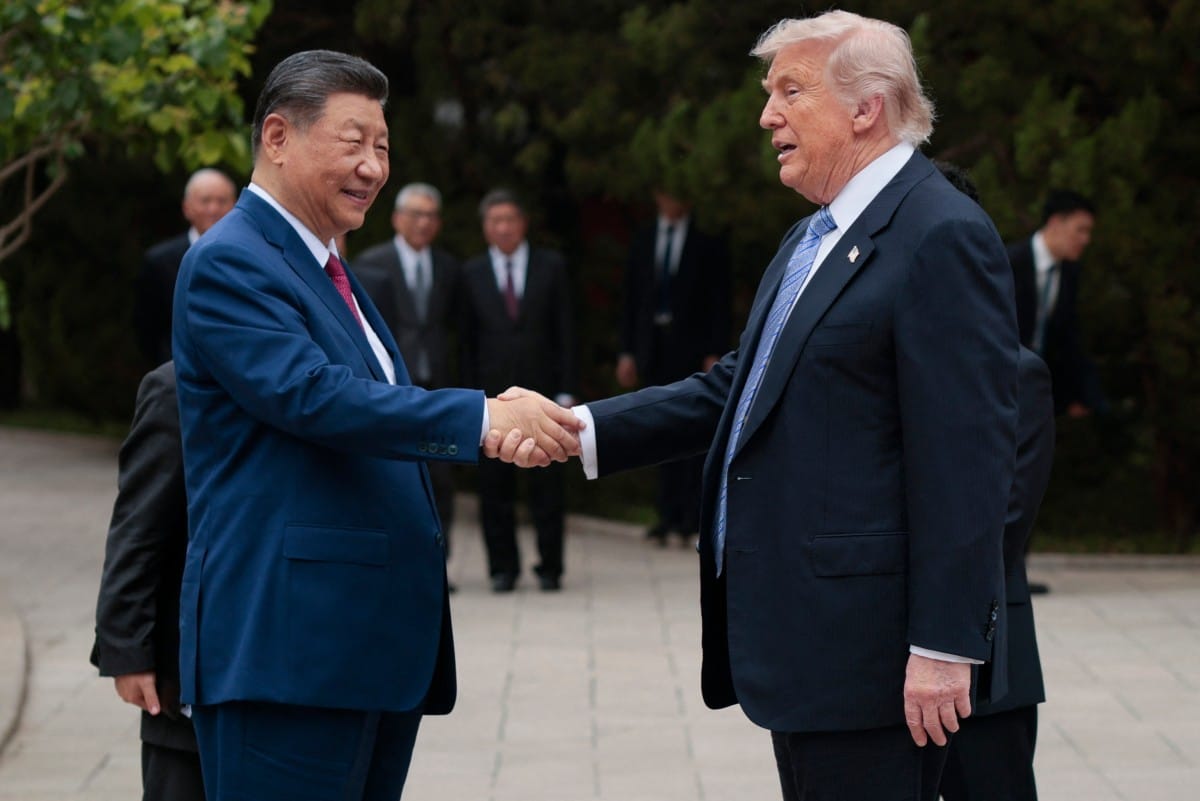
US President Donald Trump (R) shakes hands with China’s President Xi Jinping as he leaves after a visit to Zhongnanhai Garden in Beijing on May 15, 2026.
AFP-EVAN VUCCI
After two days of talks in Beijing, US President Donald Trump departed China on Friday following a high-stakes summit with Chinese leader Xi Jinping. Both sides hailed progress in stabilizing strained ties and hinted at new trade deals, including possible Chinese purchases of US oil. However, sharp divisions remain over tariffs, Taiwan, Iran and broader geopolitical tensions. Follow our live coverage for the latest updates:
UAE and India announce key agreements and major investments
The UAE President Sheikh Mohamed bin Zayed Al Nahyan and Indian Prime Minister Narendra Modi witnessed the exchange of multiple agreements and MoUs aimed at strengthening the India–UAE strategic partnership.
The deals cover energy cooperation, including partnerships with Abu Dhabi National Oil Company, along with defence collaboration, advanced supercomputing projects, and maritime and shipbuilding initiatives.
Both sides also announced major investments in India, including stakes in RBL Bank, NIIF, and Sammaan Capital, marking a significant boost to bilateral economic ties.
Trump to Iran: Surrender nukes or face strikes
Speaking aboard Air Force One after departing Beijing, Donald Trump escalated his rhetoric against Iran, warning that the United States could target Iranian bridges, electricity infrastructure and other strategic sites if Tehran failed to hand over its nuclear material.
Trump said Washington “could wipe out everything there within two days” and insisted Iran would “never have a nuclear weapon”.
He also signalled the possibility of renewed military action, saying the US “may have to do a little clean-up work” despite the recent ceasefire, which he claimed Washington accepted at the request of other countries, particularly Pakistan.
Trump further said he rejects any Iranian proposal that does not immediately commit to abandoning all nuclear activity, adding that Tehran must remove all nuclear fuel and halt production entirely.
UAE President bids farewell to Modi
Indian Prime Minister Narendra Modi has arrived in the United Arab Emirates on an official visit.
His Highness Sheikh Mohamed bin Zayed Al Nahyan, President of the UAE, was at the forefront of his arrival in the UAE.
An official reception ceremony was held for HE the Prime Minister, where the national anthems of the UAE and India were played, while a number of honor guards lined up to greet the visiting Prime Minister.
The plane carrying the Indian Prime Minister was accompanied by a squadron of Emirati military planes when it entered the country's airspace, where the squadron commander asked him permission to accompany him to the airport to greet and welcome his visit to the country.
Iran backs China’s efforts to de-escalate conflict with US
Iranian Foreign Minister Abbas Araghchi said Tehran would welcome any diplomatic initiative by China aimed at reducing tensions with the United States.
“Any effort made by the Chinese to support diplomacy will be welcomed by the Islamic Republic of Iran,” Araghchi said during a press conference in New Delhi, where he was attending the BRICS foreign ministers’ meeting.
The Iranian minister also referred to mediation efforts by Pakistan, saying the initiative had not failed but was facing “a very difficult path” largely due to what he described as American behaviour.
Iran FM says US willing to continue talks
Iran's Foreign Minister Abbas Araghchi said on Friday he had "received messages" from the United States saying it is willing to continue talks, and that he was open to any support, including from China.
"We received messages again from the Americans saying that they are willing to continue the talks and continue the interaction," Araghchi told reporters in the Indian capital.
Araghchi spoke a day after US President Donald Trump said Xi Jinping had offered China's help to reopen the Strait of Hormuz, and that the Chinese leader had also pledged not to send military equipment to aid Iran in its war against the United States and Israel.
Stocks tumble as US-Iran impasse fuels inflation fears
Global stocks slumped and oil prices rose Friday as talks between the United States and China failed to deliver progress on reopening the Strait of Hormuz, reigniting worries of persistent inflation pressures that could derail economic growth.
Oil prices rose around two percent, with the international benchmark Brent crude contract close to $108 a barrel.
Rising crude futures also pushed up government bond yields, including in Britain, where Prime Minister Keir Starmer faced fresh threats to his leadership.
UAE and India deepen strategic partnership
The UAE President Sheikh Mohamed bin Zayed Al Nahyan and Indian Prime Minister Narendra Modi held discussions focused on strengthening cooperation under the Comprehensive Strategic Partnership and Comprehensive Economic Partnership Agreement between the two countries.
The talks took place during the Indian Prime Minister’s official visit to the UAE, with both sides reaffirming their commitment to expanding development ties that support long-term prosperity.
The two leaders reviewed progress across key sectors, including economy, investment, energy, space, food security, technology and artificial intelligence, highlighting steady growth in bilateral cooperation.
Both sides also exchanged views on regional developments, particularly in the Middle East, and their implications for international peace and security, maritime stability, energy supplies and the global economy.
Prime Minister Modi reiterated India’s condemnation of attacks targeting civilians and infrastructure in the UAE, describing them as a violation of sovereignty and international norms.
Trump leaves China aboard Air Force One after Xi summit
US President Donald Trump left Beijing on Friday after a major summit with Chinese leader Xi Jinping.
Trump took off aboard Air Force One around 2:40 pm (0640 GMT) from Beijing Capital International Airport, bound for Washington.
Exuberant airport send-off for Trump at end of China visit
Schoolchildren dressed in some of Air Force One's light blue and white colors waved American and Chinese flags in a coordinated movement as the U.S. president arrived to board the plane.
"Farewell, farewell," they chanted. "Warm farewell!"
Chinese Foreign Minister Wang Yi saw a smiling Trump off at the airport.
Trump turned at the top of the stairs and pumped his fist and waved before entering the aircraft.
He didn't speak again before departing for home.
Trump and Xi wrap up summit
Trump has boarded Air Force One for his flight out of China.
Trump and Xi both said they made progress in stabilizing U.S.-China relations. But deep differences persist.
The leaders spent a lot of time together the past two days.
They met for about two hours at the Great Hall of the People, toured the Temple of Heaven and attended a banquet on Thursday. On Friday they walked the grounds of Zhongnanhai and had a working tea and lunch.
China has nonetheless shown little public interest in getting more involved in solving the war in Iran.
Xi also suggested differences over Taiwan could put his country and the U.S. on the path toward conflict.
Threats of each side imposing steep tariffs also still loom.
Trump and Xi dine on a menu including stir-fried lobster balls
While folks outside their closed lunch chowed down on McDonalds, the menu for Trump and Xi was far more formal.
The two leaders had minced codfish in seafood soup, crispy and stir-fried lobster balls and pan-seared beef fillet stuffed with morel mushrooms, according to the White House.
They also ate kung pao chicken and scallops, braised seasonal greens, bamboo shoots, mushrooms and beans, as well as stewed beef in a bun and steamed pork and shrimp dumplings.
Dessert was chocolate brownies and fruits and ice cream. Coffee and tea also was served.
After lunch, Trump is not expected to make any more public appearances before heading to the airport to fly back to Washington.
Get updated faster and for FREE: Download the Gulf News app now - simply click here.
Israel army issues evacuation warning for five south Lebanon villages
Israel's military called on residents of five villages in southern Lebanon to immediately evacuate on Friday ahead of expected attacks against Hezbollah, despite a truce with Lebanon intended to halt the fighting.
"In light of the terrorist Hezbollah's violation of the ceasefire agreement, the Defence Army is compelled to act against it forcefully," the military's Arabic-language spokesman Avichay Adraee posted on X, listing five villages near the city of Tyre, on the south Lebanon coast.
"For your safety, you must evacuate your homes immediately and stay away from the villages and towns by a distance of no less than 1,000 metres," he added.
Trump says 'fantastic trade deals' struck during 'incredible' visit
The White House so far hasn't released details of any deals struck during Trump's summit with Xi in Beijing.
Trump told Fox News about soybeans, airplanes and oil in an interview that followed his two-hour sit-down with Xi on Thursday.
Meeting with Xi again on Friday, Trump praised the visit as "incredible."
He said "a lot of good has come of it," including "some fantastic trade deals" that are "great for both countries."
Trump says he and Xi discussed Iran
"We feel very similar about (how) we want it to end," the president said of the U.S. and Israel's war in Iran. "We don't want them to have a nuclear weapon."
Trump added of both sides and the Strait of Hormuz, which Iran has effectively closed, "We want the straits open."
He said of the conflict in Iran, "We want them to get it ended because it's a crazy thing there. A little bit crazy. And it's no good, it can't happen."
Trump and China's leader had a working tea before heading into a closed-door lunch.
Trump and Xi meet in garden at Zhongnanhai
Photos showed the leaders shaking hands on a road alongside a waterway.
Xi also was seen talking to Trump, who admired the garden.
A clock chimed 11 as Trump arrived.
Trump says China could buy US oil as Iran war drags on
Trump suggested there could be a deal for China to buy oil from the United States after talks in Beijing.
Xi "said he likes the idea," Trump said in an interview with Sean Hannity on Fox News. "I think it will happen."
"They've agreed they want to buy oil from the United States. They're going to go to Texas. We're going to start sending Chinese ships to Texas and to Louisiana and to Alaska," Trump said.
There were no immediate details of the deals.
Beijing limited U.S. energy imports to a "bare minimum" after Trump imposed significant trade tariffs in 2025 and U.S. crude exports to China effectively halted more than a year ago, according to trade data and analytics platform Kpler.
Despite the global energy shock from the Iran war, China's ample oil stockpile has so far been able to cushion it from bigger economic impacts. Russia has been a major source for crude imports for China.
China was the biggest buyer of Iranian oil before the Iran war began.
IMF downbeat on growth
The International Monetary Fund warned that continuing disruptions due to the Iran war meant its global economic outlook was moving towards an "adverse" scenario, with growth pared down and greater risks to inflation.
Last month, the multilateral lender's World Economic Outlook predicted global growth would drop to 3.1 percent in 2026 in its "reference" scenario, but warned of a bleaker outlook if the war were to drag on.
In the "adverse" scenario, where oil prices remain higher for longer, inflation expectations become less stable and financial conditions tighten, growth would slow to 2.5 percent, the Fund said at the time.
Get updated faster and for FREE: Download the Gulf News app now - simply click here.
US says Israel-Lebanon talks 'positive'
A US official said talks in Washington on Thursday between Israel and Lebanon about an expiring ceasefire were "positive" and will take place as planned for a second day.
"We had a full day of productive and positive talks that lasted from 9 am to 5 pm (1300-2100 GMT). We look forward to continuing this tomorrow and hope to have more to share then," a senior State Department official said.
On the ground, Israel's military said it struck Hezbollah targets in south Lebanon on Thursday after warning residents of several towns and villages there and in the country's east to evacuate. It also said a Hezbollah drone fell in Israeli territory, wounding several civilians.
Trump and Xi will talk at Zhongnanhai
Next to Beijing's Forbidden City lies a secretive compound wrapped around two man-made lakes built for the pleasure of emperors.
Today, Zhongnanhai, or "middle and southern seas," is synonymous with China's seat of power as the primary residence of Chinese President Xi Jinping and the headquarters of the central government.
Zhongnanhai is often compared to the White House, the Kremlin or South Korea's Blue House. But unlike the other presidential residences, Zhongnanhai does not serve as the main venue for diplomatic visits.
China's top leaders reserve the highly secure grounds for only their closest allies and carefully selected dignitaries.
Russian President Vladimir Putin, whom Xi has called his closest friend, was received at Zhongnanhai at least twice, in 2024 and 2025.
Xi also welcomed former U.S. President Barack Obama to Zhongnanhai in 2014. The two leaders took an evening stroll and had dinner.
Trump suggests wants Iran uranium for 'public relations'
US President Donald Trump suggested that hunting down Iran's enriched uranium was primarily for political 'public relations', after Israel demanded it as a goal. "I just feel better if I got it, actually, but it's — I think, it's more for public relations than it is for anything else," Trump told Fox News host Sean Hannity in an interview from China broadcast late Thursday in the United States.
Prior to the war, confidential International Atomic Energy Agency (IAEA) reports in early 2026 indicated that Iran had continued to increase its stockpile of uranium enriched to 60% purity, a level just a technical step away from the 90% weapons-grade threshold.
Trump says Iran has gone back and forth on US extraction of 'nuclear dust'
The president suggested during the Fox News interview that Irian officials at first "said very strongly" that the U.S. could send it teams to collect hundreds of pounds of enriched uranium believed to be buried under nuclear sites badly damaged by U.S. military strikes last year.
But then, he said, Iran reneged.
"They agreed to it. They take it back. They agree, you know it's back and forth," he said.
Whether Iran would be willing to relinquish enriched uranium is a key point in negotiations to end the war.
Trump has long insisted Tehran is willing to do so, but Iran has largely rejected such assertions.
Trump added during the interview that Iran says only the U.S. and China had sufficient technology to remove the enriched uranium, given that its buried deep underground.
Trump is wrapping up his whirlwind Beijing visit
US President Donald Trump (R) and China's President Xi Jinping inspect a guard of honour during a welcome ceremony at the Great Hall of the People in Beijing on May 14, 2026.
Trump and Xi are scheduled to hold more talks Friday.
They are set to spend time together at Xi's official residence in Beijing before Trump flies back to Washington.
Trump has taken a decidedly rosy outlook on the U.S.-China relationship during this trip. But that is colliding with some difficult truths about the thorniest issues between the two superpowers including Taiwan, the Iran war and trade issues.
'Floating armoury' seized by Iranian forces in the Gulf of Oman
A vessel reportedly operating as a “floating armoury” in the Gulf of Oman has been seized by Iranian military forces, according to maritime risk management company Vanguard.
The UK Maritime Trade Operations (UKMTO) said the ship is now “bound for Iranian territorial waters.”
The vessel — identified by maritime risk consultancy Vanguard as the Honduras-flagged Hui Chuan — was last tracked transmitting its Automatic Identification System (AIS) signal on Wednesday, when it was located roughly 70km (about 40 miles) north-east of Fujairah in the United Arab Emirates, BBC reported.
Trump had 'good meeting' with Xi: White House
US President Donald Trump and Chinese President Xi Jinping held a "good" meeting in Beijing on Friday, the White House said. ''The two sides discussed ways to enhance economic cooperation, including expanding market access for American businesses into China and increasing Chinese investment in US indsutries," the White House said in a statement. According to the statement, the two sides agreed that the Strait of Hormuz must remain open to support the free flow of energy. Both countries, it added, agreed that Iran can never have a nuclear weapon.
Trump says Xi won’t arm Iran, China backs opening of Hormuz
President Donald Trump said Chinese President Xi Jinping pledged not to provide military equipment to Iran and voiced support for keeping the Strait of Hormuz open, a notable signal as Washington, Beijing and Gulf capitals navigate the war’s fallout. China has long been one of Iran’s most important economic partners, especially as a buyer of Iranian oil, but Beijing has also been trying to protect its broader interests in the Gulf and keep shipping lanes open. That balancing act has grown more visible in recent weeks, with Xi publicly urging that Hormuz remain open for normal passage and Chinese officials calling for de-escalation.
World leaders call for security in Strait of Hormuz
As US President Donald Trump and Chinese leader Xi Jinping met in Beijing on Thursday, a group of world leaders restated their call for the Strait of Hormuz to return to normal operations.
In a statement, the leaders affirmed their “commitment to using collective diplomatic, economic, and military capabilities to support freedom of navigation through the Strait of Hormuz.”
“Navigation must be free, as per the provisions of the United Nations Convention on the Law of the Sea (UNCLOS), and international law,” the statement read. It pledged support for “an independent and strictly defensive multinational military mission” to achieve that goal, including by conducting “mine clearance operations.”
The message came from 26 countries, including Britain, France, Bahrain, Canada, Germany, Japan, Qatar and South Korea.
Xi to order 200 jets: Trump
US President Donald Trump said that Chinese President Xi Jinping agreed to order 200 Boeing jets, describing the move as a commitment from the Chinese leader.
“One thing he agreed to today is he is going to order 200 jets,” Trump said during a clip of an interview with Fox News’ Sean Hannity that was quoted by CNN.
“Boeing,” Trump said, “200 big ones,” adding, “That’s a lot of jobs.”
Boeing shares fell about four percent, suggesting investors had expected a bigger order.
US‑Israel war on Iran: Recent developments
Day 76: World leaders call for security in Strait of Hormuz
Sign up for the Daily Briefing
Get the latest news and updates straight to your inbox
Network Links
GN StoreAbout Gulf NewsTerms & ConditionsReach by GNSitemapContact usPrivacy PolicyGN FocusHave your sayWork with usAdvertise with usGulf News epaperPrinting Services
Download our app
© Al Nisr Publishing LLC 2026. All rights reserved.