Trump walks the gardens of China’s most secretive compound
Rare Zhongnanhai visit underscores Xi’s carefully staged diplomatic gesture
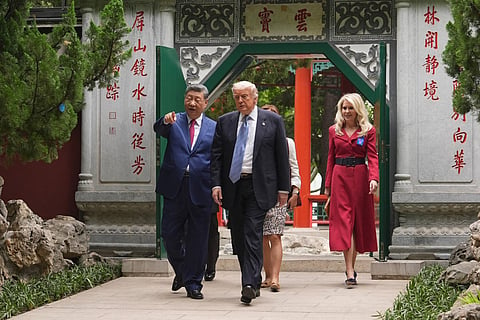
US President Donald Trump spent the final morning of his Beijing visit inside one of China’s most secretive and heavily guarded compounds, walking through imperial-era gardens with President Xi Jinping in a carefully choreographed display of diplomatic symbolism.
The two leaders strolled through Zhongnanhai — the political nerve centre of China’s ruling Communist Party — admiring centuries-old trees, landscaped lakes and historic pavilions before holding talks over tea and lunch, CNN reported. During the walk, Xi even offered to send Trump rose seeds from the compound’s gardens.
The rare invitation placed Trump among a small group of American presidents granted access to the sprawling leadership enclave hidden behind red walls beside Beijing’s Forbidden City.
Xi described the visit as a gesture of reciprocity after Trump hosted him at the Mar-a-Lago resort in Florida during their first meeting in 2017.
China’s modern citadel of power
Often compared to the White House or the Kremlin, Zhongnanhai serves as both workplace and residence for China’s top Communist Party leadership. The compound remains one of the country’s most tightly protected locations, with security overseen by elite military units tasked with safeguarding senior leaders.
Images and details of the site are heavily censored in China, and digital mapping services often obscure sections of the area.
Speaking during the visit, Xi noted the compound had housed generations of Communist leaders since the founding of the People’s Republic in 1949, including Mao Zedong, Zhou Enlai, Deng Xiaoping, Jiang Zemin and Hu Jintao, CNN reported.
The name Zhongnanhai refers to two lakes located within the complex, whose grounds stretch across roughly 1,500 acres in central Beijing.
From imperial retreat to Communist headquarters
Long before it became China’s political heart, Zhongnanhai served as an imperial garden where Chinese emperors relaxed away from the Forbidden City.
Xi highlighted that history during the tour, pointing out ancient trees within the compound — including one nearly 500 years old — and telling Trump that some trees there were more than a millennium old.
At one point, Xi encouraged Trump to touch the trees, describing them as symbols of continuity and history. Trump later remarked: “Nice place. I like it. I could get used to this.”
Following the collapse of China’s imperial system in 1912, the compound was repurposed as a presidential residence before Mao transformed it into the headquarters of Communist rule after the party’s victory in the civil war.
Mao deliberately avoided using the Forbidden City itself, seeking to distance the new Communist state from China’s imperial past and aristocratic symbolism.
Over the decades, Zhongnanhai underwent extensive redevelopment, with new office buildings, residences and recreational facilities added alongside preserved temples and historic pavilions.
A select list of American visitors
Trump’s visit follows a small but historically significant line of American presidents invited into the compound.
President Richard Nixon met Mao there during his landmark 1972 trip that reopened US-China relations. President George W. Bush later visited alongside then-Chinese leader Jiang Zemin, while Barack Obama toured parts of the compound during a 2014 meeting with Xi.
Obama’s visit included access to Yingtai, an artificial island within Zhongnanhai that once served as the confinement site of an emperor stripped of power during the final years of the Qing dynasty.
Chinese state media later released footage of Xi and Trump posing for photographs in front of a historic hall once used by Communist leaders for ballroom dancing and film screenings after the party first moved into the compound.
The highly symbolic visit offered a glimpse into a place rarely seen by outsiders — a secluded political fortress where imperial history and Communist power continue to intersect.


