Maj. Gen. Amir Hatami, Iran’s army chief.
LIVE
Middle East conflict: Houthis strike Yemen's presidential palace, US issues new Iran sanctions
At least 10 wounded as missiles hit headquarters of internationally recognised government
Last updated:
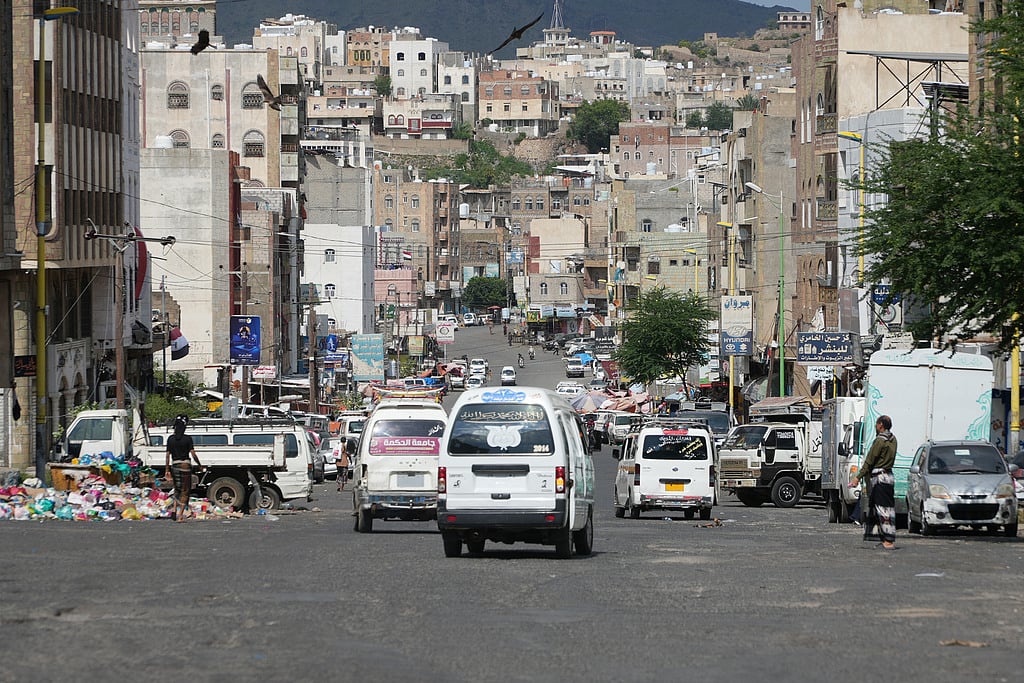
People use minibuses to save gasoline in Taiz, Yemen.
AP
Yemen's Houthis launched a missile attack on the presidential palace in Aden on Thursday, killing at least four people and injuring 10, according to government military sources. The Al-Maashiq Palace serves as the headquarters of Yemen's internationally recognised government. Meanwhile, Saudi Arabia said it intercepted a cruise missile over Medina, an attack the Houthis denied. Meanwhile, CNN reported that the US military was considering using its largest non-nuclear bomb against Iranian targets if President Donald Trump decides to resume combat. Follow our live coverage for the latest.
Trump dismisses going nuclear on Iran, possible ground invasion
US President Donald Trump ruled out using nuclear weapons against Iran amid the ongoing conflict and expressed little inclination towards deploying American ground troops, even as the US military develops fresh strike options against Iranian energy infrastructure and nuclear facilities, including the potential use of the “mother of all bombs”.
In an interview with Newsmax, Trump clarified that the weapon under discussion was not nuclear and said Washington did not need to resort to nuclear weapons to achieve its objectives against Tehran.
“Well, the mother of all bombs is not nuclear. It's not nuclear at all. This is just an extremely large bomb. It's like a tiny nuclear bomb, but the mother of all bombs is one big bomb. But it's not nuclear. No, I wouldn't use nuclear. We don't have to,” Trump said.
Asked whether he would consider deploying US troops on the ground in Iran, the President responded, “I don't see that. I don't.”
India reiterates call to end Gulf conflict
India has reiterated its call for an immediate end to the conflict that encompasses the entire Gulf region and has taken a toll on its economy that has strong links to the region and on its people there.
The conflict must be de-escalated immediately and resolved through dialogue and diplomacy, India's Permanent Representative P Harish said on Thursday at the Security Council's quarterly open debate on the Middle East.
"India has very high stakes in the safety, security and stability of the Middle East", he said. "Our political, economic, investment, energy and people-to-people relations with the region are extremely strong".
With the six countries of the Gulf Cooperation Council alone, India's annual trade is $180 billion, cumulative Foreign Direct Investment is $31 billion, and remittances are more than $52 billion, he said.
The "safety, security and wellbeing" of the ten million Indians living in those countries "is a core interest and a vital part of our bilateral relationships", he added.
Another priority area for New Delhi is the safety of its seafarers and shipping, Harish said.
"All attacks on commercial shipping and merchant mariners are legally and morally indefensible", he said.
"Freedom of navigation, and the safe and unimpeded flow of maritime commerce through international waterways, in accordance with international law, must be upheld", he said.
Oil edges lower in Asian trade, Brent holds above $105
Oil prices fell in early on Friday, with Brent crude remaining above $105 a barrel as markets weighed persistent threats to Middle Eastern supplies against plans to release more emergency oil reserves.
Brent crude was quoted at $105.50 a barrel, down 45 cents, or 0.42%, while US West Texas Intermediate crude fell 53 cents, or 0.54%, to $97.44, according to OilPrice.com data at about 10:40 am Tokyo time (5.40am Gulf, 1.40am GMT) on Oct. 16, 2026.
The declines followed a mixed session Thursday. WTI futures for November delivery rose $2.88, or about 3%, to settle at $97.97 a barrel, while Brent futures for December delivery slipped 14 cents to $105.92, according to CNBC.
Iran’s Basij chief says AI improved military targeting
Iran’s Basij paramilitary chief, Hossein Taeb, said that AI had improved military targeting and intelligence capabilities, Iran International reported. “We saw the benefits of artificial intelligence in the defense field,” Taeb said. “We used AI for intelligence awareness, and our targeting became more precise.”
Taeb urged Iran to prioritize AI and cybersecurity, saying technological capability increasingly determined national power. A cleric and former Revolutionary Guard intelligence chief, Taeb returned to lead the Basij in August, with a mandate to expand its grassroots intelligence network.
Iran army chief vows Hormuz to stay shut until Iran’s ‘rights’ respected; US says shipping continues
Iran’s army chief, Maj. Gen. Amir Hatami, said that the Strait of Hormuz would remain "closed" until what he described as the rights of the Iranian people were respected, Iranian state media reported.
“The Strait of Hormuz was immediately closed, remains closed to this day and will remain closed until the enemy respects the rights of the Iranian people,” Hatami said at an event at Imam Ali Officers’ University in Tehran, according to Iran’s state broadcaster IRIB.
Hatami said the strategic waterway was under the “full surveillance” of Iran’s army and the IRGC. He claimed that “not a single enemy vessel” had been able to enter the maritime space of Oman and the Strait of Hormuz.
He also said Iran’s armed forces were prepared for any further conflict and claimed that many enemy military bases had been "damaged".
The US military disputes Iran’s assertion that it controls or has fully closed the strait. US Central Command said commercial and energy traffic continues to move through Hormuz and rejected Iranian claims of control, saying US forces and regional partners helped ship more than 19 million barrels of crude oil through the waterway in a single day.
Bessent says ‘noose is tightening’ around Iran’s economy
US Treasury Secretary Scott Bessent said Thursday Washington would maintain financial pressure on Tehran until its government could no longer fund its military, following new sanctions targeting Iran-linked financial networks.
“The noose is tightening around Iran’s economy, and not even Iran’s so-called allies can save it,” Bessent said in a post on X.
“The Department of the Treasury will not relent until the Iranian regime’s coffers are empty and every remaining financial lifeline sustaining its war machine has been severed,” he added.
The Treasury said the measures, part of its Operation Economic Outcast campaign, targeted Iran’s efforts to access international financial systems through an Iraqi bank and offshore and shadow-banking networks.
According to the department, these networks moved hundreds of millions of dollars through shell companies and foreign-exchange specialists across the Middle East and Asia.
Washington said the campaign seeks to disrupt financial channels Iran allegedly uses to evade sanctions, generate revenue and fund its military and allied armed groups.
CENTCOM disputes Iran’s Hormuz claims, ship-sinking account
The US military on Thursday rejected claims by Iran’s Islamic Revolutionary Guard Corps (IRGC) that Tehran controls the Strait of Hormuz, that a Singapore-registered container ship sank after "striking a naval mine" and that hundreds of American service members had been killed in Jordan.
US Central Command, which oversees American military operations in the Middle East, said the US and regional partners maintained control of the strategic waterway despite what it described as aggression by Iran’s Revolutionary Guard.
“The United States and regional partners control the strait as commercial vessels continue to transit despite unwarranted IRGC aggression,” CENTCOM said, according to the statement provided.
Iran accuses Britain of 'destructive' role, fueling insecurity in Mid-East
Iran’s Foreign Ministry accused Britain of playing a “destructive role” and fueling insecurity across the Middle East, escalating a diplomatic dispute over British allegations that Tehran was involved in a suspected plot against a British air base.
Foreign Ministry spokesperson Esmaeil Baghaei said the British government could not conceal its role in regional instability by “shifting blame and distorting reality,” according to Iran’s state-run IRNA news agency.
His comments responded to British Foreign Secretary Ed Miliband, who described Iran’s actions as “aggression.” Baghaei said the chaos in the region stemmed from “unlawful interventions,” including those backed or supported by Britain, and accused Miliband of reversing the roles of victim and aggressor.
The remarks came after Britain said a suspected plot near RAF Fairford, an air base used by US bombers, was probably coordinated in Iran. The British government said the incident demonstrated the Revolutionary Guard’s willingness to project hostile activity beyond Iran’s borders through covert networks and proxy actors.
Iran has denied the allegation, called it a “clumsy false flag operation,” and summoned British Ambassador Hugo Shorter to protest. Tehran has demanded that Britain provide evidence and warned it may reconsider diplomatic ties if London does not.
Iran condemns Colombia's reopening of its embassy in Israel
Iran’s Foreign Ministry condemned Colombia’s reopening of its embassy in Israel — specifically its relocation to Jerusalem — in a statement issued Thursday, calling the move a "violation of the UN Charter and international law".
The ministry said Colombia’s action “strongly” violated the UN Charter and fundamental principles of international law. It described Jerusalem as an inseparable part of Palestinian territory and said states must avoid measures that amount to recognizing what it called Israel’s occupation.
Iran also accused Colombia’s government of aligning itself with an “occupying and genocidal regime,” saying the embassy move legitimised the occupation of Palestinian land and contradicted the Palestinian people’s right to self-determination. It warned Bogota that it must accept responsibility for the consequences of what Iran called an “immoral” and unlawful decision.
Colombia opened its embassy in Jerusalem on Wednesday, becoming the 10th country to locate its Israeli embassy there rather than in Tel Aviv. The move came under conservative President Abelardo de la Espriella, who restored diplomatic ties with Israel after his predecessor, Gustavo Petro, severed them in May 2024 over the war in Gaza.
Saudi-led coalition releases footage of cruise missile interception
The Saudi-led coalition has released video footage showing the interception and destruction of a cruise missile, according to its official spokesman.
Saudi-led coalition releases footage of Houthi attacks
The Saudi-led coalition has released video footage showing attacks attributed to the Houthi militia on Abha International Airport, Najran International Airport and King Abdullah International Airport in Jazan.
The footage was presented during Thursday’s press conference by the coalition’s official spokesman.
Saudi-led coalition says Houthi attacks on airports violate international law
The Saudi-led Coalition to Restore Legitimacy in Yemen has condemned Houthi attacks on civilian airports and facilities, including King Khalid International Airport in Riyadh, describing them as violations of international humanitarian law.
Coalition spokesman Major General Turki Al Malki said the attacks threaten civilian safety and travellers. He also warned that the coalition would continue taking measures to dismantle the Houthis’ offensive capabilities, including weapons depots, missile launch platforms and other facilities used to carry out attacks.
Al Malki said coalition forces had dismantled mountain storage facilities in Sanaa, Saada and Amran, and destroyed several missile launch platforms. He also accused the Houthis of using civilian infrastructure and vital resources to support their military operations.
He called for an immediate halt to Houthi attacks on civilians and civilian infrastructure, including airports, ports, oil facilities and other essential sites.
US issues new Iran-related sanctions
The US Treasury’s Financial Crimes Enforcement Network (FinCEN) has issued an alert to help financial institutions identify and report potential Iranian abuse of religious charity networks, including the diversion of religious donations known as tithes or khums.
The alert forms part of Operation Economic Outcast, a US initiative targeting Iran and its financial enablers, including the Islamic Revolutionary Guard Corps (IRGC).
Saudi-led coalition intercepts drone over Khamis Mushait
Saudi-led coalition forces have intercepted and destroyed a hostile drone in Khamis Mushait in southwestern Saudi Arabia, coalition spokesperson Turki Al Maliki said.
Houthi attack on presidential palace in Yemen's Aden kills 4
At least four people were killed and 10 more wounded in a Houthi missile attack Thursday on the presidential palace in Yemen's Aden, which also serves as the internationally recognised government's headquarters, three government military sources told AFP.
Media affiliated with the Houthis said earlier that the group attacked a "headquarters of military operations" at the Al-Maashiq Palace in Aden, the southern city that is the government's interim capital.
Houthis target presidential palace in Yemen's Aden
Yemen's Houthis on Thursday fired missiles at the presidential palace in Aden, which also serves as the headquarters of the internationally recognised government, security sources told AFP, while a journalist saw smoke rising from the site.
"Houthi missiles targeted the Al-Maashiq presidential palace in Aden," the government's interim capital, three local police sources said on condition of anonymity, after residents of the southern city reported hearing explosions.
US‑Israel war on Iran: Recent developments
Sign up for the Daily Briefing
Get the latest news and updates straight to your inbox
Network Links
GN StoreAbout Gulf NewsTerms & ConditionsReach by GNSitemapContact usPrivacy PolicyGN FocusHave your sayWork with usAdvertise with usGulf News epaperPrinting Services
Download our app
© Al Nisr Publishing LLC 2026. All rights reserved.