President Donald Trump prepares to sign an executive order in the Oval Office of the White House on June 22, 2026 in Washington, DC. President Trump signed two orders on quantum computing.
Trump says Iran agrees to ‘highest-level’ nuclear inspections; as Tehran and Oman weigh Hormuz service costs
Rubio tours UAE as Iran leaders visit Pakistan amid diplomacy shift
Last updated:
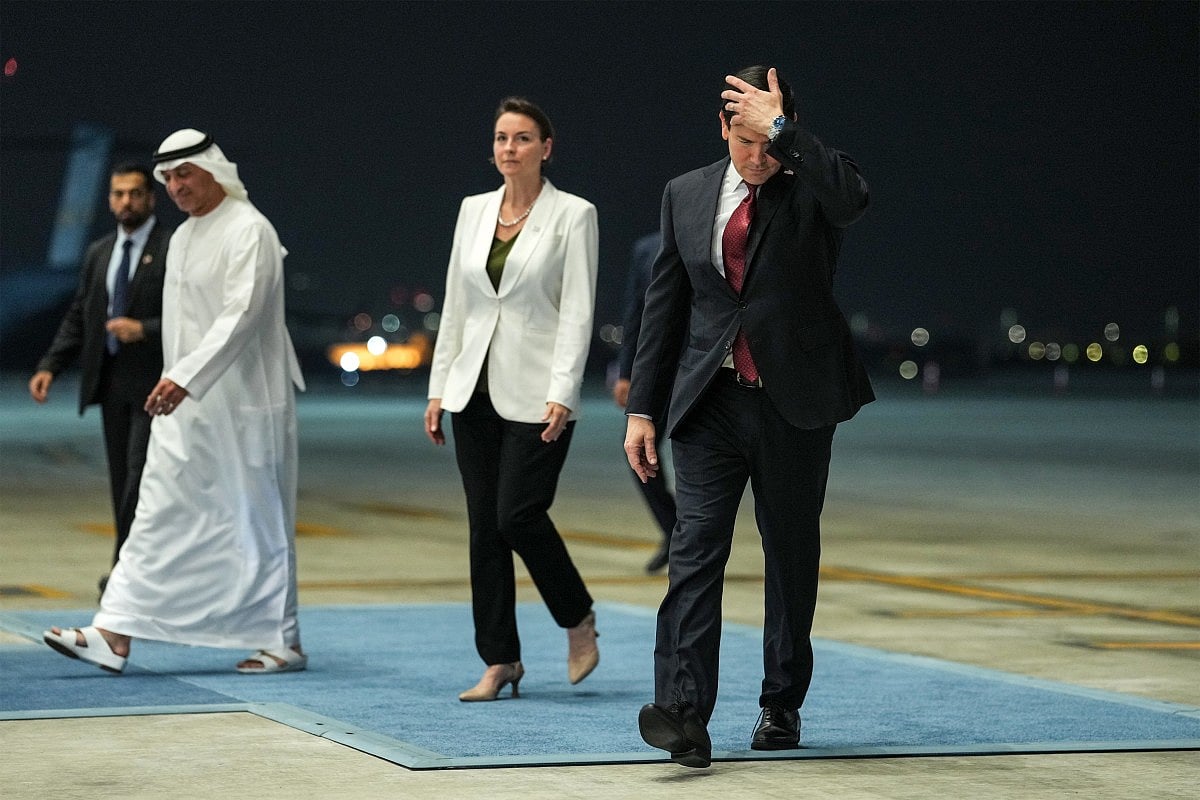
US Secretary of State Marco Rubio adjusts his hair following his arrival at al-Bateen Executive Airport in Abu Dhabi on June 23, 2026, on the first stop of a tour of Gulf states aimed at showing solidarity with key allies hit hard by the Middle East war.
AFP
President Donald Trump has said there will be no further US naval blockade of the Strait of Hormuz, while insisting that Iran has agreed to allow nuclear inspections, despite Tehran’s denial of such commitments. US Secretary of State Marco Rubio has arrived in Abu Dhabi, marking the first stop on his Gulf tour. Meanwhile, Iran’s president and foreign minister are in Pakistan following weekend negotiations in Switzerland. In parallel diplomatic developments, a new round of talks between Israel and Lebanon has begun in Washington, DC, according to the Israeli Embassy in the United States. Follow our live updates here:
US‑Israel war on Iran: Recent developments
Rubio to travel to Gulf amid Iran talks
US Secretary of State Marco Rubio will begin a trip to three Gulf countries on Tuesday amid negotiations with Iran to end the war in the Middle East, his spokesperson said.
In his first trip to the region since the United States and Israel started the war on February 28, Rubio will visit the UAE, Kuwait and Bahrain, State Department spokesman Tommy Pigott said in a statement. The trip is scheduled to run through Thursday.
Rubio will discuss "the memorandum of understanding with Iran, efforts to secure full and free safe transit through the Strait of Hormuz, and the importance of peace and stability in the region," the statement said.
In Bahrain on Thursday, Rubio will also meet with the Gulf Cooperation Council to discuss common priorities with the region.
Rubio will have a difficult task restoring trust with the Gulf states, which have been targeted by Iran in retaliation for US-Israeli strikes.
Iran negotiators Ghalibaf, Araghchi head to Oman
Iran’s top negotiator Mohammad Bagher Ghalibaf and Foreign Minister Abbas Araghchi are travelling to Oman for discussions focused on the management of the Strait of Hormuz, according to official remarks.
Ghalibaf said in a post on Telegram that the visit will focus on “consolidating Iranian arrangements for managing the strait” and strengthening bilateral coordination with Omani officials.
Iran rejects US claim on IAEA access, says no new commitments made
Iran has rejected US Vice President JD Vance’s claim that Tehran agreed to allow IAEA inspectors back, saying cooperation with the UN nuclear watchdog will continue only under existing procedures, according to CNN.
Foreign Ministry spokesperson Esmaeil Baghaei said Iran’s engagement with the IAEA remains “in accordance with safeguard agreements” and aligned with domestic legal and security frameworks, including parliamentary resolutions and decisions of the Supreme National Security Council.
He stressed that Iran has not accepted any new commitments regarding inspections, following US statements made after talks in Switzerland, according to IRNA.
Under Iranian legislation passed last summer, cooperation with the IAEA has been suspended, limiting inspection activity.
IRNA also reported that nuclear issues were not addressed during lengthy US-Iran discussions, and that arrangements over inspections, enriched uranium stockpiles, and access to nuclear sites would depend on future mechanisms to be finalised in any eventual agreement.
Get updated faster and for FREE: Download the Gulf News app now - simply click here.
'You can’t trust anybody’s words,' Vance says amid talks
JD Vance described his talks in Switzerland as “very productive”, but cautioned that “you can’t trust anybody’s words”.
He said a mechanism had been established to ensure the Straits of Hormuz remain open and will continue to stay open.
The US Vice President also claimed Iran had allowed weapons and nuclear inspectors “into the country for the first time in a long time”, reiterating progress made during the discussions.
Trump says Iran ‘will agree’ to allow weapons inspection
Trump has said on social media that Iran must agree to “major weapons inspections” over an extended period.
In a post, Trump stated that “everybody is fully aware” Iran would need to accept comprehensive inspections to ensure what he described as “nuclear honesty” in the long term.
The remarks reference a framework similar to the Obama-era nuclear agreement, which included international inspections before Trump withdrew the US from the deal during his first term.
Vance leaves Switzerland, but other US negotiators are still talking
“We left a lot of our team. The Iranians left a lot of their team at the resort there to keep on working at it,” Vance told reporters just before he got on Air Force Two for the return flight to the US.
Vance did not give details on which US negotiators are staying in Switzerland to continue to work out details of the interim agreement with Iran.
Vance says Iran will allow nuclear inspections, Tehran hasn’t commented
US Vice President JD Vance said that the opening round of peace talks with Iran had laid "a good foundation for a successful final deal" to end the conflict that erupted in late February.
His remarks came after he concluded an extended session of negotiations with Iranian Parliament Speaker Mohammad Bagher Ghalibaf, part of a diplomatic push to transform the recent ceasefire into a permanent peace agreement.
Vance also said Iran had agreed to allow inspectors from the International Atomic Energy Agency (IAEA) to return to the country, a move that would mark a significant step toward restoring international oversight of Tehran's nuclear programme. Iranian officials, however, did not confirm the claim, leaving the scope and timing of any renewed inspections unclear.
US grants 60-day waiver on Iran sanctions, Lebanon fighting abates: Optimism after first talks
The United States on Monday granted Iran a 60-day waiver from key oil sanctions following the first round of talks under a fledgling peace agreement, paving the way for Tehran to resume legal crude exports to global markets after months of wartime disruption.
The temporary licence, issued by the US Treasury, authorizes the sale, transport, financing and insurance of Iranian crude and petroleum products through Aug. 21, reversing restrictions imposed during the conflict that began on Feb. 28.
The sanctions relief came as officials reported a return to calm in Lebanon after fighting linked to the regional conflict, and after Iran lifted its closure of the Strait of Hormuz under the terms of the interim accord.
Get updated faster and for FREE: Download the Gulf News app now - simply click here.
Ceasefire between Israel and Hezbollah appears to be holding: UNIFIL
Tilak Pokharel, a spokesperson for the UN peacekeeping force in southern Lebanon known as UNIFIL, said Monday evening that a ceasefire between Israel and Hezbollah appears to be holding.
“We have not detected trajectories from either side since yesterday,” he said. “We have also not seen airstrikes,” although he added that peacekeepers “continue to observe air(space) violations and IDF ground movements.”
Commercial tanker traffic through Hormuz resumes
Commercial tanker traffic through the Strait of Hormuz has resumed, easing concerns over global energy supplies, while the reopening of Iranian exports is expected to restore additional barrels to international markets and broaden Tehran's customer base beyond the limited channels it relied on under sanctions.
According to data and analytics firm Kpler, there were 71 confirmed transits over the weekend, with a peak of 35 crossings on Saturday. About 100 to 130 vessels passed through the strait each day before the war.
Strait of Hormuz will be 'managed' by Iran: Ghalibaf insists
The lead negotiator of the Iranian delegation, Mohammad Bagher Ghalibaf, insisted on Monday the Strait of Hormuz will be managed by Iran and would follow international laws.
Qalibaf, who is also the speaker of the parliament, spoke with Iran state media on a plane on his way back from Switzerland.
“Hopefully we can activate the strait again, in terms of passage, and bring prosperity back to regional and global economy” he said.
Ghalibaf confirmed that the issue of releasing the frozen assets as well as the sale of Iranian oil were discussed in the talks with the U.S.
Ghalibaf and the Foreign Minister, Abbas Araghchi, arrived on Monday night in Oman where they met with the country’s Foreign Minister Badr Al Busaidi to discuss the peace efforts and ensure safety navigation in the Strait of Hormuz.
Iran pushes back against Vance's claims about nuclear inspectors
Iran has pushed back against claims made by US Vice President JD Vance that Tehran had agreed to allow international nuclear inspectors into the country, with Iranian Foreign Ministry spokesperson Esmaeil Baqaei stating that the country's engagement with the International Atomic Energy Agency (IAEA) would continue strictly under existing safeguards obligations and domestic legal frameworks.
Speaking to Iran's state-run news agency IRNA on Monday, following the recent US-Iran technical talks held in Switzerland, Baqaei responded to Vance's remarks, stating that the interaction with the UN nuclear watchdog will be based on the "Safeguards Agreements" between Tehran and the IAEA.
"Iran's interactions with the Agency, in accordance with Iran's obligations under the Safeguards Agreements, will continue according to existing procedures and comply with the laws enacted by the Islamic Consultative Assembly and the decisions of the Supreme National Security Council (SNSC)," Baqaei told IRNA.
Trump said he could refuse to help NATO if asked
US President Donald Trump said Monday that he could refuse to help NATO countries as pay back for the lack of support from member nations with the US military operation in Iran.
"We spent all of this money. And then when we want to maybe have help on small stuff... They say no we would rather not help," Trump said during a press conference in the Oval Office.
Energy secretary says oil moving at 'pre-crisis levels' -except it is not
Energy secretary suggests oil is moving through the Strait of Hormuz at pre-Iran war levels - except it is not
When Trump proclaimed that there was "a lot of oil pouring out" of the strait, Energy Secretary Chris Wright suggested that oil and natural gas were flowing through at "pre-crisis levels."
"We could get to above that, we will get above that," Wright added. Trump then suggested that "two days ago" there had been a record in terms of oil being taken out of the strait.
Neither of those statements were true.
According to data and analytics firm Kpler, there were 71 confirmed transits over the weekend, with a peak of 35 crossings on Saturday.
About 100 to 130 vessels passed through the strait each day before the war.
Get updated faster and for FREE: Download the Gulf News app now - simply click here.
Iran says technical talks with US in Switzerland have concluded
Technical talks between Iran and the United States in Switzerland have concluded, with negotiating groups to be set up on nuclear issues and sanctions, Iran's state media reported Tuesday.
The negotiators "decided that four working groups would be established: Sanctions Termination, Nuclear Affairs, Reconstruction and Economic Development, and Monitoring and Implementation," said IRNA state news agency, quoting Deputy Foreign Minister Kazem Gharibabadi.
Pezeshkian stresses importance of sticking to agreed framework
Iranian President Masoud Pezeshkian said progress in negotiations with the US depends on adhering to previously agreed commitments and implementing them accurately.
Speaking on the status of the talks, Pezeshkian stressed the importance of sticking to the agreed framework, saying: "The effectiveness of the talks with the US depends on fulfilling the commitments to the agreed obligations and their precise implementation", adding that "statements outside the agreed text do not help advance the negotiations."
His remarks come amid ongoing diplomatic efforts between Tehran and Washington, with both sides seeking to resolve outstanding issues through dialogue while maintaining their respective positions on key areas of contention.
Iran says UN watchdog will not be allowed to inspect bombed nuclear sites
Iran said Tuesday that the United Nations nuclear watchdog's inspectors would not be given access to the country's key nuclear sites that were bombed during the war with Israel and the United States last year.
"We have not had a meeting with the director general of the International Atomic Energy Agency, nor do we have any plans for the agency to inspect Iran's nuclear facilities damaged by the US and Zionist military aggression," said foreign ministry spokesman Esmaeil Baqaei.
On Monday US Vice President JD Vance had said Iran would allow UN nuclear inspectors to return, calling it "a major milestone".
Monday ship traffic through Strait of Hormuz highest since start of war: monitor
At least 35 commodity carriers transited the Strait of Hormuz on Monday, a record level since the start of the Middle East war in late February, according to data from the maritime tracking firm Kpler.
The 35 passages represent nearly a third of normal peacetime traffic (around 120 per day) through the strait, which normally sees around a fifth of the world's oil and gas exports.
The total count for Monday crossings is expected to rise further as ships are detected later by maritime trackers.
India hopes Hormuz traffic will provide energy relief
Resumed shipping flows through the Strait of Hormuz would ease energy and fertiliser supply bottlenecks, India's security chief said during a BRICS security meeting in New Delhi on Tuesday.
The current state of the crucial waterway for oil and gas transport is uncertain - it reopened last week, after Iran and the United States reached an agreement, but Tehran announced on Saturday it had closed it again in response to Israeli attacks in Lebanon.
Indian National Security Advisor Ajit Doval said its reopening would be a "highly welcome development," as security chiefs of the BRICS bloc of nations met.
India is heavily reliant on imported energy, and its fuel supplies were hit hard during the US-Iran war.
"It will help ease supply chain bottlenecks, and many of the shortages in fertilisers, chemicals, and other essential commodities may be alleviated," Doval said.
Doval on Monday met with Iranian official Ghadir Nezamipour, a senior member of Tehran's Supreme National Security Council, as well as China's Foreign Minister Wang Yi.
Other BRICS representatives, including Russia, South Africa, and Brazil, are also in New Delhi.
Iran will be 'only country' to determine how to use unfrozen assets: Ambassador
Tehran alone will decide how to use its frozen assets once they are unfrozen under a US-Iranian deal towards ending the Middle East war, an Iranian ambassador said Tuesday, contradicting US claims.
"Iran is the only country who will decide what to do with its assets, which are going to be defrozen and so I reject any claim by (Washington) about that there should... be any role for any other country to have an influence on those decisions or on those processes," Ali Bahreini, the Iranian ambassador to the United Nations in Geneva, told reporters.
Israeli gunfire kills one in south Lebanon
Israeli machinegun fire killed one person and wounded two others on Tuesday in southern Lebanon, state media reported, despite a reduction in hostilities there following the declaration of a new ceasefire.
"A young man was killed and two others were wounded" when Israeli soldiers "opened fire with their machineguns in their direction while they were standing near an excavator that was unblocking a road" in a town near the city of Nabatieh, Lebanon's National News Agency (NNA) said.
Iran’s President and Foreign Minister arrive in Islamabad
The Iranian government said on Tuesday that President Masoud Pezeshkian had left Tehran for a one-day official visit to Islamabad to discuss diplomatic developments, and hold talks on bilateral and international issues.
In a post on X, the government said Pezeshkian, accompanied by his Foreign Minister Abbas Araghchi, was scheduled to meet senior Pakistani officials for talks on key bilateral, regional and international matters.
The discussions will focus on current diplomatic developments, the implementation of the Islamabad memorandum, and expanding cooperation in political, economic, trade, cultural and regional fields, the government said, adding that the visit reflected Iran’s commitment to strengthening ties with neighbouring countries.
Iran, Oman to study charging service costs for Hormuz
Oman and Iran will study the future administration of the Strait of Hormuz and the costs to be charged for services provided, they said in a joint statement, insisting on sovereignty over the vital waterway.
The two countries emphasised "their sovereignty and sovereign rights over their territorial waters in the Strait of Hormuz" and "agreed to maintain their dialogue on this issue through a joint working group between the two foreign ministries in order to reach agreement on the future administration of navigation in the Strait of Hormuz and the services that will be provided in this regard and the costs associated with them in accordance with international standards".
The statement followed a high-level meeting between their top diplomats in Muscat, where Iran's Foreign Minister Abbas Araghchi and chief negotiator Mohammad Bagher Ghalibaf also met Oman's Sultan Haitham bin Tariq.
Trump says Iran agrees to 'highest level' nuclear inspections
US President Donald Trump said Tuesday that Iran has "fully and completely agreed" to allow nuclear inspectors to return to the country, and that US Navy forces would no longer blockade the Strait of Hormuz.
"Iran has fully and completely agreed to highest level Nuclear inspections long into the future (Infinity!!!). This will insure 'Nuclear Honesty,'" Trump posted on his Truth Social platform, adding that bilateral negotiations are "going well."
"Based on this and other major concessions being made by Iran, I have agreed to allow the Hormuz Strait to remain OPEN, with no further Naval Blockade," he added.
Trump says unfrozen Iran funds to go into US-run escrow account
President Donald Trump said Tuesday that any Iranian funds unfrozen through sanctions relief or released by the US Treasury would go into a Washington-controlled escrow account, which Tehran could tap to purchase US food and medical supplies.
"The Money and/or Sanctions that the US Treasury is releasing goes into escrow, controlled by the USA, and will be used for the purchase of food and medical supplies, exclusively from the United States, including Corn, Wheat, and Soybeans from our great American Farmers," Trump posted on his Truth Social platform.
"This is a humanitarian crisis, and I feel it is necessary to help, NOW, before it is too late."
Iran announces three-day holiday in Tehran for Ali Khamenei's funeral
Irani announced three days of public holidays in the capital Tehran for late supreme leader Ayatollah Ali Khamenei's funeral ceremonies, state television reported.
"The farewell ceremony and prayers for the martyred leader's body will be held on Saturday and Sunday, July 4th and 5th, in Tehran's Grand Mosalla, and the funeral will be held on Monday, July 6th, and Tehran province will be off for these three days," IRGC commander Hassan Hassanzadeh, in charge of the funeral ceremonies, was quoted as saying.
Earlier, state media said Tehran would be on holiday on July 4 and 5, while the whole country will follow suit on July 6.
US–mediated Israel–Lebanon talks begin in Washington
A new round of Israel–Lebanon discussions is underway in Washington, DC, the Israeli Embassy in the United States has confirmed.
The embassy said the talks will run on parallel diplomatic and military tracks, underscoring the structured nature of the negotiations.
A US State Department official said the process will open with a joint military and political session, followed by a dedicated military round, and conclude with a final political meeting.
The discussions are expected to continue through Thursday.
Lebanon president rejects Israeli occupation, foreign interference
Lebanese President Joseph Aoun rejected Israel's occupation of south Lebanon and other foreign interference, alluding to Iran, as a fifth round of Israel-Lebanon talks began in Washington.
"We accept nothing less than an end to the Israeli occupation and at the same time, the fall of foreign tutelage, because our only option is our national sovereignty and our sole wager is on the Lebanese state," Aoun said, according to his office.
He also expressed hope that the new round of talks would be "decisive along the path of achieving what we seek for the good of our nation and people", namely "the full restoration of Lebanon's sovereignty over every grain of its soil".
Rubio heads to Gulf to reassure allies hit hard by Mideast war
US Secretary of State Marco Rubio is expected in the UAE, the first stop on a tour of Gulf states aimed at showing solidarity with key allies hit hard by the Middle East war.
It will be the first visit by a senior US official to the region since the signing last week of an initial deal between Washington and Tehran aimed at ending the war for good.
US Vice President JD Vance has taken the lead on those negotiations, which began at the weekend in Switzerland, with Rubio yet to comment.
The diplomat is expected to arrive in Abu Dhabi on Tuesday evening, before heading to Kuwait on Wednesday and Bahrain on Thursday, where he will attend a meeting of the six-member Gulf Cooperation Council
The US State Department said he would discuss the agreement with Iran, as well as efforts to ensure free transit of the Strait of Hormuz and peace and stability in the region.
UN maritime body says to begin evacuating sailors in Gulf
The UN's International Maritime Organization said it will begin evacuating more than 11,000 sailors stranded in the Gulf due to the Middle East war.
"This large-scale operation will be carried out in close cooperation with Iran, Oman, all other coastal States in the region, the United States and the maritime industry," IMO secretary-general Arsenio Dominguez said in a statement.
"We have secured the necessary safety guarantees and have thoroughly verified the conditions for safe navigation to support these operations," he added.
Pakistan to stay mediator until lasting peace is achieved
Iran's President Masoud Pezeshkian (L) shaking hands with Pakistan's Prime Minister Shehbaz Sharif during his ceremonial reception at the Prime Minister House in Islamabad.
Pakistan Prime Minister Shehbaz Sharif has praised Iran’s role in securing a ceasefire and a memorandum of understanding with the United States, saying Islamabad recognises the diplomatic progress made.
“Convey my message to the Supreme Leader that Iran has been able to achieve the ceasefire and MoU with dignity,” Sharif said during a press conference alongside Iranian President Masoud Pezeshkian in Islamabad.
He added that Pakistan is willing to maintain its mediation efforts “until a lasting peace is achieved.”
Rubio lands in UAE on first leg of Gulf tour
US Secretary of State Marco Rubio landed in Abu Dhabi, the first stop on a tour of the Gulf states hit hard by Iran's retaliatory campaign, an AFP journalist said.
Rubio is to meet Emirati leaders on Wednesday, before heading to Kuwait following by Bahrain for a meeting of the Gulf Cooperation Council, as he seeks to reassure US allies after the signing of an initial US-Iran deal last week.
Rubio says US won't accept tolls or fees in Strait of Hormuz
US Secretary of State Marco Rubio speaks to the media upon arrival at al-Bateen Executive Airport in Abu Dhabi on June 23, 2026
US Secretary of State Marco Rubio said that no country is allowed to impose tolls or fees on the Strait of Hormuz, as Iran seeks to extract revenue from the vital waterway.
"It's an international waterway. No country is allowed to charge tolls or fees on an international waterway. That's existing international law," he said as he arrived in the United Arab Emirates.
"I don't think we have anybody to convince around here in that regard. I think all the countries in this region would agree with us."
Hezbollah chief demands full Israeli withdrawal 'according to a timetable'
Hezbollah chief Naim Qassem demanded a full, scheduled withdrawal of Israeli troops from Lebanon to make way for a Lebanese army deployment in the south following the US-Iran deal to end the Middle East war.
"We now have a ceasefire. The withdrawal must take place according to a timetable. Israel has no choice but to fully withdraw from all Lebanese territory, without retaining an inch," Qassem said in a televised address. "Israel withdraws and the Lebanese army deploys exclusively south of the Litani River."
Rubio says regional peace impossible amid proxy attacks from Iraq
US Senator Marco Rubio said on arrival in Abu Dhabi that lasting peace in the Middle East cannot be achieved while Iranian-backed groups continue launching attacks from Iraq.
“You can’t have the end of hostilities and conflicts in the region as long as Iranian proxies are launching missiles and drones from Iraq, and are participating in terrorism like Hamas did and Hezbollah did,” Rubio said.
Pakistan PM says Iran’s ballistic missile capability not included in MOU
Pakistan’s Prime Minister Shehbaz Sharif has said there was no reference to Iran’s ballistic missile capability in a memorandum of understanding signed between the two sides, noting that the issue was never part of the discussions.
Speaking during a joint news conference with Iranian President Masoud Pezeshkian in Islamabad, Sharif said the agreement did not address missile systems because the subject was not on the negotiating table.
He also cautioned against what he described as double standards in international policy, arguing that Iran should not face restrictions while other countries continue to develop and possess ballistic missile capabilities.
Pakistan warns 'spoilers' are trying to derail US–Iran peace progress
Pakistan Prime Minister Shehbaz Sharif has said efforts are underway by unnamed actors to undermine progress made between the United States and Iran, warning that “spoilers” are attempting to derail a potential peace deal.
“There are spoilers all over the world who want to scuttle this peace deal,” Sharif said, without naming specific countries or groups.
He added that such actors “don’t want the Iranian nation, a great nation, to come out of the ashes of war and touch the zenith of glory.”
IAEA inspectors to visit Iran at 'appropriate time', Trump says
US President Donald Trump has said International Atomic Energy Agency (IAEA) inspectors will travel to Iran at an “appropriate time”, adding that there is “no rush” over the planned visit.
Speaking to reporters outside the White House, Trump rejected Tehran’s claim that no inspections were scheduled, insisting Iran was aware of the arrangements.
“They’re wrong, they know they’re wrong. They told us inside, and we have it down 100 percent,” Trump said. “If they were right, I’d cancel the meetings right now.”
US eases travel curbs on Iran World Cup team
Players of IR Iran pose for a team photograph before the FIFA World Cup 2026 Group G match between Belgium and IR Iran at Los Angeles Stadium on June 21, 2026 in Inglewood, California.
The US is easing its restrictions on Iran's World Cup team, allowing the squad to travel into the country two days before its next match, the U.S. Department of Homeland Security said Tuesday.
The team will still be required to leave after Friday's match in Seattle, a department spokesperson said. A spokesperson for the Iran Football Federation confirmed that the team will leave its base camp in Tijuana, Mexico, on Wednesday for Seattle.
Iran's squad has complained about the travel restrictions levied on the team. For the first two matches, in Los Angeles, the team was not permitted to travel until the day before.
Lebanon speaker says 2024 deal key to ceasefire stability
Lebanon’s Parliament Speaker Nabih Berri has said the November 2024 truce agreement between Hezbollah and Israel remains a “ready opportunity” to stabilise the current ceasefire and manage violations through existing monitoring mechanisms.
According to Lebanon’s National News Agency (NNA), Berri made the remarks during a phone call with French President Emmanuel Macron.
Berri stressed the need to consolidate the ceasefire, ensure Israel’s withdrawal to internationally recognised borders, deploy the Lebanese army, and facilitate the return of displaced residents ahead of reconstruction efforts.
President Macron, meanwhile, underscored Lebanon’s importance and the need to safeguard its stability and sovereignty, according to NNA.
Bank chief says Iran may buy US food, but not obliged to
The governor of Tehran's central bank said Iran might well use the frozen funds released to it under its deal with Washington to buy US farm products.
But Abdolnaser Hemmati, in a video message, denied Trump's declaration that the agreement obliges Iran to spend the money on American exports.
Hemmati said it was true that the initial $12 billion released to Tehran was to be used to buy "essential goods and medicine", adding that this would free it to spend its regular funds on whatever it wanted.
Trump said Tuesday that Iran's money would be "used for the purchase of food and medical supplies, exclusively from the United States, including Corn, Wheat, and Soybeans from our great American Farmers."
But Hemmati reassured his fellow Iranians: "That is not true. There is no such requirement in the memoranda that were signed during the negotiations."
"There is no obligation to buy from the United States," he insisted.
"However, we also see no problem with purchasing from the United States if the price and quality of essential goods - whether corn, wheat, or any other products we need - are competitive."
US Congress passes symbolic Iran war rebuke to Trump
The US Senate passed a largely symbolic resolution calling for an end to President Donald Trump's war with Iran, delivering a fresh rebuke to the White House as it tries to negotiate a lasting settlement with Tehran.
The House-passed measure, adopted by the Senate in a 50-48 vote, directs Trump to remove US forces from hostilities with Iran unless Congress explicitly authorizes military action.
Because the measure is a "concurrent resolution," it does not go to Trump's desk for signature and carries disputed legal force.
Oman announces temporary maritime corridor through Strait of Hormuz
Oman said on Tuesday it had coordinated with the International Maritime Organisation (IMO) to establish a temporary maritime corridor for vessels transiting the Strait of Hormuz, as authorities move to restore safe commercial shipping through one of the world's most critical energy chokepoints following months of regional conflict.
According to Oman's state news agency, ships wishing to use the temporary corridor must coordinate with the IMO using navigation coordinates issued by the organisation and Omani authorities.
The measure is intended to safeguard freedom of navigation in accordance with international law and the United Nations Convention on the Law of the Sea, which guarantees transit passage through international straits without the imposition of transit fees.
Vessels wanting to use the temporary corridor would need to coordinate with the IMO, based on coordinates announced by the organisation and Omani authorities, it added.
The measure was aimed at ensuring freedom of navigation through the strategic waterway in line with international law and the law of the sea, which uphold freedom of navigation without imposing transit fees.
Evacuation of more than 11,000 seafarers underway: IMO
The International Maritime Organisation (IMO) has started implementing a large-scale operation to facilitate the safe movement of hundreds of vessels and the evacuation of more than 11,000 seafarers who had been stranded in the Arabian Gulf during months of heightened tensions.
The agency said it had secured safety guarantees from relevant parties.
The operation, coordinated with Iran, Oman, and the US, follows a recent peace agreement and provides two temporary routes through the Strait of Hormuz.
Trump signals fresh US-Iran thaw, says ‘fair deal’ within reach as nuclear talks continue
US President Donald Trump his administration was working toward a "fair deal" with Iran, expressing optimism that negotiations were progressing and describing relations between the two countries as positive despite lingering disagreements over key issues, including nuclear inspections and sanctions relief.
"We're trying to work out a fair deal with Iran," Trump told reporters, adding that the United States and Iran were "getting along well" as negotiators seek to finalize an agreement aimed at ending months of conflict and preventing Tehran from developing nuclear weapons.
Rubio calls out Iranian proxies for threatening regional peace — Lebanon ceasefire 'separate' from Iran deal
US Secretary of State Marco Rubio said in Abu Dhabi that lasting peace and stability in the Middle East cannot be achieved as long as Iranian-backed proxy groups continue launching attacks and engaging in militant activities across the region, while stressing that discussions over a Lebanon ceasefire are "separate" from ongoing negotiations with Iran.
We are closing this coverage now. For the latest updates, click here.
Sign up for the Daily Briefing
Get the latest news and updates straight to your inbox
Network Links
GN StoreAbout Gulf NewsTerms & ConditionsReach by GNSitemapContact usPrivacy PolicyGN FocusHave your sayWork with usAdvertise with usGulf News epaperPrinting Services
Download our app
© Al Nisr Publishing LLC 2026. All rights reserved.