Trump calls Iran deal a 'victory' as US military lifts blockade of Iranian ports
US-Iran pact launches 60-day talks on nukes, sanctions and regional de-escalation
Highlights
We are closing this coverage now. For the latest updates, click here.
Brent not going back to $60/barrel?
The US-Iran memorandum aimed at ending months of conflict across the Middle East has triggered a dramatic shift in global oil markets. Traders have rushed to unwind the geopolitical risk premium that sent crude prices soaring during the crisis, betting that millions of barrels of Middle Eastern oil will soon flow back into world markets. But while the immediate threat of a supply shock has eased, energy analysts warn that investors may be overlooking a more fundamental reality: the agreement is only a framework for future negotiations. Analysts said Brent crude is not going back to $60/barrel anytime soon as global oil inventories are historically depleted, and even a sizeable supply surplus may not be enough to send crude prices back to the levels seen before the war.
Vance not flying Thursday night to Switzerland for Iran talks: White House
US Vice President JD Vance has postponed a trip to Switzerland for talks that were originally slated for Friday to discuss next steps on the US-Iran agreement on ending the war in the Middle East, according to the White House.
"The logistics of these negotiations have never been simple or predictable. As of now the Vice President is not departing tonight," a White House spokesperson said late Thursday. "We look forward to beginning technical talks as soon as possible."
Khamenei breaks silence in first public response on US-Iran deal
Iran’s Supreme Leader Mojtaba Khamenei has issued his first public response to the US-Iran Memorandum of Understanding (MoU).
He said he allowed the agreement to proceed after receiving assurances from President Masoud Pezeshkian that he would “protect the rights of the Iranian nation”.
The remarks are Khamenei’s first known reaction to the agreement, and come amid questions about his political standing following a period of relative absence from public view since taking office in March.
It also marks an acknowledgement internal divisions but confirming he had approved it despite having a “different view”.
Khamenei also accused US President Donald Trump of applying maximum pressure tactics, saying Trump had “out of desperation, used all kinds of leverage” to bring the deal about.
While noting that future engagement could include “in-person negotiations in the future” between Tehran and Washington, he stressed this “will not mean acceptance of the enemy’s position”, the BBC reported.
His rise followed the killing of his father and predecessor, Ayatollah Ali Khamenei, in the 28 February US-Israeli strikes on Iran that escalated into a wider regional war.
President Trump did not directly address Khamenei’s comments but posted on Truth Social that he expects a ceasefire to take effect “on all fronts”, including between Israel and Iran-backed Hezbollah in Lebanon.
The US has lifted its naval blockade on Iran following the signing of a landmark agreement aimed at ending months of conflict in the Middle East, marking one of the most significant de-escalations since fighting erupted.
US Central Command confirmed the move on X, saying it was carried out “in accordance with the President’s direction” and adding that while the blockade has ended, some US vessels will remain “in the general area”, signaling continued monitoring of maritime routes and regional stability.
Trump also urged regional governments to “maintain their commitment to allowing our negotiations” to proceed, framing the deal as part of a broader stabilization effort across the Middle East.
The developments point to a fragile but fast-moving diplomatic shift: a formal de-escalation on maritime confrontation paired with cautious, conditional political engagement between long-time adversaries whose broader regional tensions remain unresolved.
Saudi crude tankers reappear on AIS after Hormuz transits
Three Saudi-flagged very large crude carriers (VLCCs), previously “dark” for more than two months, have reappeared on automatic identification system (AIS) tracking, signaling a cautious return of vessel visibility in the Strait of Hormuz.
Data from MarineTraffic shows the VLCCs Jaham, Shaden, and Awtad resumed AIS transmissions on 18 June. Shaden is currently bound for Kiire, Japan, while Awtad is en route to Ulsan, South Korea. The destination of Jaham has not yet been disclosed.
The three tankers are collectively carrying an estimated 6 million barrels of crude oil, as per Kpler.
Post-MoU negotiations between US and Iran now taking place behind closed doors
Even as Washington hailed the 14-point memorandum of understanding (MOU) with Tehran, much of the real negotiation is now taking place behind closed doors. According to CNN, the United States and Iran are quietly working on a series of confidential proposals that would spell out how the agreement will actually be implemented.
The discussions include sensitive details on the future of Iran's nuclear programme, CNN quoted US officials "familiar with the talks". The proposals are intended to transform the broad commitments outlined in the MOU into concrete steps, including verification measures and implementation timelines.
However, officials cautioned that the follow-up documents remain preliminary and have not yet been finalised.
Speaking to CNN on Thursday, Vice President JD Vance acknowledged that at least some of the additional understandings — described by administration officials as "gentleman's agreements" that go beyond the signed memorandum — have been put into writing.
Still, the arrangements remain politically fragile. The latest developments illustrate the difficult path ahead.
Both US, Iran have so far honoured signed deal, toughest negotiations still ahead
Following the breakthrough that led to the signing of the accord by the the US and Iran aimed at ending the war and launching a 60-day window to negotiate a comprehensive peace deal, US Vice President JD Vance said both sides have so far honoured their commitments, but acknowledged that the most difficult issues will be resolved during the next phase of talks.
Vance warns Israel against criticising US-Iran deal
US Vice President JD Vance on Thursday issued an extraordinary rebuke to Israeli critics of the Iran deal, warning them not to alienate their "only powerful ally" left in the world.
Vance told members of Israeli Prime Minister Benjamin Netanyahu's cabinet to "wake up and smell the reality," amid growing tensions between Netanyahu and US President Donald Trump.
"Donald J. Trump is the only head of state in the entire world who is sympathetic to the nation of Israel at this moment in time, and he happens to be the head of state of the world superpower," Vance told reporters in a briefing at the White House.
"If I was in the cabinet of the Israeli government, I might not be attacking the only powerful ally that I have anywhere left in the entire world."
UAE offers 30-day visa grace to affected travellers
The Federal Authority for Identity, Citizenship, Customs and Port Security (ICP) has granted a 30-day grace period for individuals affected by exceptional regional circumstances to adjust their status in the country or depart without facing penalties.
The grace period runs from June 10 to July 9, 2026, and applies to all those who had previously been exempted from overstay fines after being unable to leave the UAE because of disruptions linked to exceptional conditions in the region.
Direct talks with US do 'not mean accepting its views'
Iran's supreme leader Ayatollah Mojtaba Khamenei said on Thursday that future talks with the United States would be held directly but that did not mean "accepting its views".
"It is obvious that the face-to-face negotiations that will be held in the future will not mean accepting the enemy's point of view," Khamenei said in a message read on state television, his first reaction to the Iran-US deal ending the war that broke out late February.
Iran's supreme leader says approved US deal despite having 'different view'
Iran's supreme leader Ayatollah Mojtaba Khamenei said on Thursday that he had approved a deal with the United States to end the Middle East war despite having a "different view", without elaborating.
Iran's supreme leader says future talks with US to be held 'face to face'
Trump says Iran deal means 'victory' for US
President Donald Trump on Thursday said the deal with Iran to end the war was a "victory" for the United States, rejecting mounting criticism including from some in his own Republican party.
"There is no 300 Billion Dollar payment to Iran by the U.S. That’s Fake News! All there is for the U.S. is Success, Lower Oil Prices, and Victory. Check out the Stock Market. Dumocrat propaganda at play!!!" Trump said in a post on his Truth Social network.
US forces lift blockade of Iran ports: US military
American forces on Thursday lifted their naval blockade of Iranian ports after more than two months of preventing ships from sailing from or to the Islamic republic, the US military said.
"Today, US forces lifted the blockade on all maritime traffic entering and exiting Iranian ports and coastal areas," US Central Command said in a post on X, adding that American warships "will remain in the general area to make sure that all aspects of the agreement are adhered to."
Vance says may go to Switzerland 'this weekend' for Iran talks
US Vice President JD Vance said Thursday he plans to go to Switzerland for talks with Iran this weekend, but that the plan could change.
"We think these technical negotiations are going to start sometime this weekend. That's still the plan, but that could change," Vance told journalists at the White House.
Vance tells Israeli critics of US-Iran deal to 'wake up'
US let at least 12 ships pass blockade after Iran deal: Vance
The US military has allowed at least 12 ships to pass through its naval blockade of Iran's ports following the signing of a memorandum of understanding between Washington and Tehran, Vice President JD Vance said Thursday.
"On the blockade, CENTCOM has allowed north of a dozen ships to go through our naval blockade, and so we're also honoring our end of the early part of the agreement," Vance told journalists, referring to the US military command responsible for the Middle East.
US-Iran 60-day negotiating period begins Thursday: VP Vance
The 60-day period for negotiations between the United States and Iran begins on Thursday, but the agreement between the two sides took effect the day before, Vice President JD Vance said.
"I would say the 60 day period officially started today," Vance told journalists, adding that "the deal started yesterday."
Netanyahu urges preserving 'vital' US ties after Iran deal
Prime Minister Benjamin Netanyahu on Thursday underscored the importance of maintaining Israel's close ties with the United States, saying Washington had stood "shoulder to shoulder" with Israel during the war with Iran.
"The struggle is not yet over, and further challenges lie ahead. They require calm judgement, steadfast defence of Israel's security interests, and at the same time the preservation of our vital relationship with our American friends, who stood shoulder to shoulder with us in this fight -- a partnership we deeply appreciate," Netanyahu said at a function, according to a statement issued by his office.
Trump's Iran deal sparks anger among Republican hawks
US President Donald Trump's deal with Iran has opened a rare breach with Republican hawks, who warn that the agreement falls far short of the sweeping victory he promised and could leave Tehran richer, stronger and still able to threaten the region.
The memorandum of understanding, signed by Trump in France, is aimed at ending months of conflict, reopening the vital Strait of Hormuz and stabilizing energy markets after a war that drove up oil prices and raised fears of a wider Middle East crisis.
But the terms have alarmed some of the same Republicans who spent years denouncing Democratic former president Barack Obama's 2015 nuclear agreement with Iran as dangerously weak.
UK updates its travel advisory to UAE
The UK Foreign, Commonwealth and Development Office (FCDO) has updated its travel advice for the UAE, removing its warning against all but essential travel, while continuing to caution that the wider regional security situation remains unpredictable.
The move is expected to come as a welcome change for UAE–UK travellers, who have faced uncertainty around travel plans during the recent period of regional tensions.
The update follows a memorandum of understanding announced by the United States and Iran relating to the conflict in the Middle East.
Trump: Oil starts flowing through the Strait of Hormuz
US President Donald Trump hailed what he described as a series of economic and national security achievements in a post on Truth Social, saying oil production was strong, stock markets were rising and prices were falling.
"Oil is flowing, Iran can never have a nuclear weapon (the world will be safe!), the stock markets are roaring, jobs are at records, and prices are dropping (affordability!). Our country is strong, safe, and respected like never before. You're welcome!" Trump wrote.
The post reinforced Trump's message of energy dominance, economic growth and national strength, as he argued that the United States had become stronger, safer and more prosperous under his leadership.
Hegseth rips NATO allies, orders review of US Forces in Europe
US Defense Secretary Pete Hegseth told NATO Thursday the Pentagon will review its force presence in Europe within six months, as he lashed out at allies over defence spending and their response to the Iran war.
"This will be a real review. It will be designed to ensure that NATO is moving fast and irreversibly toward Europe leading, stepping up to take primary responsibility for the defence of Europe," Hegseth told a meeting of NATO defence ministers in Brussels.
"It's a review that some countries will fail, and others will pass with flying colours."
The Pentagon chief said the move was also aimed at ensuring US "access, basing and overflight are clearly delineated and assured" after some European nations imposed restrictions on US forces during the Iran war.
US gas prices fall below $4 for 1st time since March
US gas prices fell below $4 a gallon on average Thursday, but just barely. It is the first time since March that the average cost for a regular gallon has been that low. Prices fell overnight after President Donald Trump signed an agreement with Iran that calls for Tehran to dilute its stockpile of highly enriched uranium and waives U.S.-backed sanctions on the country.
Gas prices are at $3.999 on average in the US, according to motor club AAA. The drop below $4 follows a 15% decline in the price of US crude this month.
Lebanon says Israeli strikes kill three
Israeli strikes in south Lebanon killed three people on Thursday, according to Lebanese state media, hours after the United States and Iran signed an agreement to end the Middle East war.
"An enemy drone targeted a car" in the Kfar Tebnit area, killing two people, the official National News Agency (NNA) reported, raising an earlier toll of one dead.
In the neighbouring village of Zebdine, another drone killed one more person, NNA said.
Israel's military, meanwhile, announced the death of one of its soldiers the night before in an incident in south Lebanon that also left seven others wounded.
Since Iran and the US announced they had reached an agreement on Monday, there has been a sharp decrease in the level of violence in Lebanon.
Israel military says will keep operating in south Lebanon
The Israeli military said on Thursday it will continue operating in southern Lebanon and "remove threats" beyond its so-called security zone, after the US and Iran signed an agreement to end the Middle East war, including in Lebanon.
The military published a map of its declared "security zone" -- which runs some 10 kilometres (six miles) inside Lebanese territory.
It said troops would continue to be deployed there "to remove threats and strengthen the defence of Israel's northern residents".
Qatar says US-Iran deal 'solid foundation' for next round of talks
Qatar, a key negotiator in the deal to end the war between the US and Iran, said on Thursday the agreement served as a firm basis for further talks.
The Gulf state's foreign ministry said in a statement that the deal "represents a solid foundation for advancing to the next stage of negotiations between the American and Iranian parties", ahead of technical talks expected in Switzerland on Friday.
US, Israel nukes brought no advantage in Mideast war talks: ICAN
The US-Iran framework agreement to end the Middle East war proves that nuclear weapons provide no strategic advantage, the International Campaign to Abolish Nuclear Weapons (ICAN) said Thursday.
US President Donald Trump and Iranian President Masoud Pezeshkian signed a deal Wednesday meant to end the Middle East war, which has rocked the global economy.
The agreement lays the groundwork for detailed negotiations on Iran's nuclear programme and sanctions relief for Tehran.
ICAN, which won the 2017 Nobel Peace Prize for its key role in drafting the Treaty on the Prohibition of Nuclear Weapons (TPNW), insisted the deal revealed how little advantage US and Israeli nuclear arsenals provided.
French tanker passes Hormuz Strait after war deal: tracker
A French-flagged LNG tanker left the Gulf through the Strait of Hormuz on Thursday, a tracking platform said, as an agreement to end the US-Iran war paved the way for the key passage's reopening.
The liquefied natural gas vessel (LNG) the Mraikh, owned by the Nantes-based subsidiary of Norwegian company Knutsen OAS Shipping, was the first such French vessel to make the transit since the start of the Iran conflict on February 28.
It was carrying 76,535 tons of LNG, which it loaded in Ras Laffan, Qatar, and was bound for Port Qasim, Pakistan, according to the MarineTraffic platform operated by data firm Kpler, which tracks cargo ships.
The carrier began moving on Wednesday around 2000 GMT (early Thursday morning, local time), according to the ship's AIS transponder signal published on MarineTraffic.
Trump says 'fools' who criticise Iran deal are 'jealous, bad people, or stupid'
US President Donald Trump said Thursday that "fools" who said his deal to end the Middle East war was not "tough enough on Iran" were "jealous, bad people, or stupid."
Trump is facing criticism over concessions to Tehran in an agreement that he and his Iranian counterpart signed Wednesday aiming to draw a line under the conflict.
Talks on implementing US-Iran deal still planned in Switzerland Friday
The Swiss foreign ministry confirmed Thursday that "initial negotiations" on implementing a US-Iran memorandum of understanding on ending the Middle East war were planned to take place in Switzerland on Friday.
"Currently, the plan remains for the United States and Iran, along with the mediators Pakistan and Qatar and other involved countries, to meet tomorrow at the Burgenstock for initial negotiations on the implementation of the agreement," the ministry said, lifting a degree of uncertainty that had hung over the meeting at the luxury mountainside resort near Lucerne.
Lebanon says Israeli strike kills one
An Israeli drone strike in south Lebanon killed one person on Thursday, according to Lebanese state media, hours after the United States and Iran signed an agreement to end the Middle East war.
"An enemy drone targeted a car" in the Kfar Tebnit region, killing one person and seriously wounding another, the official National News Agency (NNA) reported.
Israel's military meanwhile announced the death of one of its soldiers the night before during an incident in south Lebanon that also left seven other troops wounded.
US media slam Trump's 'spin job' over Iran war deal
Pre-war objectives abandoned, Iran's power bolstered, tens of billions of dollars guzzled away: US media appear unanimous in condemning Donald Trump's concessions to Iran in a deal meant to end the war.
The US president put his signature to a memorandum of understanding on Wednesday at a candlelit dinner outside Paris, aiming to draw a line under the war which has engulfed the Middle East and rocked the global economy.
But Trump's return to the United States on Thursday is set to bring him back to reality, with a barrage of criticism expected from both opponents and supporters of the war.
"The White House agreed to this ceasefire extension that met none of its prewar objectives while providing enormous financial concessions to Tehran," said US TV network MS NOW.
"Now, the administration is desperately trying to argue otherwise. Quite simply, Trump got played by the Iranians, and no one is buying his spin job."
"As a first step, Islamic Republic of Iran will instantly reopen the Strait of Hormuz and the United States of America will immediately lift the naval blockade," Prime Minister Shehbaz Sharif of Pakistan, which mediated the agreement, said on X.
Under the text, Washington also commits to immediately waive oil sanctions that have crippled Iran's economy.
Iran says missile programme not part of talks with US
Iran said on Thursday that its missile programme would not be part of future negotiations with the United States, after the two sides agreed a framework deal for ending their war.
"Our missiles do not like at all to be talked about by anyone," foreign ministry spokesman Esmaeil Baqaei said in an interview with Iranian state television.
"Iranian missiles are only for firing, not for negotiations. Iran's defence capability will not be discussed in any way, in any process or with any party."
Iran has repeatedly refused to discuss what it describes as its defensive capabilities.
On Wednesday, Trump appeared to soften his position, saying it would be "unfair" for Iran not to have missiles.
"I'm saying that if other countries have them, it's a little bit unfair for them not to have some," Trump said.
"A ballistic missile is not the same thing as what we are talking about when we talk nuclear."
IAEA says ready to help formulate 'concrete steps' towards implementing US-Iran deal
The International Atomic Energy Agency (IAEA) said Thursday that it was as ready to begin defining the "concrete steps" that will need to be taken to implement a US-Iran deal.
"Now it's for us to sit down with our American colleagues, our Iranian colleagues, and start formulating the concrete steps that will have to be to be taken," IAEA chief Rafael Grossi told reporters in Geneva.
Get updated faster and for FREE: Download the Gulf News app now - simply click here.
China welcomes Iran-US signing deal
China said on Thursday it "welcomes" news that the United States and Iran signed a deal to end the Middle East war, urging both sides to continue their cooperation in a second round of negotiations.
"China welcomes this development and hopes that all relevant parties - including the US and Iran - will uphold the spirit of their agreement and earnestly honour their commitments," foreign ministry spokesman Lin Jian told a news conference, urging Washington and Tehran to "meet each other halfway" in the next stage of talks.
Trump touts Iran deal as defining victory
Donald Trump mounted an aggressive defence of his Iran agreement, portraying it as a historic diplomatic achievement that prevented a wider Middle East war, reopened the Strait of Hormuz and permanently blocked Tehran from obtaining a nuclear weapon.
Speaking at a lengthy news conference after the G7 summit in France, Trump repeatedly described the agreement as a breakthrough made possible by a combination of military force and diplomacy.
"On Sunday, we reached an agreement with Iran that achieves everything we set out to accomplish - everything and much more," Trump said.
"Ending the current conflict, reopening the Strait of Hormuz and preventing Iran from obtaining a nuclear weapon, that's what it was all about."
Trump argued that continued military action would have prolonged instability in the Gulf and disrupted global energy markets.
"If we didn't do this deal, we could have dropped more bombs for another three weeks, two weeks, four weeks, two years," he said.
"You would never have the Hormuz Strait open."
Iran rejects transfer of enriched material abroad
Iranian ships have entered ports without issue, and cargos have also been unloaded from ports without hindrance, spokesperson of the country's foreign ministry Esmaeil Baqaei, said on Thursday as per the ISNA news agency.
Baqaei said that when the presidents of both US and Iran- Donald Trump and Masoud Pezeshkian- had signed an agreement, the cost of breaking it will be higher.
"We concluded that the better option is for the presidents of the two countries to sign the text virtually, without the need to be present in a specific location. There are multiple reasons for this decision, one of the most important of which is that when the text reaches the signature of the highest officials of the two countries, the cost of violating it will also be higher. I think there's no room for holding another ceremony," the Iranian spokesperson said.
Baqaei said further that during the 60-day period, both parties will discuss the nuclear issue and the lifting of sanctions.
However, he said that the transfer of enriched materials outside of Iran was unacceptable to them. He also claimed that Iran's superpower status was not a slogan, because they 'defeated' two nuclear powers.
He was quoted as saying by the ISNA News Agency, "The Islamic Republic of Iran is the skin of Iran; and the enemies wanted to peel off the skin of Iran. Every patriotic person understood that this separation (between Iran and the Islamic Republic) is an illusory separation."
Baqaei said that the peace MoU was signed in both English and Persian, to leave no room for ambiguity.
"The memorandum of understanding is signed in two languages. We insisted that the text must be available in both Persian and English. If the text were only in English, we might have encountered subjective translations. The Persian text is fully aligned with the English text and is fully valid from our perspective," he said.
Israel military says 1 soldier killed in Lebanon, 7 injured
The Israeli military announced on Thursday that one of its soldiers had been killed in fighting in southern Lebanon the day before, in an incident that also wounded seven soldiers.
Master Sergeant Alexander Filin, 29, "fell in combat", the military said in a brief statement, adding that an officer, a reserve officer and a reserve soldier were moderately injured.
A combat non-commissioned officer, two reserve soldiers and a female reserve soldier were lightly injured, the military added.
Lebanon earlier said Israel's massive campaign of airstrikes and ground invasion has so far killed more than 3,800 people.
Israel's side saw 31 soldiers and one civilian contractor killed since March 2.
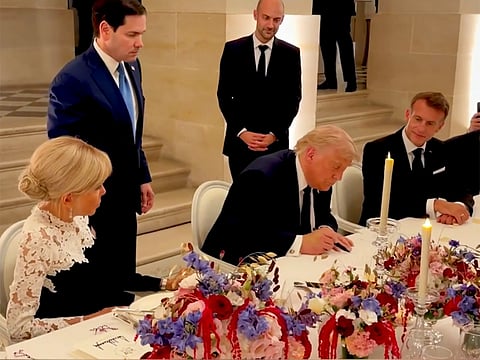
Trump, Iran's president sign deal to end war
US President Donald Trump and Iran's president signed a deal Wednesday meant to end the Middle East war, with Tehran agreeing to dilute its enriched uranium in return for large-scale economic relief.
Trump put his signature to the memorandum of understanding during a candlelit dinner at the Palace of Versailles following a G7 summit, as host French President Emmanuel Macron and other guests applauded, a video posted by a Trump aide showed.
"Just signed it," Trump told reporters as he emerged from the palace.
Iranian Foreign Ministry spokesman Esmaeil Baqaei, quoted by the state news agency IRNA, said the document "was finalized with the signatures of the presidents."
Prime Minister Shehbaz Sharif of Pakistan, which mediated the agreement, said on X that it "shall enter into force with immediate effect."
The deal aims to draw a line under the war launched February 28 by the United States and Israel, prompting Iran to counterattack with missile and drone salvos across the region - and effectively shutting down the Strait of Hormuz, a crucial waterway for the world economy. The US responded by blocking shipping to and from Iranian ports.
"As a first step, Islamic Republic of Iran will instantly reopen the Strait of Hormuz and the United States of America will immediately lift the naval blockade," Sharif wrote.
Under the text, Washington also commits to immediately waive oil sanctions crippling Iran's economy.
And once a final agreement is reached on the Islamic republic's nuclear program, the United States will also facilitate the release of a $300 billion reconstruction fund supported by regional nations, the deal says.
The agreement had earlier been slated for signatures by Iran's chief negotiator and parliament speaker, Mohammad Bagher Ghalibaf, and US Vice President JD Vance. Iran said an in-person ceremony was no longer needed.
Get updated faster and for FREE: Download the Gulf News app now - simply click here.
Pakistan PM says Iran to 'instantly' reopen Hormuz, US to 'immediately' lift blockade
Pakistan’s Prime Minister Shehbaz Sharif has announced that Iran will “instantly” reopen the Strait of Hormuz to all maritime traffic once a US‑Iran peace framework is signed, and that the United States will “immediately” lift its naval blockade of Iranian ports in exchange.
The statement comes as Washington and Tehran prepare to sign what they call a “peace deal” on Friday, June 19, ending hostilities "on all fronts" — including in Lebanon — and terminating the US naval blockade against Iran.
No venue yet for signing of US-Iran deal
US President Donald Trump says the Iran accord will be signed "shortly", "maybe" Thursday (June 18) or Friday (June 19), but no venue has been determined for the signing ceremony, the president noted.
"The deal we reached with Iran on Sunday will be signed shortly, tomorrow (Thursday), maybe the next day (Friday)," Trump said at the G7 summit.
Previous announcements stated that it would be signed on Friday in Switzerland with Vice President JD Vance representing the United States.
"We are going to most likely sign a deal," he added.
Trump told reporters at the final G7 press conference that he was prepared to "bomb the hell" out of Iran if they violated the agreement. "If they are not behaving, they will be hit again," he said.
Get updated faster and for FREE: Download the Gulf News app now - simply click here.
Trump said Washington 'did send a copy' to Israel of the US-Iran accord
President Donald Trump confirmed that Washington "did send a copy" of the US-Iran accord to Israel. The remark came in response to reports suggesting that the Israeli government had been blindsided by the emerging agreement between Washington and Tehran.
"We did send a copy," Trump said, rejecting suggestions that Israeli Prime Minister Benjamin Netanyahu had been kept in the dark about the negotiations. The comment came as Trump expressed confidence that the agreement could be signed within days, while acknowledging that negotiations could still fall apart at the last minute.
Israel has long viewed Iran's nuclear programme as an existential security threat and has repeatedly warned against any agreement that allows Tehran to retain significant nuclear capabilities or receive sanctions relief.
Reports that Israel had not been consulted fuelled speculation of growing friction between Washington and Jerusalem. Trump's statement was intended to reassure both Israeli leaders and domestic critics that the US had coordinated with its closest Middle East ally.


