US-Iran deal: Trump meets UAE President as world leaders discuss regional tensions at G7
Iran warns of 'harsh response' as Israel accused of repeated Lebanon ceasefire violations
Highlights
We are closing this coverage now. For the latest updates, click here.
'Near-final' 14-point US-Iran peace deal: Hormuz reopening, sanctions relief, nuclear talks in focus
The United States and Iran are preparing to formally sign an interim peace agreement in Geneva on Friday (June 19). Both sides portray the deal as a strategic victory.
Key details of the accord remain shrouded in mystery.
The agreement, described as a memorandum of understanding (MoU), is expected to launch a 60-day negotiating period focused on Iran's nuclear programme, regional security issues, and the future framework of relations between Washington and Tehran.
Bloomberg has reported on what it called the "near-final" 14-point US-Iran interim agreement (or MoU).
'Syria will do the job' vs Hezbollah — Trump rebukes Israel
President Trump has publicly rebuked Israel over its war against Hezbollah. "Israel's fighting Hezbollah too long and too many people are being killed." Trump, in an interview aired on Fox, said he opposed strikes that destroy apartment buildings filled with civilians and revealed he urged Israel to let Syria take the lead against Hezbollah instead. "If Israel can't do the job without killing everyone else, he'll do the job. Syria will do the job."
Trump goes after Netanyahu, putting their friendship to the test
Israeli Prime Minister Benjamin Netanyahu told President Donald Trump last year that he was the “greatest friend Israel ever had in the White House." Now, as Trump tries to finalise a deal to end the war with Iran, the US leader is unloading on Netanyahu with rhetoric that no other American leader has dared to use publicly.
He claimed credit for Israel's existence — “without me, there would be no Israel” — and cursed his judgment in interviews.
Speaking on Tuesday at the annual G7 summit in France, Trump said he told Netanyahu that he's been unhappy with his recent moves.
He even described him as “crazy.”
Iran and US to embark on two months of peace talks Friday
The United States and Iran are to launch talks on a final settlement to their conflict on Friday (June 19, 2026) in Switzerland, officials said, as news that the Strait of Hormuz will reopen sent world oil prices tumbling.
Negotiations over a final deal are to start immediately after a signing ceremony and continue during a 60-day window, leading to decisions on the fate of Iran's nuclear programme and a plan for the lifting of international economic sanctions.
War has changed the Gulf: Iran can shut Hormuz ‘at will,’ US assessments say
War has changed the Gulf: Iran can shut Hormuz ‘at will,’ US assessments sayAfter the War, Iran emerges with new control over the world’s most critical oil chokepoint
The US-Israel war with Iran may have fundamentally altered the power calculus in the Gulf, with US intelligence assessments concluding that Tehran now possesses the capability to effectively close the Strait of Hormuz whenever it chooses. This gives Tehran a powerful new tool to disrupt the global economy following months of conflict in the Gulf, according to three people familiar with the assessments as reported by CNN.
Iran warns Israel of 'harsh response' over Lebanon strikes
Iran's military threatened to respond to Israel after strikes in southern Lebanon killed four people despite a deal between Tehran and Washington ending the Middle East war, including in Lebanon.
"If the child-killing army of the Zionist regime does not put an end to its acts of aggression in southern Lebanon, it should await a harsh response from the powerful armed forces of the Islamic Republic of Iran," said the Iranian military's central command Khatam Al Anbiya.
It added that Israel had violated the ceasefire in Lebanon "84 times" since the deal was announced.
Get updated faster and for FREE: Download the Gulf News app now - simply click here.
Vance says Iran agreement release delayed until Friday
Vice President JD Vance said the US has delayed releasing the Iran agreement text to ensure “proper sequencing” of sensitive diplomatic steps involving regional mediators, including Pakistan and Qatar, CNN reports.
Speaking on the Megyn Kelly Show, Vance said the timing is intended to respect ongoing discussions and sensitivities across the Arab and Muslim world.
He acknowledged growing calls for transparency but said officials are aiming to avoid disrupting delicate negotiations.
Vance added that the full text of the memorandum of understanding is expected to be released “at the very latest” by Friday.
Modi voices concern on maritime trade impact due to Hormuz disruptions
Indian Prime Minister Narendra Modi expressed concern over the impact of disruptions in maritime trade through the Strait of Hormuz on the global economy during the conflict in West Asia and said several Indian civilians lost their lives.
Addressing the Outreach Session on 'Forging New Partnerships and Rebuilding International Solidarity' at the 52nd G7 Summit in Evian, France, PM Modi welcomed the progress made in peace efforts in West Asia, referring to the Iran-US peace deal, while highlighting the humanitarian and economic consequences of the conflict.
He stressed that international partnerships and global solidarity would be meaningful only if countries worked together to address common challenges.
"International partnerships and global solidarity can become meaningful only when we collectively address shared challenges. India firmly believes that the lasting resolution of tensions and conflicts in different parts of the world can only be achieved through dialogue, diplomacy, and international cooperation," the Prime Minister said.
"We welcome the progress made in peace efforts in West Asia. This conflict has caused loss of life and property in our friendly countries in the region. Disruptions to maritime trade through the Strait of Hormuz have affected the global economy. Several Indian civilians have also lost their lives," he added.
The Prime Minister also underscored the importance of safeguarding maritime routes and ensuring the security of seafarers involved in global trade.
"Ensuring the safety of seafarers, who connect nations through global maritime trade, is our collective responsibility. We must ensure that sea routes remain secure and that seafarers can carry out their duties without fear...India stands fully prepared to work with all its partners on these important issues," he added.
Prime Minister Modi made the remarks during the Outreach Session of the 52nd G7 Summit, where leaders discussed ways to strengthen international cooperation and forge new partnerships to tackle pressing global issues.
Trump call delays Vance radio appearance over Iran deal
Megyn Kelly was ready to bring Vice President JD Vance live onto her radio show, but she told listeners that they’d have to wait because Vance was on the phone with Trump.
Once he’d gotten mic’d up with Kelly, Vance said Trump — who is in France for the G7 conference — “just called me to check in on how things are going” and on “the progress of the deal” concerning the Iran war.
Vance told Kelly he has been trying to correct misinformation about what is and isn’t part of the deal.
Details of the agreement announced by Trump have not been made public.
The deal is centered around reopening the Strait of Hormuz and lifting the United States’ naval blockade in the region, along with financial incentives for Iran, if it meets certain benchmarks.
For the second consecutive day, Vance flubbed the name of the Gulf alliance, referring to it as the Gulf Coast Coalition instead of the Gulf Cooperation Council.
Get updated faster and for FREE: Download the Gulf News app now - simply click here.
G7 explores alternatives to Strait of Hormuz for global energy supplies
The leaders’ discussions about the vital waterway at their summit in France have included looking at other supply routes that could be opened to bring oil and gas out of the Gulf, French Foreign Ministry spokesman Pascal Confavreux said in an interview with The Associated Press.
“There were discussions to see how we can depend less on the strait,” he said. “This has to change for the future.”
Before the Iran war, a fifth of the world’s crude oil passed through the maritime chokepoint.
“Part of the discussions were, ‘OK, how can we imagine, finance, and build infrastructures, sometimes on the terrestrial part, that will be able to go outside of the track of the Strait of Hormuz?’” Confavreux said.
Son of late Shah warns against deal with Tehran
The son of the ousted shah of Iran spoke out against any deal with Iran that leaves the Islamic government in place, as Washington prepared to sign an agreement with Tehran.
Speaking after meeting MPs during a visit to London, 65-year-old Reza Pahlavi said the international community should back opposition protesters rather than making peace with Iran.
"Dealing with this regime will fail and we will all face the consequences," he declared in a social media post.
"The regime's 47-year war against the Iranian people continues. Just as it has never made peace with its own citizens, it will never truly make peace with the world," he said.
Pahlavi's father, Mohammed Reza Pahlavi, was the last shah of Iran, who fled into exile in 1979 ahead of an Islamic revolution that overthrew he monarchy and died in exile soon afterwards.
Any agreement that preserves this regime or its remnants will fail. The Iranian people will not accept it. With or without international support, the people of Iran will overthrow this regime. Freedom will come to Iran.Reza Pahlavi
Hormuz shipping muted despite Iran war accord: Trackers
Shipping through the Strait of Hormuz stayed at a trickle, maritime trackers indicated, two days after the US promised to reopen it under an agreement with Iran to end their war.
As of 1500 GMT on Tuesday, tracking platform Kpler had detected just four crossings of the strategic waterway that day by vessels carrying raw materials.
Five were detected on Monday - a similar rate to traffic during the week before the US-Iran agreement to end the Middle East war, announced late Sunday.
"The Strait of Hormuz continues to operate below normal commercial levels, despite signals of diplomatic progress," Kpler said on X.
Shipping groups have warned however that uncertainty remains about the steps towards reopening and how long it could for the strait to be cleared of mines.
"Key operational questions remain unresolved, including transit security, navigation fees and safe passage arrangements," Kpler said.
The vessels counted since the deal all transited with their transponders switched on but others may have passed without transmitting signals, making detection more difficult.
An Iranian tanker, the Diona, switched its transponder back on Tuesday for the first time in nearly two months.
Tanker owners' association Intertanko said in an advisory published on June 5 that the US Navy had been liaising with ships to help them safely pass by night, with their lights and transponders off, through the strait on its southern side near Oman's coast.
It said 15 ships a day had been using that route.
Israel says intercepts Hezbollah rockets, conducts strikes in Lebanon
The Israeli military said Tuesday it conducted strikes in south Lebanon after intercepting rockets fired by Hezbollah against its troops in the area, despite a US-Iran deal that includes the Israel-Hezbollah war.
The military said its forces intercepted several rockets fired at soldiers, following which the air force "struck and dismantled" the launcher from which some of the projectiles were fired.
The military also conducted a strike in south Lebanon after it "identified a suspicious vehicle where IDF soldiers were operating ... to remove the threat".
“Not a single cent” of American money will reach Tehran: Vance
JD Vance has said no US funds will be transferred to Iran under the peace agreement, telling Fox News that “not a single cent of American money” will go to Tehran, the BBC reports.
He contrasted the current administration with former US President Barack Obama, alleging Iran previously received “over $1bn” in cash.
Responding to claims of large-scale financial transfers linked to the deal, Vance dismissed them as “basically Iranian propaganda”.
“Not a single cent of American money goes to Iran, not $300bn, not $24bn, not any of the money,” he said, adding that some narratives were being shaped for domestic audiences in Iran.
Iran war makes energy security a top priority in Southeast Asia
An International Energy Agency report released Tuesday says the Iran war could cost Southeast Asia billions of dollars if it doesn’t diversify sources of energy more quickly.
The energy shock from the closure of the Strait of Hormuz sent the region into a state of energy triage, leading to higher energy bills and rising inflation. In response, the region has seen rising sales of electric vehicles, a renewed interest in nuclear power and a boom in rooftop solar and other renewable energy installations, the report says.
But without more sweeping reforms, the region’s energy import bill could triple from $80 billion in 2024 to $245 billion by 2035, the report warns. And meanwhile, the conflict has reinforced the need for coal in times of crisis, a setback for efforts to phase out fossil fuels.
“Diversification of energy sources and supply routes is now a central priority,” said Fatih Birol, the IEA executive director.
Israeli strikes on south Lebanon kill four
Multiple Israeli strikes have killed at least four people on south according to Lebanon state media.
Iran says the US war deal requires Israel to withdraw from Lebanon
Iran’s top diplomat said that the tentative deal to end the war with the United States would require Israel to withdraw from Lebanon — a condition Israel has already rejected. The contradictory interpretations could sink the agreement and lead to the resumption of all-out war.
The deal between the U.S. and Iran has not been made public, and while Israel is not party to the agreement, it is part of the war: It joined the U.S. in launching strikes on Iran on Feb. 28, and has since fought the Iran-backed Hezbollah militant group in Lebanon and seized large swaths of that country.
“Without the withdrawal of Israeli forces from the territories they occupied during this war, the war has not fully come to an end,” Iranian Foreign Minister Abbas Araghchi said.
A US official who spoke on condition of anonymity to discuss the deal’s outlines said it did not call for an Israeli withdrawal. And Israeli Prime Minister Benjamin Netanyahu said Monday that Israel would remain in Lebanon “as long as necessary.”
Signing ceremony for US-Iran deal to take place Friday at Swiss resort
Switzerland's foreign ministry says a signing ceremony for a deal between the United States and Iran will take place Friday at the Bürgenstock resort near the city of Luzern.
Ministry officials said Tuesday that the location was proposed by Pakistani and Qatari mediators, along with the US and Iran.
The ministry said it has been in close contact with the four countries about the possible signing of the memorandum of understanding that US and Iranian officials announced over the weekend.
China warns next phase of US-Iran talks will be 'more difficult'
China's top diplomat told his Pakistani counterpart on Tuesday that the next phase of negotiations between the United States and Iran - which Pakistan has helped mediate - will be "more difficult".
In a phone conversation ahead of the planned signing on Friday of a US-Iran memorandum of understanding to end their war, Chinese Foreign Minister Wang Yi told Pakistan's Ishaq Dar that "it is foreseeable that, compared with the first stage, the second stage of negotiations will be more difficult", adding that the United Nations Security Council "should also play a greater role" in reaching a final deal, according to a statement from Beijing's foreign ministry.
Iran deputy foreign minister says US naval blockade 'lifted'
An Iranian deputy foreign minister on Tuesday said the two-month US naval blockade on Iranian ports had been lifted ahead of the planned formal signing of a deal ending the war.
"The lifting of the blockade was something we had emphasised from the outset. It has now begun, and the blockade has been lifted prior to the formal signing" scheduled for Friday, said Iranian Deputy Foreign Minister Majid Takht-Ravanchi, according to the government's website.
G7 leaders are discussing building new partnerships
The working session is titled “Forging New Partnerships and Rebuilding International Solidarity” and is attended by the G7 countries and the partner countries of Brazil, Egypt, India, Kenya and South Korea, along with the World Bank and the African Development Bank.
Trump was sitting between Macron and Indian Prime Minister Narendra Modi.
He’s scheduled to have a face-to-face meeting with Modi on Wednesday.
UK-EU summit date announced at last
Britain and the European Union have announced the date for a summit seen as a key step in rebuilding their relationship.
European Council President Antonio Costa says the meeting will be held in Brussels on July 22. Costa met British Prime Minister Keir Starmer at the G7 summit on Tuesday.
There has been a question mark over the date due to uncertainty about Starmer’s future. He is facing calls to resign and a potential leadership challenge this summer.
Leaders have begun final working session of the day
The session is focused on international investment. In addition to the core G7 members, leaders from Brazil, Egypt, India, Kenya, South Korea, Qatar, Ukraine, and the UAE were invited to take part in the talks.
Brent oil price drops under $80 on US-Iran deal
Oil prices fell to a three-month low on optimism over the expected reopening of the Strait of Hormuz after a peace deal between the United States and Iran.
Brent North Sea crude, the international benchmark, dropped 3.8 percent to $79.99 a barrel, dipping under $80 for the first time since early March.
The main US oil contract, West Texas Intermediate, slid 3.9 percent to $77.61 a barrel.
Trump says 'soon we will be able' to reimpose sanctions on Russian oil
Trump said the US will soon be able to reimpose sanctions against Russian oil, at the G7 summit where leaders are seeking to ratchet up pressure against Moscow over its invasion of Ukraine.
"Soon we will be able to do that as the oil is now flowing" through the Strait of Hormuz after the deal with Iran to end the Middle East war, Trump said. Washington had imposed and then extended a sanctions waiver for Russian oil cargoes already at sea, troubling European allies.
Trump says he’d send Iran deal to Congress for review
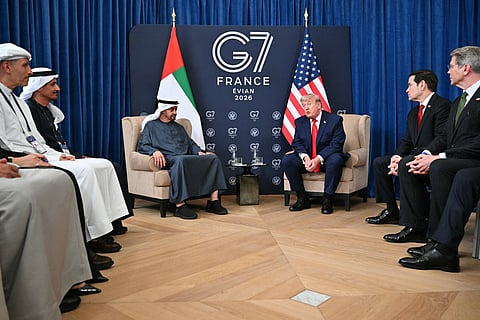
The president voiced his openness to making the move at the start of a meeting with UAE President His Highness Sheikh Mohamed bin Zayed Al Nahyan on the sidelines of the G7 summit in the French Alps.
“I like the idea, send it to Congress please,” Trump said. He added, “I mean who wouldn’t approve it.”
Republicans on Capitol Hill say they want Trump to provide more information about the agreement between the United States and Iran, with some expressing skepticism that the deal can deter Iran from pursuing a nuclear weapon.
Trump says he may read Iran agreement “word by word” publicly
Trump has pledged to publicly release the full text of an agreement with Iran within days, saying he may even read it out in its entirety on camera.
He said he is awaiting a “formal setting” before making the document public, but insisted there was no objection to transparency.
“I’d like to get a formal setting first before we do that, but I have no problem with that, it’s a great document,” he said during a meeting with UAE President His Highness Sheikh Mohamed bin Zayed Al Nahyan on the sidelines of the G7 summit in France.
Trump summarised the deal as straightforward, saying: “Here’s what it says: Iran will never have a nuclear weapon.”
The agreement was signed electronically on Sunday, but its full text has not yet been made public, and neither lawmakers nor world leaders have reportedly seen the complete document.
Downplaying concerns over secrecy, he added he would likely present it in detail at a press conference.
“I’ll probably have a press conference and read it word by word, so that the press covers it accurately, because it’s a very important document,” he said, adding that he would brief the media “in a couple of days.”
Trump to release MoU text, brief media on details
Trump has said the memorandum of understanding reached with Iran will be published in a formal setting at a later stage.
He added that he plans to hold a press conference to publicly go through the document in detail.
“I’ll not only release it, I’ll probably have a press conference and read it… word by word so that the press covers it accurately,” he said, describing the agreement as “a very important document.”
G7 leaders meeting with leaders of Egypt, Qatar and UAE
The leaders of the G7 are holding a meeting with the leaders of Egypt, Qatar and the UAE.
They are attending a working lunch dubbed “Addressing Crises and Ensuring Stability in the Middle East.”
The Middle East countries are not G7 members, but were invited to the summit at a tumultuous moment for the region and beyond because of the Iran war.
Trump says Syria 'will do the job' with Hezbollah if Israel unable
US President Donald Trump said Tuesday he had suggested to Israel that Syrian President Ahmed al-Sharaa should deal with Lebanon's Tehran-backed Hezbollah militia as the Israeli campaign was causing too many casualties.
Praising Sharaa as doing an "amazing job", Trump said at a G7 summit: "If Israel can't do the job (against Hezbollah) without killing everyone else, than he (Sharaa) will do the job. Syria will do the job."
Trump says US has 'no obligation' to invest in Iran
The United States has "no obligation" to invest in Iran even after its deal with the Islamic republic to end the Middle East war, President Donald Trump said on Tuesday.
"We are not investing any money" in Iran, Trump said at the G7 summit in France after talks with the emir of Qatar, adding that the main focus of the deal was that Iran would not acquire a nuclear weapon and that "all hell" would "rain down" on the country if it did.
Iran's top negotiator Ghalibaf to attend signing of US deal: deputy foreign minister
Iran's top negotiator Mohammad Bagher Ghalibaf will attend the signing in Switzerland of the deal ending the war with the United States, an Iranian deputy foreign minister said on Tuesday.
"Switzerland will be the venue for the signing, but the exact location has not yet been determined. The next round of negotiations will begin immediately after the signing," said Majid Takht-Ravanchi, according to state television.
He said US Vice President JD Vance will represent Washington, while "from Iran, it will be Mr Ghalibaf".
Get updated faster and for FREE: Download the Gulf News app now - simply click here.
Iran says footballer's US visa expires after World Cup opener
An Iranian national football team player's United States visa has expired, state media reported Tuesday, leaving his future at the World Cup shrouded in doubt with Tehran engulfed in a bitter diplomatic row with Washington.
Winger Mehdi Torabi was only issued a single-entry visa instead of the multiple-entry visa given to other Iranian national team players to take part in the global spectacle, where Team Melli earned a 2-2 draw with New Zealand in their opening match on Monday.
US military to build war-ready stockpile in Australia
The US military is planning a permanent war-ready weapons stockpile for its Marine Corps on Australia's southeast coast beyond the range of most Chinese missiles, tender documents show and officials confirmed to AFP.
The development of the stockpile, a first for the Marine Corps in Australia, comes as the United States is keen to leverage the continent's strategic location in the South Pacific to counter China's rapid military build-up, analysts said.
The US Marines Corps began global prepositioning of military supplies during the Cold War -- using floating stores on ships and caves in Norway where weapons, ammunition and vehicles to sustain thousands of troops are kept.
The first land stockpile in the Asia-Pacific is expected to open this year in the Philippines, close to potential flashpoints in the South China Sea.
Stocks extend rally, oil flat as peace optimism builds
Tokyo topped 70,000 and Seoul piled on more than two percent as equities extended their rally on Tuesday fuelled by the US-Iran peace deal and as tech firms tracked another blockbuster performance by SpaceX.
The euphoria that swept trading floors at the start of the week continued to propel buying amid relief at the end of a three-month conflict that sent shockwaves through energy markets and global inflation soaring.
US President Donald Trump said ships were again moving through the Strait of Hormuz and it would be "completely open" by Friday, while Iranian media said three oil tankers and two cargo ships had passed through the vital waterway that had been subject to a US naval blockade.
Iran FM says talks on final agreement with US 'likely' to start Friday
Iran's Foreign Minister Abbas Araghchi said on Tuesday that talks with the United States on a final agreement covering Tehran's nuclear programme will likely begin on Friday.
"Likely on Friday, at a location to be determined... a new round of negotiations between Iran and the United States to reach a final agreement will begin," Araghchi said in a briefing with foreign diplomats broadcast on state television.
Iran FM says ending war in Lebanon 'most important issue' in US deal
Iranians up at dawn to cheer their team at World Cup
Solemn silence during the national anthem and howls of joy after the goals: in Tehran, Iranians followed their team's first steps on American soil in the World Cup with curiosity through the night.
Most in the Iranian capital were asleep when the match against New Zealand kicked off at 4:30 am. But in one of the few cafes open to broadcast the match, there was already a buzz of excitement.
Around 40 football fans were discussing their team's chances in a World Cup being played under the shadow of the war between Iran and co-hosts the United States.
"I and my friend think (the Iranian team) will advance to the next stage, and I hope that it happens," Shiva Sharifi, a 21-year-old teacher, wearing a wrist band in the colours of the Iranian flag, told AFP.
Bank of Japan raises interest rates to 31-year high
The Bank of Japan (BOJ) raised interest rates to a 31-year high on Tuesday, marking another landmark step in normalising monetary policy as it focused on taming price pressures from the energy shock caused by the conflict in the Middle East and the weakness of the yen.
The BOJ decided to raise its short-term policy rate to 1 percent from 0.75 percent, the first rate hike since December 2025.
Strait of Hormuz transit will take 'weeks' to resume
Shipowners will not resume transit through the Strait of Hormuz for weeks until they are confident the US–Iran deal is "material", the chief executive of Japan's Mitsui O.S.K. Lines told the Financial Times in an interview published on Tuesday. Mitsui O.S.K., one of Japan's big three shipping firms, operates a fleet of more than 900 vessels, including bulk carriers, tankers and ferries.
The Iran war that began on February 28 with US–Israeli strikes largely halted shipping through the route, which carries around a fifth of the world's oil and liquefied natural gas supply, along with products such as aluminium and urea. Jotaro Tamura told the FT that any agreement would need to translate into real conditions on the ground in the strait before shipping lines feel comfortable transiting again, adding that based on recent experience it was reasonable to assume this could take at least a couple of weeks, if not a month.
According to the FT, the finalising of the agreement between Washington and Tehran had not changed Tamura's view, while Mitsui O.S.K. did not immediately respond to a request for comment from Reuters. President Donald Trump, meanwhile, said in a Truth Social post that oil-laden ships were starting to move out of the strait along a southern route he described as safe and secure.
Get updated faster and for FREE: Download the Gulf News app now - simply click here.
Europe presses Trump on Iran deal and Ukraine at G7
European leaders are set to warn US President Donald Trump at the G7 summit that a superficial interim agreement with Iran could end up entrenching Tehran's nuclear and ballistic missile programmes rather than curbing them. At the same time, they are expected to press Trump to reconsider his approach to Ukraine, urging a rethink of his current strategy as the allies seek to align on both fronts, as per Reuters.
Myanmar inflation hits 25% on US-Iran fuel shock: World Bank
Myanmar's inflation spiked to nearly 25 percent as shocks from the Middle East conflict compounded the effects of the country's civil war, the World Bank said Tuesday.
The Bank also slashed its growth forecast for the financial year that started in April, citing "a less favorable external environment".
Myanmar has been mired in civil war since the military snatched power in a 2021 coup, plunging it into a half-decade of instability and a backslide into poverty for many of its more than 50 million citizens.
The country also imports 90 percent of its fuel oil, according to official figures, leaving it highly exposed to closure of the Strait of Hormuz since the US-Iran war started on February 28.
Gold extends gains after US, Iran reach peace deal
Gold rose more than 2% on Monday after US and Iran officials said they had reached an initial agreement to end their war.
By 0536 GMT the spot gold price had risen 2.5%, to $4,323.29 an ounce, its highest since June 9, and extended gains for a 3rd straight session. US Gold Futures for August Delivery rose 2.5% at $4,343.80.
Spot silver increased 3.3%, to $70.19 an ounce.
'None of your business': Iran player lashes out over anthem boos
Iran's World Cup goalscorer Ramin Rezaeian told a journalist that boos from Iranian diaspora protesters during his country's national anthem were "none of your business" following their World Cup opener in Los Angeles on Monday.
"If there is any problem between us, it is our business, it is none of your business," said a brusque but polite Rezaeian, when asked about some vocal booing and whistling during the anthem before the game.
"I respect you, but this is something between us and we're going to settle it, don't worry."
China retail sales fell in May for first time since 2022
China's retail sales fell last month for the first time in more than three years, data showed on Tuesday, as leaders of the world's second-largest economy struggle to kickstart domestic consumer activity.
The 0.6 percent year-on-year drop in May, revealed by the National Bureau of Statistics, was a big miss compared with the 0.2 percent forecast in a Bloomberg survey, which was itself in line with April's lacklustre performance.
While the Chinese economy has enjoyed a historic boom in exports, it has been dragged for years by weak household consumption that has so far failed to recover from the Covid pandemic.
Beijing is targeting overall growth of 4.5-5.0 percent this year, though soaring energy costs and uncertainty caused by the Middle East crisis have complicated matters.
Tokyo's Nikkei stock index tops 70,000 for first time
Japan's Nikkei stock index soared past 70,000 points for the first time on Tuesday, extending a global rally fuelled by the US-Iran peace agreement and tracking tech-led gains on Wall Street.
The Nikkei 225 climbed to as high as 70,020.68 in afternoon trade before easing back slightly.
Iran snatch draw in World Cup opener
Iran came from behind to snatch a 2-2 draw against New Zealand in their long-awaited opening game at the World Cup on Monday as European heavyweights Spain were frustrated in a shock stalemate by tiny tournament debutants Cape Verde.
After months of uncertainty surrounding their participation in the tournament following the war in the Middle East, all eyes were on the Iranians as they took on the New Zealanders in Group G at Los Angeles' SoFi Stadium.
But despite scattered pre-match protests outside the venue, the game passed off largely without incident as Iran twice fought back from a goal down to earn a precious point in front of a 70,108-strong crowd.
Most stocks rise, oil flat following peace deal-fuelled rally
Equities mostly rose Tuesday and oil prices held losses following the previous day's euphoric rally sparked by the US-Iran peace deal that will reopen the crucial Strait of Hormuz.
Eyes are now on developments ahead of Friday's signing ceremony in Switzerland, which will bring an end to more than three months of a war that has sent shockwaves through energy markets and sent global inflation soaring.
US President Donald said ships were again moving through the strait and it would be "completely open" by Friday, while Iranian media said three oil tankers and two cargo ships had passed through the area that had been subject to a US naval blockade.
Vance: IAEA, US to help Iran 'destroy' enriched uranium stockpile
The US-Iran deal provides for the return of International Atomic Energy Agency (IAEA) experts to Iran to destroy its stockpile of enriched uranium, US Vice President JD Vance stated.
"Yes, absolutely," he said in an interview with NBC News. "In fact, one of the core parts of the agreement is that the IAEA [International Atomic Energy Agency] and the United States are going to help Iran destroy the highly enriched [uranium] stockpile," he emphasized.
The vice president added that this is "spelled out very clearly" in the Iran-US memorandum of understanding, Russia's TASS news agency reported.
According to Vance, there are still "some technical details to work out, not related to the text of the memorandum of understanding itself, but the implementation."
The document is scheduled to be signed in Geneva on June 19.
Hormuz reopening set for June 19 amid uncertainty over deal terms
Confusion continued to swirl over the scope and timing of a reported US–Iran agreement, even as President Donald Trump said the deal to end the war had already been signed and that details would be released “pretty soon.”
Trump said the agreement was digitally signed on Sunday (June 14) and claimed it includes provisions to reopen the Strait of Hormuz by Friday (June 19), when he said the accord would be formally inked on paper. He did not immediately provide documentation or detailed terms of the agreement.
The Strait of Hormuz has been a central flashpoint during weeks of conflict involving Iran, Israel, and allied forces in the region.
Iranian and intermediary sources have previously described the deal as a "framework" intended to halt military operations and open a 60-day negotiating period on broader security and nuclear issues, though implementation details remain unclear.
Analysts caution that while political statements suggest rapid de-escalation, key questions remain over verification mechanisms, enforcement on the ground, and whether all parties to the wider regional conflict will abide by any ceasefire arrangements.
Get updated faster and for FREE: Download the Gulf News app now - simply click here.
Oil prices crash: Sell-off follows US–Iran de-escalation, peace framework
Global oil benchmarks tumbled across the board on Monday evening and into Tuesday morning (June 16), as markets are treating the reopening of the Strait of Hormuz as positive news.
Crude oil rates prices are falling from their crisis highs as traders anticipate a gradual recovery in Gulf exports, with WTI crude sliding to $80.75 (-4.9%) and Brent to $83.38 (-4.5%).
Murban crude was down 7% to $76.81 (down $6.21) as of 6.59am Tokyo time on Tuesday.
The broad sell-off comes after reports of a US–Iran de-escalation or preliminary peace framework, including expectations of reduced military confrontation and a possible easing of pressure on maritime flows.
Hormuz naval mine risk, insurance remain high
Global shippers are insisting on independent confirmation that the Strait of Hormuz are free of naval mines and other hazards before they fully resume normal operations, amid lingering risks following months of maritime conflict in the Middle East.
Industry groups say that even after tentative political de-escalation efforts, operators will not return at scale without verified mine clearance, safe navigation corridors, and sustained security guarantees, Reuters reported. Maritime security experts, meanwhile, warn that underwater mines and unexploded ordnance remain among the most serious threats to commercial shipping, with clearance operations potentially taking weeks in heavily contested waters.
Hormuz open again, but not fully
More ships are being allowed through the Strait of Hormuz following the announcement of a US-Iran peace deal. News agencies reported that the situation has improved significantly compared with the near-total shutdown seen earlier in the conflict. While commercial shipping has not yet returned to normal operations, a number of vessels have begun transiting the strait again. Shipping companies and tanker operators are evaluating routes and security conditions before sending larger numbers of vessels through. The agreement reportedly calls for reopening the strait and restoring maritime traffic. Implementation is still underway.
US nuclear-capable B-52 crashes minutes after departure from Edwards Air Force Base in California
A US Air Force B-52 Stratofortress strategic bomber crashed shortly after takeoff from Edwards Air Force Base in California's Mojave Desert, triggering a major emergency response and prompting the closure of one of America's most important military aviation facilities.
According to the Air Force, the bomber went down at approximately 11:20 am local time shortly after departing from Edwards Air Force Base, about 100 miles (160 km) north of Los Angeles. Emergency crews rushed to the scene as thick black smoke rose from the desert crash site. Aerial footage showed a large scorched area roughly the size of a football field.
Trump draws fire from his own party over 'surrender' to Iran
President Donald Trump is facing growing criticism from some of the Republican Party's most prominent foreign-policy hawks, who argue that his emerging agreement with Iran amounts to a major "retreat" after months of military confrontation and economic pressure.
The backlash comes as the Trump administration pursues a preliminary accord aimed at ending hostilities, reopening the Strait of Hormuz and laying the groundwork for broader negotiations with Tehran. While the White House has portrayed the agreement as a diplomatic breakthrough, critics within Trump's own party fear it falls short of the administration's original objectives and could leave Iran strategically stronger.
Several Republican lawmakers have publicly questioned whether the proposed arrangement secures meaningful concessions from Iran on key issues such as its nuclear programme, missile capabilities and regional influence. Senator Lindsey Graham warned that a deal allowing Iran to retain significant leverage in the Gulf would represent a major shift in the regional balance of power, while Senator Ted Cruz described reports of concessions to Tehran as "deeply concerning".
Dow ends at record after US and Iran announce peace accord
The Dow finished at a fresh record Monday, rallying with other major US indices after the announcement of a peace accord between Washington and Tehran sent oil prices sharply lower.
The blue-chip index piled on 0.9 percent to end at 51,671.83.
The broad-based S&P 500 gained 1.7 percent to 7,554.80, while the tech-rich Nasdaq Composite Index jumped 3.1 percent to 26,883.94.
Netanyahu says he doesn’t always agree with Trump
Israeli Prime Minister Benjamin Netanyahu has said there are instances where he and US President Donald Trump do not “see eye to eye,” but stressed that he will always act in Israel’s national interest, according to the BBC.
Speaking at a press conference, Netanyahu said that when necessary, he would firmly insist on protecting Israel’s priorities.
“When necessary, I will insist on Israel’s interests,” he said.
Netanyahu says troops to stay in Lebanon, Syria, Gaza
Israeli Prime Minister Benjamin Netanyahu said on Monday that the country's forces would remain in Gaza, Lebanon and Syria "for as long as necessary," hours after a deal was announced between Iran and the US to end the Middle East war.
"We established deep security zones around the State of Israel. We did this in Gaza, in Lebanon, and in Syria," Netanyahu said in a televised press conference. "And I want to make it clear: we will remain in these security zones for as long as necessary to protect our country."
Netanyahu: Iran war prevented ‘nuclear annihilation’ threat
Israeli Prime Minister Benjamin Netanyahu said Monday that the joint US-Israeli military campaign against Iran had spared his country from what he described as the Islamic republic's threat of "nuclear annihilation".
"The most important thing is that we saved the State of Israel from the threat of nuclear annihilation," Netanyahu said, in what were his first comments after Washington and Tehran agreed to a deal to end the Middle East war.
"And what would that mean? It would mean that millions of Israeli citizens - you who are hearing me now - all of you would have been in terrible danger of mass death... And we have pushed away from us, for years, this danger of the annihilation of Israel's population," Netanyahu said in a televised press conference.
US oil strategic reserve at its lowest since 1983
US strategic oil stockpiles sank last week to their lowest level since 1983 as the US-Iran war slowed crude deliveries, government data showed Monday.
The US Strategic Petroleum Reserve fell to 340.3 million barrels, down 8.9 million from the prior week, according to weekly figures released by the US Department of Energy. That's the lowest level since July 1983.
US‑Israel war on Iran: Recent developments
Day 108: Trump says Strait of Hormuz will be 'completely open'
Day 107: Trump says Iran deal reached, Tehran claims victory
Day 106: Trump says deal to be signed Sunday, Hormuz to reopen
Day 105: Pakistan PM says US–Iran peace deal text agreed
Day 104: Trump touts Iran peace deal, to be signed in Europe


