US-Iran conflict: Trump pauses strikes as Iran demands US honour deal
Trump says Mideast allies agree on deal framework to end Iran war, pauses strikes
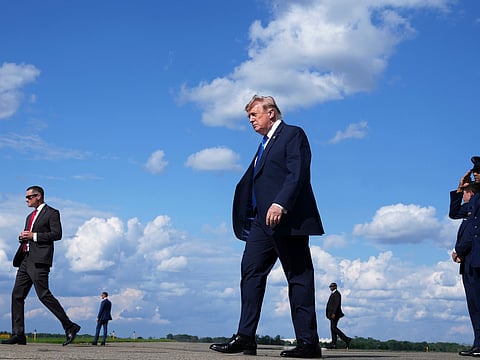
Highlights
We are closing this coverage now. For the latest updates, click here.
35 ships forced to turn back as US blockade chokes Iranian ports
The US military has redirected 38 commercial vessels as part of the renewed naval blockade of Iranian ports, according to the latest figures reported by the command amid continued enforcement operations in the region.
The update came as the aircraft carrier USS Abraham Lincoln transited the Arabian Sea, with a US Marine Corps F-35C stealth fighter launching from its deck in support of the mission.
The blockade of maritime traffic entering and exiting Iranian ports resumed on July 14 at the direction of President Donald Trump.
Israeli strikes kill 13 in Gaza
Israeli strikes on Gaza hit multiple residential buildings and killed at least 13 people, authorities said Sunday, despite Hamas saying it agreed to the latest stage of a deal to end the war.
Hamas said Friday it had agreed to a plan championed by US President Donald Trump that includes provisions for handing over its weapons and the gradual withdrawal of Israeli forces from the Gaza Strip.
Israel has yet to officially comment on the agreement, but a political source has told AFP "that there will be no withdrawal whatsoever" without Hamas's "genuine disarmament".
Blast reported near tanker off Oman coast, crew safe: UKMTO
The United Kingdom Maritime Trade Operations (UKMTO) reported an explosion in close proximity to a tanker off the coast of Oman on Sunday.
According to UKMTO, in an X post at 4.37am on Monday (August 3, 2026) the incident occurred approximately 20 nautical miles northeast of Khasab, Oman.
It confirmed that all crew members and the vessel are reported to be safe following the incident.
Maritime authorities have launched an investigation into the event. Meanwhile, the UKMTO has advised all vessels transiting the area to exercise caution and immediately report any suspicious activity to the agency.
Trump says new Iran talks to begin Monday after calling off strikes
US President Donald Trump said that negotiations with Iran will begin Monday after he decided to hold off on new "disastrous" strikes against the Islamic republic to pursue a deal.
"Obviously, they don't want to be attacked. They knew the extent of the attack because they saw it forming," Trump told reporters on Sunday aboard Air Force One.
"Now what we're doing is we're talking to them in the form of a negotiation. It begins tomorrow afternoon," he said, without providing further details of the venue of the talks or the participants.
Trump frequently announces he's halting strikes in Iran. But they keep happening
President Donald Trump said on August 1 that he would halt new planned attacks on Iran pending renewed talks to wind down the war and revive stalled cargo traffic through the Strait of Hormuz. It was the latest in a pattern of announcements the US president has made to first threaten massive strikes and then later call them off. The abrupt shifts have been a defining feature of the five-month conflict that has sent prices of oil and basic goods soaring — and the announcements to date have been upended by renewed attacks days or even hours afterward.
Iran’s Pezeshkian: US peace memorandum remains cornerstone of foreign policy, urges enforcement
The memorandum of understanding (MoU) signed by the US and Iran in June will serve as the foundation of the country’s future foreign relations, the Iranian leader said early on Monday.
Iranian President Masoud Pezeshkian stated that the deal was the product of collective decision-making by Iran’s Supreme National Security Council (SNSC) and all members of the council are aligned with the agreement.
“I believe that this memorandum of understanding will be the centre of gravity of our foreign relations in the future,” he wrote in a post on X.
“We must strive to force the enemy to remain committed to what it has signed. The security of the country, the region and our allies will be enhanced with this memorandum of understanding.”
“We must strive to force the enemy to remain committed to what it has signed. The security of the country, the region and our allies will be enhanced with this memorandum of understanding.”Iranian President Masoud Pezeshkian
Iran has plan ready for responding to potential attacks on infrastructure: Report
Iran has prepared an "extensive" plan for responding to potential attacks on Iranian infrastructure, the country's semi-official Tasnim news agency reported Saturday. Tasnim cited a senior security official as saying that Iran has prepared an "extensive" plan in response to US media's recent claims about possible US and Israeli strikes against its infrastructure.
Tehran says three nations reject involvement in Iran conflict
The UK, Bulgaria and Ukraine have told Tehran they will not take part in any military action against Iran, the Iranian foreign ministry spokesperson, Esmail Baghaei, said, according to state media, signalling a diplomatic push to limit the scope of any wider confrontation.
Speaking in an interview with SNN, Baghaei said discussions with Oman were continuing over a proposed transit route through the Strait of Hormuz that is “neither a northern nor a southern route”, adding that the reopening of the vital waterway remained separate from those talks.
He accused Washington of breaching a memorandum of understanding by failing to allow shipping traffic to resume within an agreed timeframe, saying the United States had “attacked us before the agreed-upon period expired”, and linked any decision on reopening the strait to what he described as US violations of its commitments.
Iran: US must honour memorandum it signed
Iran must compel the US to honour the Iran-US memorandum of understanding it signed, President Masoud Pezeshkian said on X, adding that the agreement would become the cornerstone of Tehran’s future foreign relations.
“We must strive to compel the enemy to honor what it signed,” Pezeshkian said. “This memorandum enhances the security of our country, the region and our allies.”
Iran foreign ministry says close to deal with Oman on Hormuz route
The spokesman for Iran's foreign ministry said on Sunday that Tehran and Muscat were close to reaching a deal on a new maritime route through the Strait of Hormuz, separate from the existing corridors.
"We are now going to reach an understanding on a route acceptable to both sides - neither the northern route nor the southern route - but one that respects the sovereign rights of both sides and safeguards our national interests and security," Esmaeil Baqaei said in an interview with state television.
Get updated faster and for FREE: Download the Gulf News app now - simply click here.
US carrier operations continue in Arabian Sea
A US Marine Corps F-35C stealth fighter launched from the USS Abraham Lincoln as the aircraft carrier continued operations in the Arabian Sea in support of the US blockade against Iran.
US Central Command (CENTCOM) said that, as of August 2, it had redirected 35 commercial vessels, disabled two and boarded another two as part of its ongoing maritime operations linked to the blockade.
Efforts underway to revive June US-Iran deal: Iranian MP
An Iranian lawmaker said on Sunday that mediators were seeking to revive a deal that briefly halted the war between Iran and the United States in June.
Hassan Ghashghavi, spokesman for parliament's national security commission, said in a video interview that "there is an effort underway to revive the 14-point Islamabad agreement, particularly by the mediators".
"They know that the main issue and, in fact, the key to the matter right now is the issue of the Strait of Hormuz, so yes, there is an exchange of views," he said.
The agreement, known as the Islamabad memorandum of understanding, was reached with the involvement of Iran's Gulf neighbour Qatar and eastern neighbour Pakistan, with negotiating sessions held in Islamabad.
The deal included arrangements concerning the Strait of Hormuz and a resumption of diplomacy between Tehran and Washington for a broader deal.
It also called for an end to the hostilities in Lebanon where Israel has been fighting the Iran-backed Hezbollah militant group.
The agreement later collapsed after Iran and the United States accused each other of violating its provisions.
Five Lebanon army soldiers injured in Lebanon blast
Five Lebanese soldiers were injured on Sunday after a suspicious object exploded in the southern town of Kfara, Bint Jbeil, while their vehicle was escorting residents.
The Lebanese Army said the soldiers suffered minor injuries in the blast and were taken for medical treatment.
The incident comes amid continued security tensions in southern Lebanon, where the army has been expanding its deployment under a US-brokered framework agreement covering security arrangements, troop redeployment, reconstruction efforts, economic recovery and direct communication channels between the two sides.
Bahraini, Jordanian Kings condemn Iranian attacks
King Hamad bin Isa Al Khalifa of Bahrain held a phone call on Sunday with King Abdullah II bin Al Hussein of the Hashemite Kingdom of Jordan, during which they reviewed the deep-rooted ties between the two Kingdoms and discussed efforts to de-escalate regional tensions.
According to the Bahrain News Agency (BNA), the two leaders underscored their rejection, condemnation and denunciation of the Iranian attacks against the two Kingdoms and the countries of the region.
They also stressed the importance of intensifying efforts to strengthen peace, security and stability in the region to serve the interests of its countries and peoples.
UN says Israeli demolitions in Lebanon 'deeply concerning'
The United Nations on Saturday expressed concern over Israel's ongoing demolitions in southern Lebanon despite a ceasefire in its war with Iran-backed Hezbollah.
"The scale of the detonations and demolitions taking place in south Lebanon is deeply concerning, with a devastating impact on civilian infrastructure, cultural heritage, and the collective memory of communities," the office of the UN special coordinator for Lebanon said in a statement.
The statement comes a day after the Israeli military carried out large overnight detonations near a UNESCO-listed castle in Lebanon.
Israeli Prime Minister Benjamin Netanyahu and Defence Minister Israel Katz said the army destroyed "terror tunnels in the Beaufort area" using approximately 700 tonnes of explosives.
Beaufort castle was added last week to UNESCO's List of World Heritage in Danger.
Lebanese President Joseph Aoun on Friday labelled the detonation "an extremely dangerous escalation" and "a direct threat to the process which was launched as part of the framework agreement" reached with Israel during US-sponsored talks last month.
Under the Israel-Lebanon deal, Lebanon's army is to disarm Hezbollah and the Israeli military is to withdraw from "pilot zones" where Lebanese forces will subsequently deploy.
Sheikh Abdullah, Kuwait FM discuss regional security
Sheikh Abdullah bin Zayed Al Nahyan, Deputy Prime Minister and Minister of Foreign Affairs, received a phone call from Sheikh Jarrah Jaber Al Ahmad Al Sabah, Minister of Foreign Affairs of the State of Kuwait.
During the call, the two sides discussed the latest regional developments and efforts to enhance security and stability in the Middle East.
OPEC+ boosts September production by 188,000 barrels/day
Saudi Arabia, Russia and five other key members of OPEC+ agreed in an online meeting Sunday to boost oil production by 188,000 barrels a day from September, against a backdrop of disruption caused by the Mideast war.
"The seven participating countries decided to implement a production adjustment of 188 thousand barrels per day," they said in a joint statement. The increase was widely expected by analysts.
Iran media denies Trump claim that Tehran asked US not to strike
Iran's Mehr news agency denied Trump's claim that the Islamic republic asked the United States to refrain from conducting new strikes.
Citing military officials, the agency said the allegation "was nothing but a new lie" and that the Iranian armed forces were "on high alert and ready for any eventuality".
On Saturday, Trump said the US was "ready to go against the Islamic republic" but that Tehran and other Middle Eastern countries had asked him to hold off on fresh strikes.
Iran rejects US-backed Strait of Hormuz reopening deal
Iran has rejected a US-backed Qatari proposal to reopen the Strait of Hormuz, denying reports that Foreign Minister Abbas Araghchi had accepted the deal.
According to Fars News Agency, Tehran dismissed an Israeli Channel 12 report claiming Araghchi had agreed to the proposal as “false”.
Citing military sources, the agency said Iran’s policy remains unchanged, with the Strait still closed and vessels seeking passage required to obtain authorisation and coordinate with the IRGC Navy.
Iran’s Defence Minister said Tehran treats every US threat as a serious matter, adding that the country is not backing down. He said Iran is increasing combat readiness and strengthening its deterrence capabilities to prepare for any scenario.
Saudi Crown Prince, Trump discuss regional tensions
Saudi Arabia’s Crown Prince Mohammed bin Salman and US President Donald Trump discussed regional developments and their wider regional and international implications during a phone call, the Saudi Press Agency (SPA) reported.
During the conversation, the Crown Prince stressed the need to prioritise dialogue and reduce escalation, highlighting the importance of making all possible efforts to support de-escalation.
He also underlined the need for diplomatic solutions to preserve regional and international security and stability, while preventing the region from being drawn into a broader conflict with wider consequences.
The call comes amid heightened tensions in the region, as international efforts continue to prevent further escalation and encourage diplomatic engagement.
Israel releases footage of strikes on alleged Hamas weapons sites
The Israeli military has released footage it says shows air strikes targeting Hamas weapons depots across several areas of the Gaza Strip. The aerial images, distributed by the Israel Defense Forces (IDF) and AFP, show explosions during the reported operations.
The IDF also said it had killed two Hamas commanders in separate strikes in Gaza. They were identified as Salem Jamal Abdul Rahman Abu Labaid, a Nukhba unit commander who the military alleges took part in the October 7 attack on Kibbutz Nir Oz, and Muhammad Abdul Nasser Muhammad Al Khatib, a commander in Hamas’ Al Mughazi Battalion.
The Israeli military said both commanders were involved in planning attacks against Israeli forces. Meanwhile, senior Palestinian officials said they expected the IDF to halt its elimination campaign in Gaza.
Rubio praises Trump’s Iran strategy, says Tehran shifted
US Secretary of State Marco Rubio praised President Donald Trump's decisive strategy against Tehran, stating that the Iranian regime has never encountered an American leader who acts with such directness.
Speaking in an interview with Fox News, Rubio reflected on Washington's approach to the Islamic Republic and highlighted a sharp shift from past precedent, asserting that Tehran can no longer rely on usual tactics to evade consequences.
I don't think the Iranian regime has ever faced a President like Trump, which is somebody that actually takes action," Rubio said. "They got used to, for 20-30 years -- not just the US, but the broader world -- allowing them to get away with things like lying, breaking deals.Marco Rubio
Detailing the impact of recent military actions, Rubio stated that US strikes have "severely degraded" Iran's defensive capabilities, claiming that the regime has lost the conventional shield it once relied on for protection.
"They still have missiles and they still have drones, and they can still do damage," Rubio acknowledged. He emphasised, however, that Iran no longer possesses the "conventional shield that they were going to hide behind."
He asserted this as the reason why Iran now appears eager to negotiate deals regarding denuclearisation and the Strait of Hormuz, emphasising that Washington is dealing from a position of absolute strength.
Get updated faster and for FREE: Download the Gulf News app now - simply click here.
Key moments before Trump’s strike pause
July 8: The US resumed strikes on Iran after Tehran attacked ships it said had used an unauthorised route through the Strait of Hormuz. Trump later declared the ceasefire was over.
After the strikes: Iran launched retaliatory attacks targeting what it described as US-linked assets in Bahrain, Kuwait, Oman, Jordan and Qatar, as well as vessels in the Strait of Hormuz. Four US soldiers were killed in Jordan and Iraq.
July 20: Houthis announced a naval blockade of Saudi Arabia in the Red Sea, widening the conflict’s regional impact.
July 25: The US paused its bombing campaign after 13 consecutive nights of strikes, with Trump saying Washington and Tehran were engaged in “good talks”.
July 28: Trump met Israeli Prime Minister Benjamin Netanyahu at the White House as diplomatic efforts continued.
July 31: Trump warned that the US would continue hitting Iran “very hard” until Tehran could no longer withstand the pressure, fuelling fears of renewed attacks.
August 1: Iranian Foreign Minister Abbas Araghchi held talks with officials from Pakistan, Turkiye and Saudi Arabia, warning that any US or Israeli “aggression” would face a “decisive and proportionate response”.
August 2: Trump said the US and Israel would pause planned strikes after Iran and other regional countries requested a delay, claiming the “parameters” of a possible deal had been agreed. Iran has not officially confirmed accepting the proposal.
Rubio says US strikes pushed Iran towards negotiations
US Secretary of State Marco Rubio said Iran is now more willing to negotiate on its nuclear programme and the Strait of Hormuz following US military strikes.
In an interview with Fox News, Rubio claimed the attacks had damaged Iran’s navy, air force, missile defences, launch systems and weapons-production facilities, weakening its ability to respond.
“It's changed the whole dynamic,” Rubio said, arguing that Iran was now more open to talks because the US was negotiating “from a position of strength”.
However, he acknowledged that Iran still has missiles and drones capable of causing damage, despite what he described as a major reduction in its defensive capabilities.
Get updated faster and for FREE: Download the Gulf News app now - simply click here.
Trump’s statement on cancelling the attack
“The U.S.A. is locked and loaded and ready to go against the Islamic Republic of Iran, at levels of Military Terror, Strength, and Power not seen since World War II.
“Despite this, we have just been asked by Iran, and other Middle Eastern countries, to hold off any attack because the perimeters of a deal have been agreed to.
“This would include the immediate, complete and total opening of the Strait of Hormuz, and an end to Iran’s nuclear threat.
“Based on this request, I have agreed, for the future benefit of the world and, likewise, the survival of a successful and prosperous Iran, to cancel the attack, subject to being able to rapidly make a deal.
“The country of Israel joins me in this commitment. Get to work, everybody, and get it done.
“Thank you for your attention to this matter!
President Donald J. Trump”
Trump says deal would include opening Strait of Hormuz
In a statement shared on his Truth Social account, Trump said the US military had been prepared to launch an operation against Iran with “strength and power not seen since World War II”.
However, he said Iran and other regional countries had asked Washington to hold back from an attack because the framework of a deal had been agreed.
Trump said the proposed agreement would include the “immediate, complete and total opening” of the Strait of Hormuz and an end to Iran’s nuclear threat.
Trump cancels planned Iran attack
US President Donald Trump said he has cancelled a threatened attack on Iran, saying the decision was made after Iran and other Middle Eastern countries requested a pause as the “perimeters of a deal” had been agreed.
Trump said the cancellation was conditional on the possibility of reaching an agreement quickly.
He added that Israel had joined the commitment to pursue the deal.
Get updated faster and for FREE: Download the Gulf News app now - simply click here.
Iranian foreign minister warns against US ‘aggression’
Iranian Foreign Minister Abbas Araghchi has warned that Tehran would respond firmly to any further US “aggression” following separate calls with regional officials on Saturday.
According to posts on his Telegram channel, Araghchi told Turkish Foreign Minister Hakan Fidan and Pakistan’s Field Marshal Asim Munir that Iran would deliver a “decisive” response to any “adventurous action” by Washington.
Fidan also confirmed the conversation on social media, saying the two officials discussed the latest developments in the ongoing negotiation process.
Fire reported after drone attack in Iraq
Alarge fire broke out in Iraq’s Sulaimaniyah city following a drone attack, according to Iraqi media reports.
The attack targeted the Peshmerga’s 70th Brigade headquarters, but air defences intercepted the drones, Shafaq News reported.
The outlet said debris from an intercepted drone fell near the headquarters and caught fire.
Videos shared online by Rudaw showed flames and smoke rising from the site.
No group has claimed responsibility for the drone attack.
However, Lebanese outlet Al Mayadeen reported that Iran-backed groups in Iraq were behind the strike, while Iran’s semi-official Fars News Agency described the targeted site as a base linked to “anti-Iran terrorists”.
Iran has carried out several strikes against Kurdish opposition groups in Iraq since the US and Israel launched their war on Iran on February 28.
Get updated faster and for FREE: Download the Gulf News app now - simply click here.
US‑Israel war on Iran: Recent developments
Day 152: Trump announces Hamas disarmament deal
Day 151: GCC condemns renewed Iranian attacks on Kuwait, Jordan
Day 150: US, Saudi forces strike Iran-backed militias in Iraq
Day 149: Trump holds 'positive' talks with Zelenskyy, Netanyahu
Day 148: Saudi air defences foil drone attack on oil facilities
Day 147: Iran says military ready as Netanyahu heads to US
Day 146: Iran says it earned $11.5b in oil sales during the war
Day 145: US-Iran war escalates as Tehran targets US bases in Gulf


