Iran says military ready for all scenarios ahead of Netanyahu's US visit
While Trump envoy says US remains 'locked and loaded' for any further action
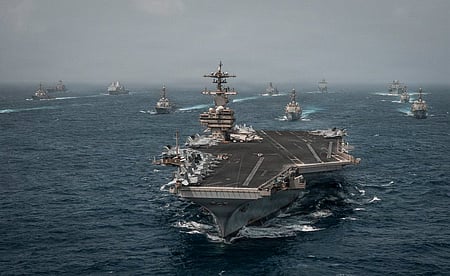
Iran's army declared itself fully prepared for all scenarios, claiming it used a recent ceasefire to rebuild and upgrade its air defence systems. Meanwhile, US and Iranian forces have paused retaliatory attacks as Omani-mediated talks make headway regarding safe shipping in the Strait of Hormuz. As Israeli PM Netanyahu heads to Washington for high-level meetings with President Trump, US diplomat insists the military remains fully stocked and ready to resume operations if negotiations fail. Follow all the latest developments here:
The US military is preparing contingency plans in case large-scale combat operations against Iran resume, but President Donald Trump has not ordered any such action so far.
Two White House sources told Axios that Trump wants to allow more time for diplomacy and has therefore decided against launching additional strikes on Iran for now.
Ukrainian President Volodymyr Zelenskyy has claimed that Ukraine detected Russia passing satellite intelligence on the Middle East to Iran, enabling it to direct attacks across the region.
In a post on X, Zelenskyy said Ukraine had recorded active Russian satellite surveillance of Gulf countries and US military facilities there since early July, adding that the imagery later appeared in Iran.
He said there was a clear link between Russian satellite images of those sites and Iranian attacks, whether before they were carried out, during preparations, or afterwards to assess the damage.
Get updated faster and for FREE: Download the Gulf News app now - simply click here.
Iran's Foreign Ministry condemned a Ukrainian attack on an Iranian commercial vessel in the Caspian Sea, saying on Saturday it resulted in an explosion that killed one sailor and injured another, according to Reuters.
Tehran described the incident as an act of aggression and said it would defend its national interests and security, while accusing Ukraine of seeking to expand the Russia-Ukraine war.
Ukraine's forces struck a Russian warship and vessels used for transporting Iran-linked military cargo in the Caspian Sea, President Volodymyr Zelenskiy said on Saturday.
Iran's oil ministry said it was able to sell a total of $18 billion worth of oil during the war and the ensuing ceasefire with the United States.
"The ministry sold $11.5 billion of oil during the war and $6.5 billion during the ceasefire" that collapsed earlier this month, the ministry said in a statement carried by its official website.
"This covers more than 60 percent of the oil revenues forecast in the year's budget in the midst of the crisis," it added.
In late June, however, Iran's parliament speaker and chief negotiator Mohammad Bagher Ghalibaf had said that Iran was unable to export any oil during the US blockade on its ports.
US-Israeli strikes on Iran sparked the war on February 28, prompting Iran to retaliate against US allies in the region.
An April ceasefire largely put an end to fighting, but hostilities resumed earlier in July as the two foes battle over control of the vital Strait of Hormuz.
The United States Central Command (CENTCOM) announced on Saturday that it had disabled a commercial vessel that repeatedly attempted to breach the US blockade imposed on Iranian ports.
In a statement, CENTCOM said US forces disabled the Mozambique-flagged tanker Lavine in the Gulf of Oman on Friday after its crew repeatedly attempted to violate the blockade despite repeated warnings.
The statement added that US forces also boarded another tanker, Charminar, flying the flag of the Comoros in the Arabian Sea. The vessel was allowed to continue its voyage after its cargo had been inspected.
CENTCOM affirmed that the US naval blockade imposed on Iran remains fully in force, noting that since the blockade was reinstated and up to 25th July, US forces have redirected 12 commercial vessels and disabled the movement of two vessels that failed to comply with orders.
Iran’s Foreign Minister Seyed Abbas Araghchi has urged the European Union to take “decisive” action after Tehran accused Ukraine of targeting an Iranian commercial ship in the Caspian Sea.
Iran said the attack killed one sailor and injured another, and summoned Ukraine’s chargé d’affaires to issue a formal protest. Iran accused Kyiv of an “act of aggression” and warned the strike could worsen regional insecurity.
Ukrainian President Volodymyr Zelensky said Ukraine’s forces had targeted a Russian warship and vessels carrying Iran-linked military cargo in the Caspian Sea.
Araghchi and EU foreign policy chief Kaja Kallas also discussed tensions in the Strait of Hormuz and the need for diplomatic efforts.
Get updated faster and for FREE: Download the Gulf News app now - simply click here.
UN Secretary-General Antonio Guterres has called on Israel to stop its incursions into Syrian territory in the occupied Golan Heights, describing the violations as “unacceptable”.
“Violations by Israel of the 1974 Disengagement of Forces Agreement are unacceptable and must stop,” Guterres said in a post on X, referring to the accord signed by Israel and Syria after the 1973 war.
He stressed that Syria’s sovereignty, independence, unity and territorial integrity must be fully respected.
The US Department of Defense has officially confirmed the identity of a soldier killed in Iranian strikes targeting the Muwaffaq Salti Air Base in Jordan on July 17, according to CNN.
The Pentagon identified the soldier as Staff Sgt. Angel S. Rampersad, 28, of Ozone Park, New York, following “positive identification by the Armed Forces Medical Examiner System”.
The department had earlier said Rampersad was believed to have been killed in the attack and confirmed that investigations into the incident are ongoing.
Known as Sarah to her family, Rampersad was born in Trinidad and moved to the US as a toddler. Her aunt, Judy Rackal, said at a news conference in Queens last week that Rampersad and her sister were raised by their single mother in Ozone Park.
The US Federal Reserve is expected to keep interest rates unchanged at 3.50% to 3.75% during its upcoming policy meeting, as policymakers weigh persistent inflation and rising energy prices linked to escalating US-Iran tensions.
The meeting will be the second under new Fed Chair Kevin Warsh, who was appointed by President Donald Trump amid pressure from the White House for lower borrowing costs.
US inflation eased to 3.5% annually last month but remains above the Fed’s 2% target. Recent Middle East tensions have pushed oil prices above $100 a barrel, raising concerns that higher energy costs could fuel inflation again.
Fed officials have warned they may need to tighten monetary policy if inflation remains elevated, with Governor Chris Waller saying the central bank must avoid a repeat of the 2021-22 inflation surge.
The US has paused airstrikes on Iran after nearly two weeks of escalating attacks, while diplomatic efforts continue to prevent a wider conflict. President Donald Trump has kept both options open — threatening further strikes while saying negotiations are moving forward.
A key issue in talks is the Strait of Hormuz, a vital oil shipping route disrupted during the conflict, pushing energy prices higher. Mediators say Washington and Tehran are exploring ways to restore a temporary ceasefire and ease restrictions on commercial shipping.
Tensions remain high, with Israel’s planned visit to Washington adding uncertainty and the US continuing naval operations against Iranian ports. Analysts say the pause could mark a shift towards diplomacy or a temporary break before further escalation.
Diplomatic talks between Oman and Iran on reopening the Strait of Hormuz are making progress, though more time is needed to reach a final agreement, regional sources told CBS News.
Omani officials travelled to Tehran on Friday for discussions on restoring access through the strategic waterway and nearby territorial waters. Sources said the talks are moving in a positive direction but remain sensitive.
The diplomatic push coincided with President Donald Trump’s decision to pause US airstrikes on Iran after 13 consecutive nights of military action. Regional officials said the pause was intended to prevent the strikes from disrupting the ongoing negotiations.
The US is closely monitoring the Oman-Iran talks. Trump said Iran would “love to make a deal” but added that he did not believe Tehran was ready yet, while saying he remained open to negotiations.
The UK’s Foreign, Commonwealth & Development Office (FCDO) has updated its travel advice for Saudi Arabia, warning travellers about regional security risks, including threats linked to the Saudi-Yemen border and attacks by Houthi rebels.
The FCDO advises against all travel within 10km of the Saudi-Yemen border and against all but essential travel to areas between 10km and 80km from the border.
Travellers are warned that insurance coverage may become invalid if they travel against official advice. In the event of a missile or drone attack, the FCDO recommends staying indoors in a secure shelter, monitoring local media and following instructions from Saudi authorities.
The advisory also highlights restrictions on travel to military zones and border areas, with the Saudi Tourism Authority banning tourist trips to such locations.
The UK government said its latest guidance, updated on July 25, aims to help travellers make informed decisions about risks while visiting Saudi Arabia.
Kuwait has denied a report claiming it took part in US military operations against Iran, calling the allegations “utterly and completely baseless”.
Kuwait’s ambassador to the US, Sheikha Al-Zain Al-Sabah, rejected a Wall Street Journal report that alleged Kuwait had deployed fighter jets to strike targets inside Iran.
In a letter to the newspaper’s editorial board, the ambassador said Kuwait had not participated in any military operations against Iran and had not allowed the use of its territory, airspace or territorial waters for offensive actions, according to the Kuwait News Agency.
The Wall Street Journal had reported that Kuwait and Bahrain sent fighter jets to attack sites in Iran after Tehran launched missile and drone attacks on what it described as US military assets in Gulf countries. Iran said those attacks were in response to US strikes on its cities.
Saudi Foreign Minister Prince Faisal bin Farhan and Pakistan’s Deputy Prime Minister and Foreign Minister Muhammad Ishaq Dar discussed regional developments and efforts to ease tensions during a phone call.
The two ministers reviewed the latest situation in the region and stressed the importance of continued coordination and consultation.
They also highlighted the need to contain escalating tensions and ensure the security and safety of maritime routes in the Arabian Gulf and the Red Sea, while supporting efforts to achieve peaceful solutions that strengthen regional and international stability.
Iran accused Ukraine of attacking one of its merchant vessels in the Caspian Sea, killing a sailor and wounding another, and warned it would not leave the incident unanswered.
The accusation came after Ukrainian President Volodymyr Zelensky said Kyiv had carried out long-range strikes in the Caspian Sea against vessels involved in transporting military cargo involving Iran, underscoring the increasingly international dimensions of Russia's war in Ukraine.
Iran's foreign ministry said the attack on Saturday morning caused the ship "to explode, killing one sailor and injuring another", according to the official IRNA news agency.
The Islamic republic "has never intervened in the conflict between Russia and Ukraine", it asserted.
On Saturday, Ukrainian President Volodymyr Zelensky said on social media that armed forces had achieved "very strong results with long?range strikes in the Caspian Sea - including vessels used in military cargo shipments involving Iran, as well as a warship".
Ukraine's intelligence services (SBU), for their part, reported on Telegram that drone attacks had been carried out against "cargo vessels under international sanctions that were used to transport military cargo between Iran and Russia".
According to Iranian state television, the foreign ministry summoned the Ukrainian charge d'affaires in Tehran on Saturday to protest this "hostile and criminal act".
And in a conversation with the European Union's foreign policy chief Kaja Kallas, Iranian Foreign Minister Abbas Araghchi called for a "firm response" by the EU and the United Nations Security Council to this attack, IRNA added.
Iran said progress was made during talks with Oman on managing traffic through the Strait of Hormuz, while discussions between the two sides continue.
Iranian Foreign Ministry spokesman Esmaeil Baghaei said Iranian and Omani deputy foreign ministers held talks in Tehran on Friday and Saturday, focusing on safe shipping operations in the strategic waterway.
“The two sides exchanged views on common principles and operational mechanisms for managing safe shipping traffic in the Strait of Hormuz while respecting the sovereign rights of the two coastal states,” Baghaei said, according to Tasnim news agency.
He described the talks as “useful”, saying progress had been achieved and that technical and political consultations were ongoing.
Kuwait's Ministry of Interior on Sunday denied reports circulating on social media claiming that a terrorist cell had been arrested inside the country, saying the information was unfounded and did not originate from any official source.
In a statement, the ministry said it dealt with all matters related to national security with full transparency and would announce any such cases through official channels and in accordance with approved procedures.
Read more here.
Iran's army warned on Sunday that the Middle East war would widen if the United States chose to press ahead with attacks on the Islamic republic, ahead of the visit of Israeli Prime Minister Benjamin Netanyahu to Washington.
"I believe that if the Americans once again fall for the Zionists' deception, or move in line with them, and insist on continuing the war, particularly through air strikes, geographically this will expand further," army spokesman Mohammad Akraminia told state television.
Get updated faster and for FREE: Download the Gulf News app now - simply click here.
The Kuwaiti Foreign Ministry on Sunday strongly condemned and denounced the repeated attacks by the Houthi group on ships in the Red Sea, the last of which was on Saudi ship NCA MASA while sailing in the Red Sea.
In a press release, the ministry termed the attacks as a blatant breach of international law and a direct threat to the security and freedom of maritime navigation and the safety of international trade.
Iran's Islamic Revolutionary Guard Corps (IRGC) has fired warning shots at six vessels over the past 24 hours as they attempted to transit the Strait of Hormuz, according to Iranian state television.
The broadcaster reported the ships were halted after allegedly straying "outside the designated route" set by Tehran.
Military pressures, diplomacy and political realities have combined to slow the US campaign against Iran, but none of the underlying drivers of the conflict have disappeared.
By the end of last week, the rhythm of the conflict had become familiar. American aircraft struck Iranian targets night after night, Tehran responded through missiles, drones and its regional allies, and President Donald Trump alternated between warning of even heavier attacks and insisting diplomacy remained possible.
Then, for the first time in nearly two weeks, the airstrikes stopped.
Read full story here.
The United Kingdom Maritime Trade Operations (UKMTO) has received a report of suspicious activity involving a tanker in the southern Red Sea.
According to UKMTO, the vessel reported witnessing a splash from an unknown projectile in close proximity to the ship. The vessel and crew were confirmed to be safe, while the environmental impact remains unconfirmed.
Authorities are investigating the incident. UKMTO has advised vessels operating in the area to transit with caution and report any suspicious activity through official channels.
Iran said it has halted retaliatory attacks in the region after the United States stopped its strikes on the country for the past two nights.
"These attacks continued until two nights ago, but over the past two nights the Americans have stopped their attacks," said army spokesman Mohammad Akraminia. "Since... our strategy has essentially been retaliatory, we have also halted our retaliatory operations."
Formula 1 is heading back to Malaysia for the first time in nine years as the Bahrain Grand Prix was rescheduled there for Oct. 4.
The Sepang circuit is slotted in between races in Azerbaijan and Singapore, subject to approval from the FIA's world motor sport council, F1 and the FIA said Sunday.
"Most importantly, this is fantastic news for our fans. They will continue to enjoy a full and exciting Formula 1 calendar, while also seeing the sport return to a great venue," F1 president and chief executive Stefano Domenicali said in a statement.
"Malaysia is an incredible country, and Sepang holds a special place in Formula 1 history. It will provide a spectacular setting for racing and an unforgettable experience for fans at the circuit and watching around the world."
F1 called off its races in Bahrain and Saudi Arabia, which had been set for March and April, as the Iran war escalated.
Iran-backed Houthi rebels on Sunday said they downed a Saudi drone over the northwest of Yemen, a day after the Yemeni group claimed it attacked oil facilities in the Gulf kingdom.
The Houthi's military spokesman Yahya Saree said the group "successfully shot down a Turkish-made... armed reconnaissance drone belonging to the Saudi enemy while it was conducting hostile operations".
Lebanon's army on Sunday condemned ongoing Israeli military activities in the country's south that it said were preventing its full deployment under a framework deal reached with Israel last month.
"Israeli occupation forces continue their attacks and violations of current understandings and of international laws through the systematic destruction and bulldozing of homes, bombardment and sweeps with automatic weapons in several southern areas," an army statement said.
"The continuation of these attacks obstructs the army's full deployment according to current agreements and prevents the return of residents to their villages and towns," it added.
Iranian media on Sunday reported that an oil tanker exploded after allegedly striking a naval mine in the Strait of Hormuz after deviating from a shipping route designated by Tehran.
According to Iran's Tasnim News Agency, the incident involved a "rogue" oil tanker that had reportedly departed from the route specified by Iranian authorities before colliding with a sea mine.
Tasnim said Iran had "repeatedly warned beforehand that if ships deviate from Iran's designated route, they would bear the consequences themselves."
Iranian authorities had not officially commented on the reported incident at the time of publication.
US President Donald Trump is giving negotiations with Iran "some space," his UN ambassador said Sunday, while dismissing reports that the United States was rationing munitions over supply concerns.
UN ambassador Mike Waltz told "Fox News Sunday" that the United States remained "locked and loaded" for more attacks, with additional assets moved into the region.
But Trump is "giving talks some space - he's giving it a little bit of room," he said.
Prior to Friday, the US military had announced strikes on Iran for 13 consecutive nights, in the largest rekindling of the war since an April ceasefire. No new strikes were announced over the last two days.
Waltz also appeared on NBC News' "Meet the Press," where he was asked about reports that the US military was rationing some weaponry over supply concerns.
The ambassador initially responded by pointing the finger at former president Joe Biden, noting that "a lot of stockpiles were depleted" when Trump took office last year.
Pressed on whether he would acknowledge a current shortage amid the Iran war, Waltz repeatedly denied.
"I want to be crystal clear. The US military - and I've verified this every which way - has everything that it needs to conduct this campaign as effectively as it needs to be," he asserted.
"The people that are leaking this nonsense deserve to be in jail," he added.
Iran's army is "fully prepared for all scenarios" and has strengthened its air defence capabilities ahead of Israeli Prime Minister Benjamin Netanyahu's visit to the United States, Iranian media reported.
According to the ISNA news agency, Army spokesperson Mohammad Akraminia said the United States had failed to achieve its objectives during the recent conflict and was now reassessing its strategy. He also claimed Washington was acting under Israeli influence.
"The situation for America is chaotic and undesirable, and they failed to achieve their goals in the Strait of Hormuz and in weakening Iran," he said.
He added: "They are now seeking a new strategy, with the possibility of withdrawing from the war, subject to Israel's approval."
Tasnim News Agency reported that Akraminia said Iran had used the recent ceasefire to rebuild and strengthen its military capabilities, particularly its air defence systems.
"We have tried to make good use of the opportunity. The three-month ceasefire was a valuable period for our defence planning, especially in the field of air defence," he said.
He said repaired air defence systems had been returned to service and new equipment had been integrated into the Army's operational structure, further strengthening the country's defensive capabilities.
Akraminia also claimed the United States had failed in its objectives of reopening the Strait of Hormuz, weakening Iran's defences and undermining the resolve of the Iranian Armed Forces.
He said Iran's military had prepared for every possible scenario and would respond appropriately to any future action. He warned that any continued US "aggression" could widen the conflict beyond its current boundaries, adding that Iran had developed new strategies to deal with any escalation.
The remarks came as Netanyahu said on Sunday that Iran would be one of the main topics on the agenda during his meeting with US President Donald Trump in Washington.
Pope Leo XIV on Sunday renewed his appeal for peace in the West Asia, urging all parties to halt military operations and return to diplomacy as violence across the region continues to escalate.
In a post on X, the pontiff said the intensification of military operations had "again wreaked violence and destruction, endangering the lives of countless civilians and further aggravating the shortages of drinking water and electricity."
"From the depths of my heart, I exhort all parties involved to suspend the attacks and urgently reopen paths of dialogue and diplomacy, so that the longed-for peace for the entire region may be achieved without delay," he said.
The pontiff also expressed concern over the situation in the 'Holy Land'. The Pope was referring to the recent civilian casualties reported in both the West Bank and Gaza, stressing that innocent people continue to bear the brunt of the conflict.
"I continue to follow with deep concern the ongoing and escalating violence in the Holy Land, where, in recent days, many civilians, both in the West Bank and in Gaza, have once again fallen victim," he said.
The Pope underscored the Vatican's long-standing position that peace can only be secured through negotiations leading to a political settlement that guarantees equal rights and dignity for all people.
"I make a heartfelt appeal for a return to negotiations to achieve a just political solution, founded on the equal dignity and equal rights of every human person," he added.
Get updated faster and for FREE: Download the Gulf News app now - simply click here.
Israeli Prime Minister Benjamin Netanyahu on Sunday said that Iran's nuclear programme "has to come to an end" regardless of whether a diplomatic agreement is reached, as he prepared to meet US President Donald Trump in Washington on Monday (local time), while US officials signalled a pause in military action to allow diplomacy where as Iran vowed to strengthen its military preparedness.
Speaking to Fox News, Netanyahu outlined what he believes would be required to end the conflict with Iran. "I think when this regime is either toppled or it's sufficiently weakened that it knows it has to end its nuclear program and has to change its course," Netanyahu said.
The Israeli Prime Minister indicated that, in his view, the war would effectively end only if Iran either undergoes a fundamental political change or abandons its nuclear programme and alters its regional policies.
"That's really what President Trump is trying to achieve. And I backed him fully... But one way or the other, they have to end their nuclear program. And with a deal or without a deal, that has to come to an end," he added.
Ahead of his departure for Washington, Netanyahu said Iran would be among the key issues during his talks with Trump.
"Tomorrow I will fly to Washington to meet, at his invitation, with President Trump, and afterwards to participate in the memorial service for a great friend of Israel, the late Senator Lindsey Graham. I will also discuss all pending issues with President Trump, including the situation in Iran," he said at the start of the weekly Cabinet meeting.
Get updated faster and for FREE: Download the Gulf News app now - simply click here.
We are closing this coverage now. For the latest updates, click here.
Sign up for the Daily Briefing
Get the latest news and updates straight to your inbox
Network Links
GN StoreDownload our app
© Al Nisr Publishing LLC 2026. All rights reserved.