A person walks past debris, seen through a shattered window at the site of what Iranian media said was a U.S. strike on a home where a wedding celebration was being held late Tuesday, Sept. 1
US insists Iran conflict is not a war while economic blockade tightens
US downplays conflict even as strikes, sanctions and naval blockade squeeze Iran
Last updated:
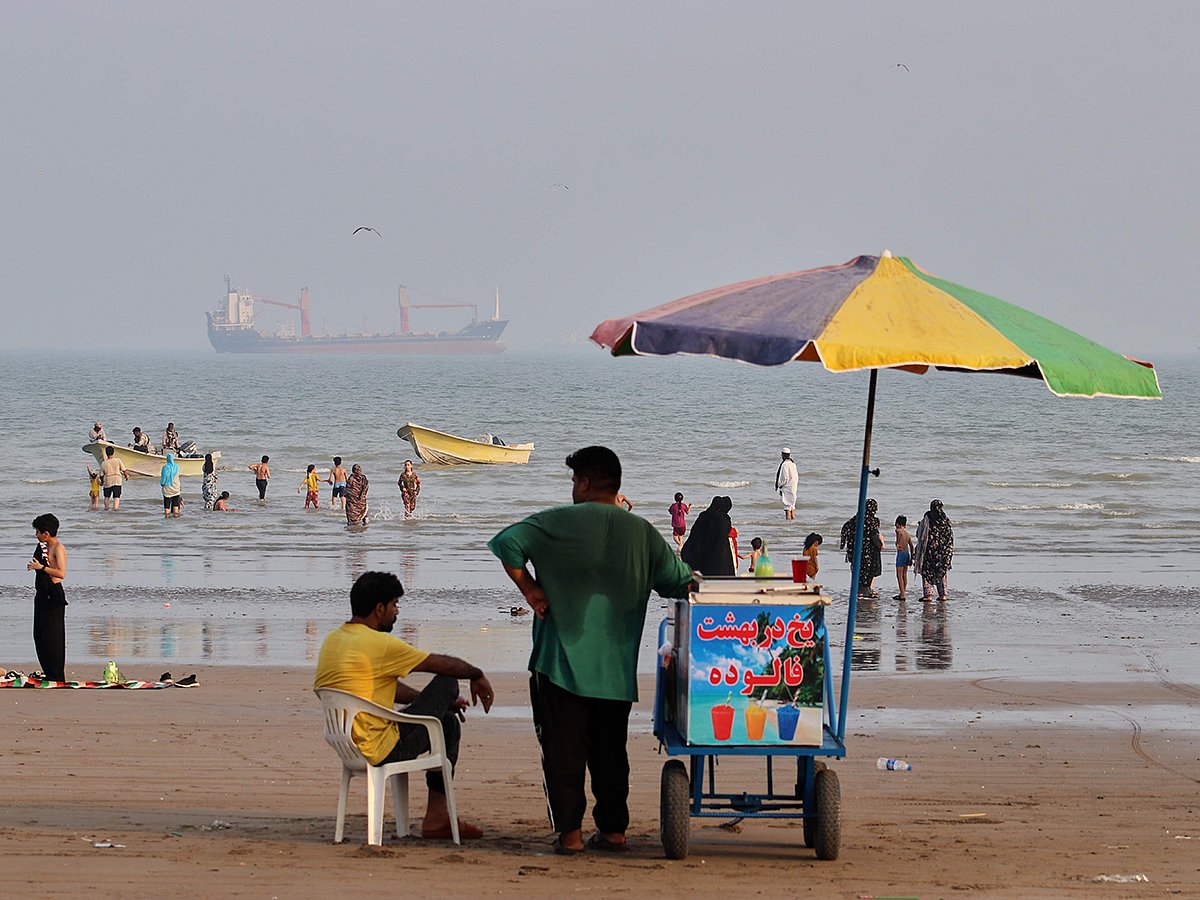
A juice seller serves beachgoers from his cart as commercial vessels sit anchored in the Strait of Hormuz off Bandar Abbas, Iran.
AP
The Iran conflict remains fluid, with US Vice President JD Vance saying he would not call it a war despite renewed clashes. Iran has accused the US of a war crime over a strike on a wedding gathering that killed four people. Meanwhile, Donald Trump has warned of more strikes, while US sanctions and a naval blockade deepen Iran’s economic crisis. Shipping risks remain severe around the Strait of Hormuz. Follow all the latest developments here:
US‑Israel war on Iran: Recent developments
Day 180: Trump warns of more strikes on Tehran
Iran war is not a war, US VP Vance says
US Vice President JD Vance said Thursday he would not categorize the Iran war as a war, despite continuing clashes with Tehran six months after the start of the conflict.
Vance's comments came amid growing signs that President Donald Trump is trying to draw a line under the conflict that has bogged down his administration.
"I wouldn't call it a war. Right now, there is no active shooting," Vance told a White House briefing when asked if the war would be over by US midterm elections in November.
Vance added that "I recognize there have been places where this has flared up" but said major combat operations only lasted for six weeks after the US-Israel war started on February 28.
"But when you ask when will this end, you're asking me a question like when will the Iranians stop shooting at ships? I think the reality is I don't know the answer to that question. You would have to ask the Iranians," he said.
Trump boasts ‘unlimited’ US ammunition, warns of more strikes
President Donald Trump assailed media reports about strained American munitions stockpiles, and threatened further US strikes against Iran “any time we want”. In a post on his Truth Social platform, Trump said the United States had “virtually unlimited amounts of Mid to High Grade Ammunition, far more than we could ever use for this, or for any other War (which is highly unlikely!), that could improbably take place.”.
The message came after the latest US attacks on Iranian targets near the Strait of Hormuz and Iranian retaliation against US-linked facilities in the region.
Iran's economy 'buckling': US blockade, expanded sanctions strangle lifeline
Iran’s economic defences, built over years to withstand sanctions, are showing serious signs of failure as a US naval blockade, expanded financial restrictions and the collapse of oil exports deprive Tehran of the foreign currency it needs to keep trade and basic imports moving, Reuters reported.
The pressure is now reaching a level that even Iranian officials are publicly acknowledging. President Masoud Pezeshkian has said Iranian exports and imports have fallen by about 35% because of US sanctions and the maritime blockade.
At the same time, Iran's inflation is approaching 70%, while the rial has plunged to record lows.
The result is a potentially dangerous economic feedback loop: fewer oil exports mean fewer dollars; fewer dollars make imports more expensive; higher import costs push inflation higher; and inflation further weakens household purchasing power and confidence in the rial.
Maritime security remains ‘severe’ as Hormuz traffic stays depressed: JMIC
Maritime security risks remained “severe” across the Middle East maritime region, with Iran continuing to monitor and harass commercial shipping around the Strait of Hormuz, according to a regional maritime security advisory.
The Joint Maritime Information Center (JMIC) based in Bahrain, said in Advisory No. 093, issued at 0315 UTC on Sept. 3 (7.15pm Gulf), that its regional threat level remained at "severe".
The assessment covered the previous 48 hours and highlighted continued military activity, navigation-system interference and reduced commercial traffic through the strategic waterway.Iran continues surveillance and harassment
The JMIC said attacks, attempted attacks and harassment by Iran's Islamic Revolutionary Guard Corps persisted around the strait.
Commercial traffic through the Strait of Hormuz showed a modest increase from recent lows but remained well below normal levels, according to the JMIC.
Independent vessel-tracking data showed single-digit numbers of vessels transiting the strait in both directions during the period covered by the advisory.
US Naval Cooperation and Guidance for Shipping, or NCAGS, data gave a somewhat higher figure, showing an average of more than 20 vessel transits a day during the previous week.
The differing figures reflect the use of different tracking and reporting systems, but both point to the same conclusion: commercial shipping remains heavily suppressed.
No confirmed attacks or disruptions were reported in the Arabian Gulf during the 48-hour period, the JMIC said.
Traffic flows remained stable and congestion at anchorages was largely unchanged. The JMIC said wider military activity also warranted caution from commercial operators.
Oil: Now Iran’s biggest vulnerability
Iranian crude exports have fallen from roughly 1.7 million barrels a day to about 260,000 barrels a day as the US blockade restricts tanker movements and undermines Tehran's ability to reach its principal market, China.
A Reuters report found that Iranian crude loadings had collapsed from roughly 2 million barrels per day in March to only 220,000–255,000 bpd in August.
That matters enormously because oil remains one of Tehran's most important sources of hard currency.
For years, Iran managed to keep oil flowing despite US sanctions by relying on a sophisticated sanctions-evasion ecosystem: so-called "shadow fleets", ship-to-ship transfers, disguised cargoes, opaque ownership structures and alternative financial channels.
The US Navy's blockade of Iranian ports changes the equation. While sanctions make Iranian oil difficult to sell, a naval blockade makes it physically difficult to move.
The Iranian rial has not only become just a symbol of the crisis but is a major pressure point affecting the locals.
With the rial falling to record lows against the US dollar, it makes imported food, medicine, machinery and industrial inputs increasingly expensive, creates a "vicious cycle" for an economy already suffering from years of sanctions and structural weaknesses.
Iran accuses US of war crime after wedding strike kills 4
Iran has accused the US of committing a war crime after a US strike hit a private home in southern Iran where a wedding celebration was taking place, killing four people, including two children, and wounding dozens.
The Iranian Red Crescent said the victims included two women and two children, aged 4 and 16. At least 68 people were wounded, according to Iranian state media and emergency officials. A local official earlier reported five deaths, but Iranian authorities later revised the toll to four.
The strike took place in Kuhestak, in Sirik County in southern Iran, near the strategic Strait of Hormuz. Iranian officials said the building was a residential property where a family was celebrating a wedding. Iran's Red Crescent has called for an international investigation, including an inquiry by the International Criminal Court, arguing that the attack killed civilians at a private gathering.
The US has not acknowledged that the wedding was deliberately targeted. Vice President JD Vance said the incident was being investigated and maintained that the United States does not intentionally target civilians. He also questioned some Iranian accounts of the incident, adding he was "extremely sceptical" over alleged strike on the wedding. The episode has nevertheless raised difficult questions about the conduct of US military operations in Iran, particularly because the strike occurred in a civilian area.
'We woke up to the reality': Rubio assails 'fantasy' of globalisation
US Secretary of State Marco Rubio delivered a blunt defence of the Trump administration’s “America First” economic agenda, arguing that decades of "globalisation" left the United States dangerously dependent on foreign countries for goods essential to its economy and national security.
“The nation states still does matter. National still matters. National borders still matter!” Rubio said. In saying that America "lost our ability to make things", Rubio declared globalisation’s era over. He said the US made a “terrible mistake” after the Cold War by deciding that it no longer mattered where goods were produced, as long as they were made as efficiently and cheaply as possible.
EU 'officially' joins US-led 'Operation Economic Outcast' against Iran: Bessent
US Treasury Secretary Scott Bessent on Thursday (local time) said that the European Union has "officially joined" the US-led "Operation Economic Outcast" against Iran, welcoming what he described as the bloc's strong and early stance in maintaining economic pressure on Tehran as the West Asia conflict continues.
"The European Union has officially joined Operation Economic Outcast and we appreciate their strong and early stance," Bessent said in a statement on X.
"The United States stands firm with our allies in ensuring the murderous Iranian regime cannot exploit the global financial system to fund its nuclear ambitions, weapons programs, and terror proxies. The world is sending a clear message to the Iranian regime: We will not stop until every remaining financial lifeline has been severed," he added.
Get updated faster and for FREE: Download the Gulf News app now - simply click here.
Bessent's remarks came after the EU said it was prepared to support additional economic pressure on Iran, including through the US-led operation, while stressing the need for continued diplomatic efforts and de-escalation.
"The European Union has consistently urged Iran to curb its nuclear programme, and its ballistic missile programme, refrain from destabilising activities in the region and in Europe, stop its military support for Russia's war of aggression against Ukraine and cease the violence and repression against its own people," the EU said in a statement shared by Bessent.
The bloc said it believes continued diplomatic efforts are necessary to reach a peace settlement, restore regional stability and ensure "full freedom of navigation and safe transit through the Strait of Hormuz".
The EU also said it had already adopted extensive sanctions aimed at preventing Iran from exploiting the global economy and financial system to sustain what it described as hostile actions and undermine international security.
"It remains ready to take further measures, where necessary, to safeguard its security and interests, including freedom of navigation through the Strait of Hormuz," the EU said.
The bloc welcomed efforts aimed at ensuring Iran ceases its destabilising activities and engages in peace negotiations "with good faith", adding that this could include additional economic pressure through Operation Economic Outcast.
"The EU will continue to work closely with the United States and other G7 and international partners to maintain pressure on Iran and contribute to de-escalation and regional stability," it said.
JD Vance warns ‘everything’ is on the table in Iran conflict
US Vice President JD Vance on Thursday (local time) said that the Trump administration has a range of options at its disposal to deal with Iran, including economic, military, diplomatic and covert measures, as tensions between Washington and Tehran continue to escalate amid the conflict in the Middle East.
Speaking during a media briefing, Vance said the administration would not publicly disclose its plans for engaging with Iran, stressing that doing so would limit US President Donald Trump's ability to make decisions.
"There are a lot of additional tools that we have at our disposal. Some of those the President will use and some of them he won't," Vance said.
"But everything that could happen is on the table. Economic pressure, military pressure, diplomatic pressure, covert pressure. Of course these are tools in the President's toolkit," he added. Read more...
Get updated faster and for FREE: Download the Gulf News app now - simply click here.
Seoul weighs 'contributions' to Hormuz security
South Korea said Friday it was weighing "contributions" to US security efforts in the Strait of Hormuz provided its own military readiness was not compromised, but noted no decision had been made.
US President Donald Trump has repeatedly pressured ally South Korea to provide help for the war in the Middle East, saying Seoul rejected his request for assistance securing the Strait of Hormuz.
"Contributions to the Strait of Hormuz could be managed within limits that do not compromise military readiness," a South Korean presidential official told reporters.
"The references made during today's briefing regarding military contributions-such as combat participation, non-combat roles, and search operations-were merely general descriptions of various options. Please be advised that nothing has been decided yet concerning actual contributions," the president's office said in a separate statement.
The comments came a day after local broadcaster JTBC reported that South Korea's government was "leaning toward" dispatching troops to help in Hormuz and reviewing details ahead of seeking parliamentary approval.
Katz hails capture of Hezbollah highland
Israel's defence minister on Friday hailed the capture of a strategic highland from Hezbollah as solidifying Israel's "security zone" in Lebanon and vowed that troops would not leave it.
"The capture of the Ali Tahar ridge marks the completion of the phase of securing control in the security zone in southern Lebanon," Defence Minister Israel Katz said in a statement.
Israel says that Hezbollah, the Iran-backed Shia group originally founded to fight an earlier Israeli invasion, used the strategic high point to fire at Israeli targets and had constructed there a vast network of tunnels housing a command structure.
The Israeli military "will now complete the neutralisation of the tunnels and prepare in the appropriate tactical manner to hold the ridge and prevent the enemy from re-establishing itself in the area", Katz said.
He said he and PM Netanyahu, who faces close-fought elections on October 27, will pursue a "clear and uncompromising line" on Lebanon.
"Israel will not withdraw from the security zone in Lebanon until Hezbollah is disarmed throughout Lebanon and the threats over the residents of the Galilee are removed," Katz said, referring to Israel's northern region.
Weather and war push up food prices in August: FAO
Food price inflation accelerated in August as drought and conflicts impacted commodity markets, with sugar prices hitting their highest level in more than a year, UN data showed Friday.
The food price index compiled by the UN's Food and Agricultural Organization rose by 1.9 percent in August from July, and by 2.5 percent from the level of August 2025.
That was an acceleration from July, when prices rose by 0.6 percent over the month and one percent over the year.
Europe was gripped by exceptional heat this summer, leading to a drop in crop yields, while the El Nino climate phenomenon threatens production in Asia.
The closure of the Strait of Hormuz due to the Mideast war has caused a surge in fuel prices but also closed off a major source of fertiliser supplies, compounding concerns about supplies and higher prices over the longer term.
Hamas urges Arab, Muslim nations to oppose Israeli ministers' Gaza proposal
Hamas called on Arab and Muslim countries on Friday to oppose a proposal from two Israeli ministers to remove Palestinians from the Gaza Strip and send them abroad.
"Escalating statements by ministers in the Israeli government regarding the continued adoption of plans to displace the Palestinian people from the Gaza Strip represent an extremely dangerous development," Hamas spokesman Hazem Qassem said in a statement.
US diesel prices hit new high amid Iran war disruption
The price of diesel -- the vital fuel used for road hauling, agriculture and construction -- hit a new record Friday in the United States, a motorists' association said, amid disruption from the US war with Iran.
The price is now $5.85 a gallon, up from $3.71 a year ago, the AAA said.
Six months into the Middle East war and with weeks to go before November's key US midterm elections, voters are increasingly feeling the pinch from persistent inflation.
Prices at the pump have jumped since US-Israeli strikes targeting Iran from late February sparked Tehran's retaliation in blocking the Strait of Hormuz -- a key waterway for energy transit.
US paratroopers set up communications equipment in Middle East
US Army paratroopers have set up communications equipment at a remote location in the Middle East, US Central Command (CENTCOM) said on Friday.
CENTCOM shared images of the troops installing the equipment at the undisclosed site. The military did not provide further details on the location or the purpose of the deployment.
US sanctions three Turkey-based financial entities over Iran links
The US Treasury Department imposed Iran-related sanctions on three Turkey-based financial entities Friday, the latest action in Washington’s economic pressure campaign against Tehran.
The measures target Golden Global Portfoy Yonetimi Anonim Sirketi, Golden Global Varlik Kiralama Anonim Sirketi and Golden Global Yatirim Bankasi Anonim Sirketi.
Israel raises alert over signs Iran may renew attacks
Israel has raised its state of alert amid concerns that Iran could be preparing to resume direct attacks, with Israeli officials citing what they described as “serious signs” of a possible renewed confrontation, according to Israel’s Channel 14.
An Israeli political official told the broadcaster that no final decision by Tehran to renew the war had been detected, but said Israel’s political and security establishments were preparing for that possibility.
The assessment comes amid heightened tensions over the strategic Ali al-Taher ridge in southern Lebanon. Iran has warned Washington that a full-scale Israeli offensive on the ridge would trigger a large-scale Iranian response, three officials briefed on the message told Reuters.
The Israeli military said on Thursday that it had gained operational control of the ridge and cleared Hezbollah underground infrastructure there. The area has emerged as a major flashpoint in the Israel-Hezbollah conflict.
Israel releases 4 more Lebanese civilians
Israel released four Lebanese civilians to Lebanese authorities on Friday as part of a deal between the countries, a day after the first was freed. All had been detained by Israeli forces in southern Lebanon, where troops now occupy a large swath in the wake of new fighting with Hezbollah that began two days after the U.S. and Israel attacked Iran.
Israel on Thursday said it had agreed to release them after Lebanon provided assistance in searching for the bodies of Lebanese Jewish leaders who went missing in the 1980s during Lebanon's civil war.
Officials said the release comes as a result of U.S. mediation and negotiations between Israel and Lebanon. Another round of talks is expected in Rome later this month.
Iranian official says its military doctrine pivoting toward 'preemptive warfare'
Iran's Army spokesperson said Friday that recent strikes carried out by Iran "had both a deterrent aspect and a preemptive aspect."
In an interview with Iran's state TV, Brig. Gen. Mohammad Akramnia said that since the 12-day war in 2025, Iran has been moving in the direction of preemptive warfare and acting for deterrence, which he said is "permissible" under the United Nations Charter.
"In several cases, before they attacked us and committed aggression, we acted for deterrence, in order to genuinely deter them from aggression," he said of the United States.
The Islamic Republic has repeatedly stated that it carries out retaliatory strikes on its neighboring Gulf countries to target U.S. facilities and interests in the region, and in response to U.S. strikes.
Ship traffic remains low after latest attacks
Ship traffic through the Strait of Hormuz remained low after the renewed U.S. attacks on targets in Iran earlier this week and Iran's retaliatory attacks in the region, including firing at U.S. Gulf ally Kuwait on Thursday.
Fuel prices are again affected. Diesel hit a record price in the U.S. on Friday, soaring to an average of $5.85 a gallon for the first time ever.
The benchmark U.S. crude price rose above $91 a barrel with the new wave of uncertainty around traffic on the strait, which Iran continues to use as leverage after six months of war with the U.S.
Iranian official says its military doctrine pivoting toward 'preemptive warfare'
Israeli strike on Lebanon kills two: state media
Beirut: An Israeli strike on south Lebanon killed two people on Friday, Lebanese official media said, despite a truce with Iran-backed Hezbollah.
Lebanon's state-run National News Agency (NNA) reported the strike hit near the strategic Ali al-Taher ridge, which the Israeli army said it had captured, though Hezbollah did not confirm losing it.
Two young men were "targeted while riding a motorcycle" in the city of Nabatieh, NNA said, adding that rescuers transported their bodies to a local hospital.
Trump says Iran war is 'small potatoes' for US
President Donald Trump said Friday that the Iran war was "small potatoes" for the United States, a day after Vice President JD Vance said he wouldn't describe the conflict as a war.
"A lot of people don't call it a war. I call it a military conflict because it's small potatoes for us. It's not a big thing. We did Venezuela, and we did this," Trump told reporters when asked about Vance's comments.
Photos show destruction and mourning after a strike on an Iranian wedding
Days after a missile strike hit a home in southern Iran during a wedding celebration, images show the destruction left behind and mourners gathering for a mass funeral for those killed.
Trump says US may strike Iran's Pickaxe Mountain 'very soon'
President Donald Trump told reporters on Friday that the United States may hit Iran's Pickaxe Mountain very soon.
Pickaxe Mountain, located near Iran's heavily damaged Natanz uranium enrichment facility, is a heavily fortified site that hosts two deeply buried tunnel complexes.
We are closing this live coverage. For the latest updates, click here.
Sign up for the Daily Briefing
Get the latest news and updates straight to your inbox
Network Links
GN StoreAbout Gulf NewsTerms & ConditionsReach by GNSitemapContact usPrivacy PolicyGN FocusHave your sayWork with usAdvertise with usGulf News epaperPrinting Services
Download our app
© Al Nisr Publishing LLC 2026. All rights reserved.