Trump says Iran strikes won’t last ‘too long’ as US vows to hit again and keep Strait of Hormuz open
Washington vows to keep vital oil chokepoint open amid largest US‑Iran clash in months
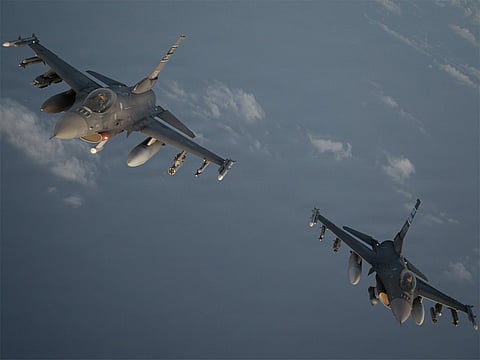
Highlights
We are closing this live coverage. For the latest updates, click here.
'We woke up to the reality': Rubio assails 'fantasy' of globalisation
US Secretary of State Marco Rubio delivered a blunt defence of the Trump administration’s “America First” economic agenda, arguing that decades of "globalisation" left the United States dangerously dependent on foreign countries for goods essential to its economy and national security.
“The nation states still does matter. National still matters. National borders still matter!” Rubio said. In saying that America "lost our ability to make things", Rubio declared globalisation’s era over. He said the US made a “terrible mistake” after the Cold War by deciding that it no longer mattered where goods were produced, as long as they were made as efficiently and cheaply as possible.
Iran accuses US of war crime after wedding strike kills 4
Iran has accused the US of committing a war crime after a US strike hit a private home in southern Iran where a wedding celebration was taking place, killing four people, including two children, and wounding dozens.
The Iranian Red Crescent said the victims included two women and two children, aged 4 and 16. At least 68 people were wounded, according to Iranian state media and emergency officials. A local official earlier reported five deaths, but Iranian authorities later revised the toll to four.
The strike took place in Kuhestak, in Sirik County in southern Iran, near the strategic Strait of Hormuz. Iranian officials said the building was a residential property where a family was celebrating a wedding. Iran's Red Crescent has called for an international investigation, including an inquiry by the International Criminal Court, arguing that the attack killed civilians at a private gathering.
The US has not acknowledged that the wedding was deliberately targeted. Vice President JD Vance said the incident was being investigated and maintained that the United States does not intentionally target civilians. He also questioned some Iranian accounts of the incident, adding he was "extremely sceptical" over alleged strike on the wedding. The episode has nevertheless raised difficult questions about the conduct of US military operations in Iran, particularly because the strike occurred in a civilian area.
Oil: Now Iran’s biggest vulnerability
Iranian crude exports have fallen from roughly 1.7 million barrels a day to about 260,000 barrels a day as the US blockade restricts tanker movements and undermines Tehran's ability to reach its principal market, China.
A Reuters report found that Iranian crude loadings had collapsed from roughly 2 million barrels per day in March to only 220,000–255,000 bpd in August.
That matters enormously because oil remains one of Tehran's most important sources of hard currency.
For years, Iran managed to keep oil flowing despite US sanctions by relying on a sophisticated sanctions-evasion ecosystem: so-called "shadow fleets", ship-to-ship transfers, disguised cargoes, opaque ownership structures and alternative financial channels.
The US Navy's blockade of Iranian ports changes the equation. While sanctions make Iranian oil difficult to sell, a naval blockade makes it physically difficult to move.
The Iranian rial has not only become just a symbol of the crisis but is a major pressure point affecting the locals.
With the rial falling to record lows against the US dollar, it makes imported food, medicine, machinery and industrial inputs increasingly expensive, creates a "vicious cycle" for an economy already suffering from years of sanctions and structural weaknesses.
Maritime security remains ‘severe’ as Hormuz traffic stays depressed: JMIC
Maritime security risks remained “severe” across the Middle East maritime region, with Iran continuing to monitor and harass commercial shipping around the Strait of Hormuz, according to a regional maritime security advisory.
The Joint Maritime Information Center (JMIC) based in Bahrain, said in Advisory No. 093, issued at 0315 UTC on Sept. 3 (7.15pm Gulf), that its regional threat level remained at "severe".
The assessment covered the previous 48 hours and highlighted continued military activity, navigation-system interference and reduced commercial traffic through the strategic waterway.Iran continues surveillance and harassment
The JMIC said attacks, attempted attacks and harassment by Iran's Islamic Revolutionary Guard Corps persisted around the strait.
Commercial traffic through the Strait of Hormuz showed a modest increase from recent lows but remained well below normal levels, according to the JMIC.
Independent vessel-tracking data showed single-digit numbers of vessels transiting the strait in both directions during the period covered by the advisory.
US Naval Cooperation and Guidance for Shipping, or NCAGS, data gave a somewhat higher figure, showing an average of more than 20 vessel transits a day during the previous week.
The differing figures reflect the use of different tracking and reporting systems, but both point to the same conclusion: commercial shipping remains heavily suppressed.
No confirmed attacks or disruptions were reported in the Arabian Gulf during the 48-hour period, the JMIC said.
Traffic flows remained stable and congestion at anchorages was largely unchanged. The JMIC said wider military activity also warranted caution from commercial operators.
Iran's economy 'buckling': US blockade, expanded sanctions strangle lifeline
Iran’s economic defences, built over years to withstand sanctions, are showing serious signs of failure as a US naval blockade, expanded financial restrictions and the collapse of oil exports deprive Tehran of the foreign currency it needs to keep trade and basic imports moving, Reuters reported.
The pressure is now reaching a level that even Iranian officials are publicly acknowledging. President Masoud Pezeshkian has said Iranian exports and imports have fallen by about 35% because of US sanctions and the maritime blockade.
At the same time, Iran's inflation is approaching 70%, while the rial has plunged to record lows.
The result is a potentially dangerous economic feedback loop: fewer oil exports mean fewer dollars; fewer dollars make imports more expensive; higher import costs push inflation higher; and inflation further weakens household purchasing power and confidence in the rial.
Trump boasts ‘unlimited’ US ammunition, warns of more strikes as clashes with Iran flare up again
President Donald Trump assailed media reports about strained American munitions stockpiles, and threatened further US strikes against Iran “any time we want”. In a post on his Truth Social platform, Trump said the United States had “virtually unlimited amounts of Mid to High Grade Ammunition, far more than we could ever use for this, or for any other War (which is highly unlikely!), that could improbably take place.”.
The message came after the latest US attacks on Iranian targets near the Strait of Hormuz and Iranian retaliation against US-linked facilities in the region.
Iran war is not a war, US VP Vance says
US Vice President JD Vance said Thursday he would not categorize the Iran war as a war, despite continuing clashes with Tehran six months after the start of the conflict.
Vance's comments came amid growing signs that President Donald Trump is trying to draw a line under the conflict that has bogged down his administration.
"I wouldn't call it a war. Right now, there is no active shooting," Vance told a White House briefing when asked if the war would be over by US midterm elections in November.
Vance added that "I recognize there have been places where this has flared up" but said major combat operations only lasted for six weeks after the US-Israel war started on February 28.
"But when you ask when will this end, you're asking me a question like when will the Iranians stop shooting at ships? I think the reality is I don't know the answer to that question. You would have to ask the Iranians," he said.
US probing alleged Iranian wedding strike but 'skeptical': Vance
US Vice President JD Vance said Thursday the United States is investigating an alleged strike on a wedding that Tehran said had killed four people, but cast doubt on Iranian reports about the incident.
"I know that we're investigating," Vance told a White House briefing. "I will say that the Iranian state media has not been a very good scribe about what's happened in the conflict thus far. So I'm extremely skeptical of this."
US VP Vance says Hormuz oil flow 'almost' at pre-war levels
US Vice President JD Vance said Thursday the flow of oil through the Strait of Hormuz was nearly back to levels seen before the Iran war, adding that Tehran's control of the waterway was "effectively gone."
"If you go back three months ago, how much oil and gas was coming out of the strait under Iranian threats? It was virtually nothing. Now, it's almost back to where it was before the conflict even started," Vance said at a White House briefing.
Netanyahu says toppling Iran's Islamic republic 'within reach'
Israeli Prime Minister Benjamin Netanyahu on Thursday voiced confidence that Iran's Islamic republic could soon fall, saying it was weaker than ever as the United States resumed attacks.
"This regime is currently teetering. It is weaker than ever. It is fighting for its survival," Netanyahu said at an event with Israeli military leaders.
"I am convinced that we can remove this threat once and for all -- that is, to overthrow this regime. That is the central task that still lies ahead of us, but it is close. It is not impossible. It is within reach," he said.
Netanyahu, after decades of describing Iran's cleric-run state as an existential threat, in late February launched a joint attack on Iran with the United States, although President Donald Trump abruptly called a ceasefire in April.
UAE strongly condemns hostile Iranian attack on Kuwait
The United Arab Emirates has condemned in the strongest terms the hostile attack by Iran targeting the brotherly State of Kuwait, with missiles and drones.
In a statement, the Ministry of Foreign Affairs (MoFA) affirmed that this hostile attack constitutes a flagrant violation of the sovereignty of Kuwait and a threat to its security and stability.
The Ministry expressed the UAE’s full solidarity with the State of Kuwait and its support for all measures aimed at safeguarding its security and stability.
Iran Guards chief vows to avenge victims killed in US wedding strike
Israel says releasing 5 detained Lebanese civilians: PM office
Israel says economic pressure could push Iran into 'desperate steps'
Israeli Defence Minister Israel Katz said Thursday that US economic sanctions against Iran have proven to be effective, but the pressure might lead Tehran into extreme measures.
"We see signs indicating that the heavy economic pressure they are under, and the fear of an uprising and the collapse of the regime, may push them to desperate steps," Katz said at a ceremony for defence ministry employees.
Israel launched the Middle East war alongside the United States in late February, but has stayed on the sidelines militarily since President Donald Trump sealed a ceasefire deal in April -- even after that truce later fell apart.
Kuwait says Iran strikes 'direct threat' to its security, stability
Kuwait's foreign ministry on Thursday lambasted Tehran after the latest overnight attack targeting the tiny Gulf state, as hostilities between Iran and the United States reignited over the past days.
In a statement, the foreign ministry called the strikes "a direct threat to its (Kuwait's) security and stability, and the safety of its citizens and residents on its territory, and a grave breach of the rules of international law".
UAE President receives phone call from US President
UAE President His Highness Sheikh Mohamed bin Zayed Al Nahyan received a phone call from President of the United States Donald Trump.
During the call, His Highness and President Trump discussed various aspects of cooperation between the UAE and the United States and ways to further strengthen ties in support of their mutual interests.
The two sides also exchanged views on a number of issues of mutual interest, particularly developments in the Middle East and ongoing efforts to address them.
Hormuz vessel traffic falls
Six commodity vessels crossed the Strait of Hormuz on Wednesday, down from 11 the previous day and below the 10-day average of about 13, according to Reuters, citing the latest ship-tracking data from Kpler.
The vessels included two very large gas carriers, two long-range tankers, a Supramax tanker and a Panamax tanker.
The figure could be revised as some vessels typically switch off their transponders while passing through the waterway.
Israeli forces reported to strike southern Lebanon
Israeli forces carried out bombings this morning in the towns of Haddatha and Wadi Barashit, Lebanon’s National News Agency reported.
The agency also reported Israeli drone activity over the Tyre region at dawn.
Rubio warns countries helping Iran could face US sanctions
US Secretary of State Marco Rubio has warned that countries helping Iran evade American sanctions could themselves face penalties, while dismissing suggestions that India and Iran were preparing a trade agreement.
Rubio made the remarks when asked about Prime Minister Narendra Modi's meeting with the Iranian President and officials, and reports that the two countries appeared to be moving towards a trade deal.
"Well, I don't think there's a trade deal between India and Iran," Rubio said in an interview with The Brian Kilmeade Show.
He acknowledged that countries pursued independent foreign policies and maintained contacts with Tehran. Washington itself had communicated with representatives of the Iranian government, he said.
"Obviously, there are -- countries all develop their own foreign policy, and many countries around the world talk to the Iranian regime," Rubio said. "I mean, we've met with elements of the Iranian regime as well, in terms of some of these discussions that have occurred and there's been contact with them."
But Rubio said President Donald Trump had made clear that no country should assist Tehran in bypassing sanctions or establishing channels to earn revenue.
"I think what ultimately happens though is -- and the President's been very clear -- is no country should be helping Iran evade sanctions," he said.
"No country should be out there helping them create mechanisms by which they can generate revenue that they will then use to sponsor terrorism and try to build a nuclear weapon. And if countries decide to do that, then we're going to have to sanction them too."
Kuwait says intercepting Iran attack
Kuwait's army said Thursday it was intercepting a missile and drone attack from Iran, as Tehran targeted US allies in the Middle East.
Iran has targeted US bases in Kuwait, Jordan, the United Arab Emirates, Bahrain and Iraq's autonomous Kurdistan region after extensive US bombardment on Tuesday of sites across the Islamic republic.
"Kuwaiti air defenses are currently engaging hostile missile and drone attacks following the heinous Iranian aggression," Kuwait's army wrote on X.
Iranian state TV confirmed Tehran was targeting US bases in Kuwait "in response to America's crimes against the Iranian people".
Get updated faster and for FREE: Download the Gulf News app now - simply click here.
Egypt, China call for regional de-escalation, stability
Egypt and China have called for reduced tensions and escalation in the Gulf and Middle East regions, urging stronger dialogue and political consensus to address regional security concerns.
In a joint statement issued on Wednesday during the state visit of Chinese President Xi Jinping to Egypt, both nations emphasised the necessity of comprehensive political settlements for geopolitical crises across the Middle East, while reinforcing principles of good neighborliness, state sovereignty, and non-interference in internal affairs.
Both sides highlighted the importance of enhancing political and security coordination on regional and international issues, advocating for peace, stability, and adherence to the UN Charter and international law.
Egypt and China also affirmed that the primary responsibility for the security and governance of the Red Sea rests with its littoral states, stressing the need for regional cooperation to guarantee freedom of navigation and international trade.
Arab League warns Iranian escalation directly threatens regional security
The Arab League has warned against the severe consequences of ongoing Iranian escalation across the region, stressing that it poses a direct threat to regional security and risks broadening the conflict.
In a statement issued Wednesday, the AL General Secretariat condemned renewed attacks on several Arab nations, citing them as a violation of state sovereignty and territorial integrity that undermines de-escalation efforts.
It urged an immediate halt to all aggression, calling on all sides to exercise maximum restraint and return to political negotiations to restore regional stability.
US strikes on Iran would not continue 'too long': Trump
US military strikes on Iran would not continue “too long,” US President Donald Trump said late on Wednesday, after American forces attacked targets along Iran’s southern coast and Tehran launched missiles and drones at US bases across the region.
"We hit them very hard last night," he told US media. "We took out all of the new equipment that they tried to build along the Strait of Hormuz... It was a very heavy attack last night, and we're prepared to do another one any time we want.”
The exchange was the largest direct clash between the two countries since July, raising fears that the conflict — which began with US strikes in February — could widen further.
Iran accused the US of striking a wedding gathering in Kuhestak, Sirik, killing four people and injuring dozens. Iranian Health Minister Mohammad-Reza Zafarqandi later said the latest US strikes killed 18 people and wounded 108 others. The claims have not been independently verified.
According to the US military, the strikes targeted IRGC-linked capabilities, including:
Air-defence sites
Radar systems
Maritime assets
Facilities used for mine-laying
Communications sites
Iranian reports said several locations near the Strait of Hormuz were hit, but the US has not released a full list of specific facilities or coordinates.
Sirik is a coastal area close to the Strait of Hormuz. Iran’s Red Crescent initially reported four deaths and dozens of injuries, while other Iranian officials gave higher casualty figures. The US has denied intentionally targeting civilians, BBC reported.
The escalation has further threatened oil and shipping flows through Hormuz.
Iran regime 'getting weaker by the day': Trump
President Trump has refused to tell White House reporters whether or not he'd consider sending the CIA into Iran to arm protesters so they can rise up and fight against the regime. Trump says Iranians aren't directly taking on the Islamic Republic's leadership because they get shot and killed for protesting.
"When they get out to protest, they kill them... They shoot them right between the eyes." Trump says he believes that could eventually change as the regime loses its grip: "The regime is getting weaker by the day."
40 ships, 18 million barrels: US Navy escorts keep Hormuz open
The US military escorted 40 commercial vessels carrying a record 18 million barrels of oil through the Strait of Hormuz, marking the largest such operation since the Iran-US war began more than six months ago, two US officials familiar with the mission told CNN.
The operation took place Tuesday (Sept. 1) as the US and Iran exchanged a new round of strikes, highlighting the risks facing one of the world’s most important energy corridors.
US forces used air, naval and space-based assets to protect the vessels while targeting Iran’s ability to attack commercial shipping.
The military also defended against "waves of Iranian drones" during the escort, the officials said. One official said US forces intercepted an anti-ship cruise missile during the operation.
US Navy turns back 86 Iran-linked ships, disables 3, boards 2
The Central Command, made up of some 10,000 sailors and airmen, continues to strictly enforce the US blockade against Iran. As of Sept. 2, US forces have redirected 86 commercial vessels, disabled 3 and boarded 2 to ensure compliance, according to the US military.
Israel says prepared to 'respond with great force' if Iran attacks
Israel's defence minister said on Wednesday his country was prepared to respond "with great force" if attacked by Iran, after Iranian forces targeted US military positions across the region.
Israel Katz said Israeli forces were prepared for a possible attack over the Jewish high holiday season, which begins in mid-September.
"For now, they are striking throughout the region except us," he told a conference hosted by Israeli news site Ynet and newspaper Yedioth Ahronoth.
"But there is a possibility that they will attack us. We are prepared for that defensively."
If Iran did attack, Israel would "respond with great force, independently of anyone else", Katz said, adding that "our planes are ready to take off".
US‑Israel war on Iran: Recent developments
Day 182: US strikes on Iran would not continue 'too long': Trump
Day 180: Trump warns of more strikes on Tehran
Day 179: UAE strongly condemns missile attacks on Jordan
Day 178: Iran supreme leader calls for unity among Muslim countries


