Iran's 'dark fleet' gears up as US reimposes naval blockade, maritime trackers explain evasion tactics
Iran’s covert tankers manoeuvre to keep oil flowing as US blockade returns
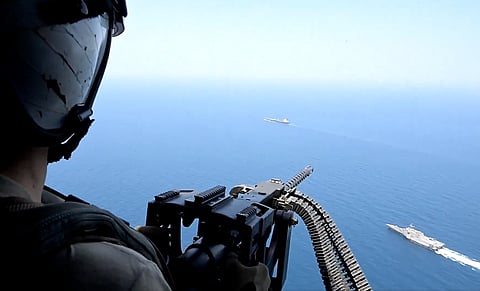
Iran appeared to be positioning vessels capable of evading sanctions just hours before the United States reinstated its naval blockade of Iranian ports on Wednesday, according to CNN and maritime intelligence firms that monitor global shipping.
Get updated faster and for FREE: Download the Gulf News app now - simply click here
The US blockade took effect at 12:01 am Gulf time (July 15) after Washington declared the collapse of a U.S.-Iran memorandum of understanding that had temporarily eased restrictions on Iranian oil exports.
Maritime risk intelligence company Windward told CNN it had identified 23 Iranian-linked vessels operating in or near the Strait of Hormuz that displayed behaviors commonly associated with so-called "dark vessels" — ships that disable or manipulate their Automatic Identification System (AIS) transponders or use deceptive identity practices to make tracking more difficult.
According to Windward, some of the vessels recently switched off their AIS signals, while others appeared to manipulate location or identity data, tactics long associated with sanctions evasion.
Cargo intelligence firm Vortexa, meanwhile, said 10 of the 23 vessels were carrying cargo, while the remaining 13 were sailing empty, potentially allowing them to load crude oil or other exports if an opportunity arose.
Disguising Iranian oil as Iraqi
One tanker tracked by Windward illustrated the techniques used by Iran's shadow shipping network.
The vessel reportedly loaded crude oil at Kharg Island, Iran's largest oil export terminal, before routing through Iraq's Basrah Oil Terminal on its way toward China — a voyage analysts say is consistent with efforts to disguise the cargo's Iranian origin.
Shadow fleet 'active'
The renewed blockade comes despite the fact that the now-defunct US-Iran memorandum temporarily relaxed sanctions on Iranian oil exports during a three-week ceasefire.
According to independent monitoring firm TankerTrackers.com, Iran continued exporting substantial volumes of crude throughout that period using its long-established shadow fleet.
The company estimated Iran exported about 50 million barrels of crude during June, with shipments reaching around 10 million barrels in a single day last week, even while the memorandum remained in effect.
Windward said several tankers that exited the Strait of Hormuz during the ceasefire are now once again subject to U.S. sanctions. Among them are seven very large crude carriers (VLCCs) currently anchored in the Indian Ocean carrying Iranian crude while awaiting buyers.
What is a shadow fleet?
A shadow fleet refers to ships used to move oil or other cargo outside international sanctions regimes.
Unlike ordinary commercial tankers, these vessels often:
disable or manipulate AIS tracking signals;
conduct ship-to-ship oil transfers at sea;
change vessel names or flags;
use shell companies registered in multiple jurisdictions;
falsify cargo documentation; and
reroute voyages to conceal the origin of crude oil.
Because large oil tankers cannot simply disappear, maritime analysts combine satellite imagery, AIS data, synthetic aperture radar, port records, insurance filings and cargo intelligence to continue tracking many of these vessels even when their electronic signals disappear.
How ships become "dark"
The Automatic Identification System (AIS) is an internationally required safety system that continuously broadcasts a ship's identity, position, speed and destination.
When a vessel intentionally switches off its transponder without a legitimate safety reason—or transmits false location or identity data—it becomes what the shipping industry calls a "dark vessel."
Maritime intelligence firms use advanced analytics to detect suspicious gaps in transmissions, unusual routing patterns and likely rendezvous points for ship-to-ship transfers.
China remains Iran's largest customer
Economists say Iran has spent years building sophisticated sanctions-evasion networks.
Adnan Mazarei, a senior fellow at the Peterson Institute for International Economics and former deputy managing director of the International Monetary Fund, said Iran relies on shadow companies, opaque financial arrangements and clandestine shipping networks to sustain its oil exports.
According to the U.S. Energy Information Administration (EIA), China purchases roughly 80% of Iran's crude exports, despite continuing U.S. sanctions.
Oil exports account for about half of Iran's government revenue, making uninterrupted crude shipments essential to Tehran's economy.
Economic pressure
The United States previously enforced a naval blockade from mid-April to mid-June, significantly reducing—but not completely halting—Iranian maritime exports.
Mazarei said the earlier blockade intensified economic pressures already facing Iran.
Iran's annual inflation rate has averaged around 50% over the past year, among the highest in decades, while food inflation has exceeded 100% for some categories.
The Peterson Institute estimates that around 90% of Iran's trade passes through the Persian Gulf, making maritime access vital for both imports and exports.
Strategic significance
The renewed US blockade is expected to test the resilience of Iran's shadow fleet once again.
While the blockade may not stop every tanker, maritime analysts say it increases shipping risks, insurance costs and transaction complexity, forcing Iranian exporters to rely even more heavily on deceptive shipping practices to keep oil flowing to overseas buyers—particularly in Asia.
Whether those tactics can offset renewed U.S. enforcement is likely to become one of the key indicators of the blockade's effectiveness in the weeks ahead.


