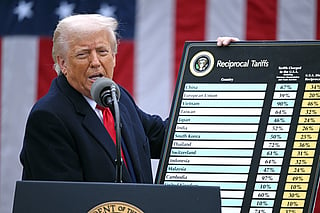
'We woke up to the reality': Rubio assails 'fantasy' of globalisation, warns of 'dangerous dependence'
US foreign secretary decries 'de‑industrialised America' and push to rebuild manufacturing
US Secretary of State Marco Rubio delivered a blunt defence of the Trump administration’s “America First” economic agenda Thursday, arguing that decades of "globalisation" left the United States dangerously dependent on foreign countries for goods essential to its economy and national security.
“The nation states still does matter. Nationalism still matters. National borders still matter!” Rubio said.
In saying that America "lost our ability to make things", Rubio declared globalisation’s era over.
He said the United States made a “terrible mistake” after the Cold War by deciding that it no longer mattered where goods were produced, as long as they were made as efficiently and cheaply as possible.
Get it: Fast, verified news for FREE ... download the Gulf News app — simply click here
“I think we made a terrible mistake in this country...the idea that the ability to make things no longer mattered. It didn't matter any longer where things were made!”
Rubio's remarks, delivered at the launch of a national programme aimed at training industrial leaders, amount to one of the clearest articulations yet of the administration's argument that industrial capacity is a national-security asset, not simply an economic variable.
For decades, the dominant economic model treated production as something that could move freely across borders in pursuit of lower costs.
“They were to be made in the most efficient place at the lowest possible cost that meant more profits for the company, lower costs for the consumers, and that was the way the world would work.”
It was an elegant proposition. It was also incomplete.
The borderless-economy drive
Rubio argued that the post-Cold War vision went beyond free trade.
It assumed that increasing economic integration would make national differences and geopolitical rivalry less important.
“There was this fantasy, really, that the whole world would become a free enterprise. And that everyone would look like us. That ran into reality!”
That reality arrived in stages.
The COVID-19 pandemic exposed vulnerabilities in global supply chains.
Russia's invasion of Ukraine demonstrated how energy and food dependencies could become strategic liabilities.
The growing US-China rivalry transformed semiconductors, batteries, critical minerals and advanced technologies into national-security concerns.
Efficiency, resilienc They're not the same
Rubio's argument is not that trade itself was the mistake.
It is that efficiency and resilience are not the same thing.
“The reality that that is not how human events have ever worked... countries are going to always act in their best interest. The result of it is that it de-industrialised America.”
That claim needs some qualification.
The decline of US manufacturing employment cannot be attributed to globalisation alone. Automation, productivity gains, changing consumer demand, technology and corporate decisions also played major roles.
But there is substantial evidence that import competition — particularly from China — imposed significant costs on some American communities.
Economists David Autor, David Dorn and Gordon Hanson found that rising Chinese import competition from 1990 to 2007 increased unemployment, reduced labour-force participation and lowered wages in exposed US labour markets.
The study, published in October 2013 in the American Economic Review and Issues ("The China Syndrome: Local Labor Market Effects of Import Competition in the United States") estimated that the "China trade shock" accounted for about one-quarter of the contemporaneous aggregate decline in US manufacturing employment.
A later study found that the effects persisted for years after the initial shock.
The net effect: more-exposed communities experienced lasting reductions in manufacturing employment, employment rates and income.
While this does not prove that free trade destroyed American industry, it does demonstrate something more complicated:
Trade can produce large aggregate benefits while concentrating severe costs in particular communities.
‘We lost our ability and our capacity to make things’
For Rubio, the bigger issue is not simply the number of factory jobs lost.
It is the loss of productive capability.
“We lost our ability and our capacity to make things.”
And he stressed that he was talking about much more than steel mills and automobile factories.
“And not just big things, not just the kinds of big machinery and things that we normally identify with industry. But even some of the most basic components that are necessary, that underpin economic life, especially in the 21st century.”
That includes semiconductors, batteries, pharmaceutical ingredients, telecommunications equipment, industrial machinery and critical minerals.
A country can import a product without being economically vulnerable — provided it has alternative suppliers and can obtain the product when needed.
The danger, as experts increasingly point out, comes when production becomes concentrated in a handful of countries, companies or geographic chokepoints.
The pandemic offered a preview of what that can mean.
A shortage of one component can shut down an entire production line thousands of miles away.
A disruption in semiconductor supplies can affect automobile production. A geopolitical confrontation can threaten access to critical minerals or advanced technologies.
The factory, in other words, is not merely a building.
It is also a reservoir of engineers, skilled workers, suppliers, production knowledge, tooling and intellectual property.
Lose the factory for long enough, and the ecosystem around it can disappear as well.
The semiconductor warning
Semiconductors illustrate the problem particularly well.
Modern economies depend on chips for automobiles, smartphones, telecommunications networks, medical equipment, electricity grids, weapons systems and artificial intelligence.
That makes semiconductor production more than a commercial issue.
It is a strategic capability.
Washington has responded with subsidies, export controls and efforts to encourage semiconductor manufacturing at home. China, Europe, Japan and other economies are pursuing similar strategies.
The world is rediscovering an old idea:
A factory is not just a factory.
It can provide surge capacity during a crisis. It can train workers. It can support local suppliers. It can preserve technical knowledge. And it can reduce dependence on a foreign government that may one day become an adversary.
‘Dangerously dependence’
Rubio said the United States eventually woke up to the consequences of its dependence.
That argument is at the heart of the Trump administration's push to rebuild American manufacturing, attract semiconductor investment, secure critical-mineral supplies and reshape trade relationships.
But rebuilding industrial capacity is not something that can be accomplished with tariffs or subsidies alone.
It requires workers, engineers, factories, electricity, ports, transportation networks, research institutions, capital and reliable supply chains.
And it takes years. That may be the most important part of Rubio's message.
The United States is not simply trying to bring factories home. It is trying to rebuild the ability to make things.
The strategy carries risks. Government subsidies can protect inefficient companies. Tariffs can raise prices. Attempts at self-sufficiency can duplicate production unnecessarily and reduce competition.
But the strategic calculation has changed.
For much of the post-Cold War era, the overriding question was:
Where can we make this most cheaply?
The question emerging from Washington is different:
What happens if we suddenly can't make it at all?
That is the question behind Rubio's declaration:
“We lost our ability and our capacity to MAKE THINGS.”
And it is why the return of borders, nationalism and industrial policy may be less a rejection of globalization than an attempt to make globalization survivable when the world stops behaving like one market.
Shoes and toys vs magnets, chips, military gear
The stakes become clearer when viewed through national security.
“And we woke up to the reality, just a few years ago, that we are suddenly, as a nation, dangerously dependent, dangerously dependent on other nations for all sorts of things that we need.”
That dependence can be tolerable for shoes or toys. It becomes considerably more uncomfortable when the product is a semiconductor, an antibiotic, a power-grid component, a satellite system or a military component.
And the problem is not necessarily that the foreign producer is hostile. A pandemic, earthquake, war, blockade or shipping disruption can be enough.
The OECD has increasingly framed this as economic security: the capacity to protect critical infrastructure, strategic industries and access to essential resources while maintaining the benefits of international trade.
That is a very different proposition from economic autarky. It is closer to strategic interdependence: remain connected to the world, but make sure no single external shock can bring the country to its knees.
Frictionless globalisation
The most important lesson may be that the old choice between nationalism and globalisation was false.
Countries can trade extensively while protecting strategic capabilities.
They can welcome foreign investment while requiring technology transfer, local suppliers and workforce development.
They can participate in global supply chains while ensuring that critical links have alternatives.
They can pursue industrial policy without turning every industry into a protected national champion.
And they can recognise that borders matter without pretending borders are walls against the global economy.
Rubio's conclusion leads to the direction in which much of the world is moving: “Not simply for our economic vibrancy, but in many cases for our national security and our very survival as a prosperous nation state.”
And therefore: “And so now we are involved in this endeavour across the board to try to reverse those mistakes.”
The interesting question is no longer whether the industrial age is coming back.
It already has — this time with semiconductors, AI, batteries, critical minerals and supply chains at the center of the battlefield.
The countries that understand that early will not necessarily be the ones that make everything. They will be the ones that know what they cannot afford to stop making.
Also In This Package
Banatao: Filipino who became Silicon Valley billionaire
Philippines' poverty challenge: Corruption or industry?

Filipino don't vote for policies — they vote for a show

Power, protectionism, and the remaking of global trade