Lebanese army forces deploy in the village of Bir al-Salasel in southern Lebanon on June 15, 2026.
LIVE
Trump turns on Netanyahu as US-Iran peace talks raise hopes of ending Middle East war
US-Iran negotiations, Iran threats and oil concerns dominate global attention.
Last updated:
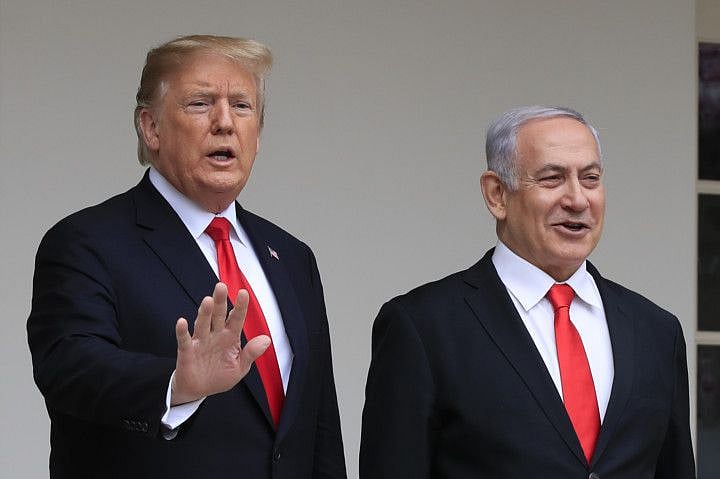
The president's remarks mark a dramatic shift in US-Israel relations.
AP
US President Donald Trump has launched an extraordinary public rebuke of Israeli Prime Minister Benjamin Netanyahu as Washington prepares for high-stakes talks with Iran aimed at securing a permanent end to the Middle East conflict. Trump criticised Israel's conduct in its war against Hezbollah, saying too many civilians had been killed, while fresh threats from Tehran, plans to reopen the Strait of Hormuz and renewed diplomatic efforts have added urgency to an increasingly fragile regional landscape.
Iranian crude oil tankers exit US blockade zone: tracking site
Iranian oil tankers have exited the zone in the Gulf blockaded by the US Navy, the TankerTrackers website said on Wednesday, calling it the country's "first crude oil exports in two months".
"At least two National Iranian Tanker Company (NITC) VLCC supertankers named DIONA (9569695) and HERO2 (9362073) have exited the US Navy blockade perimeter carrying a combined total of 3.8 million barrels of Iranian crude oil between them," TankerTrackers said in a post on X, citing digital tracking data corroborated by satellite imagery.
The site - which monitors oil shipments and storage - later added that a third NITC tanker had "exited the blockade line with 1 million barrels of Iranian crude oil".
'Near-final' 14-point US-Iran peace deal
The United States and Iran are preparing to formally sign an interim peace agreement in Geneva on Friday (June 19). Both sides portray the deal as a strategic victory.
Key details of the accord remain shrouded in mystery.
The agreement, described as a memorandum of understanding (MoU), is expected to launch a 60-day negotiating period focused on Iran's nuclear programme, regional security issues, and the future framework of relations between Washington and Tehran.
Bloomberg has reported on what it called the "near-final" 14-point US-Iran interim agreement (or MoU).
'Syria will do the job' vs Hezbollah — Trump rebukes Israel
President Trump has publicly rebuked Israel over its war against Hezbollah. "Israel's fighting Hezbollah too long and too many people are being killed." Trump, in an interview aired on Fox, said he opposed strikes that destroy apartment buildings filled with civilians and revealed he urged Israel to let Syria take the lead against Hezbollah instead. "If Israel can't do the job without killing everyone else, he'll do the job. Syria will do the job."
Trump goes after Netanyahu, putting their friendship to the test
Israeli Prime Minister Benjamin Netanyahu told President Donald Trump last year that he was the “greatest friend Israel ever had in the White House." Now, as Trump tries to finalise a deal to end the war with Iran, the US leader is unloading on Netanyahu with rhetoric that no other American leader has dared to use publicly.
He claimed credit for Israel's existence — “without me, there would be no Israel” — and cursed his judgment in interviews.
Speaking on Tuesday at the annual G7 summit in France, Trump said he told Netanyahu that he's been unhappy with his recent moves.
He even described him as “crazy.”
Iran and US to embark on two months of peace talks Friday
The United States and Iran are to launch talks on a final settlement to their conflict on Friday (June 19, 2026) in Switzerland, officials said, as news that the Strait of Hormuz will reopen sent world oil prices tumbling.
Negotiations over a final deal are to start immediately after a signing ceremony and continue during a 60-day window, leading to decisions on the fate of Iran's nuclear programme and a plan for the lifting of international economic sanctions.
Iran warns Israel of 'harsh response' over Lebanon strikes
Iran's military threatened to respond to Israel after strikes in southern Lebanon killed four people despite a deal between Tehran and Washington ending the Middle East war, including in Lebanon.
"If the child-killing army of the Zionist regime does not put an end to its acts of aggression in southern Lebanon, it should await a harsh response from the powerful armed forces of the Islamic Republic of Iran," said the Iranian military's central command Khatam Al Anbiya.
It added that Israel had violated the ceasefire in Lebanon "84 times" since the deal was announced.
Get updated faster and for FREE: Download the Gulf News app now - simply click here.
Vance says Iran agreement release delayed until Friday
Vice President JD Vance visits "FOX & Friends" at Fox News Channel Studios on June 16, 2026 in New York City.
Vice President JD Vance said the US has delayed releasing the Iran agreement text to ensure “proper sequencing” of sensitive diplomatic steps involving regional mediators, including Pakistan and Qatar, CNN reports.
Speaking on the Megyn Kelly Show, Vance said the timing is intended to respect ongoing discussions and sensitivities across the Arab and Muslim world.
He acknowledged growing calls for transparency but said officials are aiming to avoid disrupting delicate negotiations.
Vance added that the full text of the memorandum of understanding is expected to be released “at the very latest” by Friday.
G7 explores alternatives to Strait of Hormuz for global energy supplies
The leaders’ discussions about the vital waterway at their summit in France have included looking at other supply routes that could be opened to bring oil and gas out of the Gulf, French Foreign Ministry spokesman Pascal Confavreux said in an interview with The Associated Press.
“There were discussions to see how we can depend less on the strait,” he said. “This has to change for the future.”
Before the Iran war, a fifth of the world’s crude oil passed through the maritime chokepoint.
“Part of the discussions were, ‘OK, how can we imagine, finance, and build infrastructures, sometimes on the terrestrial part, that will be able to go outside of the track of the Strait of Hormuz?’” Confavreux said.
Iran says the US war deal requires Israel to withdraw from Lebanon
Iran’s top diplomat said that the tentative deal to end the war with the United States would require Israel to withdraw from Lebanon — a condition Israel has already rejected. The contradictory interpretations could sink the agreement and lead to the resumption of all-out war.
The deal between the U.S. and Iran has not been made public, and while Israel is not party to the agreement, it is part of the war: It joined the U.S. in launching strikes on Iran on Feb. 28, and has since fought the Iran-backed Hezbollah militant group in Lebanon and seized large swaths of that country.
“Without the withdrawal of Israeli forces from the territories they occupied during this war, the war has not fully come to an end,” Iranian Foreign Minister Abbas Araghchi said.
A US official who spoke on condition of anonymity to discuss the deal’s outlines said it did not call for an Israeli withdrawal. And Israeli Prime Minister Benjamin Netanyahu said Monday that Israel would remain in Lebanon “as long as necessary.”
Signing ceremony for US-Iran deal to take place Friday at Swiss resort
Switzerland's foreign ministry says a signing ceremony for a deal between the United States and Iran will take place Friday at the Bürgenstock resort near the city of Luzern.
Ministry officials said Tuesday that the location was proposed by Pakistani and Qatari mediators, along with the US and Iran.
The ministry said it has been in close contact with the four countries about the possible signing of the memorandum of understanding that US and Iranian officials announced over the weekend.
Iran deputy foreign minister says US naval blockade 'lifted'
Majid Takht-Ravanchi, Iran's Deputy Foreign Minister for Political Affairs
An Iranian deputy foreign minister on Tuesday said the two-month US naval blockade on Iranian ports had been lifted ahead of the planned formal signing of a deal ending the war.
"The lifting of the blockade was something we had emphasised from the outset. It has now begun, and the blockade has been lifted prior to the formal signing" scheduled for Friday, said Iranian Deputy Foreign Minister Majid Takht-Ravanchi, according to the government's website.
G7 leaders are discussing building new partnerships
The working session is titled “Forging New Partnerships and Rebuilding International Solidarity” and is attended by the G7 countries and the partner countries of Brazil, Egypt, India, Kenya and South Korea, along with the World Bank and the African Development Bank.
Trump was sitting between Macron and Indian Prime Minister Narendra Modi.
He’s scheduled to have a face-to-face meeting with Modi on Wednesday.
US‑Israel war on Iran: Recent developments
Sign up for the Daily Briefing
Get the latest news and updates straight to your inbox
Network Links
GN StoreAbout Gulf NewsTerms & ConditionsReach by GNSitemapContact usPrivacy PolicyGN FocusHave your sayWork with usAdvertise with usGulf News epaperPrinting Services
Download our app
© Al Nisr Publishing LLC 2026. All rights reserved.