Middle East conflict: US investigates Iran over cyberattacks on 50 ships as fresh sanctions target Iran's shadow banking network
Qatar steps up efforts to revive US-Iran talks, warning against further escalation
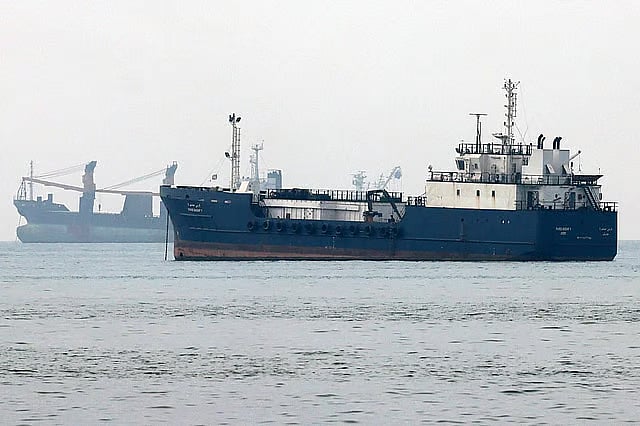
The US is investigating suspected Iranian links to cyberattacks targeting up to 50 commercial vessels carrying oil, gas and hazardous cargo, as Washington imposes fresh sanctions on Tehran's shadow banking network. US Treasury Secretary Scott Bessent says Iran's leadership is "panicking" over the worsening economy. Meanwhile, Qatar is stepping up diplomatic efforts to revive US-Iran negotiations, warning against further regional escalation. Its prime minister raised the issue during talks with US Secretary of State Marco Rubio in Washington. Follow our live coverage for the latest developments, military moves and their implications for the UAE and wider Gulf.
The United States is investigating whether Iran is behind a series of cyberattacks targeting as many as 50 commercial vessels carrying oil, liquefied petroleum gas, chemicals and other potentially hazardous cargo, according to a report by The Wall Street Journal (WSJ).
The attacks, which have reportedly affected ships operating near the US, Europe and Asia, have raised concerns that the confrontation between Washington and Tehran is expanding beyond conventional military operations into cyberspace and international maritime trade.
The WSJ report, published on Monday and citing US officials and people familiar with the investigation, identified Iran as a primary suspect. Russia is also being considered as a possible source of the attacks.
However, US investigators have not established Iranian responsibility. According to the WSJ investigation, attackers have exploited "vulnerabilities" in Fortinet routers, networking equipment widely used by shipping companies and maritime facilities.
Get updated faster and for FREE: Download the Gulf News app now - simply click here.
US Treasury Secretary Scott Bessent said Monday that Iran's leadership is "panicking" over a worsening economy, as Washington announced a fresh round of sanctions aimed at the country's shadow banking network.
In a post on X, Bessent said Iran's economy is "underwater" and called its shadow banking system "the last financial lifeline of a bankrupt regime."
He vowed that Treasury will keep dismantling these networks "until we have buried the head of the snake."
The claims about Iran's leaders "panicking" and an exhausted oil supply are US government assertions. Iranian officials have not endorsed them, and the Treasury figures haven't been independently verified.
Read more here.
Houthi-affiliated news agency Saba said Tuesday that a Saudi strike on buses and trucks had left 25 people dead or missing in Yemen's southwest.
The Iran-backed fighters, who control swathes of Yemen, are battling a Saudi-led coalition that supports Yemen's internationally recognised government.
"The toll from the Saudi enemy planes' targeting of buses and trucks in Wadi Mabaq, Lahj Governorate, has risen to 25 martyrs or missing, and six wounded," reported the Houthi-run Saba news agency, adding that the continued presence of Saudi aircraft over the area was hindering rescue efforts.
On Monday, the Houthi's military spokesperson Yahya Saree had reported the attack -- without providing casualty figures -- and vowed it would not go "unanswered."
Separate strikes on Monday killed 17 people and destroyed several buildings in the neighbouring coast province of Hodeida, the Houthis' telecommunications ministry said.
US Treasury Secretary Scott Bessent said Monday that Iran's leadership is panicking over a worsening economy, as Washington announced a fresh round of sanctions aimed at the country's shadow banking network.
In a post on X, Bessent said Iran's economy is "underwater" and called its shadow banking system "the last financial lifeline of a bankrupt regime."
He vowed that Treasury will keep dismantling these networks "until we have buried the head of the snake." The Office of Foreign Assets Control added 22 entities and eight people to its sanctions list. The network stretches across Iran, Dubai, Hong Kong and Turkey. Among those designated is the Iran Center for Exchange of Currency and Gold, which Treasury says matches Iranian exporters earning foreign currency with importers who need it, and serves tens of billions of dollars in trade annually.
Treasury also said FinCEN identified about $14.7 billion of financial activity from January 2025 to August 2026 potentially linked to Iranian shadow banking.
Iran has summoned Qatar's chargé d'affaires in Tehran to protest a joint Qatari-German statement condemning Iranian attacks on countries in the region.
Baghaei said the envoy was summoned in the ambassador's absence and formally notified of Iran's protest over claims he called "completely baseless and unacceptable." He said Tehran viewed the statement with "surprise and regret."
Qatar and Germany issued the statement Saturday, at the end of Emir Sheikh Tamim bin Hamad Al Thani's official visit to Germany on Nov. 20-21.
The two countries called Iranian attacks on Qatar and other states a "flagrant violation" of sovereignty, international law and the UN Charter.
They also condemned attacks and threats against commercial shipping, rejected any obstruction of navigation through the Strait of Hormuz, and urged Tehran to stop supporting and arming affiliated armed groups. The statement also called on Iran to meet its obligations under the Non-Proliferation Treaty, said it should never develop nuclear weapons, and urged it to end support for Yemen's Houthis.
Qatar is stepping up diplomatic efforts to revive negotiations between the United States and Iran, warning that the Middle East cannot afford another escalation as tensions continue to threaten regional security, energy supplies and maritime trade.
Qatari Prime Minister and Foreign Minister Sheikh Mohammed bin Abdulrahman Al Thani made the remarks on Monday, November 23, following a meeting with US Secretary of State Marco Rubio at the State Department in Washington.
The meeting signals renewed diplomatic engagement between Washington and Doha over the possibility of reopening a negotiating channel with Tehran.
Qatar, which maintains diplomatic contacts with Iran while hosting major US military facilities, occupies an important position as a potential intermediary between the two adversaries.
Its diplomatic role is particularly significant because direct US-Iran engagement has repeatedly faced obstacles over security guarantees, sanctions, Iran's nuclear programme and the future of regional military arrangements.
Sign up for the Daily Briefing
Get the latest news and updates straight to your inbox
Network Links
GN StoreDownload our app
© Al Nisr Publishing LLC 2026. All rights reserved.