Trump threatens to sink Iranian vessels as US strikes oil tanker, Ghalibaf calls for lasting security
CENTCOM chief concludes regional meetings as Gulf security concerns intensify
Iran war escalation: Trump's warning before US midterms
US President Donald Trump has accused Iran of becoming more aggressive following the Democrats' victory in the November 3 midterm elections, claiming Tehran views the party as weak and ineffective.
In a series of posts on his Truth Social platform, Trump said he had predicted increased Iranian aggression after the election. He also accused Democrats and Iran of trying to keep oil prices high before the vote, while linking the subsequent decline in crude prices to the election outcome.
Trump separately blamed Democrats for the downturn in US stock markets, criticising the party's economic policies.
His comments come amid continuing tensions between Washington and Tehran, with Trump also indicating that he is inclined to resume military strikes against Iran after the New Year if negotiations fail.
Read more here.
CENTCOM chief wraps up Middle East tour
US Central Command chief Admiral Brad Cooper has concluded a weeklong Middle East visit, meeting senior civilian and military leaders in Israel, Qatar and Saudi Arabia to discuss regional security and continued cooperation.
He also met US troops deployed across the region, thanking them for their service and recognising their bravery and contributions during combat operations against Iran’s Islamic Revolutionary Guard Corps (IRGC).
Iran's double missile launcher: What to know
Iran says it has a launcher that can fire two liquid-fuel missiles at once, and showed it inside an underground base.
The claim comes from state media, in clips shared by state controlled IRIB and PressTV, a state-funded network based in Tehran.
No independent source has verified the system’s performance.
State news agency IRIB said the Revolutionary Guards unveiled the launcher and a new missile base during a visit by IRGC commander Ahmad Vahidi and aerospace chief Seyed Majid Mousavi.
Read more here.
US struck tanker amid blockade standoff
The US struck a tanker exporting Iranian oil as part of its blockade, according maritime security analyst. There is no official confirmation from either the US or Iran.
UKMTO, however, reported on Sunday evening that a tanker was involved in an incident with "military forces" in the Gulf of Oman, east of the Strait of Hormuz, near the Iranian city of Chabahar. It didn’t identify the vessel or link it to the reported Iranian convoy.
The location is close to the US blockade line. Central Command hasn’t formally commented on the strike. It rejected Iranian claims of successful attacks. Maritime security analyst reported about the US attack in an X post.
Iran has threatened for days that any US attempt to stop its tankers would draw a “fierce military response” and immediate strikes on Gulf energy infrastructure. Deputy Foreign Minister Kazem Gharibabadi called the blockade an "act of war".
A report by Hamshahri, a Tehran-municipality-linked outlet, claimed 14 tankers were preparing to move at Kharg Island. A UANI adviser, however, called a 14-ship breakout almost logistically impossible and based on propaganda. Another report stated 31 laden tankers will attempt to cross the blockade line. There is no independent confirmation of the Iranian tankers' movement. The blockade is currently being enforced by the US Central command, with two US carrier strike groups currently in the region.
Trump warns Tehran against 'testing' naval blockade
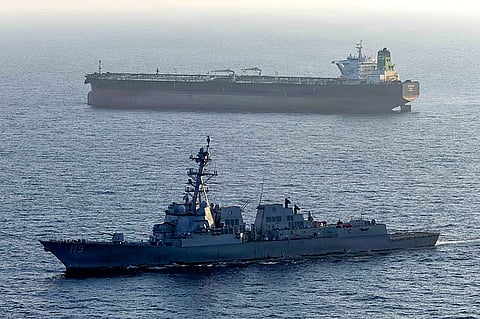
US President Donald Trump has threatened to sink Iranian vessels attempting to breach the American naval blockade, as reports emerge of a fresh US strike against a tanker exporting Iranian oil.
The developments raise the risk of a wider confrontation in the Gulf, particularly after Iran warned that attacks on its shipping could trigger retaliation against energy infrastructure across the region.
In an interview with Fox News chief foreign correspondent Trey Yingst on Sunday, November 22, Trump was asked about reports that Iran was preparing to test the US naval blockade.
His response was blunt: "I hope they do, they'll all be at the bottom of the sea like the rest of the navy," Trump said.
Yingst also reported that Trump was inclined to resume military strikes against Iran after the New Year if diplomatic negotiations failed to produce an agreement.
Trump accused Iranian negotiators of prolonging discussions without making meaningful concessions, describing them as "professional tap dancers".
The comments signal that Washington is keeping military escalation on the table even as indirect diplomatic contacts with Tehran continue.
'Tanker swarm' from Iran: 31 tankers already beyond Hormuz to challenge US blockade, says report
Iran may not need to send another convoy from Kharg Island to test the US naval blockade. At least 31 laden, sanctioned tankers have already passed through the Strait of Hormuz and are positioned outside the waterway, potentially within reach of the US blockade line.
According to maritime intelligence firm Windward AI, its Maritime Intelligence Operations Centre (MIOC) identified 31 tankers positioned beyond the Strait between November 13 and 20.
Four are crude oil tankers carrying an estimated 4.9 million barrels of oil. Their positions were confirmed through satellite imagery.
The closest vessel is the Suezmax tanker TOUR 2 (IMO 9364112), spotted off Chabahar, approximately three to six hours' sailing from the blockade line.
The remaining 27 vessels are carrying liquefied petroleum gas (LPG) or refined petroleum products. Twenty are positioned at the Shinas and Sohar anchorages.
Saudi, Pakistani foreign ministers discuss regional diplomacy amid Iran tensions
Saudi Foreign Minister Prince Faisal bin Farhan and Pakistani counterpart Ishaq Dar discussed regional developments and diplomatic efforts in a phone call on Sunday, Saudi Arabia’s Foreign Ministry said on X.
The call came amid rising tensions between Iran and the United States. The two ministers also discussed ways to strengthen cooperation between their countries.
The ministry did not release further details of the conversation. Saudi Arabia and Pakistan are seeking closer coordination as regional tensions continue to rise. The call signals a push for diplomatic engagement amid the Iran-US standoff. The two countries play key roles in regional security and could help shape diplomatic efforts.
Iranian missiles are displayed next to a banner with a picture of Iran's Supreme Leader, Mojtaba Khamenei, on a street in Tehran, Iran, September 27, 2026. (via Reuters)
Ghalibaf calls for 'sustainable deterrence' to ensure lasting security
Iranian Parliament Speaker Mohammad Bagher Ghalibaf has warned that the country cannot remain indefinitely in a situation of "neither war nor peace", calling for what he describes as sustainable deterrence to prevent another military confrontation.
Ghalibaf argued that the only way to eliminate the threat of war is to remove the underlying security threat against Iran. "If we do not want the current situation to continue, we must remove the threat from our country," he said, adding that this could only be achieved through "sustainable deterrence".
UAE, Oman continue search for missing Jordanian sailor after Hormuz tanker attack
The United Arab Emirates and Oman are searching for a Jordanian sailor missing after an ADNOC Logistics and Services tanker was attacked in the Strait of Hormuz. The attack is part of a series of incidents involving seven oil tankers in the area since November 16.
The search follows a series of attacks on commercial vessels in the strait since November 16. The Joint Maritime Information Centre said seven oil tankers have been hit, including three vessels struck near Oman’s coast between November 20 and 21. The latest attacks targeted outbound tankers between 8 and 17 nautical miles from Khasab, Oman.
US‑Israel war on Iran: Recent developments
Day 264: US says blockade of Iran reaches 130 consecutive days
Day 263: US strikes near Iran’s Qeshm Island as tensions escalate
Day 262: Iran war has cost US more than $48 billion: Pentagon
Day 261: Iran rejects claims of possible chemical attack on US
Day 261: Third US carrier enters Middle East as Iran blockade widens


