Middle East war: Riyadh skyscraper damaged, tanker hit near Oman as Trump weighs fresh Iran strikes
Tanker hit near Oman as IEA warns of unprecedented energy security threat
Highlights
US-Israel attack on Iran remains on Trump's table, report says
Even as US President Trump sits across the table in a critical trilateral with Chinese President Xi Jinping and Russian President Vladimir Putin, there are indications that the situation in the Middle East could see further escalation. Israeli news site Mako cited two sources familiar with the matter to report that Trump is still considering launching a joint attack with Israel against the Iranian regime.
A senior US Official told Mako that all options are available to President Trump to ensure that Iran never has a nuclear weapon.
Trump is is under pressure from incumbent Israeli PM Benjamin Netanyahu who has urged the US to push strikes against Iran. Last week, Mossad head Roman Goffman was in DC to meet senior US officials to make a pitch for enhanced action against the Islamic Republic.
Mako reported Trump has not yet made any decisions, but the issue is expected to be discussed after he returns from his visit to Asia.
Riyadh skyscraper damaged as Saudi reports new Houthi attacks
A skyscraper in Riyadh housing the headquarters of Saudi Arabia's sovereign wealth fund was damaged on Thursday, witnesses told AFP, as the kingdom reported new attacks by Yemen's Houthis.
In the early hours of Thursday, AFP journalists in the Saudi capital reported a powerful blast had been heard.
Around the same time, civil defence authorities issued a warning for "potential danger" but said minutes later that the danger had passed.
The Saudi-led military coalition fighting the Houthis said it had "addressed a missile threat launched by the terrorist Houthi militia towards Riyadh".
"Initial assessment indicates the impact of debris, with material damage currently being surveyed," said coalition spokesman Turki al-Malki.
Witnesses later told AFP that Riyadh's Public Investment Fund Tower, which at 80 storeys is the tallest in the city's financial district, had been damaged.
"The facade is damaged across several floors, with windows blown out," said one source who requested anonymity. Two other sources confirmed the damage.
Standing 385 metres high, the tower dominates King Abdullah Financial District, which acts as a showcase for Saudi Arabia's economic ambitions.
With imposing skyscrapers, luxury shops and green spaces, the district also hosts the headquarters of the Saudi stock exchange along with multinationals such as Goldman Sachs.
Chaired by Saudi Arabia's de facto ruler Crown Prince Mohammed bin Salman, the sovereign wealth fund is one of the largest in the world with more than $900 billion in assets under management.
It is also one of the main instruments for diversifying the kingdom's economy away from oil, plans which have been threatened by the latest fighting.
US Democrat lawmakers tie funding votes to Iran war curb
Indian American Congressman Ro Khanna and fellow Democrat Yassamin Ansari have said they will oppose any government funding package that does not explicitly bar spending on offensive operations in Iran, bringing their opposition to the war into the negotiations ahead of a December 11 deadline.
"We will oppose any funding package that does not explicitly prohibit funds from being used for offensive operations in Iran," the two lawmakers said in a joint statement released on Wednesday (local time).
Their demand makes an Iran funding restriction a condition for their support for legislation to keep federal agencies operating. The statement does not establish that Democratic leaders or the wider caucus have adopted the same position.
Khanna and Ansari argued that the November 3 election result demonstrated public opposition to President Donald Trump's war. They accused the administration of conducting the conflict unlawfully and without congressional authorisation, and blamed it for increasing costs for Americans.
The statement did not include legislative language defining offensive operations or specifying exceptions to the proposed prohibition.
Federal agencies are operating under a temporary funding law that generally extends appropriations through December 11. Congress must enact further funding before that authority expires to prevent a funding lapse affecting government operations.
The Continuing Appropriations and Extensions Act, 2027, was signed into law on September 2. It provides interim funding for agencies covered by all 12 annual appropriations bills.
The lawmakers' announcement comes as Democratic leaders discuss how to pursue their opposition to the Iran war while negotiating the next spending measure.
House Democratic Leader Hakeem Jeffries said earlier this week that congressional negotiators were discussing either a government funding agreement before December 11 or another temporary extension into next year.
"I don't want to get out ahead of that process," Jeffries said.
Mid-East crisis 'largest threat' to energy security ever: IEA
The crisis in the Middle East sparked in February by the US and Israeli bombing of Iran has created the "largest threat" to energy security in history, the International Energy Agency (IEA) warned Thursday.
The agency said in its flagship annual World Energy Outlook that consumers were increasingly footing the bill as the world runs out of ways to absorb the impact of the conflict on energy supplies.
The crisis, just like previous energy shocks, would certainly leave "lasting marks", the agency warned.
Saudi-led coalition intercepts Houthi cruise missile fired at southern Saudi Arabia
The Saudi-led coalition said it intercepted and destroyed a cruise missile that the Houthis launched towards Saudi Arabia’s southern region, according to the Saudi Press Agency (SPA).
'Double standard': Iran criticises IAEA chief Grossi Baghaei
Iranian Foreign Ministry spokesperson Esmaeil Baghaei has criticised International Atomic Energy Agency (IAEA) Director General Rafael Grossi over his remarks that there was no “double standard” in the treatment of Israel and Iran concerning the verification of nuclear activities, questioning why Israel remains outside comprehensive nuclear safeguards despite possessing a nuclear arsenal.
In a statement posted on X, Baghaei challenged Grossi's assertion that the difference in the two countries' treatment was based on their respective status under the Treaty on the Non-Proliferation of Nuclear Weapons (NPT).
Quoting Grossi, Baghaei said: “IAEA Director General Grossi has stated: '[...] there is no double standard. If Israel was a state party to the NPT and I was treating Iran and Israel differently, then there would be a double standard'.”
In response, the Iranian spokesperson argued that the distinction based on formal legal status failed to address the IAEA's broader responsibility to ensure impartiality and advance nuclear non-proliferation.
“This response confuses formal legal status with institutional responsibility and impartiality. The real question is why a genocidal occupying entity possessing a nuclear arsenal remains outside comprehensive safeguards, and how this inequality can be reconciled with the stated objectives of the non-proliferation regime,” Baghaei said.
Get updated faster and for FREE: Download the Gulf News app now - simply click here.
Iran war at crossroads: Trump demands 'lasting' deal, says conflict will end 'one way or the other'
US President Donald Trump has renewed his warning that he intends to end the conflict with Iran "soon", insisting that any agreement with Tehran must be durable enough to survive future changes in American leadership.
In an interview with Fox, an excerpt of which was circulated by the White House-affiliated Rapid Response 47 account (@RapidResponse47) on X, Trump said he wanted a long-term agreement rather than a temporary arrangement that could be reversed by a successor.
"I want a deal that can be lasting. If we have a bad President, a weak President, I want a deal that will supersede the President," Trump said.
He also reiterated his determination to bring the confrontation to an end.
"I'm going to finish it off — soon. One way or the other, we'll finish it off," he added.
The remarks highlight Trump's twin-track approach to Iran: keeping diplomatic channels open while maintaining military and economic pressure on Tehran.
In the wider Fox News interview, Trump confirmed that Washington remained in contact with Iranian representatives and claimed Tehran wanted an agreement. He nevertheless insisted that any settlement must prevent Iran from rebuilding its military and nuclear capabilities.
"Yeah, we talked to them. We talked to them. They want to make a deal, but I want a deal that can be lasting," he said.
Trump did not provide a proposed agreement, negotiating timetable or specific mechanism that would guarantee a future US administration could not reverse the arrangement.
Tanker hit by unknown projectile near Oman in latest Hormuz attack
A tanker was struck by an unknown projectile in its engine room while sailing outbound through the Strait of Hormuz, prompting a maritime security warning, according to the United Kingdom Maritime Trade Operations (UKMTO).
The incident occurred approximately 6 nautical miles north of Khasab, Oman, at 1645 UTC (8:45pm UAE/Gulf time) on November 18. UKMTO issued an incident alert at 2.30am on Thursday (UAE/Gulf time), Nov. 19 following a delayed report from local authorities.
All crew members were reported safe and accounted for.
The extent of the damage and any potential environmental impact remained unknown at the time of reporting.
The incident report does not identify the tanker, the projectile's origin or those responsible. It also does not establish whether the incident was connected to the earlier attacks.
UKMTO advised vessels transiting the strategic waterway to exercise caution and report suspicious activity while authorities investigate the incident.
The latest incident adds to a series of maritime security alerts involving commercial vessels around the Strait of Hormuz in November.
Iran fires on US airbase in Kuwait, several times at Bahrain
Iran fired on a US airbase in Kuwait and several times at Bahrain on Wednesday, in what appeared to be retaliation for US strikes the day before. Iran’s military said its drones targeted Patriot air defence systems and drone and missile launch platforms at Ali Al-Salem Air Base in Kuwait. Kuwait’s army said its air defences intercepted drone attacks, and Bahrain’s military said it intercepted a number of Iranian attacks.
Neither country immediately reported damage or casualties.
A US military official described the US action as a “self-defense” strike on one Iranian missile launch site on Qeshm Island, using precision munitions.
AP reported that the US strike was retaliation for an Iranian strike on a US radar installation in Bahrain earlier on Tuesday. Shipping attacks are happening in parallel.
Bahrain’s military didn’t say whether it repelled missiles or drones. The drone claim is firmest for Kuwait, where it comes from Iran itself.
US reissues security warnings to citizens in Bahrain, Saudi
The US State Department reiterated its security warning to American citizens in Saudi Arabia and Bahrain on Wednesday, after both countries came under attack from Iran and its allies.
The department reissued alerts last sent late in October calling for "heightened vigilance" in both Gulf countries because of attacks by Iran and its Yemeni allies the Houthis. The group attacked Saudi Arabia again on Wednesday, while Bahrain said it was attacked for a second day in a row after Tehran said it had launched drones at the island kingdom on Tuesday.
US‑Israel war on Iran: Recent developments
Day 262:
Day 261: Iran rejects claims of possible chemical attack on US
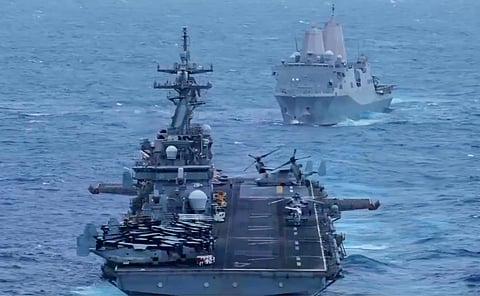
Day 261: Third US carrier enters Middle East as Iran blockade widens
Day 260: US, Israel draw up plans for possible Iran strikes
Day 259: Trump threat claim emerges amid Iran war tensions
Day 258: Turkey, Qatar sign defence pact
Day 257: Trump says US does not 'need a deal with Iran'
Day 256: Iran warns US as Gaza crisis deepens


