Qatar's Emir Sheikh Tamim bin Hamad al-Thani speaks during the 81st United Nations General Assembly at the United Nations Headquarters in New York, on September 22, 2026.
LIVE
Middle East tensions: Trump says US-Iran talks were ‘productive’ at UN; Saudi king condemns Houthi targeting of Mecca
UN summit overshadowed by Iran war, Hormuz threats and Houthi attacks on Saudi Arabia
Last updated:
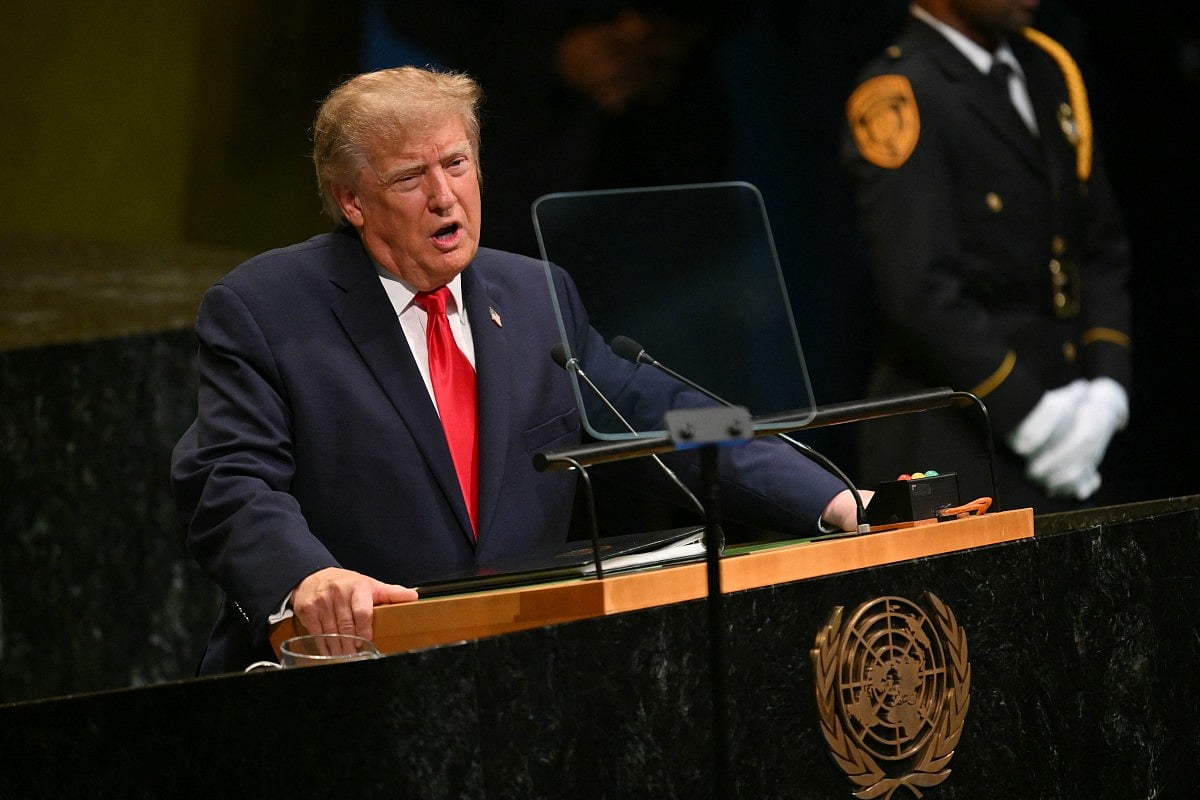
US President Donald Trump addresses the 81st United Nations General Assembly at the United Nations Headquarters in New York, on September 22, 2026.
AFP
President Donald Trump said US and Iranian officials held “very good” and “productive” talks at the UN in New York, with the meeting lasting about three hours. Earlier, Trump warned Iran it could face “annihilation” without a deal to end the war, while saying he expected an agreement after the US midterm elections. UN Secretary-General Antonio Guterres called for “a world built on interdependence” in his final General Assembly address, while Saudi Arabia’s King Salman said an alleged Houthi attempt to target Mecca violated the sanctity of Islam’s holy sites and provoked Muslims worldwide. Follow this blog for live updates as the situation develops.
Trump at UN: Iran was ‘bully of the Middle East’ — ‘but bully no more’
US President Donald Trump used his address to the UN General Assembly to portray Iran as the central security threat in the Middle East, calling Tehran the region’s former “bully” and defending his decision to confront it militarily.
“There is no better example of a danger that was allowed to gather strength at the world’s peril than the number one sponsor of terror, the Islamic Republic of Iran,” Trump said in New York.
“For 51 years, the fanatical Iranian regime has ruled by bloodshed and mass murder, spreading death and carnage and chaos across the entire Middle East and beyond.”
“They were the bully of the Middle East, but they are the bully no more,” he said.
Trump made Iran the centrepiece of his foreign-policy argument at the UN, presenting the conflict as the culmination of what he described as decades of failure by previous administrations to prevent Tehran from becoming more powerful.
Trump tells GCC, Arab leaders Iran could face ‘annihilation’
Trump again warned Iran that it could face “annihilation”, echoing remarks he made earlier at the UN General Assembly.
“We’ve isolated Iran financially and hopefully they’ll do the right thing fast,” Trump said during a meeting with GCC and Arab leaders on the sidelines of the UN General Assembly.
“There will be a time when it’s too late and we won’t have the chance of letting them survive as a nation,” he added.
“I would like to see that and I can tell you that people around this table would like to see it,” Trump said.
Get updated faster and for FREE: Download the Gulf News app now - simply click here.
Iran minister gives Witkoff conditions to reopen Hormuz: Media
Iran's Foreign Minister Abbas Araghchi met US envoy Steve Witkoff on the sidelines of the UN General assembly in New York on Tuesday and informed him of Tehran's conditions for reopening the Strait of Hormuz, Iranian media reported.
According to the state news agency IRIB, Araghchi told Witkoff that Tehran demands included "the immediate lifting of the (US) naval blockade, the prompt payment of all Iranian assets that have been frozen, and an end to the war on all resistance fronts".
Trump repeats claim US ‘destroyed’ Iran’s military
Trump has reiterated claims that US military action has severely damaged Iran’s military capabilities, including its navy, air defences and weapons facilities.
Speaking ahead of his meeting with GCC and Arab leaders, Trump claimed that all 159 Iranian naval vessels had been destroyed and that more than 90 per cent of Iran’s aircraft had been hit.
He also claimed US forces had struck 430 weapons storage facilities and 800 drone storage facilities.
“We annihilated its air defence systems, completely decimated its terrorist leadership and destroyed its economy,” Trump said.
Trump addresses GCC and Arab leaders
Trump is addressing a meeting with Gulf Cooperation Council (GCC) and Arab leaders on the sidelines of the UN General Assembly in New York.
Kushner, Witkoff part of US team that met Iran delegation
Trump said Jared Kushner and Steve Witkoff were part of the American team that met with the Iranian delegation on the sidelines of the UN General Assembly on Tuesday.
Trump confirmed the participation of his son-in-law Kushner and special envoy Witkoff in the meeting, which he earlier described as “very good” and “productive”.
The talks lasted about three hours, according to Trump.
Get updated faster and for FREE: Download the Gulf News app now - simply click here.
Qatar says mediation remains a priority
Qatar’s Emir Sheikh Tamim bin Hamad Al Thani said that the country’s role extends beyond mediating between conflicting parties, highlighting its efforts to address humanitarian suffering caused by wars and natural disasters.
Sheikh Tamim said Qatar had spared no effort in its mediation efforts to stem bloodshed, ease civilian suffering and secure the release of prisoners and detainees until a ceasefire was reached.
He said Qatar would remain an open platform for dialogue and cultural interaction, as well as the exchange of views and experiences.
The Amir reaffirmed Qatar’s support for Lebanon’s state institutions and sovereignty over its entire territory.
He condemned Israeli attacks on Lebanon and stressed the need to uphold the ceasefire and UN Security Council Resolution 1701.
Sheikh Tamim said there could be no just international order while Palestine remained a “blind spot” within it.
“What happened in Gaza is genocide in every sense of the word and a stain of shame on the conscience of humanity as a whole,” he said.
Iran media reports flights to Baghdad, Muscat cancelled
Iranian flights to Baghdad and Muscat will be cancelled as of midnight, local media reported, as new US sanctions were set to come into force aimed at hobbling Iran's aviation industry.
The Tasnim news agency cited a civil aviation spokesman as saying that "Baghdad and Muscat airports will no longer accept Iranian flights", though the authority was "negotiating so that flights whose destination is Baghdad can be redirected to (Iraq's) Najaf Airport".
The ISNA news agency also reported the cancellations, and said negotiations with Oman were likewise ongoing.
Trump says he would like to ban diesel exports from US
With voters facing higher fuel prices ahead of the midterm elections, Trump is exploring a ban on selling diesel abroad.
“I’ve called for it,” the president said in response to a reporter’s question “I’ve called for it within my people. I’ve been talking about it.”
The president said he has asked Treasury Secretary Scott Bessent to examine if an export ban could help to curb inflation.
Bessent said at Trump’s prompting: “We’re examining that, whether it’s feasible in terms of the overall refining capacity and whether a full or partial ban would work.”
Trump said the timeline for the decision would be “fast.”
Get updated faster and for FREE: Download the Gulf News app now - simply click here.
Trump says US, Iranian officials had 'productive' talks
Trump said US and Iranian officials had "productive" talks at the United Nations on Tuesday, hours after he threatened to annihilate Iran if it doesn't make a deal to end the war.
"They had a very good meeting, a very productive meeting," Trump told reporters, adding that the meeting on the sidelines of the UN General Assembly in New York lasted about three hours.
"They have another one scheduled in the very near future."
Iran says ‘violating’ Hormuz vessels face fines, seizure
Iran will impose fines and temporarily seize vessels it deems to be violating its blockade of the Strait of Hormuz, the spokesperson for Parliament’s national security committee said.
The spokesperson told Iran’s Fars news agency that vessels considered to be in violation while transiting the strait would face a fine equivalent to 20% of the value of their cargo.
The vessels would be temporarily seized until the imposed fine is paid, the spokesperson said.
The comments come amid heightened tensions around the Strait of Hormuz, a key global shipping route.
Trump says US, Iranian officials met at UN on Tuesday
Trump said his representatives met with the Iranian delegation at the United Nations earlier Tuesday, arguing that Tehran faced a choice between “obliteration” and what he described as “potential greatness”.
I can't imagine why they wouldn't want to do it... In one case, it's obliteration and the other alternative is potential greatness. It could be a great country.US President Donald Trump
Kuwait denies transit flights will start from October 1
Kuwait’s Public Authority of Civil Aviation has denied reports that an airline operating at Kuwait International Airport will launch transit flights from October 1.
Authority spokesperson Abdullah Al Rajhi told the Kuwait News Agency (KUNA) on Tuesday that the reports were inaccurate and that airlines operating at the airport had not been informed or notified of any decision to begin transit flights from the date mentioned.
Al Rajhi urged airlines to verify information and regulatory decisions with the relevant authorities before issuing announcements about operations or air services.
He said any decisions or developments regarding the operation of transit flights would be officially announced through the authority’s approved channels.
The authority also warned that inaccurate announcements could cause confusion among passengers and the wider public.
Qatar Emir: Gulf faces ‘one of its most dangerous phases’
Qatar's Emir Sheikh Tamim bin Hamad al-Thani speaks during the 81st United Nations General Assembly at the United Nations Headquarters in New York, on September 22, 2026.
Qatar’s Emir Sheikh Tamim bin Hamad Al Thani said that the Gulf is going through “one of its most dangerous phases” as he addressed the UN General Assembly amid the ongoing regional conflict.
Sheikh Tamim said the current situation posed serious risks to regional security and stability as he delivered his remarks before world leaders gathered in New York.
The Qatari emir has repeatedly called for diplomacy and dialogue to resolve regional conflicts and prevent further escalation.
Jordan’s King warns Israel poses ‘regional threat’
King Abdullah II of Jordan speaks during the 81st session of the United Nations (U.N.) General Assembly at U.N. Headquarters
In a speech at the UN General Assembly in New York, King Abdullah II said Israel was displaying an “expansionist appetite” that was threatening its neighbors.
Jordan, which signed a peace treaty with Israel in 1994, has long called for a resolution to the Palestinian-Israeli conflict and the establishment of a Palestinian state.
“For decades, I have stood before this General Assembly and warned of the dangers of leaving the Palestinian-Israeli conflict unresolved, but the international community has chosen to manage the conflict rather than confront it,” Abdullah said.
He called the “destruction in Gaza and the de facto annexation of lands in the West Bank” an “attempt to erase the Palestinian presence,” and said the Israeli goal was to make establishing a Palestinian state “impossible.”
“Forcibly removing Palestinians from their homes in the West Bank is forced displacement,” he said, adding his country will “continue to support the Palestinian resistance.”
Saudi Arabia condemns Houthi attempts to target Mecca
Custodian of the Two Holy Mosques King Salman has condemned repeated Houthi attempts to target Mecca, calling the acts a violation of the sanctity of Islam’s holy sites.
Chairing the Saudi Cabinet meeting in Jeddah, King Salman said the Houthi actions “provoke the sentiments of Muslims worldwide” and praised Saudi forces for defending the holy sites, pilgrims and residents.
The King commended military and security personnel for their role in protecting the Kingdom and confronting aggression against its territory and the holy sites.
The Saudi Cabinet called for respect for state sovereignty and international law, peaceful resolution of disputes and the protection of safe navigation through international waterways.
Trump denies the US is running low on advanced weapons
During his United Nations speech, Trump denied the US military is running low on advanced weapons because of the Iran war. But that has been contradicted by experts and allies alike.
“We have more munitions than we could ever possibly even think of using, and we’re building them at levels that we have never done before,” Trump said.
Experts, however, say weapons stockpiles are diminishing and that it’ll take years to replenish Tomahawk cruise missiles as well as Patriot and THAAD missile interceptors.
Depleted stockpiles have caused alarm in Europe, where U.S. and NATO officials have told The Associated Press there is a “beyond critical” shortage of missile interceptors. Saudi Arabia also is running low on interceptors and has turned to allies for help.
Trump says midterm election ‘doesn’t even enter my mind’
Trump says he’s not worried that the war in Iran will undermine the Republican Party’s chances in the midterm elections. In fact, he says, the election “doesn’t even enter my mind” when it comes to Iran.
Polling suggests the unpopular war is making it more difficult for the GOP to maintain control of Congress. Republicans in some states have also started to speak out against the war.
Still, Trump insisted Tuesday that he’s not concerned with politics.
“They’re waiting to see how I do in the midterm election,” Trump said of Iran. “What they don’t realize is that I’m not running. I did that already, and won in a landslide … and I’ll be here for two-and-a-half years.”
Trump says he faces ‘big decision’ on Iran
Trump said he faces a “big decision” over Iran, suggesting a deal could be reached after the US midterm elections.
Speaking at the UN General Assembly, Trump said the US would maintain pressure on Iran and cited US Navy escorts for oil shipments through the Strait of Hormuz.
He presented two possible paths — a deal with Tehran or further military action — and said he believed an agreement could be reached after the election. Trump also said Iran was watching the outcome of the midterms, although he is not running in the election.
Will a deal be made with Iran that lets them rebuild and create a far greater country than it ever was before? Or do I annihilate the Islamic Republic and do it quickly, never giving them a chance to kill and destroy people and countries again? The president continued: “Do I drive them into hell?”US President Donald Trump
Trump says deciding between deal or driving Iran 'into hell'
US President Donald Trump addresses the 81st United Nations General Assembly at United Nations headquarters in New York.
Trump told the United Nations General Assembly Tuesday that he had to choose whether to "annihilate" Iran if it fails to make a deal to end the Middle East war.
"Do I drive them into hell with no chance of survival and no hope of future greatness or generations?" Trump said, while adding that he believed an agreement was possible after US midterm elections in November.
Trump: ‘I have made peace’ while others talked
Trump said he had taken action against global threats while other leaders had only talked about peace, during his address to the UN General Assembly.
“As president of the most extraordinary nation in history, I have no interest in leaving dangers to grow for another day,” Trump said.
“While others have talked, I have acted. While others have spoken of peace, I have made peace. While others have ignored threats, I have confronted them,” he said, adding that the US had demonstrated its strength and become “the most powerful country in the world”.
Trump pointed to Iran as a key example of what he described as a threat that had been allowed to grow.
“There is no better example of a danger that was allowed to gather strength at the world’s peril than the number one sponsor of terror, the Islamic Republic of Iran,” he said.
Iranian delegation walks out during Trump speech
US President Donald Trump addresses the 81st United Nations General Assembly at the United Nations Headquarters in New York, on September 22, 2026.
Members of Iran’s delegation walked out of the United Nations General Assembly as US President Donald Trump spoke about US military action against Tehran.
Trump was addressing world leaders in New York when the Iranian delegation left the chamber, according to reports.
The walkout came as Trump defended US action against Iran and warned that he would not allow threats to grow or unresolved problems to become harder to address.
“As President of the most extraordinary nation in history, I have no interest in leaving dangers to grow for another day,” Trump said. “I do not believe in letting problems fester until they only become harder to solve.”
Trump says US will not allow threats to grow
US President Donald Trump said the United States would not allow potential threats to remain unresolved, arguing that problems become harder to address when left unchecked.
“As President of the most extraordinary nation in history, I have no interest in leaving dangers to grow for another day,” Trump said. He added that he did not believe in allowing problems to “fester until they only become harder to solve.”
Trump says unity can end Iran threat, drive oil prices lower
US President Donald Trump said unity and resolve could bring an end to what he described as the “51-year menace of Iranian terror” and lead to lower oil prices.
“If we stand united, we will soon see a world free at last from the 51-year menace of Iranian terror, and oil prices will come plummeting down even lower than they were at the start of the conflict,” Trump said during his address to the UN General Assembly.
“With courage and resolve, anything is possible,” he added
Trump opens UN speech with focus on US domestic record
Trump opened his address to the United Nations General Assembly by highlighting his administration’s domestic record, focusing on the economy, immigration and crime rather than foreign policy.
“America is back and our country is stronger today than ever before,” Trump said, adding that the US was leading in technology and “virtually everything”.
Trump pointed to the performance of US stock markets, a reported decline in the country’s official poverty rate in 2025, efforts to curb illegal crossings along the southern border and lower violent crime rates in American cities.
Trump speaks at UN General Assembly
US President Donald Trump has begun his address to the United Nations General Assembly in New York.
As the leader of the host country, Trump traditionally speaks early in the session. Other world leaders scheduled to address the UN today include French President Emmanuel Macron and Turkish President Recep Tayyip Erdoğan, while UK Prime Minister Andy Burnham is due to speak later in the day.
UN chief calls on China, US to establish AI dialogue
UN chief Antonio Guterres called for AI superpowers the United States and China to start a dialogue on the fast-moving technology's future akin to US-Soviet engagement at the height of the Cold War.
"Governments with the greatest AI capabilities have the greatest responsibilities to humanity, to establish channels for dialogue, transparency, trust and cooperation," Guterres said.
"At a pivotal moment during the Cold War, strategic rivals came to recognize the need to manage shared existential risks."
China and the US are currently discussing creating a communication channel for AI concerns in anticipation of a Washington summit meeting between US President Donald Trump and Chinese President Xi Jinping on Thursday.
The talks come as both powers confront rising fears that increasingly capable artificial intelligence systems could wipe out humanity, offering a rare incentive for cooperation despite an intensifying race for technological supremacy.
AI is a major theme at this year's UN General Assembly, where Trump will be speaking on Tuesday.
Trump signals interest in meeting Iran officials
Trump has reportedly told advisers he is interested in meeting senior Iranian officials in New York during the UN General Assembly to discuss the ongoing war, CNN reported, citing a US official.
Such a meeting could include Trump’s senior advisers if “the conditions are right”. Iranian Foreign Minister Abbas Araghchi is already in New York, while President Masoud Pezeshkian is expected to arrive soon.
Trump challenges CNN over Iran war coverage
Trump challenged CNN reporter Kaitlan Collins over the network’s coverage of the Iran war as he arrived at the United Nations General Assembly on Tuesday.
Asked about Americans’ disapproval of the war, Trump told Collins that CNN “should not be here”.
“It’s an honour to be here,” Trump told reporters as he arrived. “I’m surprised that CNN is here covering me. You shouldn’t be here.”
Collins responded that the United Nations had granted CNN access to cover the event.
“You said you weren’t going to cover me. You shouldn’t be covering me,” Trump replied
Pressed on when the war would end, Trump did not give a timeline and instead spoke about the UN gathering.
“It is an honour to be at the United Nations, and we’re making a lot of progress. Our country is doing really, really well,” he said.
Trump arrives at UN headquarters for General Assembly
US President Donald Trump arrived at United Nations headquarters in New York on Tuesday for the UN General Assembly, where he is due to address world leaders.
“It is an honour to be at the United Nations,” Trump told reporters as he arrived, according to the BBC.
“We're making progress, our country is doing really well,” he added.
Trump is among the leaders attending the annual high-level gathering, which is focused on conflicts, global security and other major international challenges.
UN chief says 'Big Oil' treats atmosphere as 'open sewer'
Major global oil companies are treating the atmosphere like an "open sewer," outgoing United Nations chief Antonio Guterres said Tuesday in a withering attack at the UN's showpiece annual event.
"We know that fossil fuel interests won't step aside on their own. For decades, Big Oil has treated the atmosphere as an open sewer - and cashed in on the consequences," Guterres said.
Guterres warns military power cannot secure peace
UN Secretary-General Antonio Guterres has warned major powers that military strength alone cannot guarantee peace, urging them to recognise the limits of their influence in an increasingly divided world.
Speaking at the United Nations, Guterres said superpowers must realise “that their power isn't so super” and that lasting peace cannot be achieved through military might alone.
His comments came as world leaders gathered for the UN General Assembly amid conflicts, geopolitical tensions and growing competition between major powers.
Guterres has repeatedly called for greater international cooperation, warning that global divisions are making it harder to address conflicts and other shared challenges.
The UN chief is due to leave office at the end of the year after serving two five-year terms.
UN leaders gather as Guterres calls for a world built on interdependence
United Nations Secretary-General António Guterres speaks during the 81st session of the United Nations (U.N.) General Assembly at U.N. Headquarters on September 22, 2026 in New York City.
World leaders gathered at the United Nations on Tuesday as Secretary-General Antonio Guterres urged countries to strengthen cooperation and build “a world built on interdependence” in his final address to the General Assembly.
Guterres, whose second five-year term ends on December 31, warned that geopolitical divisions, wars, climate change and artificial intelligence were deepening global fault lines.
“Instead of letting the future continue to veer toward fragmentation, transactionalism and mistrust,” Guterres called for a world sustained by stronger economic, political, social and technological connections.
His appeal comes as leaders confront conflicts in Iran, Gaza, Ukraine, Sudan, Congo and Myanmar, alongside climate change, economic uncertainty and rising inequality.
Iran rejects Hormuz reopening report
Iranian sources have rejected reports that Tehran was ready to reopen the Strait of Hormuz within seven days if Washington reduces military pressure and lifts its blockade of Iranian ports, semi-official Fars news agency reported.
Earlier, Reuters and Japan’s Kyodo news agency separately quoted a senior Iranian official as saying Iran would reopen the strait if the US took those measures.
Fars said the reports were followed by a drop in oil prices. Iranian sources warned officials to be “vigilant and careful” about the consequences of such reports and their potential impact on the oil market.
Rubio reaffirms US security commitment to Saudi Arabia
US Senator Marco Rubio has reaffirmed Washington’s security commitments to Saudi Arabia amid the ongoing conflict involving Yemen’s Houthis.
“We have a defence agreement with Saudi Arabia. We intend to live up to our commitments on it. We will,” Rubio told Fox News.
“That is a very dangerous and complicated conflict,” he added.
US open to Iran talks at UN, no meeting scheduled: Rubio
US Secretary of State Marco Rubio said on Tuesday that Washington was open to speaking with Iranian officials at the UN General Assembly, although no meeting has been scheduled, Reuters reported.
“We’re open to that. I don’t think anything is scheduled at this point, but we’re certainly open to something like that, especially if it has the prospects of leading to something positive and ultimately achieving the goal of what this is all about,” Rubio said in an interview with NBC’s Today show.
He said the US objective was to ensure that Iran could never acquire a nuclear weapon.
“And that is the fact that Iran can never have a nuclear weapon. They just simply can’t,” Rubio said
Iran Air says no regional flight ban despite US sanctions
Iran's national airline on Tuesday said it had not received any ban on serving neighbouring countries, a day before US sanctions are due to be tightened against the Iranian aviation sector.
"Iran Air has not received any notification or official instruction from the civil aviation authorities of Turkey, the Republic of Azerbaijan, or Iraq regarding a halt or suspension of the airline's flights to Istanbul, Baku, and Najaf," the company said in a statement carried by state news agency IRNA.
Israel minister vows to expel Gaza City residents if hostage harmed
Israel's defence minister threatened Tuesday to force out all of Gaza City's residents and displace a million people in the war-ravaged territory if any Israeli is abducted in the future.
Speaking at a memorial for the 1973 Yom Kippur War, Defence Minister Israel Katz also threatened the destruction of infrastructure, which, like the forced displacement of civilians, constitutes a war crime under the Geneva Conventions.
"I hereby warn the terrorist organisation and its supporters, from Iran to Erdogan - if a single Israeli soldier or civilian is kidnapped, the entire city of Gaza, with its houses and terror towers, will be evacuated southward with its million residents," Katz said, referring to Hamas and Turkish President Recep Tayyip Erdogan, an outspoken critic of Israel's Gaza campaign.
Get updated faster and for FREE: Download the Gulf News app now - simply click here.
Houthis say Saudi Arabia conducts deadly strike on key port city
Yemen's Houthis said Saudi Arabia carried out a deadly strike on a key port city on Tuesday, over a week into the Houthi offensive that has seen them seize control of a strait that is crucial to global energy flows.
G7 nations called on the Houthis meanwhile to halt cross-border strikes on Saudi Arabia, which backs Yemen's internationally recognised government.
The Houthis' takeover of the country's Red Sea coast in a dramatic offensive that has left hundreds of people on both sides dead, has also threatened global trade and pushed up energy prices.
Gains made by the Iran-backed Houthis have cemented the hold Tehran and its allies have over two key waterways -- the Bab al-Mandab and the Strait of Hormuz -- which top oil and gas exporters, including Saudi Arabia, rely on, and which are key to global shipping generally.
China says opposes 'illegal' US sanctions on Iran airlines
China said on Tuesday it opposed "illegal" US sanctions on Iranian airlines, a day after Treasury Secretary Scott Bessent threatened potential measures in a televised interview.
Bessent told CNBC that "all the Iranian airlines will be shut down around the world" in a matter of days under the weight of American sanctions, as the Trump administration seeks to ramp up pressure on Tehran.
Beijing -- a top economic partner and diplomatic backer of Iran -- slammed the threats on Tuesday, calling such measures "illegal".
"China consistently opposes illegal unilateral sanctions that lack a basis in international law or authorisation from the UN Security Council," foreign ministry spokesman Guo Jiakun told a news conference.
Get updated faster and for FREE: Download the Gulf News app now - simply click here.
UK to provide Saudi with military air-to-air refuelling support
Britain has agreed to provide some military support to Saudi Arabia in the face of attacks by Yemen's Iran-backed Houthis to support its own "national security", a UK defence minister said Tuesday.
A British tanker plane will provide "defensive" air-to-air refuelling for Saudi warplanes to help the country defend against Houthi strikes, the UK government confirmed late Monday.
The show of solidarity follows a Saudi request for military support after the Houthis increased drone and missile attacks on it in recent weeks alongside a lightning offensive to capture Yemen's Red Sea coast.
A Houthi attack on Riyadh on Saturday was the first to target the Saudi capital in years and a major escalation.
Saudi lifts Najran warning
Saudi Arabia's Civil Defense announced that the danger has passed in Najran province after issuing an earlier warning for the region. Residents have been urged to continue following official safety instructions, avoid gathering in public, and refrain from filming the area, with the emergency number 998 available for any concerns.
Iran president vows to 'firmly defend' country's positions at UN
Iran's President Masoud Pezeshkian on Tuesday vowed to "firmly defend" his country's positions before departing for New York to attend the UN General Assembly.
"We emerged with our heads held high, and this is a source of dignity and pride for all of us. Therefore, we will firmly defend our positions in international forums," he said before flying out of Iran, according to footage broadcast by state television.
Houthis say Saudi strike kills 6 in Yemen port city Mokha
Saudi strikes on the strategic Red Sea port city of Mokha killed at least six people and wounded eight others, the Houthi-affiliated news agency Saba reported Tuesday.
Yemen's Iran-backed Houthi movement has staged a lightning offensive in recent weeks to take over Yemen's entire Red Sea coast, including Mokha, leaving the Saudi-backed government scrambling to respond.
"Six civilians, including two children and a woman, were killed and eight others, including a child and a woman, were injured in Saudi-led coalition airstrikes on Mokha," Saba said.
The head of Yemen's governing body Rashad al-Alimi held a call with US President Donald Trump to request American support against the pro-Iranian fighters, a source in Alimi's office told AFP on Monday.
G7 leaders condemn Houthi strikes on Saudi Arabia
G7 nations called on Yemen's Houthis Tuesday to halt strikes on Saudi Arabia, offering a show of solidarity with Riyadh as the Tehran-backed fighters have added a new threat to the Middle East war.
The Houthi movement staged a lightning offensive in recent weeks to take over Yemen's entire Red Sea coast, including Mokha, threatening global trade and pushing up energy prices up.
Gains made by Yemen's Houthis have cemented Iran and its allies hold over two key waterways, including the Strait of Hormuz, that the wider Gulf and top crude exporter Saudi Arabia rely on to ship out its oil.
Houthis must 'immediately cease' strikes against Saudi Arabia: G7 foreign ministers
The foreign ministers of the G7 condemned on Monday the "unacceptable continued strikes" waged from Yemen against Saudi Arabia and urged the Iran-backed group to immediately hold fire.
"We call on the Houthis to immediately cease all military actions, all threats and attacks against civilian shipping, and to return to the political process in good faith," the leaders representing Canada, France, Germany, Italy, Japan, the United Kingdom and the United States said in a statement.
They also called on Iran "to end its arming of and support for the Houthis," alleging Tehran is in violation of past UN Security Council resolutions.
Iran’s top diplomat arrives in New York as Trump weighs talks
Iran’s foreign minister arrived in New York on Monday as President Donald Trump prepares to meet Gulf leaders and weighs a possible encounter with Iran’s president during the annual United Nations General Assembly.
Foreign Minister Abbas Araghchi traveled to New York via Doha, where he held consultations with Qatari officials on regional developments before continuing to the United States, Iranian and Turkish media reported. Iranian President Masoud Pezeshkian is also due to arrive in New York to attend the U.N. gathering.
The diplomatic traffic comes as Washington and Tehran remain locked in a months-long conflict, while mediators try to revive negotiations.
Iran has conveyed conditions for renewed talks to the United States through Qatar. Iran’s security chief, Mohsen Rezaei, said the demands include an end to the war, release of frozen Iranian funds and an end to the naval blockade. Other conditions reported in connection with earlier negotiations include guarantees against new sanctions and arrangements involving the Strait of Hormuz.
Trump, meanwhile, has signaled that he is open to meeting Pezeshkian in New York. Asked about such a meeting, U.S. Ambassador to the United Nations Mike Waltz said Monday that Trump is “always open to a deal.” Trump has also said he is in a “deciding mode” over his next steps toward Iran.
Trump to tout deals, defend Iran war in UN speech
US President Donald Trump is expected to claim he is winning both on the battlefield and as a peacemaker Tuesday in a speech to the United Nations overshadowed by growing spillover from his stalled war against Iran.
Trump will likely not hold back in renewing his frequent boasts that under him the United States is "the hottest country" in the world.
He is also expected to seek to justify the Iran war, which has so far failed to fulfil White House objectives and provoked widespread economic damage over the Strait of Hormuz's closure.
But the self-styled peacemaker could equally use the UN stage to tout his controversial efforts to end the Gaza conflict and his ongoing effort to bring more Arab countries into the Abraham Accords with Israel.
"No one knows what Trump is going to say, not even Trump's speechwriters," International Crisis Group's Daniel Forti said.
"This year, we expect more of a contrast between Trump, sort of both announcing and celebrating his record as a peacemaker versus defending his ongoing military operations around the world," said Forti.
"It's not entirely clear what reaction Trump's going to get from world leaders."
France ready to help secure 'Saudi energy infrastructure': source
France is ready to work on "securing" Saudi energy infrastructure targeted by Iran-backed Houthis, adopting a "strictly defensive approach," a diplomatic source said.
"France is ready to contribute to securing Saudi energy infrastructure in Yanbu and along the East-West Pipeline, within the framework of a strictly defensive approach," the source said, emphasizing that "this in no way involves taking part in the conflict with the Houthis."
The Houthis have carried out attacks against facilities belonging to the Saudi oil giant Aramco in the Red Sea port city of Yanbu. The East-West Pipeline -- a crucial crude oil export route -- has also been shut down following drone attacks launched from Iraq, according to Riyadh.
Oil producers continue exporting on tankers sailing with their transponders switched off
While "visible" traffic through the Strait of Hormuz has dwindled sharply, Middle Eastern producers continue exporting oil on tankers traveling with their transponders switched off, Reuters reported.
A dozen commodity vessels transited the Strait of Hormuz over the weekend, down from 35 the previous weekend, according to Kpler data tracking ships using transponder and satellite information.
Kpler data showed four trackable vessels exited the strait Sunday, including two tankers carrying refined oil products, while two small oil tankers entered the Arabian Gulf.
Critics say Kpler data is "skewed", adding that the real moves are all "off-chain", as dozens of ships transit with automatic identification system (AIS) off using the southern route, near Oman.
UK to provide Saudi Arabia with 'defensive' military support: Burnham
British Prime Minister Andy Burnham has said the UK will provide Saudi Arabia with "defensive air-to-air refuelling" following a request from Riyadh, after it faced attacks from the Houthis in Yemen, the BBC reported.
Yemenis flee across Red Sea as Houthis and Saudi-backed forces escalate war
Many have fled the war by crossing the Red Sea to Djibouti.
Thousands of Yemenis have taken boats across the Red Sea to Djibouti as a renewed Houthi offensive and Saudi-backed counterattacks drive a rapidly worsening humanitarian crisis, threatening to reopen one of the Middle East's most dangerous conflicts.
The latest escalation has pushed Yemen's long-running civil war into a new and potentially wider phase, with Iran-backed Houthi forces expanding their control along the Red Sea coast while Saudi Arabia steps up airstrikes against Houthi positions.
More than 130,000 people have been displaced inside Yemen since the latest fighting began, while about 3,000 Yemenis have fled by sea to Africa, according to figures cited by Reuters. Nearly 700 people have been killed and thousands injured.
White House launches Trump TV streaming service amid media tensions
The White House has launched "Trump TV" streaming service. The move came after President Trump banned CNN, MSNBC, and Politico from White House grounds over what he called "fake news".
The new service features major remarks, real-time updates, and videos in one spot. Supporters cheered it as an epic checkmate on traditional outlets, with posts hailing the direct line to the action.
Critics labeled it state media fit for dictators, highlighting divides over independent coverage. Live programming starts at 7 pm EST on Sept. 21, 2026 (3am on Sept. 22 Gulf | 7am Beijing | 8am Tokyo) as media access disputes rage on.
CNN, MS NOW and Politico have filed a lawsuit against Trump's White ban. Major US networks later suspended White House TV coverage of Trump as he heads to New York for the UN summit.
Nasdaq jumps 2.3% to end at record as oil prices fall
The Nasdaq jumped to a new record on Monday while oil prices retreated on optimism for a diplomatic breakthrough in the US-Iran war at this week's United Nations gathering.
The Nasdaq piled on 2.3 percent to lead major US indices as analysts also cited hopes for progress on artificial intelligence at a US-China summit.
JD Vance says Iran is driving up US fuel prices
US Vice President JD Vance
US Vice President JD Vance has blamed Iran for rising fuel prices in the US, saying Tehran was “creating fear and threats in shipping” and driving up energy costs.
Turkish Airlines suspends Iran flights
Turkish Airlines has suspended all flights to Iran until at least March 2027, a company representative told Iran International, as Iraq also moves to halt Iranian carriers following a US Treasury warning of a worldwide shutdown.
The representative said the airline currently has no flights scheduled to Iran before March and could not guarantee that services would resume then.
Turkey has long been one of the most accessible international destinations for Iranians, with relatively affordable travel and extensive air links supporting tourism, family visits and business.
The prolonged suspension by Turkish Airlines would further reduce international air connectivity for Iranians facing growing restrictions on overseas travel.
US‑Israel war on Iran: Recent developments
Sign up for the Daily Briefing
Get the latest news and updates straight to your inbox
Network Links
GN StoreAbout Gulf NewsTerms & ConditionsReach by GNSitemapContact usPrivacy PolicyGN FocusHave your sayWork with usAdvertise with usGulf News epaperPrinting Services
Download our app
© Al Nisr Publishing LLC 2026. All rights reserved.