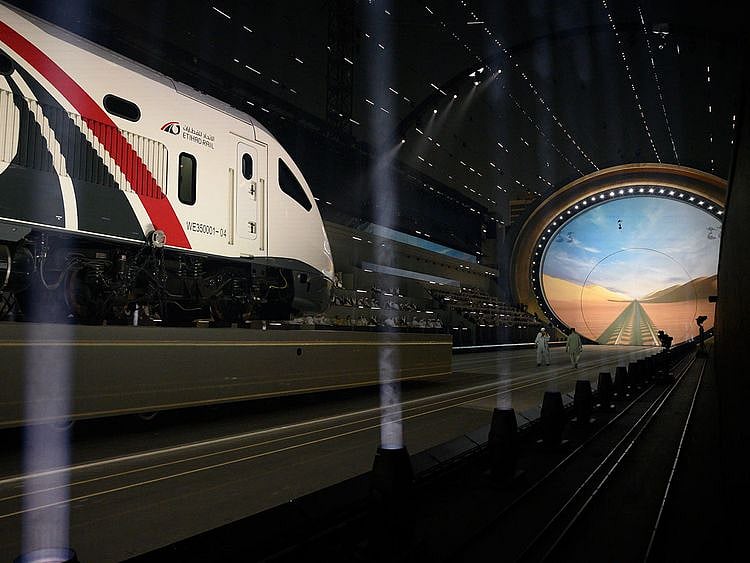
Dubai: Long drives, traffic bottlenecks and short-haul flights have shaped inter-emirate travel in the UAE for years. That is set to change this year, when Etihad Rail will begin carrying passengers across the country for the first time.
The arrival of a national passenger rail service introduces a new way to move between cities. For commuters, families and business travellers, the shift could quietly redefine what a domestic journey looks like in the UAE.
A network built for national scale
Etihad Rail spans 900 kilometres, stretching from Al Sila in Abu Dhabi’s western region to Fujairah on the east coast. When passenger services begin, the network will connect 11 cities and regions across all seven emirates, including Abu Dhabi, Dubai, Sharjah, Al Ruwais, Al Mirfa, Al Dhaid and Ras Al Khaimah.
The rail line was developed in phases. Freight operations began in 2016 with sulphur transport between Shah, Habshan and Ruwais. By 2023, the full nationwide network linking all emirates was completed, enabling cross-country freight movement. Passenger services are the final domestic piece of the plan, with a future phase envisaging rail links across the wider GCC.
Journey times that change the equation
For travellers, the headline figures are hard to ignore. Etihad Rail expects journey times of 57 minutes between Abu Dhabi and Dubai, 70 minutes between Abu Dhabi and Ruwais, and 105 minutes between Abu Dhabi and Fujairah. Trains will operate at speeds of up to 200 km per hour, cutting travel times by around a third compared to driving.
Alongside this network, a separate high-speed rail project is under development that will eventually link Abu Dhabi and Dubai in about 30 minutes at speeds of up to 350 km per hour. That service, unveiled in 2025, will operate with dedicated stations and is positioned as a premium, ultra-fast corridor rather than a replacement for the wider passenger network.
What trains and cabins will look like
Passenger services will run using two train models. Chinese-built CRC coaches will carry around 365 passengers, while Spanish-manufactured CAF coaches will accommodate about 369. Despite minor design differences, both models share the same three-class layout.
Economy Class features face-to-face seating in dark grey, designed for short and medium journeys. Family Class offers opposing seats with larger shared tables, aimed at group travel. First Class provides wider, adjustable seats focused on comfort. All cabins include overhead luggage storage, foldable tables behind seats and dedicated spaces for larger baggage.
Each train can carry up to 400 passengers, with multiple services scheduled daily once operations scale up. Passenger volumes are projected to reach 36.5 million annually by 2030.
Stations and last-mile connections
Major passenger stations are planned in Abu Dhabi, Dubai, Sharjah and Fujairah, with designs inspired by Emirati heritage and facilities that include lounges, retail outlets and family-friendly amenities.
In Abu Dhabi, stations are expected at Reem Island, Saadiyat Island, Yas Island and near the Mussafah and Mohammed bin Zayed City corridor. Dubai’s main station is under construction near Jumeirah Golf Estates Metro Station, with another planned close to Al Jaddaf and Al Maktoum International Airport. Sharjah’s station will sit near University City, while Fujairah’s first passenger station is in Sakamkam.
Crucially, Etihad Rail stations are being integrated with metro and bus networks, along with shared mobility options such as e-scooters and bikes. The aim is to reduce friction at the start and end of journeys, one of the common weaknesses of intercity rail elsewhere.
Ticketing, access and what is still unknown
Passengers will enter stations through smart electronic gates by scanning tickets. Booking is expected to be primarily online, supported by ticket vending machines at stations. Payment options will include cash, debit and credit cards and Apple Pay. No cards will be accepted, following an agreement to integrate Etihad Rail fares with Dubai’s existing public transport system.
Ticket prices have not yet been announced, nor have final timetables or details of connecting transport fares. These are expected closer to launch.
Etihad Rail is also central to the UAE’s logistics and trade strategy, linking ports such as Khalifa Port, Jebel Ali and the Port of Fujairah with industrial zones across the country. Beyond that, the UAE-Oman Hafeet Rail project will connect Sohar to the UAE network, cutting travel times between Sohar and Abu Dhabi to about 1 hour 40 minutes.

Sign up for the Daily Briefing
Get the latest news and updates straight to your inbox
Network Links
GN StoreDownload our app
© Al Nisr Publishing LLC 2026. All rights reserved.