With the addition of Paris and Manila to Gulf Air’s operations from Dammam, the airline now operates flights to 10 international destinations across its network.
UAE, regional aviation 33 days into war: What has changed, what travellers need to know
Airspace closures, reroutes, and airline waivers have redrawn travel across the region
Last updated:
5 MIN READ
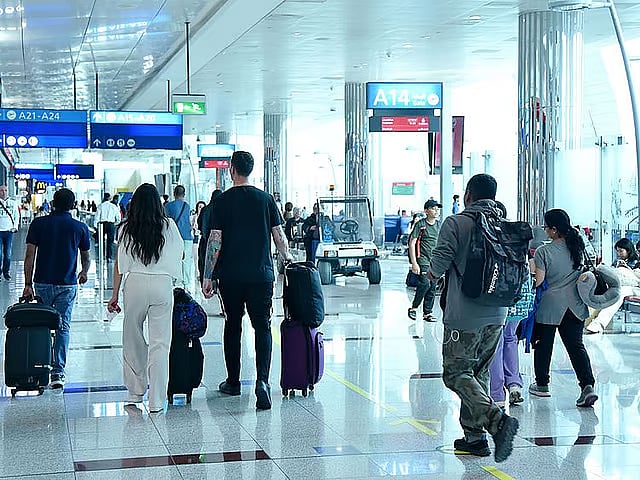
Due to ongoing regional airspace disruptions, UAE carriers have adjusted schedules across major airports.
GN Archives
Dubai: The regional aviation map has changed completely in just over a month. Airspace restrictions, temporary closures, and safety-driven rerouting have forced airlines to suspend some flights, reduce schedules, and reroute many services along longer corridors to avoid affected zones.
The UAE’s General Civil Aviation Authority said its airspace decisions were taken as an “exceptional precautionary measure” following a security assessment and in coordination with national and international authorities.
Get updated faster and for FREE: Download the Gulf News app now - simply click here.
For travellers, the biggest change is that the Middle East is no longer flown as a single connected block. Airlines are now operating around restricted airspace, with some services moving on special or alternate corridors and others being held until airspace is officially declared safe again.
EASA’s conflict-zone guidance for the Middle East advised airlines not to operate in the affected airspace of Iran, Iraq, Israel and Jordan, while also setting specific conditions for Lebanon.
UAE operations changed
UAE aviation has gone from near-normal hub operations to a highly managed, disruption-heavy model. Here’s how UAE airlines were operating pre-war and what they are doing now.
Emirates
Before the conflict began, Emirates was operating at near full strength. In 2025, Emirates moved 55.6 million customers, circled Earth 29,290 times on nearly 180,580 flights, and placed orders for 73 new aircraft.
Investing in the highest levels of luxury hospitality, Emirates also opened its Centre of Hospitality Excellence in Dubai last year to train nearly 25,000 cabin crew in Michelin-star-standard hospitality, featuring an immersive fine-dining restaurant, presentation kitchens, and tech-enabled classrooms.
Today, Emirates is operating a reduced flight schedule after the partial reopening of regional airspace. Recovery is underway, as by mid-March, Emirates had begun operating flights to over 110 destinations. However, operations remain constrained and dependent on geopolitical conditions.
Passengers booked to travel between February 28 and April 30 can rebook on another flight to the same destination or another destination in the same region on or before June 15. Passengers can also request for a refund.
Etihad Airways
Before the war, Etihad was experiencing strong growth. In 2025, the airline carried 22.4 million passengers, up 21 per cent year-on-year, with load factors around 88 per cent, with some days reaching 90 per cent.
Its fleet expanded to 127 aircraft, marking its largest-ever annual growth, and the airline was operating more than 1,000 weekly flights to over 120 destinations.
When the conflict began, operations dropped sharply. In the first few days, scheduled commercial flights were largely suspended, with only a handful of services operating under strict safety approvals.
As operations resumed, Etihad initially operated around 15 flights per day on key routes, a fraction of its normal schedule. Weeks into the conflict, flights have partially resumed, but schedules remain fluid, and capacity is still below pre-war levels, with operations dependent on airspace availability and safety clearances.
Etihad is currently operating between Abu Dhabi and around 80 destinations across the Middle East, Africa, Asia, Australia, Europe and North America. Passengers holding Etihad tickets issued on or before February 28, with original travel dates up to April 15, may rebook free of charge onto Etihad-operated flights up to May 15.
flydubai
Before the war, flydubai was operating at record scale. In 2025, the airline carried 15.7 million passengers, supported by strong demand across regional and mid-haul routes. Its fleet had grown to over 90 aircraft, with plans to exceed 95 aircraft, serving more than 135 destinations in 57 countries.
In January 2026 alone, flydubai recorded 1.4 million seats in capacity, reflecting steady growth and high utilisation. At the height of the crisis, flydubai — like other UAE carriers — suspended most of its flights, with only limited operations restarting in coordination with authorities.
As airspace partially reopened, the airline gradually resumed services, with adjusted schedules and reduced frequencies, particularly on routes affected by restricted airspace. “Flight durations and transit times in Dubai may be longer than usual due to the temporary rerouting of some flight paths,” the airline advised passengers.
Air Arabia
Before the conflict, Air Arabia and its subsidiaries were in expansion mode, particularly in Abu Dhabi. The airline was increasing capacity, with plans to boost operations by up to 40 per cent through fleet expansion.
Across its network, the group operated a fleet of around 50–60 aircraft, focusing on high-density, short- to mid-haul routes across the Middle East, Asia and Europe.
After February 28, Air Arabia was among the carriers that halted most scheduled flights. As operations resumed, the airline gradually restored services, but with reduced frequencies and selective route suspensions, particularly on routes requiring complex rerouting.
Regional airlines
Other airlines in the region, including Qatar Airways, said their scheduled operations remained suspended due to the closure of Qatari airspace. Later, the airline introduced limited relief flights to support stranded passengers. It also offered complimentary date changes and refunds for certain bookings.
In Qatar Airways recently published revised schedule, reflecting the gradual increase in flights to and from Doha, the airline is reaching more than 120 destinations by mid-May 2026 across its global network.
Oman Air
Meanwhile, Oman’s national carrier continues to operate as normal, although some routes have been affected by regional airspace closures.
Services to Amman and Dammam are scheduled to resume from April 1. The airline said flights to and from Dubai, Bahrain, Doha, Kuwait, Copenhagen, Baghdad and Khasab remain cancelled until April 15. Low-cost Omani carrier SalamAir said several of its flights have been affected by regional airspace closures.
Gulf Air
Bahrain’s national carrier, Gulf Air, has suspended operations at Bahrain International Airport following the closure of the country’s airspace. The airline is now running limited commercial flights from King Fahd International Airport in Dammam, Saudi Arabia, to maintain connectivity.
Passengers can book flights to select destinations, including Paris until April 5 and London until April 11. Services to cities such as Mumbai, Chennai, Bangkok, Manila, Frankfurt, Cairo and Nairobi are available for travel until April 30, with more dates expected to be added. Flexible booking options have also been introduced, allowing free rebooking for travel up to April 15 and penalty-free refunds.
Saudia
Saudia has partially resumed flights to and from Abu Dhabi and Dubai, operating reduced services on routes from Riyadh and Jeddah, with a gradual ramp-up planned.
Meanwhile, Saudi low-cost carrier flynas has extended the suspension of flights to multiple regional destinations, including the UAE, Qatar, Bahrain, Kuwait, Iraq and Syria, until April 15.
Network Links
GN StoreAbout Gulf NewsTerms & ConditionsReach by GNSitemapContact usPrivacy PolicyGN FocusHave your sayWork with usAdvertise with usGulf News epaperPrinting Services
Download our app
© Al Nisr Publishing LLC 2026. All rights reserved.