Etihad Airways is increasing Airbus A380 services to Paris as demand for Europe travel rises this summer.
Etihad doubles down on growth plans even as war threatens airline profits, says CEO
UAE flag carrier expects to exceed last year’s operational capacity levels by mid-June
Last updated:
5 MIN READ
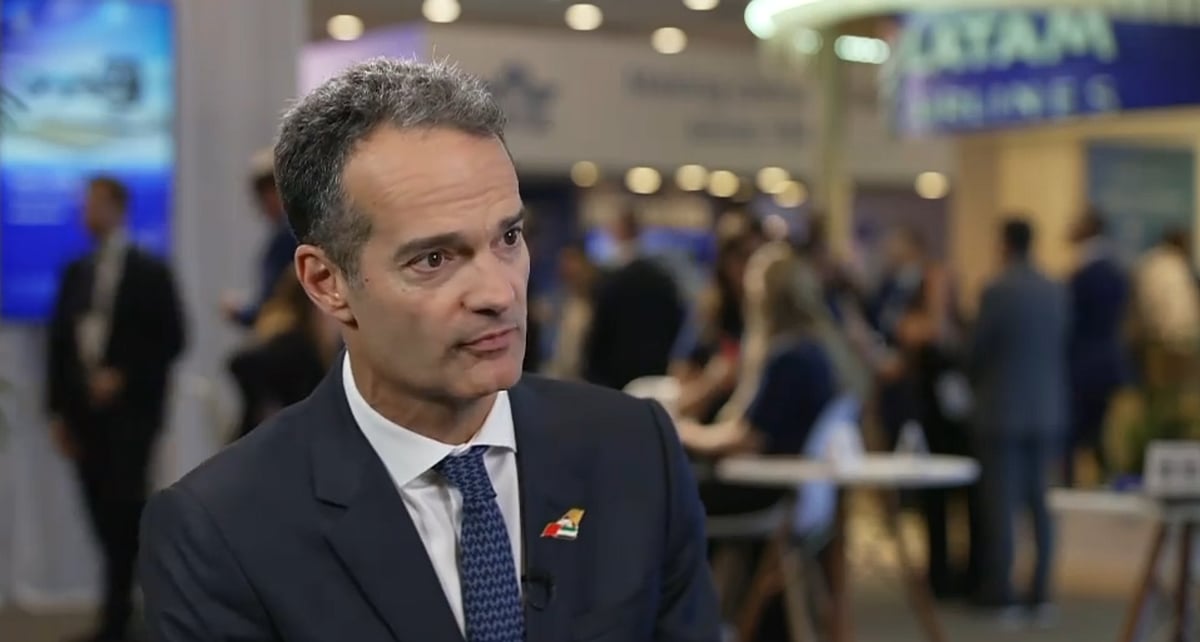
"Foreign investors want to come to Abu Dhabi, and they want to tell Abu Dhabi, I'm here with you," said Neves on recovering corporate travel at the IATA AGM 2026.
Screengrab/ Bloomberg
Rio de Janeiro: UAE’s national carrier Etihad Airways plans to speed up aircraft purchases, route launches and product expansion even as the airline warns it may not make a profit this year because of the Middle East conflict.
The airline’s chief executive, Antonoaldo Neves, told Gulf News on the sidelines of the IATA AGM in Rio de Janeiro, that the carrier remains committed to aggressive growth plans despite the disruption caused by the war and surging fuel prices across the region. “We’re buying planes,” Neves said. “A lot.”
The airline is looking at additional aircraft acquisitions in double-digit numbers as it expands its fleet and network strategy. “We’re going to double the bet,” he said. “We’re going to do whatever we can to accelerate.”
The comments come as the International Air Transport Association (IATA) forecasts Middle East airlines will collectively swing to a $4.3 billion loss in 2026, making the region the only one globally expected to fall into the red.
IATA said Gulf carriers are facing operational disruption, weaker transfer traffic and soaring fuel costs after the war triggered widespread airspace restrictions and uncertainty across the region.
Etihad itself had expected to make around $1 billion in net profit this year before the conflict escalated. “The January and February results were pointing to $1 billion in net profit,” Neves said. When asked how Etihad expects to perform this year, “Maybe we break even. I don’t know, it’s too early to tell.”
On passenger demand, Neves said Abu Dhabi is well on track for recovery by June. "Foreign investors want to come to Abu Dhabi, and they want to tell Abu Dhabi, I'm here with you," said Neves on recovering corporate travel.
How Etihad handled first days of war
Neves described the first days after the conflict erupted on February 28 as highly uncertain for the airline industry. “The first three days were very different,” he said.
“We just grounded the fleet trying to understand how things would evolve.” During that period, the airline focused on assisting stranded passengers, arranging hotels, meals and repatriation flights while authorities assessed the evolving situation.
“You only take care of passengers,” he said. Etihad also faced pressure on customer service systems as travellers rushed to contact airlines.
“There was a spike,” Neves said, referring to the surge in demand at the airline’s contact centre. He added that the airline activated backup systems after an outage linked to Amazon Web Services. “We had zero downtime of contact centre.”
Neves said Etihad then worked closely with regulators and aviation authorities to gradually resume operations.
“We discussed it a lot with GCAA, ATC and everyone in the ecosystem,” he said. After an initial phase focused on passenger care and operational stability, Etihad moved into a transition phase where it slowly added flights back into the market.
“March and April we had a transition phase,” Neves said. “All safe, no safety issue.” He said the airline has now entered a third phase focused on normal business operations.
Etihad summer demand improves
The airline’s passenger demand has gradually recovered in recent months. Neves said Etihad’s load factors — a key measure of how full flights are — improved sharply from April to June.
“Our load factors in March was at 60-65 per cent, in April we were at 75 per cent,” he said. “In May we hit 83 per cent.”
Before the conflict, load factors had been around 88 per cent. Load factors measure how full an airline’s flights are, calculated by comparing the number of seats filled by passengers against the total number of seats available.
Etihad expects to exceed last year’s operational capacity levels by mid-June.
“By June 15, I go to 110,” Neves said, referring to capacity levels compared to last year.
He added that the airline expects revenues to recover by August if conditions remain stable. Still, Neves acknowledged that bookings remain volatile depending on regional tensions and headlines. “It’s going to be volatile, but it’s about the trajectory,” he said.
India, Europe traffic stays strong for Etihad
Despite concerns about travel demand to the Middle East, Etihad said several markets remain resilient. Neves said traffic between India and the US via Abu Dhabi is performing strongly.
“The traffic flow from India to the US and vice versa via the Middle East in our airline is bigger than ever before,” he said. The airline recently increased Chicago flights to double daily services.
Neves also said French travellers continue flying to Abu Dhabi in large numbers, while corporate travel linked to Abu Dhabi investment activity remains stable.
“Corporate travel into Abu Dhabi is at the same level as before,” he said. He noted that some multinational companies are still maintaining internal travel advisories for the region, slowing recovery in connecting corporate traffic.
Fuel prices remains a major concern
Like other airlines globally, Etihad is also grappling with soaring jet fuel prices.
IATA expects jet fuel prices to average nearly 70 per cent higher this year than in 2025, adding roughly $100 billion to airline fuel bills worldwide. Neves said fuel remains around 30 per cent of the airline’s cost base.
“As of now, we’re absorbing everything,” he said, referring to higher fuel costs.
He said intense competition in the Middle East makes it harder for airlines to fully pass those costs onto passengers through fare increases. “We have much more competition in the Middle East than we have in the US,” he said.
Etihad has relied partly on fuel hedging to soften the impact. “We have a good hedging position,” Neves said. Still, he expects jet fuel prices to remain elevated through the end of the year.
China, Africa expansion plans move forward
Etihad is continuing with major network expansion plans despite the challenging environment. The airline plans to significantly expand operations in China and Africa over the coming years.
“We’re going to multiply China by five in one year,” Neves said. The expansion had already been under planning before the conflict started, but the airline has now accelerated parts of the strategy.
“We anticipated China and Africa,” he said. The carrier is also continuing investments in fleet growth and new products.
Neves said Etihad is investing around $2 billion annually in new aircraft as it builds for long-term expansion. “I don’t want to take more debt to finance my growth,” he said.
He added that the airline may suspend dividend payments this year to preserve cash for expansion and operations during the downturn. “If I had to bet, I would bet that doesn’t make sense this year,” he said, referring to dividends.
Fleet flexibility helping Etihad manage crisis
Neves said Etihad’s mix of aircraft types has helped the airline adapt quickly during the crisis. The airline has been shifting aircraft sizes depending on demand conditions across different markets.
“When things are not well, I send a smaller plane,” he said.
“When things are doing very well, I send a bigger plane.” Etihad still has five Airbus A380 aircraft grounded, though Neves said they are expected to return to operations by mid-June.
He said maintaining higher profitability margins during good years was always part of the airline’s long-term strategy to withstand shocks like the current crisis.
“We need to have that buffer to absorb these shocks,” he said.
Network Links
GN StoreAbout Gulf NewsTerms & ConditionsReach by GNSitemapContact usPrivacy PolicyGN FocusHave your sayWork with usAdvertise with usGulf News epaperPrinting Services
Download our app
© Al Nisr Publishing LLC 2026. All rights reserved.