Water mist is sprayed over the crowd to provide relief for mourners gathered at the Imam Khomeini Grand Mosalla in Tehran during funeral ceremonies for Iran's slain Supreme Leader.
Body of Khamenei arrives in Qom ahead of procession; Trump says Iran faces deal or force
US president signals both diplomacy and military options remain open
Last updated:
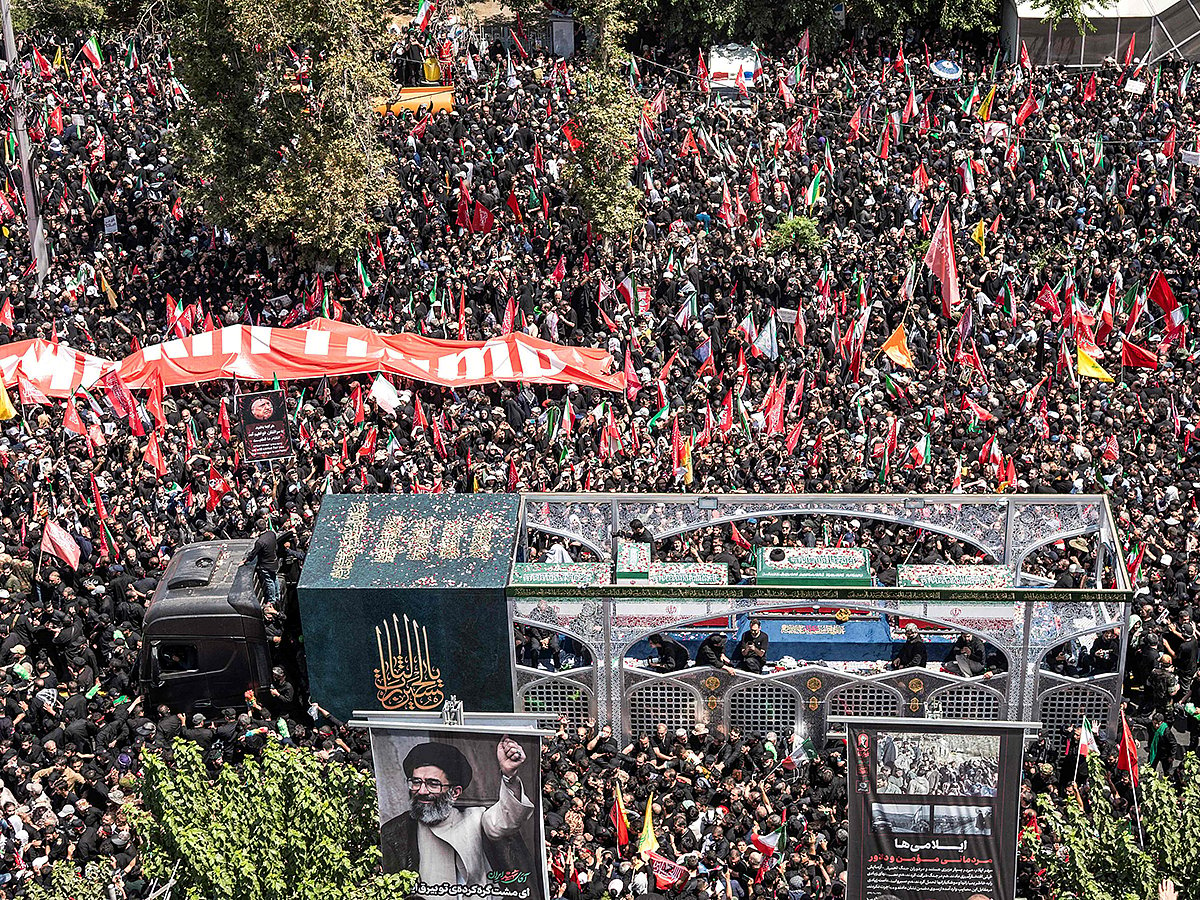
Crowds of mourners surround the convoy carrying the coffins of Iran's slain supreme leader Ali Khamenei and members of his family during a funeral procession near Azadi Square in Tehran on July 6, 2026.
AFP
A massive funeral procession for Iran’s late Supreme Leader Ayatollah Ali Khamenei is unfolding across Tehran, drawing millions amid high security and political tension. At the same time, Iran remains locked in fragile engagement with the US over nuclear and regional issues, while OPEC+ continues to adjust oil output to stabilise energy markets. The developments highlight a volatile mix of mourning, diplomacy and economic recalibration across the Middle East. Follow our live blog for the latest updates:
US‑Israel war on Iran: Recent developments
Day 128: Massive turnout at Khamenei funeral
Day 127: Huge crowds mourn Khamenei
Khamenei’s funeral becomes defiant show of unity — where is Mojtaba?
In a notable development, while millions flooded Tehran's the sprawling Imam Khomeini Grand Mosalla prayer complex, three of Khamenei's sons — Mostafa, Meysam and Masoud — made a rare public appearance during funeral prayers.
However, there was no sign of his designated successor, Mojtaba Khamenei, fueling continued speculation over his health after reports that he was seriously wounded in the same strike that killed his father.
Reuters reported Mojtaba remains out of public view, while Iranian authorities have not publicly explained his absence.
Senior Iranian leaders, including President Masoud Pezeshkian and Parliament Speaker Mohammad Bagher Ghalibaf, joined military commanders and clerics in leading the ceremonies, underscoring the government's efforts to project stability despite months of war and political uncertainty.
The funeral comes more than four months after Khamenei, who led the Islamic Republic for nearly four decades, was killed alongside several members of his family in a U.S.-Israeli strike at the outset of the war that erupted on Feb. 28. His death marked the most significant leadership change in Iran since he succeeded Ruhollah Khomeini in 1989.
The ceremonies also took on a strongly political tone. Many mourners waved Iranian flags and banners while chanting anti-US and anti-Israel slogans, with some calling for retaliation over Khamenei's assassination.
The funeral has become both a religious observance and a national demonstration of resistance following the conflict that devastated parts of Iran before ending in a fragile ceasefire.
Get updated faster and for FREE: Download the Gulf News app now - simply click here
Get updated faster and for FREE: Download the Gulf News app now - simply click here.
7 OPEC+ countries agree to expand monthly oil production modestly
A handful of countries in the OPEC+ oil-producing alliance plan to increase their outputs modestly next month, which would bring more oil online after fuel prices have fallen to levels not seen since before the U.S. and Israel's war with Iran.
The Organization of the Petroleum Exporting Countries and its allies - collectively known as OPEC+ - announced on Sunday that seven countries would expand oil production by a combined total of 188,000 barrels per day in August. It was the fifth consecutive month OPEC+ agreed to raise oil outputs.
The participating countries in Sunday's decision are Saudi Arabia, Russia, Iraq, Kuwait, Kazakhstan, Algeria and Oman.
"The countries will continue to monitor and assess market conditions, and in their continuous efforts to support market stability, they reaffirmed the importance of adopting a cautious approach," the group of oil producers said in a statement.
Huge crowds expected at Iran leader's funeral procession
A woman weeps at the Imam Khomeini Mosalla Grand Mosque during funeral ceremonies for the slain Iranian Supreme Leader Ayatollah Ali Khamenei and members of his family in Tehran, Iran, Sunday, July 5, 2026.
Massive crowds are expected today for the funeral procession of late Iranian supreme leader Ali Khamenei in Tehran, with authorities hoping to avoid a repeat of the chaos that accompanied his predecessor's funeral.
After lying in state in Tehran's Grand Mosalla religious complex for two days, Khamenei will be processed through the city for 10 to 12 hours starting at 6:00 am (0230 GMT), organisers said.
The 1989 funeral of his predecessor, Ayatollah Ruhollah Khomeini, drew some 10 million people, according to state news agency IRNA, and crowd surges killed more than 10 people and injured over 10,000.
Thousands had filled the Grand Mosalla on Sunday, where they paid their respects to Khamenei and four family members, all killed on February 28 in Israeli airstrikes based on US intelligence.
Massive concrete walls separated the public from the coffin to prevent stampedes.
It is unclear what level of access and proximity the public will have during the procession, but authorities are mindful that in 1989 they were forced to use a helicopter to transport Khomeini for burial after mourners stormed his vehicle, causing his burial shroud to tear and his body to fall to the ground.
Get updated faster and for FREE: Download the Gulf News app now - simply click here.
Iran’s Ghalibaf hails MoU as ‘achievement for Axis of Resistance’
Iran’s Parliament Speaker Mohammad Bagher Ghalibaf has met Mohammed Al-Nuaimi, Vice Chairman of Yemen’s Houthi Supreme Political Council, describing a recent memorandum of understanding with the United States as a political win for Tehran’s “Axis of Resistance”.
According to Iranian media, Ghalibaf claimed the US and Israel were compelled to effectively recognise Iran’s regional allies, calling it a key outcome of the agreement.
“The United States and Israel were forced to practically recognise Iran’s allies in the Axis of Resistance, and this is one of the achievements of this memorandum,” he said.
He further described the MoU as a “defeat for the United States and an achievement for the Axis of Resistance, both militarily and politically,” warning that Washington and Tel Aviv could “resort to war” if they detect any perceived Iranian weakness.
The “Axis of Resistance” is a term used for Iran-aligned regional groups, including Hezbollah in Lebanon, Yemen’s Houthi movement, Hamas in Gaza, and allied armed factions in Iraq.
US Navy suspends search for missing sailor in MH-60S helicopter incident
The US Navy has suspended its active search for a missing sailor after more than four days of extensive search-and-rescue operations. The sailor was aboard the MH-60S helicopter that went down in the Arabian Sea last week, the Navy said in an official statement.
The sailor, assigned to Helicopter Sea Combat Squadron (HSC) 5 aboard the aircraft carrier USS George H.W. Bush (CVN 77), was reported missing on July 1 after the helicopter went down. The search was officially suspended at 3:00pm Arabian Standard Time on July 5.
"The US Navy suspended the active search for a Sailor assigned to Helicopter Sea Combat Squadron (HSC) 5 embarked aboard aircraft carrier USS George H.W. Bush (CVN 77)," the statement said. The Navy added that the sailor's identity is being withheld "until at least 24 hours after next-of-kin notification is complete in accordance with Navy policy."
According to the Navy, the search lasted more than 102 hours and covered over 14,000 square miles in the US Central Command area of responsibility.
The operation involved a broad range of US naval and air assets, including the aircraft carriers USS George H.W. Bush and USS Abraham Lincoln, multiple helicopter squadrons, Carrier Air Wings 7 and 9, Arleigh Burke-class guided-missile destroyers USS Ross, USS Donald Cook, USS Higgins, USS Mason and USS John Finn, two P-8 Poseidon squadrons, and multiple US Air Force aircraft.
Iran begins procession through Tehran for Khamenei's funeral
Iran began a procession Monday through its capital, Tehran, for the funeral of the late Supreme Leader Ayatollah Ali Khamenei.
Khamenei's flag-draped coffin, and those of his family killed Feb. 28 in an airstrike at the start of the war launched by Israel and the United States, will be carried on board a truck.
They will be taken through the streets of Tehran on their way to Mehrabad International Airport.
Iran's theocracy plans to see large crowds attend the ceremony across the city to show popular support for the government.
Iranian state television reported the procession had started.
Authorities have shut down streets, airspace and daily life for the mourning, which will end Thursday as the 86-year-old Khamenei is buried at the Imam Reza shrine in Mashhad, his birthplace.
The US is meanwhile pressing ahead with negotiations with Iran aimed at fully reopening the Strait of Hormuz, rolling back its disputed nuclear program and reaching a permanent end to the war. Talks appear to be on hold until after the burial.
Mohseni-Ejei reappointed as Iran’s judiciary chief
Iran's Judiciary Chief Gholamhossein Mohseni Ejei (L) attends a gathering.
Iran’s Supreme Leader has reappointed Gholam-Hossein Mohseni-Ejei as head of the country’s judiciary.
In a decree, Mojtaba Khamenei praised Mohseni-Ejei for his “valuable and sincere efforts” during his previous tenure as judiciary chief.
Ghalibaf says Lebanon peace tied to Iran’s regional role
Iran’s Parliament Speaker Mohammad Bagher Ghalibaf has said lasting peace in Lebanon is not possible without what he described as Tehran’s stabilising role in the region.
He made the remarks during a meeting in Tehran with senior Hezbollah official Muhammad Fneish, who is in Iran for the funeral ceremonies of Ali Khamenei.
Ghalibaf also said Lebanon featured prominently in talks leading to the Iran–US MoU, according to Iranian media.
Israeli defence minister warns Iran leaders
Israeli Defence Minister Israel Katz has warned that any Iranian leader who “attempts to advance plans to destroy Israel will be thwarted,” according to CNN.
Speaking as Iran holds a multi-day funeral for its slain leader Ayatollah Ali Khamenei, Katz said he was targeted by Israel for allegedly leading plans against Israel across the region, a spokesperson said.
He added that US–Israel strikes on Iran had “removed the immediate existential threats facing Israel” and significantly weakened Iran’s strategic capabilities.
Katz also criticised chants of “Death to Trump” at the funeral, calling them “disgraceful” and reflective of what he described as the nature of the Iranian leadership.
Khamenei coffin convoy travels across Tehran streets
'Iran Supreme Leader's death taught importance of unity': Iran President
Iran's President Masoud Pezeshkian on Sunday said that the demise of the former Supreme Leader Ayatollah Khamenei has taught people the importance of unity.
In a post on X, Pezeshkian said, "The leadership of the martyr taught everyone that Iran's greatest asset is its people and their unity. Today, too, by acting upon the divine command "that you stand for Allah in twos and singly," with empathy, concord, and sincere service to the people, we will continue the path of Iran's honor, progress, and glory."
Hamas dissolves Gaza governing body: Official
Hamas announced Monday the dissolution of the body that has governed the Gaza Strip for nearly two decades, clearing the way for a technocratic committee to implement civilian rule.
"The head of the government's emergency committee Mohammed al-Farra has officially submitted his resignation. He has also decided to dissolve the committee to facilitate the administrative and governmental transition to the National Committee for the Administration of Gaza (NCAG)," Ismail al-Thawabta, head of Hamas' government media office told AFP.
The NCAG was created by the Board of Peace that US President Donald Trump established when he brokered the ceasefire between Hamas and Israel in October 2025.
Israeli strike on south Lebanon kills 4, including 3 women
Lebanese state media said an Israeli strike on a car in the country's south on Monday killed four people, including three women, despite a fragile ceasefire between Israel and Hezbollah.
Lebanon's official National News Agency (NNA) said a school principal, her mother, a foreign female domestic worker and a male Syrian worker were killed when "an Israeli drone targeted the car" they were travelling in as they returned from inspecting their family home in Nabatieh al-Fawqa.
Israel has kept up intermittent strikes on south Lebanon, particularly in the Nabatieh area, despite the two-week-old truce, usually saying it is targeting Hezbollah sites and operatives, with both sides accusing the other of violations.
Israeli occupation in south preventing army deployment: Aoun
Lebanon's president said Monday that Israel's occupation of the south was preventing the Lebanese army's deployment to the area, as the two sides prepare to implement a deal involving the deployment and gradual Israeli withdrawal.
According to a statement from his office, President Joseph Aoun emphasised the need to pressure Israel to withdraw its forces "because the persistence of the occupation undermines the legitimacy of the (Lebanese) state and prevents the army from deploying and the laying of the foundations for achieving a just and lasting peace".
Body of Khamenei arrives in Qom ahead of procession
The body of Iran's late supreme leader Ali Khamenei arrived in the holy city of Qom on Monday evening, hours after a sea of people filled the streets of Tehran for his funeral procession in the capital.
Ordinary Iranians loyal to the Islamic republic joined top officials for the event, in which a truck carrying the bodies of Khamenei and four family members killed in a February 28 US-Israeli strike inched its way to Azadi Square in the west of the city.
Monday's procession will be followed by similar events in Qom on Tuesday and in Iraq's holy cities of Najaf and Karbala on Wednesday.
"The body of the martyred leader has arrived in Qom," south of the capital, state television said on social media, alongside footage showing a helicopter carrying Khamenei's body landing in the city.
Trump says Iran faces deal or force
US President Donald Trump on Monday said his administration remained open to reaching a nuclear agreement with Iran but warned that Washington was prepared to use military force if negotiations failed, insisting Tehran would never be allowed to acquire a nuclear weapon.
Speaking at the White House following the launch of the "Trump Accounts" investment programme, Trump said diplomacy remained his preferred option but declared the United States would "finish the job" if a deal could not be reached.
"We're going to win one way or the other," Trump said. "We're either going to make a deal or we're going to finish the job."
The President said preventing Iran from obtaining a nuclear weapon remained the administration's overriding objective.
"I went in for one reason very strongly — that Iran cannot have a nuclear weapon," he said. "I'm not looking for regime change."
Trump nevertheless argued that recent military action had significantly weakened Iran's armed forces.
"We have completely destroyed" its military capabilities, he said, claiming Iran no longer possessed operational naval vessels, aircraft or radar systems.
He also linked military operations to stability in global energy markets, saying the United States had prevented oil prices from surging despite tensions in the Gulf.
"A lot of people were saying that oil could go to 300, 350 dollars a barrel," Trump said. "That prediction wasn't right."
Trump said the US naval blockade had disrupted Iranian oil exports before being eased as diplomatic contacts resumed.
"Our great Navy... did the greatest blockade anyone's ever seen," he said. "We then freed up the blockade because we're close to maybe making a deal."
While expressing hope that diplomacy would succeed, Trump warned that the United States retained the capability to strike critical Iranian infrastructure.
"We can knock down their bridges in one hour," he said. "We can knock out their energy supply... every plant will be gone."
The President argued that military action remained an option but said he preferred a negotiated settlement to avoid further suffering.
"I'd rather make a deal because I don't want to affect 91 million people," Trump said.
Trump also suggested that developments inside Iran had produced a more pragmatic leadership, although he stopped short of declaring success.
"I think the third regime is more reasonable," he said. "But we'll find out."
Arab League Secretary-General, Egyptian Foreign Minister stress importance of advancing joint Arab action
Arab League Secretary-General Nabil Fahmy and Egyptian Minister of Foreign Affairs, Emigration and Egyptian Expatriates Badr Abdelatty have stressed the importance of advancing the joint Arab action framework and strengthening coordination among Arab countries to address regional and international challenges.
The remarks came during two meetings held today at the Arab League General Secretariat headquarters.
The first was with the Egyptian Foreign Minister, while the second brought together the heads and directors of specialised Arab organisations.
Tanker off Oman coast in the Strait of Hormuz set ablaze by projectile
A tanker traveling off the coast of Oman in the Strait of Hormuz caught on fire early Tuesday morning after being struck by a projectile, the British military said.
The United Kingdom Maritime Trade Operations centre said the tanker had been hit near Limah, Oman, in the strait.
It said the projectile hit the port side of the vessel while trying to traveling south out of the strait toward the Gulf of Oman.
We are closing this coverage now. For the latest updates, click here.
Sign up for the Daily Briefing
Get the latest news and updates straight to your inbox
Network Links
GN StoreAbout Gulf NewsTerms & ConditionsReach by GNSitemapContact usPrivacy PolicyGN FocusHave your sayWork with usAdvertise with usGulf News epaperPrinting Services
Download our app
© Al Nisr Publishing LLC 2026. All rights reserved.