US–Iran ceasefire under strain as Iranian drones target Bahrain, ship hit in Strait of Hormuz
Hormuz shipping on edge after tanker hit, Iran and US trade fresh strikes
Highlights
We are closing this coverage now. For the latest updates, click here.
Netanyahu says deal with Lebanon a 'blow to Iran, Hezbollah'
Israel's Prime Minister Benjamin Netanyahu on Saturday hailed the US-brokered agreement with Lebanon, calling it a historic achievement that dealt a blow to arch-foes Iran and Hezbollah.
"Yesterday ... we achieved a historic deal for the state of Israel after direct negotiations between Israel and Lebanon," Netanyahu said in a televised briefing. "This is a blow to Iran and Hezbollah."
Netanyahu reiterated that Israeli forces would remain in the so-called security zone established by the military some 10 kilometres (six miles) inside the Lebanese territory.
We will continue to hold this security zone until Hezbollah and all other terrorist organisations are fully disarmed and no longer pose any threat to Israel from Lebanese territory.Benjamin Netanyahu
"We will remain in the area until Hezbollah and the rest of the terror groups are disarmed," he said.
"Both the United States and Lebanon have recognised Israel's right to maintain a security zone inside Lebanon for as long as it remains necessary to safeguard our security.
One killed in Israeli airstrikes on southern Lebanon
Israeli airstrikes hit the southern Lebanese town of Nabatieh al-Fawqa on Saturday evening, Lebanon’s National News Agency (NNA) reported.
The Lebanese health ministry said one person was killed and two others were injured in the strikes.
Authorities have not immediately provided further details on the incident
France says ready to help implement Lebanon-Israel deal
France said that it was "ready to contribute" to the framework agreement signed the day before by Lebanon and Israel, adding it should pave the way for the full restoration of Lebanese sovereignty.
The agreement was signed in Washington on Friday after five rounds of talks, and it includes a process aimed at disarming Hezbollah. But Hezbollah's leader Naim Qassem has rejected the agreement, accusing the Lebanese government of surrendering sovereignty.
"Committed to the security of Israel as well as that of Lebanon and engaged in maintaining peace in South Lebanon, France stands ready to contribute to the implementation of this framework agreement, and to the achievement of all these objectives," the French Foreign Ministry said in a statement.
It said the agreement must pave the way for the full restoration of Lebanese sovereignty.
It also backed the Lebanese government's "full monopoly on weapons" and the withdrawal of the Israeli army from Lebanese territory.
Lebanon state media reports Israeli strikes in south
Israeli forces carried out drone and air strikes in southern Lebanon on Saturday, Lebanon's state news agency reported, a day after the countries signed a agreement to pave the way to peace talks.
According to the National News Agency (NNA), Israeli warplanes hit an unidentified target in Nabatieh al-Fawqa at around 6:30 pm (1530 GMT). Earlier in the afternoon, drones carried out four strikes on the town square and the Al-Manzala neighbourhood.
Get updated faster and for FREE: Download the Gulf News app now - simply click here.
Israel says it will act against Iran over Lebanon deal
Israeli defence minister vowed to respond with "great force" if Iran attacked Israel in an attempt to prevent the implementation of an agreement with Lebanon aimed at securing peace between the two countries.
"If Iran tries to attack Israel to prevent the implementation of the agreement, we will act against it with great force," Israel Katz said in a video statement, adding that the agreement with Lebanon had dealt a "strategic blow to the Iranian axis".
Iran stats agency says year-on-year inflation hits 88.6%
Inflation in Iran rose sharply in June, driven by the Middle East war, reaching a peak of 88.6 percent year-on-year according to official figures released on Saturday.
According to the Statistical Centre of Iran, during the Persian month of Khordad (May 22-June 21), food prices more than doubled year-on-year. Even before the war, Iran was plagued by high inflation.
UAE steps up relief aid for people in Lebanon
Under the directives of President His Highness Sheikh Mohamed bin Zayed Al Nahyan, the UAE is providing humanitarian assistance through the UAE Aid Agency to support those affected by the crisis in Lebanon.
Officials said the aid reflects the UAE’s commitment to rapid humanitarian response, ensuring access to food, medicine, clothing and shelter for affected communities.
Tareq Ahmed Al Ameri, Chairman of the UAE Aid Agency, said the agency continues to support disaster-hit populations with essential relief supplies.
Relief materials, including food supplies, will be delivered in coordination with Lebanon’s Higher Relief Council to ensure swift distribution.
Lebanon’s ambassador to the UAE, Tariq Hassan Munaymina, expressed gratitude for the UAE’s continued solidarity and humanitarian support.
Get updated faster and for FREE: Download the Gulf News app now - simply click here.
Hezbollah rejects Israel-Lebanon framework deal
Hezbollah leader Naim Qassem has rejected the framework agreement between Israel and Lebanon, calling it invalid and urging it to be replaced by an Iran–US understanding.
He described the Washington-brokered deal as “humiliating, shameful, and a surrender of sovereignty,” adding that it is “null and void” and should not be implemented.
Qassem further said the provisions of an Iran–US memorandum of understanding should instead be applied.
UAE, Lebanese Presidents discuss regional developments
UAE President His Highness Sheikh Mohamed bin Zayed Al Nahyan and Joseph Aoun, President of the Lebanese Republic, spoke by telephone today to discuss bilateral relations and ways to further strengthen cooperation in support of both countries’ interests and the prosperity and wellbeing of their peoples.
The call also covered the latest developments in Lebanon and ongoing efforts to reinforce the country’s security, stability, sovereignty and territorial integrity.
President Aoun expressed his appreciation to His Highness for the UAE’s support for Lebanon and its people, and wished the UAE continued progress and prosperity.
The two leaders also reviewed a number of regional issues of mutual interest, particularly developments in the Middle East. They underscored the importance of continuing efforts to strengthen security and stability and advance peace across the region in support of the development and prosperity of its nations and peoples.
Qatar condemns Iranian drone attacks on Bahrain
Qatar’s foreign ministry has strongly condemned Iranian drone attacks on Bahrain, warning against actions that could further destabilise the region.
In a statement, the ministry emphasised the need to “spare the region the consequences of these unjustified attacks” and urged all parties to avoid escalation.
It also called for continued dialogue and diplomacy, de-escalation efforts, and building on existing understandings under the framework of the memorandum of understanding, saying such steps are essential to strengthening security and stability at both regional and international levels.
Israel military says targeted suspected militants in south Lebanon airstrike
The Israeli military said it carried out an airstrike targeting suspected militants in the Nabatieh area of southern Lebanon, the first such attack since Washington announced a framework agreement between Israel and Lebanon.
An Israeli military spokeswoman told AFP that the strike targeted "suspected terrorists who posted a threat to IDF soldiers" in the Nabatieh area.
Iran claims strike on US-linked targets after airstrikes
Iran said it struck US-linked targets in response to American airstrikes on its southern coast, calling the attacks a violation of the UN Charter and a war-ending memorandum between the two sides, according to a Reuters report. The foreign ministry statement said Tehran carried out retaliatory strikes on targets connected to US forces after the reported strikes.
Iran did not identify the targets or disclose their locations.
US violated Strait of Hormuz MoU, Iran claims
Mohsen Rezaei, adviser to Iran’s Supreme Leader Mojtaba Khamenei, has accused the United States of breaching Article 5 of a Memorandum of Understanding on the Strait of Hormuz, which calls for the restoration of safe passage for commercial vessels and outlines Iran–Oman talks on the waterway’s future administration and maritime services.
In a post on X, Rezaei said the US has violated the provision “by continuing to create tensions in the Strait of Hormuz”.
“The response to the violation of any article of the memorandum of understanding will be swift and decisive,” he added.
Kuwait condemns Iranian drone attack on Bahrain
Kuwait has condemned the alleged Iranian drone attack on Bahrain, expressing full solidarity with Manama after it accused Tehran of targeting its territory.
In a statement, Kuwait's Foreign Ministry said the attack undermined regional and international efforts to de-escalate tensions and threatened the security and stability of the region.
It also reaffirmed support for all measures Bahrain takes to protect its sovereignty, security and territorial integrity.
UAE denounces Iran-linked drone attacks targeting Bahrain
The UAE has strongly condemned hostile drone attacks carried out by Iran that targeted Bahrain.
In a statement, the Ministry of Foreign Affairs (MoFA) said the attacks were a clear violation of Bahrain’s sovereignty and a threat to its security and stability.
The ministry expressed the UAE’s full solidarity with Bahrain and its support for all measures aimed at protecting its security and maintaining stability.
Strait of Hormuz route is being expanded: Maritime body
A maritime body overseen by the US Navy said Saturday that a route through the Strait of Hormuz near Oman's shores is expanding to allow for both inbound and outbound traffic.
The announcement by the Joint Maritime Information Center serves as another warning to Iran that the US is pushing to reopen the strait.
Iran has insisted ships must obey its orders and is warning it will start charging fees for transit through the strait, through which a fifth of all oil and natural gas once passed.
The US and Gulf Arab states have rejected Iran's demands. The strait is considered around the world as an international waterway, despite being the territorial waters of Iran and Oman.
Oil tanker hit by 'unidentified projectile' in Strait of Hormuz
An oil tanker in the Strait of Hormuz was struck and damaged by an "unidentified projectile", British maritime security agency UKMTO said on Saturday, following the first exchange of fire between the US and Iran since their deal to end the Middle East war.
"The vessel sustained damage to their bridge; all crew are reported safe," UKMTO said, while another British marine security firm, Vanguard Tech, said the vessel was the Panama-flagged tanker KIKU.
Iran's Revolutionary Guards, the ideological arm of the military, announced on Saturday that they had attacked American positions in the Gulf after US strikes on Iran.
Bahrain says targeted by several Iranian drones
Bahrain said it was targeted by several Iranian drones early on Saturday, with the kingdom’s Ministry of Foreign Affairs condemning the attack “in the strongest terms” and describing it as a flagrant violation of its sovereignty.
In a statement carried by the Bahrain News Agency (BNA), the ministry said the drone attack threatened the safety of citizens and residents and constituted a clear breach of international laws and conventions prohibiting attacks on civilian infrastructure and the intimidation of civilians.
Get updated faster and for FREE: Download the Gulf News app now - simply click here.
Gargash hails Lebanon-Israel framework as a positive step
Dr Anwar Gargash, Diplomatic Adviser to the UAE President, has welcomed the US-sponsored framework agreement between Lebanon and Israel, saying it is an important step towards restoring Lebanon's full sovereignty and reinforcing the authority of the state.
In a post on X, Gargash said the agreement represented "an important and positive step" towards enabling Lebanon to regain full sovereignty over its territory. He added that the Lebanese people had endured the consequences of conflicts fought by others on their land for decades and had paid a heavy price.
Iran accuses US of 'blatant violation' of peace deal
Iran on Saturday accused the United States of a "blatant violation" of the peace deal reached between the two sides to end the Middle East war after the latest American strikes on the country.
"These brutal attacks, which targeted Iranian coastal surveillance facilities, are a blatant violation" of the memorandum of understanding to end the war, the Iranian foreign ministry said in a statement.
The US military said its forces struck Iranian missile and drone storage sites and coastal radar locations on Friday in response to an Iranian attack on a cargo ship transiting the strategic Strait of Hormuz.
UN seeks return to status quo in Strait of Hormuz
UN Secretary-General Antonio Guterres hopes that the Strait of Hormuz could return to its status quo ante, said his spokesperson.
Asked at a daily briefing on Friday (local time) where Guterres hopes that the Strait of Hormuz will return to how it was before the US-Israel conflict against Iran began, Stephane Dujarric, the spokesperson, said: "I think we have to remain determined.
The Strait of Hormuz, prior to the opening of this conflict, actually worked, right? So we know it can, and we should go back to that."
Dujarric said the United Nations welcomed the signing of the memorandum of understanding (MoU) between the United States and Iran, which covers the issue of the Strait of Hormuz, noting that it is important that all sides honour their commitments, reports Xinhua news agency.
"We are keen to see a sustained reopening of the Strait of Hormuz, based on the concept of freedom of navigation," said Dujarric.
"It is important that all parties involved keep their eyes on the greater good - the greater good of regional stability, the greater good of global stability."
Get updated faster and for FREE: Download the Gulf News app now - simply click here.
Iran Guards say targeted US sites in response to strikes
Iran's Revolutionary Guards said Saturday that they had attacked US sites in the Gulf region in retaliation to American strikes in Iran, according to state television.
The US military had earlier announced that it had struck targets in Iran in response to an attack on a commercial vessel in the Strait of Hormuz, which it attributed to Tehran.
"If the aggression is repeated, our response will be broader than this," the Guards said, according to a post by state TV on Telegram.
Ebrahim Azizi, Member of Islamic Consultative Assembly of Iran, meanwhile said that the US does not commit to ceasefire and the blame game does not work anymore.
In a post on X, he said, “ The US attacked Iran in the middle of negotiations once again. The failed US President has shown he has no commitment to the principles of negotiation or a ceasefire. This reckless violation of the ceasefire will, as always, lead to retreat and regret on their part. The blame game does not work anymore.”
Iran warns of 'unprecedented' response to US attack
Ibrahim Al Fiqar, Official military Spokesperson for Iran's Khatam Al Anbiya Central Headquarters, the operational command center that coordinates the Islamic Revolutionary Guard Corps (IRGC) and the regular Iranian army, said that Iran's response ‘to the US attack’ this time will be unprecedented.
Al Fiqar said that Iran will choose the appropriate time and place to answer back.
In a series of posts on X, he said, "We affirm that this aggression will not go unanswered, and we will choose the appropriate time and place. We warn that any further act of folly will be met with a harsh response that will shatter the illusions of the aggressors in the region. No retreat... Our response will shake the earth to its core, and will erase your military presence as if it never existed. When the three numbers match tonight, the flow will cease and the silence will become a storm. There will be nothing to say, only what will be seen. No summons and no options.. This is an unprecedented night, in which gunpowder will write the final line in your illusions. The response to the US attack will be swift and decisive."
He stated further, "Your audacity was what started the equation, and our platforms will complete it tonight... on a night unprecedented in its magnitude. All eyes are turned to the sky... Tonight is unprecedented, and the fire will paint the new stage. Our response this time will be unprecedented."
Vance warns US will respond to any Iran attack with 'violence'
US Vice President JD Vance on Friday warned Iran it will face "violence" if it carries out any further attacks after the US military said it had responded to an Iranian strike against a cargo ship.
"Iran signed a ceasefire agreement. We have honored it. If they have disagreements about how the MOU is being applied, they can pick up the phone. But violence will be met with violence," Vance posted on X, referring to the memorandum of understanding meant to stop nearly four months of conflict.
Iran violated ceasefire: Trump
The US struck Iran in response to a drone attack a day earlier on a cargo ship in the Strait of Hormuz. It's the most significant test yet to an interim understanding reached a week ago by the two countries to begin working to end their months-long war and reopen the pivotal waterway.
US President Donald Trump said the drone attack violated the ceasefire. The strikes came shortly after Trump told reporters, "You'll find out," whether the US would respond.
US Central Command said the military struck missile and drone locations and coastal radar sites in Iran.
"I don't like the fact that they took a shot yesterday, actually four of them," Trump said at the White House shortly before the US struck back. When asked why there would be strikes when Trump has insisted talks with Tehran are going well, Trump said of Iran: "They're a little bit different."
He then abruptly cut off questions and reporters were ushered out of his office.
US strikes Iran sites after cargo ship attack
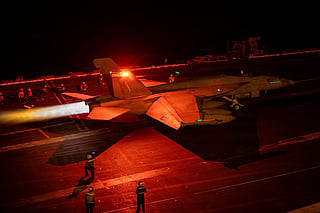
US forces struck Iranian missile and drone storage sites and coastal radar positions Friday after Washington accused Tehran of attacking a cargo ship, jolting a fragile ceasefire as diplomats struggled to contain the Middle East war.
US Central Command said the strikes were a response to "unwarranted aggression against commercial shipping by Iranian forces" that "clearly violated the ceasefire."
It described the operation as "a powerful response to yesterday's attack on a commercial ship that was transiting the Strait of Hormuz."
Iranian state television, citing a reporter in Sirik, said an explosion was heard late Friday at Taherouyeh pier in the southern port city.
It quoted an informed military source as saying the blast was caused by a projectile impact in the area.
US President Donald Trump had earlier denounced what he described as an Iranian drone strike on the vessel, saying: "Obviously, this is a foolish violation of our ceasefire agreement."
The exchange raised fresh questions about efforts to keep the Strait of Hormuz open while Washington and Tehran negotiate a final settlement to a war that began with US-Israeli strikes on Iran on February 28.
Iran has warned vessels not to enter or leave the Gulf through the Strait of Hormuz without permission, but ships have continued to move, some using a route not authorized by Tehran.
Around half of the 42 vessels that made the passage on Thursday used a non-approved southern route along the coast of Oman, according to the Kpler tracking platform.
The UN maritime agency said an evacuation operation had freed 115 vessels and 2,500 seafarers trapped by the dispute before the attack forced its suspension.
Oil prices nevertheless fell sharply, reflecting hopes that traffic through the strategic strait - which normally sees around a fifth of the world's oil and gas exports - would keep recovering despite the latest flare-up.
Lebanon framework
Israel and Lebanon hailed an agreement signed with the United States to pave a way towards peace on their front in the war, although Iran-backed Hezbollah warned the deal would thwart plans to resolve the broader conflict.
At a signing ceremony in Washington, US Secretary of State Marco Rubio, flanked by Israeli and Lebanese envoys, said the trilateral accord "begins to put in place a framework for lasting peace and security."
"It's the beginning of the beginning. There's a lot of work ahead," he said.
Israeli Prime Minister Benjamin Netanyahu welcomed the framework as a victory against Iran, which argues that the Lebanon front is inseparable from the wider war and should be resolved as part of Tehran's talks with Washington.
"Iran has been trying to force us to withdraw from southern Lebanon through pressure but, in effect, Israel, Lebanon, and the United States are telling them: this is none of your business," Netanyahu said.
"You have no role in Lebanon - not you, not Hezbollah and not any terrorist organization."
Netanyahu said the agreement would allow the Lebanese army to return to two "pilot areas" in southern Lebanon, but that Israeli forces would remain in their security zone until Hezbollah is disarmed. Displaced civilians will be prevented from returning.
Lebanese President Joseph Aoun welcomed the unpublished framework as a "first step" toward civilians returning home "under the sovereignty of the Lebanese state."
"There will be no more occupation, prisoners, subordination or tutelage," he said.
But Hezbollah MP Hassan Fadlallah said the Washington signing sought to undercut the US-Iran ceasefire, which he said envisioned Lebanon being settled through the wider peace process.
The Lebanese government, he warned, would be unable to impose the agreement "unless they go, with American support, to civil war."
Nuclear safeguards
The chief of the UN nuclear watchdog, meanwhile, warned that any final US-Iran settlement would need strong safeguards to ensure Tehran does not build a nuclear weapon.
Iran's nuclear program remains a central sticking point in the talks, with Tehran and Washington giving conflicting accounts of whether UN inspectors will regain access to Iranian facilities.
"The government of Iran has declared quite clearly that this is not their intention," International Atomic Energy Agency (IAEA) chief Rafael Grossi said of developing nuclear weapons.
"But of course intentions are not enough. We have to have a very strong verification system in place... as soon as is practicable," he added, warning that the agency had so far "barely initiated" talks with Iran.
The interim agreement says Iran's stockpile of enriched uranium - estimated before the war at 440 kilograms, or 970 pounds, enriched to 60 percent - should be "downblended" under IAEA supervision.